This site is supported by our readers. We may earn a commission, at no cost to you, if you purchase through links.
Thread a needle, pull it through fabric, and something shifts. What felt like a tangle of supplies becomes a line, then a shape, then something you made with your own hands. That quiet transformation is why embroidery has outlasted every trend thrown at it for centuries.
Most beginners assume the learning curve is steep, but the truth is the opposite. A handful of simple hand embroidery stitches—running stitch, backstitch, stem stitch—can carry you through dozens of projects before you ever need to learn anything new. The tools are inexpensive, the setup fits on a kitchen table, and the skills build on each other naturally.
What follows covers everything from choosing your first hoop to finishing your first design.
Table Of Contents
Key Takeaways
- You only need eight core stitches—running, back, split, stem, satin, chain, blanket, and French knot—to handle the vast majority of embroidery projects.
- A 6-inch wooden or plastic hoop, cotton embroidery floss, and quilting cotton fabric are all you really need to get started without spending much.
- Keeping your fabric drum-tight and re-tightening your hoop every 15 minutes is the single biggest thing you can do to prevent puckering and uneven stitches.
- Building good habits early—cutting floss no longer than 18 inches, stitching outlines before fills, and weaving thread tails instead of knotting—keeps your work clean and frustration-free from the start.
Essential Tools for Hand Embroidery
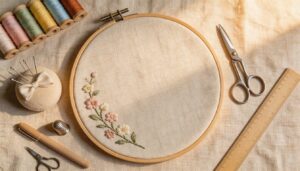
Before you stitch a single thread, having the right tools in hand makes everything easier and more enjoyable. You don’t need a lot — just a few well-chosen basics that will carry you through every project.
Starting with quality thread options for hand stitching means fewer tangles, stronger seams, and a lot less frustration from the very first project.
Here’s what you’ll want to gather before you get started.
Choosing The Right Embroidery Hoop
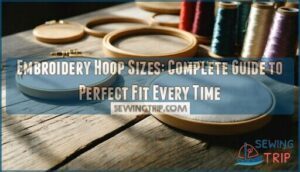
Think of your embroidery hoop as your best teammate — it holds everything steady so you can focus on the fun part. This Beginner Hand Embroidery Guide starts here because the right hoop makes every stitch easier. Most commercial embroiderers favor the 5.5‑inch square hoop for its versatility.
For most beginners, a 6‑inch wooden or plastic embroidery hoop is the sweet spot. It gives you enough room to work without feeling clunky in your hands. Here’s a quick Hoop Size Guide to match hoops to projects:
- 3–5 inches — great for small, intricate designs and delicate fabrics
- 6 inches — the ideal starter size; balances comfort and workspace
- 7–8 inches — suits medium patterns but may need a stand for long sessions
- 9+ inches — better for quilting; can cause hand fatigue without support
On Material: Pros and Cons: wood grips fabric naturally, while plastic holds tighter tension. Either works — just make sure the screw tension mechanism lets you pull the fabric drum‑tight without puckering.
Selecting Needles and Threads
With your hoop ready, grab needles and thread — these two tools shape every stitch you make.
| Thread Type | Best Needle Match |
|---|---|
| 6-strand floss | Size 1–3 crewel |
| 3–4 strands | Size 5–7 crewel |
| Single strand | Size 9–12 crewel |
| Perle cotton #5 | Size 3–5 chenille |
| Ribbon/metallics | Size 24 chenille |
Cotton embroidery floss is the friendliest starting thread — separate its six strands to control thickness. Crewel needle sizes 3–9 handle most beginner work beautifully.
Fabric Choices for Beginners
Now that your needles and thread are sorted, fabric is the next piece of the puzzle. Quilting cotton is the top pick for beginners — its cotton weave stability keeps stitches neat and holds up well in a hoop.
Natural fabrics like linen and cotton blends are great too. Linen stiffness benefits your work by keeping stitches sitting evenly.
Just prewash everything first to prevent shrinkage, then iron flat.
Avoid polyester blend slip — that slippery surface makes tension tricky to control.
Additional Helpful Accessories
A few small extras go a long way.
Tightening the screw evenly and smoothing out wrinkles makes a real difference, as this guide on keeping fabric taut in an embroidery hoop shows.
A floss organizer keeps your embroidery floss sorted and tangle-free, while a needle minder holds your needle safely between stitches.
Run your thread through a thread conditioner to cut down on fraying.
Sharp embroidery scissors make clean cuts every time.
Add portable lighting if your workspace is dim — your eyes will thank you.
Getting Started: Preparation Tips
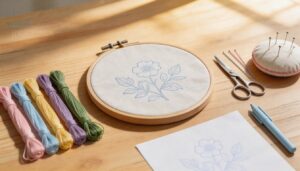
Before you make your first stitch, a little prep work goes a long way. Getting your pattern onto the fabric, organizing your floss, and keeping everything taut are the quiet steps that make the actual stitching so much easier.
Here’s what to take care of before you pick up your needle.
Transferring Patterns to Fabric
Getting your design onto fabric is easier than you’d think. Lightbox Tracing is the simplest method — hold light-colored fabric against a bright window or lightbox, then trace your Embroidery Pattern Transfer Methods with water-soluble marks that rinse away cleanly afterward.
Here are three reliable options for Transferring Patterns onto Fabric:
- Iron-On Transfer — heat transfer pens give crisp, lasting lines
- Transfer Paper — press your pattern through carbon paper onto thicker cloth
- Tracing Paper — baste it directly to textured fabric, stitch through, then tear away
Threading and Organizing Floss
Before you stitch a single thread, sorting your cotton floss saves real frustration later. Standard six‑strand floss separates easily — just pull out exactly as many strands as your stitch needs, using basic Strand Separation Techniques. Cut lengths around 18 inches to reduce tangling and fraying.
- A Bobbin Storage System labeled with DMC or Anchor color codes makes Floss Color Coding simple.
- Prewound Thread Cards keep your workspace tidy and colors instantly grabbable.
- Thread conditioning with beeswax is a simple Floss Conditioning Method that prevents snags mid‑stitch.
Keeping Fabric Taut and Smooth
Tightening your embroidery hoop correctly makes every stitch land flat and clean. Aim for drum-tight fabric tension — press the center gently, and it should spring back without sagging. Tighten the screw in stages, pulling opposite edges for even grain alignment and edge tension.
Re-tighten after about fifteen minutes. For fragile fabrics, stabilizer placement under the cloth prevents warping.
Use this re-tightening schedule as your guide:
| Hoop Pressure Stage | Action | Why It Matters |
|---|---|---|
| Initial setup | Pull opposite edges evenly | Keeps grain alignment square |
| After 15 minutes | Re-tighten screw gently | Corrects natural fabric slack |
| After stabilizer placement | Smooth any wrinkles outward | Prevents warping under hoop tension |
| Mid-project check | Lift center, test spring-back | Confirms consistent fabric tension |
| Before each new section | Readjust edge tension | Ensures even tension control |
Basic Outline and Straight Stitches
These four stitches are where most embroiderers begin, and for good reason — they’re simple, adaptable, and cover almost any outline you’ll want to stitch.
Each one works a little differently, so it’s worth learning what each does best before you pick up your needle. Here’s how to work through them one by one.
Running Stitch Step-by-Step
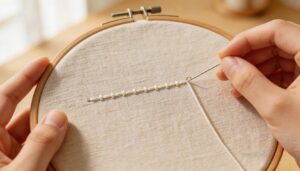
Think of the running stitch as your foundation — simple, steady, and endlessly useful. Push your needle up, then down 1–3 mm ahead, repeating that quiet rhythm across the fabric.
- Stitch Length Consistency — keep every stitch equal for a clean spacing rhythm
- Fabric Grain Alignment — stitch along the grain to avoid puckering
- Finishing Thread Ends — weave tails under nearby stitches, no knot needed
Backstitch for Clean Lines
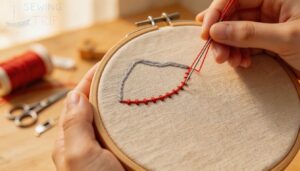
Backstitch is the workhorse of basic hand embroidery stitches — nothing beats it for crisp, unbroken outlines. Each stitch steps backward into the previous one, closing every gap for perfect line uniformity. It’s a cornerstone of any beginner embroidery guide for good reason.
- Stitch spacing and tension control — even pressure keeps lines flat without puckering on curves or corner transitions.
- Thread glide — conditioned floss moves smoothly, reducing snags on tightly woven fabric.
- Hoop steadiness — a drum-tight hoop anchors fabric so your backstitch for outlines and details stays precise.
Split Stitch Techniques
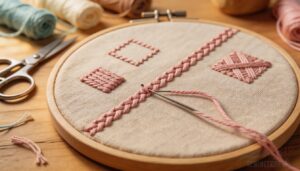
Each new stitch pierces the center of the one before it — that’s what gives split stitch its signature diagonal ladder effect and subtle rope-like texture. Keep rice-grain lengths short and split as close to the center as possible.
This is one of those basic hand embroidery stitches that rewards consistency.
Try layered split stitches for a raised fill, explore split stitch borders, or alternate direction for a hatch fill design — a great texture variation technique that any beginner embroidery guide should include.
Stem Stitch for Curves
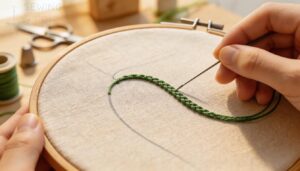
Where split stitch builds texture by splitting through itself, stem stitch moves forward by staying beside itself — and that small difference gives it a beautiful twisted rope look.
For curves, curved path planning matters most. Mark your line first, then shorten your stitch length on tight bends. Keep the thread below the needle for consistent thread tension balance. Needle insertion technique at a slight diagonal keeps the line flowing. This is a hand embroidery beginner guide favorite for botanical stems and scrollwork.
Simple Decorative and Filling Stitches
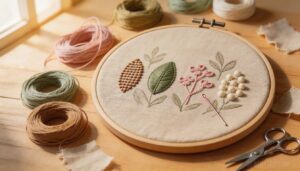
Once you’ve got the hang of outlining, it’s time to add some real personality to your work. Decorative and filling stitches are what turn a simple sketch into something that looks truly finished.
Here are four stitches worth learning first.
Satin Stitch for Solid Fills
Filling a petal or leaf with smooth, glossy color is where Satin Stitch truly shines. This Basic Embroidery Stitch Technique is a cornerstone of any beginner embroidery guide.
Get it right by focusing on three things:
- Keep stitch density tight — no gaps, no overlaps
- Work in one direction for consistent thread sheen
- Use directional shading and edge blending for clean borders
Good fabric preparation makes every stitch land smoothly.
Chain Stitch for Bold Lines
Where satin stitch gives you smooth fills, chain stitch gives you bold, textured lines. Each loop locks into the next — bring your needle up, reinsert nearby, then emerge ahead with the thread looped under the tip.
| Chain Stitch Variations | Best Used For |
|---|---|
| Basic Chain Stitch | Curved Letter Outlines |
| Heavy Chain Stitch | Decorative Borders |
| Color Lacing Techniques | Two-tone outlines |
| Loop Tension Control | Tight corners and curves |
Consistent loop size keeps your line smooth. Looser loops feel open; tighter ones look dense and raised — both are valid Chain Stitch Applications in Decorative Borders.
Blanket Stitch for Borders
Where chain stitch builds bold lines, Blanket Stitch anchors clean embroidery borders along any raw edge. Push your needle from back to front, then insert above and loop the thread under the tip before pulling through — that’s your step‑by‑step instruction in one motion.
Keep Loop Size and Thread Tension steady, around 2–4 mm border width, so loops lie flat. Try Stitch Variations like alternating colors for a lively finish. Good Finishing Techniques hide your knot neatly underneath.
French Knot for Texture
Those tiny raised dots on vintage linens? That’s the French Knot — one of the most satisfying stitches in hand embroidery.
Here’s your step by step instruction:
- Wrap Count Variations — Two wraps offer the best stability for beginners.
- Knot Size Control — More thread strands mean plumper knots; one strand stays delicate.
- Needle Choice Impact — A milliner needle slides through wraps cleanly.
Mind your Thread Tension Tips: keep it snug, not tight, for perfect Cluster Texture Effects.
Practice Ideas and Beginner Projects
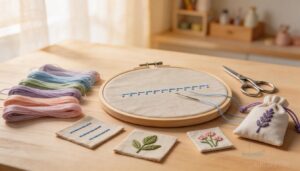
Now that you know the stitches, it’s time to put them to work. The best way to build confidence is to start small and keep things simple.
Here are some practical ways to get your needle moving.
Easy Patterns to Try First
Think of your first project as a small promise to yourself — keep it simple and finish strong. Geometric Motifs, like a Heart Motif or Star Pattern, need just 2–4 basic embroidery stitches each. A Square Grid helps you count and stay aligned. Here are four DIY embroidery projects worth trying in your beginner embroidery guide journey:
- Simple Floral sprigs using a running stitch
- Heart Motif outlines with backstitch
- Star Pattern fills with satin stitch
- Step‑by‑step instruction samplers on a square grid
Most fit a 4‑inch hoop and finish in an afternoon of hand embroidery.
Mixing Stitches in Simple Designs
Once you’re comfortable with individual stitches, stitch layering is where things get interesting. Try pairing backstitch stems with satin stitch petals — that texture contrast alone makes a simple floral feel finished.
Pair backstitch stems with satin stitch petals, and a simple floral suddenly feels finished
For color blending, outline a shape in stem stitch, then fill it with French knots in two shades.
Stitch sequencing matters too: outlines first, fills second, accents last.
That design flow keeps your work clean. This is your beginner embroidery learning path — combining multiple stitches in a project, naturally.
Common Mistakes and Troubleshooting
Even experienced stitchers hit snags — and that’s completely normal. Most common embroidery mistakes and troubleshooting moments come down to a few fixable habits:
- Hoop tension errors cause fabric puckering; re‑tighten every 15 minutes.
- Thread fraying issues start when floss runs longer than 18–24 inches.
- Color pooling happens with variegated threads under uneven tension.
- Dull needles snag fibers and risk needle breakage on tight weaves.
Catching these early keeps your hand embroidery stitch techniques clean and your beginner embroidery guide experience frustration‑free.
Tips for Neat and Even Stitches
Neat stitches come down to a few steady habits. Mark your stitch endpoints with a water-soluble pen for even stitch spacing, and practice thread length control by keeping floss under 45 cm.
Pull with consistent tension — smooth, never jerky — to avoid puckering. Smooth needle entry improves when you respect the proper fabric grain and keep your hoop drum‑tight.
These stitch length and tension control techniques are the quiet backbone of every clean basic embroidery stitch.
Frequently Asked Questions (FAQs)
What are the easiest stitches for embroidery?
Picture yourself threading your first needle. Running stitch, backstitch, chain stitch, and stem stitch are your best starting points — basic embroidery stitches that build real confidence without overwhelming you.
What are the basic hand embroidery stitches?
Eight basic hand embroidery stitches form the foundation of most projects — running stitch, backstitch, split stitch, stem stitch, satin stitch, chain stitch, blanket stitch, and French knot. Master these, and everything else builds naturally.
These embroidery basics are your starting point, but the full toolkit goes deeper. Once you’re comfortable with the core eight, stitches like the feather stitch, buttonhole stitch, detached chain stitch, and couching stitch open up a whole new range of textures and effects. Even cross stitch — often treated as its own craft — shares the same foundational logic. This embroidery beginner guide walks you through each one so you can build real confidence, stitch by stitch.
Think of basic hand embroidery stitches as a small vocabulary. You don’t need every word in the dictionary to tell a great story — you just need the right ones. In hand embroidery, those right ones are the stitches you’ll reach for again and again, no matter what you’re making.
How do I fix tangled or twisted embroidery floss?
Tangled floss is just a small knot in your journey — easy to fix. Let your needle dangle freely, and watch the thread untwist itself.
Shorter thread, smooth strand separation, and the right needle eye size solve most problems fast.
Can I wash finished embroidery without damage?
Yes — hand wash in cold water with a mild detergent after testing colorfastness first.
Press out moisture gently, lay flat to dry, then iron from the reverse side using a pressing cloth.
What causes puckering and how to prevent it?
Puckering plagues even patient stitchers. Fabric stretched too tight locks into a warped state once removed.
Balance your thread tension, match stabilizer types to fabric weight, and adjust hoop size to keep every stitch flat.
How do I secure thread ends invisibly?
Knots aren’t your only option.
The Loop Method, Waste Knot, and Anchor Stitch keep hand embroidery secure while Tail Weaving delivers a clean, Invisible Finish — no bulk, no snags, just tidy needlework every time.
Should I use a frame for small projects?
A small embroidery hoop is your quiet ally — it holds fabric drum-tight so stitches land flat and even. Once your hand tension feels steady, hoopless work is worth trying too.
How do I finish and secure my thread ends?
Weave your thread tail under 4–5 back stitches for a secure Knotless Finish. This Backstitch Lock, Weaving Tails method keeps the back flat and clean — no bulk, no knots showing through.
Can I embroider on stretchy or knit fabric?
Yes, you can — but knit fabric stretches, so stabilizer selection matters.
Back your fabric before stitching, choose a shorter stitch length, and keep thread bulk low to avoid distortion during wear and washing.
How do I wash and care for finished embroidery?
Hand-wash your finished piece gently in cool water using mild soap. Rinse it well, blot dry with a towel, then air dry flat.
Press from the backside and store in a breathable cotton bag.
Conclusion
With every stitch, you’re not just sewing threads—you’re weaving possibilities. As you’ve threaded your way through this guide, you’ve discovered how simple hand embroidery stitches can open a world of creativity.
You’ve got the tools, the techniques, and the confidence to start your embroidery journey.
So pick up your hoop, thread your needle, and let the simple hand embroidery stitches become the foundation for your next handmade masterpiece, filled with texture, beauty, and personal touch.