This site is supported by our readers. We may earn a commission, at no cost to you, if you purchase through links.
A worn-out cutting mat doesn’t just slow you down—it quietly sabotages every seam you plan.
That familiar drag of a rotary cutter catching in old grooves, the fabric shifting just enough to throw off your quarter-inch seam allowance—small frustrations that compound into wasted yardage and reworked projects.
The right cutting mat surface holds your fabric steady, takes the blade cleanly, and heals itself after each pass.
Choosing the best cutting mat surface for precision sewing means weighing self-healing technology, grid accuracy, thickness, and size against your actual workspace and projects.
The six mats ahead cover every serious sewist’s needs.
Table Of Contents
Key Takeaways
- self‑healing, double‑sided cutting mat with clear inch/metric grids, angle lines, and non‑slip stability is the best surface for precise sewing and rotary cutting.
- You should match mat size and thickness to your space and projects, using smaller 12" x 18" mats for tight or portable setups and larger 24" x 36" (or bigger) mats for quilting and full‑width fabric cuts.
- Regular care—gentle cleaning, keeping the mat flat, protecting it from heat and sun, and rotating where you cut—greatly extends its life and keeps cuts accurate.
- Many mat problems come from bad habits like vertical storage, dull or wrong blades, cutting on uneven tables, and skipping inspections, all of which lead to warping, grooves, and crooked seams.
Best Cutting Mat Surfaces for Precision Sewing
Your cutting mat is one of those tools that quietly makes or breaks your whole sewing setup.
If you’re curious about choosing the right mat or caring for it, this fabric cutting tools guide walks you through all the essentials.
The right surface keeps your cuts clean, your blades sharp, and your fabric exactly where you need it.
Here are six mats worth your attention in 2026.
1. Fiskars Self Healing Grid Cutting Mat
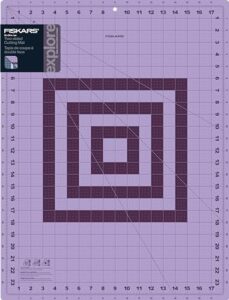
Fiskars’ self-healing grid cutting mat is a dependable, everyday workhorse when you want clean, controlled cuts.
Its 18 x 24 inch polypropylene base with a multi-layer PVC self-healing surface protects your table and stays remarkably smooth over time.
You get clear 1-inch grids plus 30°, 45°, and 60° lines, so you can square fabric, cut bias strips, and trim blocks without juggling extra rulers.
Both sides are printed, effectively doubling the mat’s usable working life for most home sewing setups.
| Best For | Sewers, quilters, and crafters who want a reliable mat that protects their work surface and makes precise cuts easier. |
|---|---|
| Material | Polypropylene |
| Dimensions | 18″L x 24″W x 0.06″Th |
| Weight | 1.45 pounds |
| Color | Lilac/Mountain Haze |
| Suitable For | Sewing, quilting, crafts |
| Care Instructions | Gentle cleaning, avoid sunlight |
| Additional Features |
|
- Double-sided design means you get twice the life out of one mat
- Built-in grid with angle lines lets you measure and cut in one step—no extra ruler needed
- Self-healing surface stays smooth even with regular rotary cutter use
- Needs careful storage—roll it up wrong or leave it in the sun and it can warp
- Cleaning takes a little care; nothing harsh or it’ll damage the surface
- The price point might feel steep for casual crafters who only cut occasionally
2. OLFA Self Healing Rotary Cutting Mat
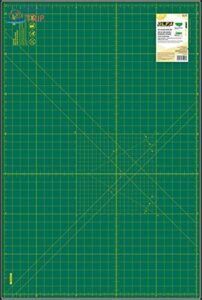
When you want a mat built for heavy rotary work, OLFA’s self‑healing rotary cutting mat earns its reputation. The 24" x 36", 1.5 mm multi‑layer PVC surface reseals after each cut, keeping things smooth and protecting your blades.
High‑visibility yellow inch and metric grids, plus 30°, 45°, and 60° lines, make accurate strip cutting and squaring blocks feel controlled, not fussy. Use it with rotary cutters only, store it flat, and keep it out of direct sun and heat sources.
| Best For | Quilters, sewists, and crafters who do a lot of rotary cutting and want a large, self‑healing surface that protects blades and keeps measurements precise. |
|---|---|
| Material | Aluminum |
| Dimensions | 2.8 inches |
| Weight | Not specified |
| Color | Multicolor |
| Suitable For | Crocheting, knitting, crafts |
| Care Instructions | Keep dry, store safely |
| Additional Features |
|
- Self‑healing surface helps reseal cuts so the mat stays smoother longer and extends the life of your rotary blades.
- Large 24" x 36" size with clear grid lines and angles makes it easy to cut strips, square up blocks, and handle bigger projects.
- Double‑sided design (one gridded, one plain) works well for both precise measuring and general cutting across fabric or paper crafts.
- Meant for rotary cutters only, so it’s not a good fit if you mainly use fixed blade utility knives.
- Needs to be stored flat and out of direct sunlight to avoid warping, which can be a hassle in small spaces.
- Some users find it a bit thin and notice cut marks or a slight new‑mat odor, especially when it’s fresh out of the package.
3. Arteza Self Healing Rotary Cutting Mat
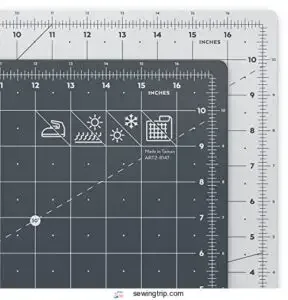
If OLFA manages your heavy-duty jobs, Arteza steps in as the flexible everyday work mat. Its 3mm triple-layer vinyl construction self-heals after each pass, so the surface stays smooth session after session.
The non-glare gray grid with built-in angle guides keeps your cuts accurate without straining your eyes.
At 12" x 18", it’s compact enough to tuck away easily, yet roomy enough for most quilting and scrapbooking cuts.
Honestly, for the price, it punches well above its weight.
| Best For | Crafters, quilters, and hobbyists who want a flexible, self-healing everyday cutting mat that protects their table while handling most day-to-day cuts. |
|---|---|
| Material | Plastic/Rubber |
| Dimensions | 24″ x 36″ |
| Weight | 2.3 pounds |
| Color | Green with yellow |
| Suitable For | Quilting, sewing, crafts |
| Care Instructions | Store flat, avoid sunlight |
| Additional Features |
|
- Self-healing 3mm triple-layer vinyl surface that stays smooth after repeated cuts.
- Non-glare gray grid with angle guides for accurate, eye-friendly measuring and cutting.
- Flexible, 12" x 18" size that’s easy to store or toss in a bag for classes or on-the-go crafting.
- May have a noticeable chemical or vinyl smell when first opened.
- Can warp if it’s bent, stored poorly, or packaged under pressure.
- Color can differ from expectations, sometimes looking lighter gray than the advertised dark gray.
4. ALVIN Self Healing Cutting Mat 12×18
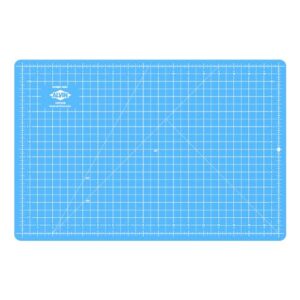
The ALVIN HM1218 brings a lot to a compact package. At 12×18 inches and just 2mm thick, it’s thin enough to slip into a bag but sturdy enough to resist warping under regular use.
For precise cutting on a surface this size, pairing it with a quality sewing ruler at least 60 inches long makes measuring across the full mat a breeze.
Its 3-ply composite surface self-heals after each pass, keeping blades sharper longer.
Flip it over and you’ve got a fresh cutting face — both sides carry 0.5-inch grid lines plus 45 and 60-degree angle guides.
Clean, non-glare, and easy to wipe down.
| Best For | Crafters, sewists, and hobbyists who want a compact, double-sided cutting surface with clear grids for precise work on a small desk or workbench. |
|---|---|
| Material | Vinyl |
| Dimensions | 12″L x 12″W x 0.2″Th |
| Weight | 1.3 pounds |
| Color | Gray/Dark Gray |
| Suitable For | Quilting, scrapbooking, DIY |
| Care Instructions | Avoid harsh chemicals |
| Additional Features |
|
- Self-healing 3-ply, 2 mm composite surface that holds up well to rotary and straight blades without dulling them quickly.
- Double-sided design with 0.5 inch and 0.125 inch grids plus 45° and 60° angle guides for accurate measuring and cutting.
- Versatile non-glare mat that can double as a desk blotter or general work mat and is easy to wipe clean.
- Can have a strong plasticky smell when first opened that may take a few days to fade.
- May be difficult to get perfectly flat again if it’s ever folded or bent.
- Composite material is linked to potential health risks, can stain over time, and may require extra care like washing hands after use or wearing gloves.
5. Idemeet 24×36 Self Healing Cutting Mat
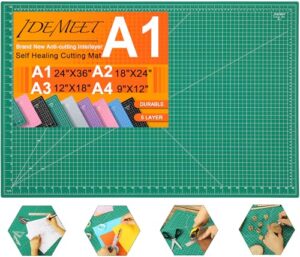
When your projects demand serious real estate, the Idemeet 24×36 delivers it.
At 36 inches long and weighing nearly 6 pounds, this mat stays put — no shifting mid‑cut.
The density‑upgraded 2600g core self‑heals reliably after each pass, keeping your surface smooth through hundreds of projects.
Both sides carry clear imperial and metric grids, plus 30, 45, and 60‑degree angle guides.
It’s a strong, stable worktable for quilters and crafters who need room to move.
| Best For | Quilters, crafters, and hobbyists who need a large, stable cutting surface for serious projects. |
|---|---|
| Material | Composite |
| Dimensions | 12 x 18 inches |
| Weight | 12.64 ounces |
| Color | Grey/Blue |
| Suitable For | Arts, crafts, sewing |
| Care Instructions | Wash hands after use |
| Additional Features |
|
- Massive 36×24 inch surface gives you plenty of room to work with big fabrics or materials
- Self-healing 2600g core holds up through heavy use and keeps the surface looking clean
- Double-sided with clear inch, metric, and angle guides — works with rotary cutters and straight blades
- Too large for smaller workspaces or compact craft tables
- Some customers reported quality control issues or receiving the wrong item
- Size and weight make it vulnerable to shipping damage if not packed well
6. Aneuzs Self Healing Rotary Cutting Mat
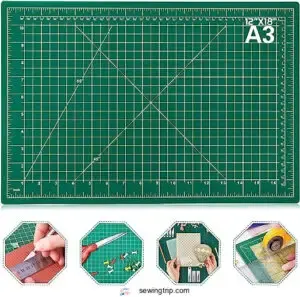
The Anezus mat punches well above its price tag for a 12×18 workhorse.
Its five-layer PVC construction self-heals cleanly after each pass, keeping the surface smooth longer than you’d expect at this price point. Both sides carry inch and metric grids, plus angle guides for bevel cuts — so you’re not squinting to line up your fabric edges.
It’s compatible with rotary cutters and straight blades, making it a practical pick for sewists who want reliable precision without overspending.
| Best For | Sewists, quilters, and crafters who need a reliable everyday cutting mat for small to medium projects without breaking the bank. |
|---|---|
| Material | Japanese Steel |
| Dimensions | 4.92 x 2.56 x 0.67 inches |
| Weight | 1.76 ounces |
| Color | Not specified |
| Suitable For | Sewing, quilting, crafts |
| Care Instructions | Handle oil, store safely |
| Additional Features |
|
- Self-healing five-layer PVC keeps the surface smooth and extends the mat’s life even with heavy use
- Double-sided with both inch and metric grids plus angle guides, so precise cuts are easy to line up
- Works with rotary cutters and straight blades, making it flexible for sewing, quilting, and general craft work
- At 12×18 inches, it’s too small for larger fabric cuts or bigger project layouts
- Only comes in one size, so you’d need to buy a second mat if your projects scale up
- Lighter crafters may find they outgrow it quickly if they work with wide fabric or large patterns
Key Features for Accurate Fabric Cutting
cutting mat is built the same, and those differences show up fast once you start working with fabric.
A few key features separate mats that hold up under real use from ones that frustrate you mid‑project.
Here’s what to look for before you buy.
Self-healing Surface Technology
Think of your cutting mat as a living surface — one that quietly repairs itself after every pass of your blade. That’s the promise of self‑healing technology, and it genuinely delivers.
Your cutting mat quietly heals itself after every blade pass, restoring precision cut after cut
Here’s how it works beneath the surface:
- Microcapsule Mechanics release healing agents directly into blade grooves as you cut
- Intrinsic Bonding reforms polymer chains, restoring the cutting mat’s smooth face
- Topographic Design guides repair agents precisely, supporting longevity metrics across hundreds of cuts
- Stimulus Activation accelerates healing, so your self‑healing mat stays precision‑cutting‑ready session after session
Double-sided and Non-slip Designs
Flip your mat over and you’ve basically bought a second surface — that’s the quiet genius of double-sided designs like the MyCrafts Double-Sided Mat.
Grip Textures, Material Coatings, and Interlocking Patterns work together to keep your fabric steady during Rotary Cutting, while Edge Reinforcements prevent peeling under pressure.
| Feature | Benefit |
|---|---|
| Flip Longevity | Doubles usable mat life |
| Non-slip Coatings | Stabilizes fabric during Precision Cutting |
Grid Lines and Measurement Markings
Sharp grid design keeps you in control, turning every cut into confident Precision Cutting.
- Inch grids with quarter-inch marks sharpen Grid Accuracy and Grid Clarity.
- Metric Grid Options and margin Conversion Charts keep international sizes straightforward with your trusted Sewing and Quilting Supplies.
- Center Alignment Guides and Non-Standard Rulers square blocks.
- Cutting Mat Reviews stress Marking Durability for long-term reliability.
Mat Thickness and Durability
mat’s thickness quietly decides how long it lasts. Most hobby sewers find the sweet spot at 3.5–4 mm — enough Core Density for Self Healing without the bulk. Layer Composition matters too: premium cores resist blade grooves longer, supporting Precision Cutting session after session.
Thicker mats also improve animal comfort benefits for livestock on farms.
| Thickness | Longevity Metrics | Best Use |
|---|---|---|
| 2–3 mm | Shorter lifespan | Light, occasional cutting |
| 3.5–4 mm | Balanced durability | Regular Rotary Cutting |
| 6 mm | Maximum Heat Resistance | Heavy daily use |
Thickness Impact and Mat Maintenance go hand in hand — thicker mats forgive more, but every Cutting Mat still needs care.
Compatibility With Rotary Cutters and Blades
Once thickness is sorted, you also need your Rotary Cutting Tools to truly match the Cutting Mat.
Blade Diameter must suit the cutter, while Edge Geometry and Blade Material balance clean cuts with Blade Life.
A stable Mounting System and working Safety Guard prevent wobble, protecting your Self Healing Cutting Mat during Rotary Cutting on delicate or dense fabrics beautifully.
You can find high‑quality rotary cutters and blades at WAWAK for your projects.
Choosing The Ideal Cutting Mat Size
Choosing the right mat size is what makes cutting feel controlled instead of cramped.
You’ll want to balance the space you actually have with the kinds of projects you sew most often.
Next, we’ll look at the main things to think about—your workspace, your project needs, and the trade-offs between larger and smaller mats—so you can quickly spot the best fit for you.
Measuring Your Workspace
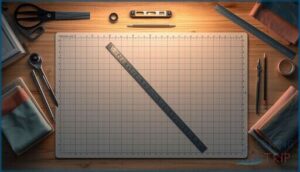
Measuring your workspace before buying a cutting mat saves you real headaches later.
Grab a ruler — at least 60 inches long — and note your table’s length and width.
Check table levelness, since even a slight wobble throws off precision crafting and cutting.
Allow a 1–2 inch clearance buffer around the mat, make sure 300 lux lighting overhead, and make sure your grid alignment runs parallel to the table’s longest edge.
Matching Mat Size to Project Needs
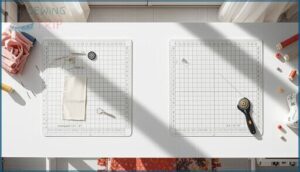
Once you know your table dimensions, match your mat to what you’re actually making. Small sewing projects fit a 12" x 18" mat — great for portable work and tight spaces.
For quilting supplies and fabric cutting across standard 45"-wide cloth, a 24" x 36" self‑healing cutting mat provides workspace coverage without constant repositioning. Project scale shapes every size decision.
Benefits of Larger Vs. Smaller Mats
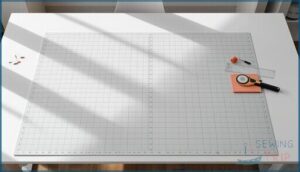
Bigger isn’t always better — but it often is. A large self healing cutting mat gives you workspace flexibility for wide fabric cutting runs and better pressure distribution across high‑use zones, slowing groove wear. Pattern visibility improves too, since full‑length grid lines stay uninterrupted.
Smaller sewing mats work well for portable projects. Your rotary cutting results depend heavily on matching mat size to the job.
Proper Maintenance for Long-Lasting Precision
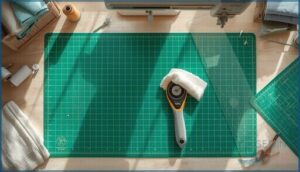
A good cutting mat is an investment, and like any tool you rely on, it needs a little regular attention to stay in top shape. The way you clean, store, and check your mat makes a real difference in how long it holds up.
Here’s what you should be doing to keep your cutting mat clean and true.
Cleaning and Debris Removal Techniques
clean cutting surface is the foundation of precise cuts. Start each session with a quick brush and lint roller pass to lift embedded fibers and thread bits.
For stubborn metal shavings from metallic trims, a magnetic debris sweep works beautifully. Follow up with a microfiber damp cloth for dust, and use air blower dusting along edges.
Solvent-free stain removal protects your self healing cutting mat’s blade protection integrity.
Avoiding Heat and Direct Sunlight
Although your mat looks tough, heat is its quiet enemy.
Choose Crafting Mats and any Self Healing Cutting Mat made with Heat‑Resistant Materials like PVC for UV Protection and Temperature Stabilization on a hot patio.
A pale Sewing Mat with Reflective Coating and a Sunlight Blocking Layer keeps the Cutting Surface cooler, improving Work Surface Protection and extending grid life.
Flat Storage Methods to Prevent Warping
Because cutting mats behave like flexible boards, you want Horizontal Placement whenever your Sewing Mat rests off the table.
Store Crafting Mats flat under a bed or on Flat Shelving, using a Rigid Backing to keep the Cutting Surface from bowing. This improves Weight Distribution, Work Surface Protection, and Organization while you Avoid Vertical Stacking over time considerably.
Inspecting for Wear, Grooves, and Damage
Treat inspection as part of Rotary Cutting and Mat Maintenance, keeping Self‑Healing Cutting Mat surfaces trustworthy.
- Surface Scratch Detection: note pits or lines signaling fatigue.
- Groove Depth Measurement: during Rotating Cutting, avoid deep channels that twist cuts.
- Warping Flatness Check: place the Cutting Mat on Rotating Surface; reject rocking.
- Delamination Inspection and Residue Build‑up: catch bubbles, peel, lint zones.
Common Cutting Mat Mistakes to Avoid

Even with a great cutting mat, small habits can quietly shorten its life.
Before you invest in another one, it helps to notice the simple mistakes that cause warping, grooves, and inaccurate cuts.
Here are the key issues to watch for so you can adjust your routine with confidence.
Incorrect Storage Practices
How you store your cutting mat matters more than most sewists realize. Vertical hanging warps the surface over time, and heavy stacking with unpadded racks creates permanent indentations. Moisture exposure causes edge lifting, while corner pressure chips the material.
For smart sewing room organization and solid craft space setup, always store your self-healing cutting mat flat, supported, and away from humidity.
Using Dull or Incompatible Blades
Nothing undermines precision faster than Blade Sharpness on a quality SelfHealing Mat.
Dull edges drag during Rotary Cutting, causing Fabric Distortion and forcing extra pressure, which raises Safety Hazards and chews up Blade Life.
Incompatible blades gouge your Cutting Mat, compounding Compatibility Risks.
Replacement Timing into your Sewing Accessories routine to swap blades before performance drops too noticeably.
Neglecting Regular Cleaning and Inspection
Skipping Mat Maintenance is just as damaging as ignoring dull blades. Debris Transfer from a dirty Cutting Mat contaminates fabric and accelerates Blade Dulling during Rotary Cutting.
Surface Warping and Grid Fading quietly sabotage your accuracy over time, and damp storage invites Mold Growth.
- Wipe down with mild soap after dense cutting sessions
- Inspect weekly for grooves that trap blades
- Store flat, away from humidity, to protect Sewing Accessories
Overusing One Area of The Mat
After cleaning and inspecting your Cutting Mat, pay close attention to wear hotspots. Overusing one area leads to Grid Accuracy Drift and uneven surface patches. You’ll notice Blade Slippage Risk and Residue Buildup Effects, making precise Fabric Cutting harder.
For balanced Self Healing and Rotary Cutting, rotate your work. This simple Mat Maintenance step prevents Edge Warping Consequences and extends your mat’s lifespan.
Frequently Asked Questions (FAQs)
What is the best surface for cutting fabric?
When you want your fabric cuts to feel like slicing through butter, a self-healing cutting mat with high edge resistance, clear color contrast, and reliable acoustic feedback is essential—especially for rotary cutting and eco-friendly sewing and crafting.
What is the difference between A1 and A2 cutting mats?
The main difference comes down to size and workspace fit. A1 measures 594×841 mm, giving you more room for rotary cutting and ruler compatibility, while A2’s 420×594 mm suits tighter spaces.
Can cutting mats be used on uneven surfaces?
Even if you’re tempted, using a Self Healing Cutting Mat on an uneven work surface isn’t wise.
Stability Solutions matter—rigidity options or a backing adaptation, like a sturdy board, help maintain alignment tools and protect your Sewing Projects’ precision.
How often should rotary blades be replaced?
You should replace rotary blades every 20–40 hours of use, or sooner if Blade Life Indicators like skipped cuts, fabric fraying, or extra pressure appear.
Keep spare blades handy for consistent Rotary Cutting and Mat Maintenance.
Are cutting mats safe for children to use?
Cutting mats, especially those labeled with Non‑toxic Materials, are generally safe for children, provided you follow Supervision Guidelines.
Age‑Appropriate Blades, prioritize Surface Hygiene Practices, and use Safe Storage Solutions to guarantee Work Surface Protection and Organization.
Do cutting mats work with non-fabric materials?
Yes, a self healing cutting mat works beautifully with foam board, cardboard, and plastic.
The surface healing and grid precision protect your table while keeping blades sharp across non-fabric materials too.
Conclusion
A craftsman is only as good as their tools—and that truth cuts deep in precision sewing.
Your best cutting mat surface for precision sewing isn’t just a workspace; it’s the foundation every accurate seam is built on.
Choose the right size, protect it from heat and warping, and replace blades before they drag.
Treat your mat well, and it’ll return the favor cut after cut, keeping your work sharp, true, and frustration‑free.
- https://www.digitalcameraworld.com/cameras/camera-accessories/alvin-hm-self-healing-cutting-mat-review
- https://www.kearing.com/how-to-choose-cutting-mat/
- https://rhinocuttingmat.co.uk/a3-vs-a2-vs-a1-cutting-mats-which-one-should-you-get/
- https://www.nationalsewingcircle.com/post/sewing-must-haves-all-about-cutting-mats
- https://sherriquiltsalot.com/2021/07/07/how-to-choose-the-right-cutting-mat-for-you/