This site is supported by our readers. We may earn a commission, at no cost to you, if you purchase through links.
Your cutting mat takes the hit so your table doesn’t. That simple trade-off is why crafters, quilters, and DIYers reach for one every time a blade comes out—but not all mats hold up the same way.
A self-healing cutting mat works differently from a standard mat. Compressed PVC fibers close back over blade passes, sealing micro-cuts before they become permanent gouges. The surface stays smooth longer, your blades stay sharper, and your measurements stay accurate. A cheap mat can’t do any of that.
The eight mats ahead cover everything from 3.5" x 5" portable options to a 72" x 40" quilting surface—with honest breakdowns of what each one actually does well.
Table Of Contents
- Key Takeaways
- Top 8 Best Self-Healing Cutting Mats
- What is a Self-Healing Cutting Mat?
- What to Look for When Buying
- Benefits of Using a Self-Healing Mat
- Best Self-Healing Mats for Quilters and Sewists
- How to Use and Maintain Your Mat
- When to Replace Your Cutting Mat
- Frequently Asked Questions (FAQs)
- Conclusion
Key Takeaways
- Self-healing cutting mats use compressed PVC fibers that close back over blade cuts, keeping your surface smooth and your blades sharper far longer than standard mats.
- Choosing the right mat comes down to matching size and construction — 3-ply for casual use, 5-ply for daily cutting — to how often and how hard you actually work.
- Rotating your mat every few weeks, cleaning it with mild soap, and storing it flat between 50–85°F are the habits that determine whether it lasts one year or several.
- When grooves exceed 1–2mm deep, grid lines fade past recognition, or the surface stops closing after cuts, it’s time to replace the mat — not push through with a worn-out tool.
Top 8 Best Self-Healing Cutting Mats
Whether you’re cutting fabric, paper, or vinyl, the right mat makes every slice cleaner and every project easier. These eight options cover a range of sizes, materials, and features to match different workspaces and crafting needs. Here’s what made the cut.
If you want to dig deeper before deciding, this guide to cutting mats for scrapbooking and sewing breaks down exactly what to look for based on your craft.
1. Self Healing Cutting Mat for Crafts
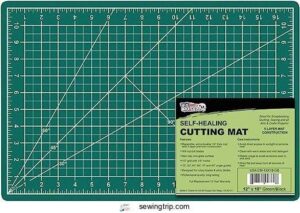
This five-ply self-healing mat controls the everyday demands of fabric cutting, scrapbooking, paper crafts, and leather work without flinching. At 18" x 12" and just 16 ounces, it’s light enough to take anywhere.
The reversible green and black surface gives you two cutting zones, which helps spread wear evenly over time. Half-inch grid increments and built-in 45° and 60° angle guides keep your cuts accurate. One heads-up — the usable grid area runs closer to 11" x 17".
| Best For | Crafters, quilters, and hobbyists who need a reliable, portable cutting surface for fabric, paper, leather, and mixed-media projects. |
|---|---|
| Material | Plastic |
| Model Number | USA CM-12X18-GB |
| Weight | 16 oz |
| Dimensions | 18x12x0.15 in |
| Craft Applications | Quilting/Sewing/Paper |
| Portability | Portable size |
| Additional Features |
|
- Five-ply self-healing construction bounces back from repeated cuts, extending the mat’s lifespan well beyond cheaper single-layer alternatives
- Reversible green and black surfaces double your cutting area and help distribute wear evenly over time
- Built-in 45° and 60° angle guides plus ½" grid increments make accurate, consistent cuts easy without extra measuring tools
- The usable grid area is closer to 11" x 17" than the advertised 12" x 18", so it runs slightly smaller than expected
- A noticeable chemical odor fresh out of the box may require washing or airing out before use
- Grid lines are thicker than professional-grade mats, which can limit precision on very fine or detailed work
2. Self Healing Cutting Mat 12×18
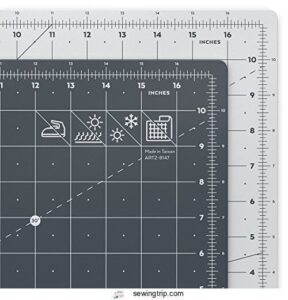
The 12×18 mat is a step up in workspace without adding bulk. Its three-ply PVC construction absorbs blade pressure and reseals between passes, keeping the surface smooth longer than basic craft mats.
Grid lines run in inch increments with 45° and 60° angle guides built right in. The non-slip backing holds firm during cuts, and the double-sided design lets you flip it to spread wear evenly. A solid pick when your projects outgrow a smaller mat.
| Best For | Crafters, quilters, and hobbyists of all skill levels who need a reliable, mid-sized cutting surface for fabric, paper, vinyl, or detailed project work. |
|---|---|
| Material | Vinyl |
| Model Number | ARTZ-8147 |
| Weight | 1.25 lbs |
| Dimensions | 12x12x0.2 in |
| Craft Applications | Fabric/Paper/Vinyl |
| Portability | Desk-friendly size |
| Additional Features |
|
- Self-healing surface reseals after cuts, keeping the mat smooth and extending its lifespan
- Built-in grid lines and angle guides (15°–75°) make precise cuts easy without extra tools
- Reversible with a non-slip backing — flip it to spread wear and keep it from sliding
- May arrive warped if the shipping packaging is too small
- Can have a noticeable odor right out of the box
- Color may not match product photos exactly — some buyers get light gray instead of dark gray
3. OLFA Rotating Cutting Mat 12×12
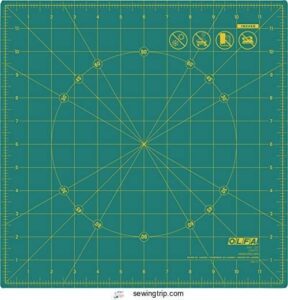
Where the 12×18 gives you room to spread out, the OLFA RM-12S trades size for control. Its 360-degree rotating top layer lets you spin your fabric instead of awkwardly repositioning the whole project — a small change that makes a real difference when you’re cutting triangles or curved pieces.
The self-healing surface reseals after each pass, keeping grid lines readable and blades sharper longer. At 12×12 inches and 500 grams, it fits neatly into tight sewing stations without sacrificing precision.
| Best For | Quilters and sewists working in smaller spaces who need precise control when cutting intricate shapes like triangles, diamonds, and circles. |
|---|---|
| Material | Plastic |
| Model Number | RM-12S |
| Weight | 500 g |
| Dimensions | 12x12x0.08 in |
| Craft Applications | Quilting/Sewing/Paper |
| Portability | Space-saving design |
| Additional Features |
|
- The 360-degree rotating top spins your fabric toward you instead of forcing you to reach and reposition — great for detailed cuts
- Self-healing surface keeps grid lines clear and extends rotary blade life over time
- Compact 12×12 size fits easily into tight sewing stations or small workspaces
- Only works with rotary cutters — not compatible with fixed blade or utility knives
- Needs flat, shaded storage to avoid warping, which can be inconvenient
- May need a rug gripper underneath to stay put on slick surfaces
4. Fiskars 8×8 Rotating Cutting Mat
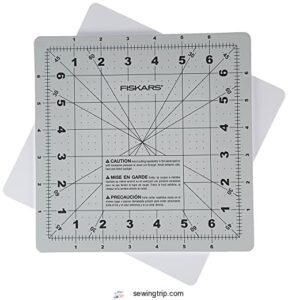
If the OLFA 12×12 is built for control, the Fiskars 8×8 takes that idea even further — shrinking things down to a surface designed purely for small-block trimming. At 8 inches square, it spins freely so you can cut at 30, 45, or 60-degree angles without twisting your wrist into an uncomfortable position.
The self-healing surface holds up well under rotary blades, and the high-contrast grid stays readable through repeated use. It fits in a project tote without a second thought.
| Best For | Quilters and crafters who work primarily with small blocks, half-square triangles, or appliqué and want a compact, travel-friendly cutting mat. |
|---|---|
| Material | Plastic |
| Model Number | 116250-1002 |
| Weight | 0.03 kg |
| Dimensions | 8.13×0.38×10.25 in |
| Craft Applications | Quilt Blocks/Applique |
| Portability | Fits project totes |
| Additional Features |
|
- Rotating design lets you cut at multiple angles without awkwardly repositioning your fabric
- Self-healing surface stands up to repeated rotary blade use and maintains a clean cutting area
- Slim and lightweight enough to toss in a project tote for retreats or on-the-go sewing
- The 8×8 surface is too small for cutting large pieces of fabric or working on bigger projects
- Safety text printed directly on the mat can partially block the grid lines
- Cutting repeatedly in the same spot will wear the surface down faster over time
5. Self Healing Cutting Mat 3.5×5 Inch
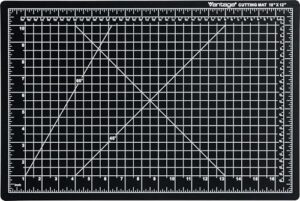
Some projects don’t need a large mat — they need the right one. At 3.5×5 inches, this compact mat fits in a craft tote, a drawer, or beside your machine without claiming any real estate.
For anyone just starting out, this beginner’s guide to choosing cutting mats breaks down exactly which size makes sense for your projects.
The self-healing polymer surface closes up after each pass from a rotary cutter or craft knife, keeping the cutting plane smooth and your blade sharper for longer. Grid marks help you align small paper or fabric pieces quickly. It’s a simple tool, but for detail work, it earns its place.
| Best For | Crafters, sewers, and hobbyists who need a portable, precise cutting surface for small-scale detail work like paper crafting, fabric trimming, or leather projects. |
|---|---|
| Material | PVC |
| Model Number | 10671 |
| Weight | 1.3 lbs |
| Dimensions | 1/8 in thick |
| Craft Applications | Sewing/Leather/Photo |
| Portability | Standard mat size |
| Additional Features |
|
- Self-healing surface keeps cuts clean and extends blade life over repeated use
- Compact 3.5×5" size fits easily in a craft bag, drawer, or tight workspace
- Built-in grid guides make aligning and measuring small pieces quick and accurate
- Small size limits usefulness for larger projects or full fabric panels
- Temporary cut marks may remain visible even after the surface self-heals
- Not suitable for heavy-duty cutting tools like box cutters, which can cut through the mat
6. Alvin Double Sided Self Healing Cutting Mat
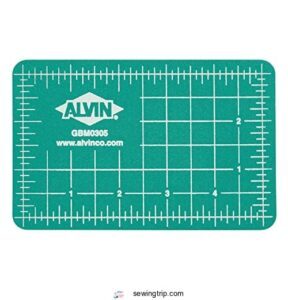
The Alvin Double Sided mat gives you two clean working surfaces in one. The green and black sides let you dedicate each face to a different material — fabric on one, paper or vinyl on the other — so projects stay organized without extra prep.
At 3mm thick, the 5-layer self-healing vinyl stands up to rotary cutters and craft knives without gouging. The printed 1/2-inch grid with 45° and 60° angle guides covers both sides, so flipping the mat never costs you your reference lines.
| Best For | Crafters, quilters, and hobbyists who work with multiple materials and want one mat that keeps fabric, paper, and vinyl projects neatly separated. |
|---|---|
| Material | Vinyl |
| Model Number | N/A |
| Weight | 0.8 oz |
| Dimensions | 5.5×3.5×0.12 in |
| Craft Applications | Sewing/Quilting/Vinyl |
| Portability | Compact small size |
| Additional Features |
|
- Self-healing 5-layer vinyl bounces back from repeated cuts, keeping the surface smooth and extending blade life
- Dual-color sides make it easy to dedicate each face to a different material, reducing cross-contamination between projects
- Built-in grid with 45° and 60° angle guides stays consistent on both sides, so flipping never disrupts your layout
- The compact 5.5" × 3.5" size can feel limiting for larger projects, often requiring multiple mats
- Cleaning is hand-wash only — no machine washing — which adds a small but real maintenance step
- Contains vinyl compounds listed under Prop 65, so users with skin sensitivities may want gloves or good ventilation nearby
7. Sullivans Super Size Cutting Mat
When a project demands serious real estate, the Sullivans Super Size Cutting Mat delivers. At 72" x 40", it’s built for quilting, Roman shades, and any cut that eats up yardage fast.
The low-density polyethylene surface resists blade damage and stays stable on slatted or standard tables. It rolls up for storage and flattens within hours. Keep in mind it’s not self-healing, so rotating your cutting zones regularly will keep the surface in better shape longer.
| Best For | Quilters, seamstresses, and home décor sewers tackling large-scale projects like quilts or Roman shades who need serious cutting space and accurate measurements. |
|---|---|
| Material | Polyethylene |
| Model Number | 87174 |
| Weight | 1.5 lbs |
| Dimensions | 72x40x0.1 in |
| Craft Applications | Quilting/Yardage |
| Portability | Rollable storage |
| Additional Features |
|
- Massive 72" x 40" surface gives you room to lay out full fabric widths without folding or repositioning
- Printed measurement lines make squaring edges and measuring yardage quick and accurate
- Rolls up compactly for easy storage and stays flat again within hours
- Not self-healing, so heavy rotary cutter use will leave permanent grooves over time
- Measurement lines only run to 70" despite the mat being 72" long
- Printed ruler markings can fade with regular use, reducing long-term accuracy
8. Dahle Self Healing Cutting Mat 24×36
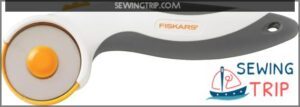
The Dahle 24×36 is where serious crafting meets serious construction. Its five-layer PVC build absorbs blade impact without delaminating, and the self-healing surface closes up after each pass to keep things smooth session after session.
At 24 by 36 inches, you get enough room for wide fabric cuts without constant repositioning. The non-glare grid includes inch and metric scales plus 45 and 60-degree guides — so precision comes built in, not bolted on.
| Best For | Quilters, sewists, and mixed-media crafters who need a durable, precision-ready cutting mat that can handle large fabric layouts and high-volume use. |
|---|---|
| Material | Plastic/Steel |
| Model Number | 01-005828 |
| Weight | N/A |
| Dimensions | 6.69×1.77 in |
| Craft Applications | Fabric/Batting/Scrapbooking |
| Portability | Lightweight handheld |
| Additional Features |
|
- The five-layer PVC construction absorbs repeated blade impact without warping or delaminating, so it holds up through long crafting sessions.
- At 24×36 inches, there’s plenty of space for wide fabric cuts, reducing the need to reposition your material mid-project.
- Built-in inch, metric, and angle guides (45° and 60°) make precise cuts straightforward without needing extra tools.
- The large size may be more than casual crafters need, taking up significant workspace.
- PVC mats can be sensitive to heat — leaving them in direct sunlight or near a warm iron may cause warping over time.
- Frequent use with a 45mm rotary cutter on tough materials like leather may wear down the self-healing surface faster than expected.
What is a Self-Healing Cutting Mat?
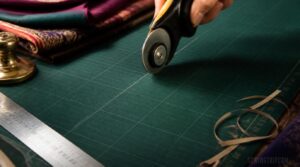
A self-healing cutting mat is exactly what it sounds like — a surface that closes back up after your blade passes through it. Understanding how it works and what it’s made of helps you pick the right one for your projects. Here’s a closer look at the technology, the materials, and how these mats stack up against regular options.
How Self-Healing Technology Actually Works
The secret is in the compressed PVC fibers. When a blade cuts through, it slips between them — then they spring back and reseal once pressure lifts.
Four things happen in that instant:
- Blade stress distributes across multiple fiber layers
- Microcapsule rupture releases bonding agents into micro-gaps
- Reversible chemical bonds re-form across the damaged interface
- The self-healing surface restores without any intervention from you
These mats often use embedded healing agents to make sure the surface remains smooth over time.
That’s blade longevity and cutting surface protection built right into the mat.
PVC Vs. Polypropylene Mat Materials
PVC is the heavier material, sitting near 1.40 g/cm³, and its surface hardness gives it strong wear resistance. That’s why most 5-layer PVC construction mats handle repeated blade passes well.
Polypropylene weighs less, around 0.90 g/cm³, and tolerates higher temperatures without warping. It’s also fully recyclable through standard streams.
For cutting surface longevity, PVC edges ahead — but polypropylene wins on sustainability.
Key Differences From Regular Cutting Mats
Regular mats just sit there and take the damage. A self-healing cutting mat closes blade grooves after each pass, so your surface stays smooth and your grid lines stay readable.
The 5-layer PVC construction absorbs blade impact rather than letting it punch straight through. That cutting surface longevity translates directly into fewer replacements and cleaner cuts every time.
What to Look for When Buying
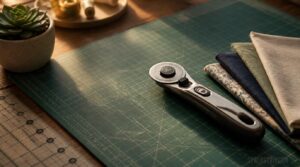
Not every mat is worth your money, and the wrong choice can slow down your work more than help it. A few key factors will quickly narrow down what actually fits your craft and space. Here’s what to keep in mind before you buy.
Size and Workspace Requirements
Picking the right mat size starts with your desk footprint. Most craft desks run 48 to 60 inches wide, so an 18×24 inch mat fits comfortably without crowding your workspace.
Consider your projects:
- Small detail work: 9×12 or 12×18 inches
- Fabric and quilting: 24×36 inches
- Bolt cutting: extra-large formats
Keep ergonomic reach zones within 24 to 30 inches from your body.
3. Ply Vs. 5-Ply Mat Construction
Once you’ve nailed down your size, construction becomes the next call to make.
3-ply mats are lighter and cheaper — solid for occasional crafting. 5-ply PVC construction adds rigidity and distributes blade stress across more layers, so grooves don’t deepen as fast. That layered durability matters in high-use workspaces. If you cut daily, the higher upfront cost of 5-ply pays off over time.
Grid Lines and Measurement Systems
Good grid lines do more than look neat — they keep your cuts honest. Look for mats with both metric and imperial grids, plus 30, 45, and 60-degree angle lines for bias cuts. Half-inch subdivisions help with fine alignment.
High-contrast, non-glare markings stay readable under studio lighting, and etched grids outlast printed ones by a wide margin.
Single-Sided Vs. Double-Sided Mats
Double-sided mats spread blade impact across two surfaces, so grooves stay shallower longer. That means more cutting life before replacement.
Single-sided versions weigh slightly less — a real plus for portable setups. For mixed-media work, though, a dual-surface design lets you flip between different grid colors or measurement systems without swapping mats entirely.
Blade and Tool Compatibility
Not every mat works equally well with every tool. Rotary cutters pair best with smooth, flexible surfaces — the self-healing fibers grip fabric cleanly without snagging. Utility knives need a denser center to prevent punch-through.
- Rotary cutters
- Craft knives
- Utility knives
- Dressmaker shears
Material-specific blades cut cleaner and last longer when matched to the right mat.
Benefits of Using a Self-Healing Mat
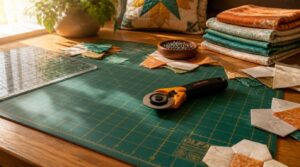
A good self-healing mat does more than just protect your table — it quietly works in your favor every single time you cut. Once you start using one regularly, the advantages become hard to ignore. Here are three real benefits worth knowing about.
Extends The Life of Cutting Blades
A sharp blade is a safe blade — and self-healing cutting mats are one of the quietest ways to keep yours sharp longer. The compressed PVC fibers absorb impact instead of fighting back, which reduces the micro-chipping that dulls edges fast.
Light, consistent cutting pressure and matching the right blade to your material do the rest, stretching each blade’s useful life noticeably further.
Protects Your Work Surface Below
Your desk takes a silent hit every time a blade lands without protection. A self-healing cutting mat distributes impact force across its layered surface, so pressure never concentrates in one spot.
The mat absorbs cuts, resists chemical spills, and even blocks heat transfer — keeping your desk finish intact beneath every pass.
Saves Money Over Time
A good mat pays for itself. Self-healing cutting mats last 2–3 times longer than standard mats, and blades stay sharp up to 40% longer on them.
Self-healing mats last two to three times longer and keep blades sharp up to 40% more — they pay for themselves
Three ways you save:
- Fewer blade replacements
- No desk refinishing costs
- Less frequent mat purchases
Most crafters recover the investment within 6–18 months — then it’s pure savings.
Best Self-Healing Mats for Quilters and Sewists
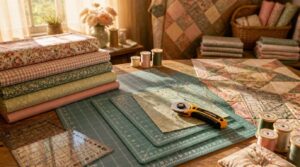
Quilters and sewists have different needs than your average crafter — bigger cuts, more precision, and a lot more fabric to manage. The right mat can make that work feel smooth instead of frustrating. Here are three styles worth knowing about.
Rotating Mats for Fabric Precision
Rotating mats change how fabric cutting feels entirely. A central pivot mechanism lets you spin the fabric toward the blade — not the other way around. Look for ball bearing rotation and adjustable resistance for long sessions.
A textured, self-healing surface grips fabric without slipping. The reinforced middle hub experiences repeated blade contact, keeping cuts clean and angular guides accurate.
Large Format Mats for Quilting Projects
When a quilt spans a full table, a 24 by 36 inch mat covers most of the work area without repositioning fabric constantly. Some large-format mats stretch to 30 by 60 inches, which suits long strip cutting and border work.
A non-slip base keeps everything flat during those extended cuts, and built-in border guides help you align sashings and margins with real precision.
Portable Mats for Small Sewing Spaces
Not everyone has a dedicated cutting table. If your sewing space is a compact desk setup or a corner of the kitchen, a 12×18 inch mat fits without crowding you out.
Foldable or roll-up designs slide under a bed or into a closet between sessions. Non-slip backing keeps the mat grounded mid-cut, and lightweight PVC or vinyl layers — usually 1.5 to 3mm — keep it easy to carry.
How to Use and Maintain Your Mat
A good cutting mat can last for years — but only if you treat it right. The way you use and store it matters just as much as the mat you choose. Here’s what to keep in mind to get the most out of yours.
Rotate Your Mat for Even Wear
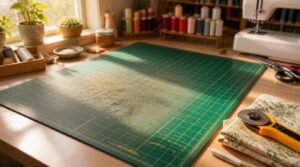
A simple habit keeps your mat performing like new. Shift it every two to four weeks to spread pressure distribution across fresh zones and protect surface durability. Check for stiffness after each rotation.
- Swap opposite corners to redistribute wear patterns
- Mark a rotation schedule on the mat edge
- Lay flat 24 hours after rotating
- Increase frequency with dominant cutting directions
Avoid Cutting The Same Area Repeatedly
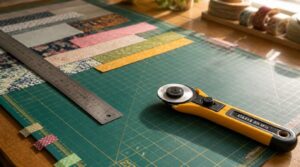
Where you cut matters as much as how often. Shift your workpiece at least 1 inch between passes — this keeps pressure from concentrating in one spot and prevents grooves that resist healing. Once deep grooves form, the self-healing surface can’t close them fully.
| Zone Strategy | Technique | Benefit |
|---|---|---|
| Pattern Rotation | Alternate directions every 15 min | Even wear distribution |
| Zone Tracking | Mark used edges with tape | Balanced blade resistance |
| Pressure Distribution | Use rulers as cutting guides | Protects mat durability |
Use cutting guides to steer blades across fresh zones and protect cutting precision over time.
Cleaning With Mild Soap and Water
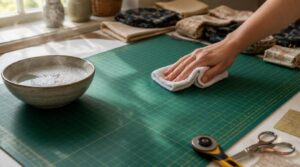
Residue builds up fast. Wipe your mat with a damp cloth and mild soap, using circular motions to lift debris without abrading the self-healing surface.
- Use warm water to dissolve oils more effectively
- Apply minimal soap to avoid residue buildup
- Wipe in circles, not straight lines
- Rinse the cloth often while cleaning
- Pat dry with a lint-free cloth after
Storing Flat Away From Heat
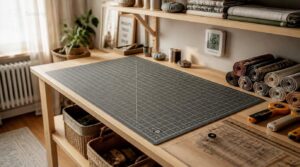
Laying your mat flat isn’t just habit — it’s how you protect your investment.
Store it between 50–85°F, away from radiators, sunny windows, or garages that bake in summer heat. Humidity matters too; aim for 30–50% relative humidity to prevent warping. Keep it off concrete floors on a shelf, and it’ll stay flat and ready for your next project.
When to Replace Your Cutting Mat
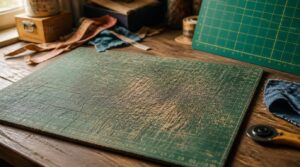
Even the best cutting mat has a lifespan, and knowing when to retire it saves you from ruined projects and wasted blades. Most crafters hold on too long, not realizing the mat is the problem. Here are the three clearest signs it’s time to replace yours.
Signs of Deep, Permanent Grooves
Deep grooves don’t just look worn — they actively work against you. Once a groove exceeds 1–2 millimeters deep, the self-healing surface can’t close back up.
Watch for these warning signs:
- Blade drift or catching mid-cut
- Radial wear patterns near rotation points
- Grid lines distorted by crossing grooves
At that point, measuring groove depth matters less than trusting your instincts: replace it.
Faded or Illegible Grid Lines
Grid lines don’t vanish overnight — UV ink degradation and daily wear quietly erase them over 6–12 months. When more than half your mat’s markings are unreadable, your gridlined accuracy is gone.
Abrasive cleaners speed this up fast. Rotating your mat helps distribute wear, but once the contrast fades beyond recovery, no amount of calibration against a reference ruler brings it back.
Surface Too Thin to Self-Heal
Once a mat wears past its thickness threshold, self-healing stops working — not gradually, but abruptly. The compressed PVC fibers need enough material volume to reseal after each cut. When that’s gone, grooves stay open.
Ply architecture failure is the real culprit. Thin layers can’t distribute heat or healing agents efficiently, so blades start reaching the base substrate. At that point, replacement isn’t optional.
Frequently Asked Questions (FAQs)
What is the best self-healing cutting mat?
The Dahle Vantage 24×36 stands out for most crafters. Its 3mm five-layer PVC build holds up to rotary cutting, utility knives, and heavy daily use without breaking down. Precision grids and self-healing surface make it a reliable long-term pick.
What is a self-healing rotary cutting mat?
A self-healing rotary cutting mat spins 360 degrees so you can reposition fabric without lifting it. Its compressed fibers reseal after each blade pass, keeping the surface smooth for precise, clean cuts every time.
How do you use a self-healing cutting mat?
Place the mat on a flat, hard surface and align your fabric to the grid lines. Use firm, even pressure with a sharp blade, cutting in different zones to distribute wear evenly.
Which self-healing mat is best?
The Dahle 36×48 tops most lists for serious crafters. For tight spaces, the OLFA rotating 12×12 wins. Quilters lean toward large 24×36 mats with dual-sided grids for the most all-around daily use.
Are cutting mats self-healing?
Not all cutting mats heal themselves — like skin closing over a scratch, self-healing surfaces use polymer elasticity to reseal the blade path after each cut, keeping your work surface smooth and ready.
Which self-healing cutting mat is best?
The Dahle 24×36 stands out for serious crafters — its 3mm five-layer PVC can take heavy daily use without flinching. For quilters, the OLFA rotating mat offers fabric precision in a compact format.
Do self-healing mats actually heal?
Not exactly. The surface uses elastic memory and micro fiber separation to close after each cut — creating the illusion of healing. The material durability depends on blade sharpness and pressure, not true repair.
Should I soak my self-healing cutting mat?
Yes, soaking works. Submerge your mat in cool water for 15–20 minutes to rehydrate the self-healing surface. Hot water warps it. After soaking, air dry it flat, away from heat.
How do you rehydrate a self-healing cutting mat?
Soak your mat in cool, distilled water for 15–20 minutes, lying flat. Blot dry with a lint-free towel and air dry completely. Never use hot water — it warps the surface.
How do self-healing mats affect blade longevity?
A blade pressed into a self-healing surface sinks slightly, then the mat rebounds — reducing blade drag and edge chipping. That gentler contact limits micro-abrasion and heat buildup, keeping your blades sharper through far more cuts.
Conclusion
The wrong mat dulls your blades. The right mat sharpens your craft. Finding the best cutting mat self-healing option isn’t about chasing features—it’s about matching the tool to how you actually work.
A quilter cutting fabric yardage needs something different than a crafter trimming cardstock. Think about your workspace, your projects, and how often you cut. Invest once in quality, and that mat will quietly protect every surface—and every cut—for years.
- https://sherriquiltsalot.com/2021/07/07/how-to-choose-the-right-cutting-mat-for-you
- https://www.bobvila.com/articles/best-cutting-mat
- https://clothhabit.com/adventures-cutting-mats
- https://ecopecoart.com/blogs/news/cutting-mat-all-you-need-to-know-about-self-healing-cutting-mats
- https://www.quiltersreview.com/self-healing-cutting-mat