This site is supported by our readers. We may earn a commission, at no cost to you, if you purchase through links.
Picking up a needle for the first time feels equal parts exciting and overwhelming—especially when faced with a tangle of floss and no clear starting point. The good news: a well-designed starter kit removes most of that friction. Pre-stamped fabric, organized threads, and clear tutorials let you focus on stitching instead of hunting for supplies or decoding vague instructions.
Not all kits deliver on this promise, though. Some cut corners on thread quality or include tools that won’t survive a second project. These shortcomings can frustrate beginners and hinder skill development.
The best embroidery starter kits give you everything to build real skills from your very first stitch. They prioritize quality materials, intuitive organization, and comprehensive guidance, ensuring a smooth and rewarding learning experience.
Table Of Contents
- Key Takeaways
- 10 Best Embroidery Starter Kits
- 1. ETSPIL Beginner Embroidery Kit Floral Patterns
- 2. Cyanfour Beginner Embroidery Kit
- 3. Bradove Classic Stitch Practice Kit
- 4. Cyanfour Beginner Floral Embroidery Kit with Hoop
- 5. Inscraft Embroidery Starter Kit
- 6. Craftwiz Starter Embroidery Kit
- 7. KintKita Embroidery Starter Kit for Beginners
- 8. Similane Embroidery Kit for Beginners
- 9. Craftwiz Beginner Embroidery Kit with Guide
- 10. Santune Floral Embroidery Kit for Beginners
- Key Features Beginners Need
- Comparing Kit Learning Support
- Choosing The Right Kit
- Beginner Embroidery Buying Tips
- Frequently Asked Questions (FAQs)
- Conclusion
Key Takeaways
- The best beginner embroidery kits bundle everything you need — pre-stamped fabric, colorfast thread, a sturdy hoop, and clear tutorials — so you can start stitching right away without hunting for extra supplies.
- Quality varies a lot between kits, so watch for thin threads, flimsy hoops, and vague instructions that can slow your progress before it even starts.
- Learning support matters as much as the tools themselves — kits with QR-linked video tutorials and step-by-step stitch guides help you build real skills, not just finish one project.
- Embroidery is one of the most budget-friendly crafts you can pick up, with solid starter kits available from $9-$28 and reusable tools that keep long-term costs low.
10 Best Embroidery Starter Kits
Finding the right embroidery kit can make all the difference when you’re just starting out.
A good starting point is browsing hand embroidery kits for beginners to find options that come with everything you need in one box.
Each kit on this list was chosen for what it actually gives you — good tools, clear instructions, and designs worth finishing.
Here are ten solid options worth your time.
1. ETSPIL Beginner Embroidery Kit Floral Patterns
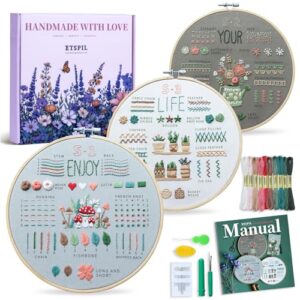
The ETSPIL Beginner Embroidery Kit Floral Patterns is a solid first pick if you’re just getting started. At $17.98, it covers the basics without overwhelming you. The kit includes three pre-printed cotton fabric panels, 10 colorfast thread skeins, a bamboo hoop, and a magnetic needle minder that keeps your needle from disappearing mid-project.
The included booklet walks you through 33 core stitches, and a QR code links to 4K video tutorials. These resources ensure you have clear guidance as you learn.
It’s practical, affordable, and genuinely ready to use right out of the box, making it an ideal choice for beginners.
| Best For | Absolute beginners who want an all-in-one embroidery kit that’s ready to use right out of the box, without needing to hunt down extra supplies. |
|---|---|
| Price | $17.98 |
| Hoop Included | Bamboo adjustable |
| Fabric Panels | 3 pre-printed cotton |
| Needles Included | 16 milliner needles |
| Video Tutorials | QR to 4K tutorials |
| Scissors Included | Yes, adult-size |
| Additional Features |
|
- Everything you need is included — hoop, needles, threads, scissors, and more — no extra shopping required.
- The 4K video tutorials paired with a step-by-step booklet make learning 33 stitches approachable, even with zero experience.
- The magnetic needle minder is a genuinely clever touch that keeps your needle from vanishing mid-project.
- Some buyers have received kits with missing pieces, which means potentially needing to buy replacements separately.
- The video tutorials have no spoken audio or captions, so if you learn better by listening, you might find them a bit frustrating.
- The needle threader is reported to break easily, which can be annoying when you’re still getting the hang of threading.
2. Cyanfour Beginner Embroidery Kit
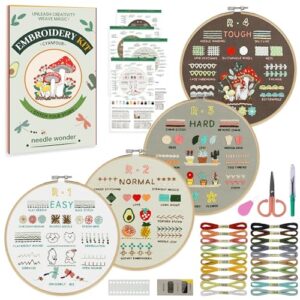
The Cyanfour Beginner Embroidery Kit offers exceptional value, priced at just $13.99. It includes four fabric panels, 20 thread colors, nine needles, scissors, a hoop, a needle threader, and a seam ripper—packing a lot into one box.
The kit guides users through 38 stitching techniques across four progressive stages, supported by QR-linked video tutorials and printed instruction sheets.
However, some users note duplicate thread colors and occasional translation issues in the guides.
| Best For | Anyone just getting into embroidery — especially kids, teens, or adults looking for a low-cost, structured way to learn without hunting down supplies separately. |
|---|---|
| Price | $13.99 |
| Hoop Included | 1 embroidery hoop |
| Fabric Panels | 4 printed fabric squares |
| Needles Included | 9 needles |
| Video Tutorials | QR-linked videos |
| Scissors Included | Yes |
| Additional Features |
|
- Comes with everything you need right out of the box — hoop, scissors, needle threader, seam ripper, the works
- Covers 38 stitching techniques across four difficulty levels, so you actually progress as you go
- QR codes link to video tutorials, which makes learning a lot easier than staring at diagrams alone
- Some users get duplicate thread colors instead of a full variety, which can be frustrating mid-project
- The instructions aren’t always well-translated, so you might end up Googling the right technique name
- The threads feel a bit thin and hard to work with compared to quality brands like DMC, and they can be tough on the needle eyes
3. Bradove Classic Stitch Practice Kit
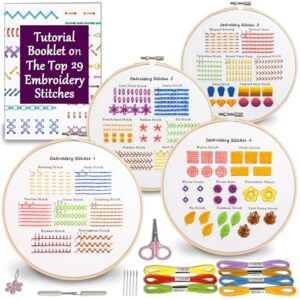
The Bradove Classic Stitch Practice Kit elevates the experience at $27.98, offering four stamped fabric squares, a full floss set, four needles, a hoop, scissors, a seam ripper, and a needle threader — a truly all-in-one solution.
QR codes provide access to video tutorials covering essential techniques like knots, floss separation, and finishing methods. The kit is REACH-certified for safety, making it ideal for families with kids ages 7 and up crafting together.
| Best For | Families and complete beginners who want an all-in-one starter kit to learn embroidery together, screen-free. |
|---|---|
| Price | $27.98 |
| Hoop Included | 1 embroidery hoop |
| Fabric Panels | 4 printed fabric squares |
| Needles Included | 4 needles |
| Video Tutorials | QR-code video links |
| Scissors Included | Yes |
| Additional Features |
|
- Everything you need is in the box — fabric, floss, needles, hoop, scissors, and more, no extra shopping required.
- QR codes link to video tutorials, so you’re never stuck guessing how a stitch works.
- Great for kids and adults to do together, and calm enough to make it a genuine wind-down activity.
- The instruction booklet is a bit thin on details, like which needle size to use or how many floss strands to pull.
- Some of the tools (hoop, scissors, needle threader) feel flimsy and may not hold up over time.
- The video tutorials are silent and short, so trickier stitches might leave you wanting a little more guidance.
4. Cyanfour Beginner Floral Embroidery Kit with Hoop
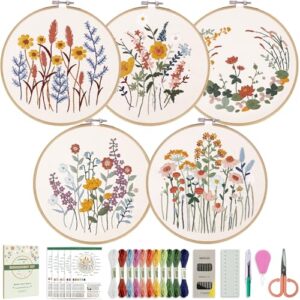
If you’re ready to step into floral designs, the Cyanfour Beginner Floral Embroidery Kit offers a solid starting point for just $15.99.
You receive five pre-printed patterns, 19 thread colors, nine needles, and a 7-inch hoop — all packaged flat for convenience.
The online video tutorials guide you through each stitch clearly, eliminating guesswork. It’s a practical pick for variety without overspending.
| Best For | Anyone just getting into embroidery who wants a complete, budget-friendly kit with real guidance built in. |
|---|---|
| Price | $15.99 |
| Hoop Included | 7-inch plastic |
| Fabric Panels | 5 pre-printed patterns |
| Needles Included | 9 stainless-steel |
| Video Tutorials | Online video access |
| Scissors Included | Not specified |
| Additional Features |
|
- Everything you need is in the box — hoop, threads, needles, and patterns — no extra shopping required.
- Online video tutorials make learning each stitch way less intimidating for true beginners.
- At $15.99, it’s an easy, low-risk way to find out if embroidery is your thing.
- The hoop’s tension loosens pretty quickly, so expect to retighten it often mid-project.
- The printed guide lines don’t wash out, meaning you’ll need to stitch over them completely to hide them.
- Thread quality is on the budget side — it can fuzz and knot, which gets frustrating fast.
5. Inscraft Embroidery Starter Kit
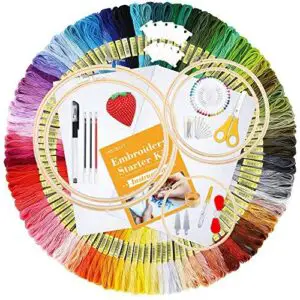
The Inscraft Embroidery Starter Kit packs everything you need into one tidy package — and that matters when you’re just finding your footing.
You get multiple floss colors, extra needles in different sizes, stamped practice fabric, and a travel pouch that keeps everything organized.
Basic stitch instructions walk you through running, back, and satin stitches without overwhelming you.
It’s an affordable, all-in-one option that removes the guesswork from getting started, so you can focus on the fun part: actually stitching.
| Best For | Beginners who want to dive into embroidery or cross-stitch without hunting down supplies piece by piece. |
|---|---|
| Price | $27.98 |
| Hoop Included | 5 bamboo hoops |
| Fabric Panels | 2 Aida cloth pieces |
| Needles Included | 30 needles |
| Video Tutorials | Instructional guide |
| Scissors Included | 1 pair |
| Additional Features |
|
- 200 floss colors give you a huge palette to work with right out of the box — no extra trips to the craft store.
- Five hoop sizes mean you can tackle everything from a small detailed piece to a larger wall-worthy project.
- The zip-up storage bag keeps everything in one place, which is a lifesaver when you’re just getting organized.
- Some needles run blunt, so you might need to swap them out sooner than expected.
- The floss can tangle easily and feels a step below higher-end cotton or silk threads.
- Sharp tools in the kit make it a no-go for kids under 12.
6. Craftwiz Starter Embroidery Kit
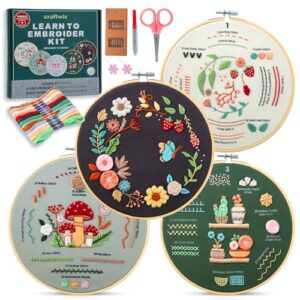
The Craftwiz Starter Embroidery Kit gives you a solid foundation without the overwhelm. Four pre-printed 12×12 inch cotton panels mean you’re not fumbling with pattern transfers — just pick up a needle and go. The 7.8-inch wooden hoop holds your fabric taut and steady, which makes a real difference when you’re learning.
You also get nine needles, scissors, a seam ripper, and two threaders.
The included guidebook covers 31 stitches, with QR-linked video tutorials to fill in the gaps.
| Best For | Adults who are completely new to embroidery and want everything in one box — no extra shopping, no guesswork. |
|---|---|
| Price | $24.99 |
| Hoop Included | 7.8-inch wooden |
| Fabric Panels | 4 cotton cloth squares |
| Needles Included | 9 hand-embroidery |
| Video Tutorials | QR-code video tutorials |
| Scissors Included | Yes |
| Additional Features |
|
- Everything’s included — hoop, needles, scissors, threaders, and thread — so you can start the same day it arrives.
- Pre-printed fabric panels take the intimidation out of getting started; no pattern transfer needed.
- Covers 31 stitches with video tutorials, so you’re actually building real skills, not just dabbling.
- The guidebook can get confusing on trickier stitches, and the videos don’t always line up with what’s on the page.
- Thread colors and pattern designs are fixed — if you want something outside what’s included, you’re on your own.
- Experienced stitchers will likely outgrow the material quality and stitch range pretty quickly.
7. KintKita Embroidery Starter Kit for Beginners
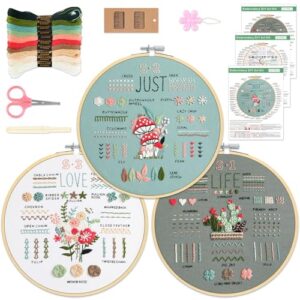
At just $8.99, the KintKita Embroidery Starter Kit punches above its price. You get three pre-printed cotton-linen panels, an adjustable hoop, needles, scissors, a needle threader, and even a seam ripper — everything in one compact package.
The printed booklet walks you through 36 basic stitches with illustrated steps, while supplemental video tutorials clarify vague written instructions.
It’s a genuinely solid entry point for learning embroidery without overspending.
| Best For | Beginners — kids and adults alike — who want to try embroidery without spending a lot or hunting down supplies separately. |
|---|---|
| Price | $8.99 |
| Hoop Included | 1 adjustable hoop |
| Fabric Panels | 3 cotton/linen panels |
| Needles Included | 2 embroidery needles |
| Video Tutorials | Supplemental videos recommended |
| Scissors Included | Yes |
| Additional Features |
|
- Everything you need is in the box — hoop, needles, scissors, threader, seam ripper, and three pre-printed panels
- Covers 36 basic stitches with illustrated guidance, giving you a real learning path to follow
- At $8.99, it’s one of the most affordable ways to get started with embroidery
- The written instructions can be vague, so you’ll likely need to lean on outside videos to fill the gaps
- Only one hoop is included, which gets tricky if you want to work on multiple panels at once
- The fabric runs a bit stiff, which can make stitching feel harder than it should for true beginners
8. Similane Embroidery Kit for Beginners
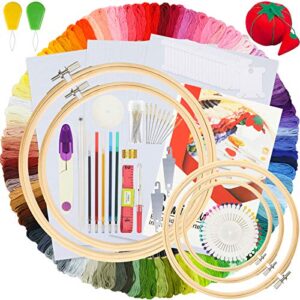
The Similane Embroidery Kit for Beginners is one of the most complete starter bundles you’ll find. With 215 total pieces — including five bamboo hoops in sizes from 5.1 to 10.2 inches — you’re ready for projects big and small from day one.
The kit offers 100 multicolored thread spools and three Aida cloth pieces, ensuring diverse creative options. These core components cater to various embroidery needs, from small details to larger designs.
However, thread separation can feel a little stiff, and the hoops are basic. While these minor drawbacks exist, the overall value remains impressive for the price.
Despite its limitations, the package delivers a surprisingly full and accessible entry point for beginners.
| Best For | Beginners who want everything in one box to start embroidery or cross-stitch without making multiple trips to the craft store. |
|---|---|
| Price | $21.99 |
| Hoop Included | 5 bamboo hoops |
| Fabric Panels | 3 Aida cloths |
| Needles Included | 30 embroidery needles |
| Video Tutorials | Instruction sheet only |
| Scissors Included | 1 pair |
| Additional Features |
|
- 215 pieces covering nearly every tool you’d need — hoops, threads, needles, scissors, thimble, and more
- Five hoop sizes let you tackle anything from small patches to larger wall-hanging projects
- Three 14-count Aida cloth pieces included, so you can jump straight into stitching
- Needles run a bit thick and blunt, which makes fine detail work tricky
- Thread is harder to separate than premium floss like DMC and feels slightly stiff
- No storage bag included, so you’ll need to find your own way to keep everything organized
9. Craftwiz Beginner Embroidery Kit with Guide
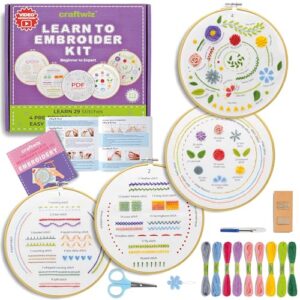
The Craftwiz Beginner Embroidery Kit with Guide offers everything in one box for $24.99. It includes a 7.8-inch wooden hoop, four pre-printed 12×12-inch cotton panels, and 13 thread colors. This comprehensive setup ensures you have all essentials without needing extras.
The kit features a 30-page beginner’s guide that teaches 29 stitches, alongside a QR code linking to video tutorials for visual learners. This dual-resource approach simplifies mastering techniques for newcomers.
Additional tools—scissors, needles, a seam ripper, and two needle threaders—round out the package. Together, these components create a solid, well-thought-out kit designed to eliminate scrambling for supplies.
| Best For | Complete beginners who want everything in one box to start embroidering right away, plus anyone looking for a thoughtful, ready-to-gift craft kit. |
|---|---|
| Price | $24.99 |
| Hoop Included | 7.8-inch wooden |
| Fabric Panels | 4 cotton cloth squares |
| Needles Included | 9 metal needles |
| Video Tutorials | QR/YouTube tutorials |
| Scissors Included | Stainless-steel scissors |
| Additional Features |
|
- Solid starter value at $24.99 — you get a hoop, pre-printed panels, thread, tools, a 30-page guide, and video tutorials without buying anything extra
- The combo of a written guide and QR-linked video tutorials is genuinely helpful for visual learners who struggle with written instructions alone
- Makes a great gift — it’s neatly packaged and covers all the basics for teens, adults, or craft class settings
- All needles are the same size, so if you want to work with thicker 6-strand floss, you’ll likely need to grab different needles separately
- The wooden hoop can be a bit rough out of the box — worth a quick sand before you start to avoid catching threads or getting splinters
- The scissors are on the small side and can feel awkward for adults during longer sessions, so you may end up reaching for your own pair
10. Santune Floral Embroidery Kit for Beginners
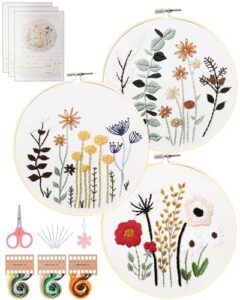
The Santune Floral Embroidery Kit keeps things simple — and that’s exactly the point. At $20.89, it offers a comprehensive starting point for beginners.
The kit includes three pre-printed floral cloths, six needles, three thread packs, a needle threader, scissors, and a 7.8-inch hoop, ensuring all essentials are covered.
A standout feature is the water-soluble patterns, which wash away cleanly after stitching for a polished finish. QR codes provide access to video tutorials, offering extra guidance when needed.
It’s a solid pick for beginners who want to start stitching immediately without complexity.
| Best For | Beginners — kids, teens, or adults — who want to jump into embroidery without hunting down supplies or figuring out where to start. |
|---|---|
| Price | $20.89 |
| Hoop Included | 7.8-inch hoop |
| Fabric Panels | 3 embroidery cloths |
| Needles Included | 6 needles |
| Video Tutorials | QR-linked videos |
| Scissors Included | Small scissors |
| Additional Features |
|
- Everything you need is in the box — hoop, needles, thread, scissors, and pre-printed cloths ready to go
- Water-soluble patterns wash away after stitching, so your finished piece looks clean and professional
- QR codes link to video tutorials, which is a lifesaver when written instructions aren’t clicking
- Only one hoop included, and it’s not the sturdiest — serious stitchers may want to upgrade
- The printed patterns can run faint or blurry on some cloths, making them tricky to follow
- All three designs are floral, so if you want variety, you’ll need to buy more kits
Key Features Beginners Need
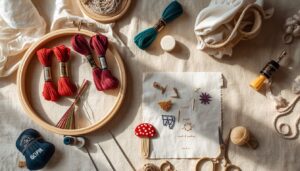
Not every kit is created equal, and the difference often comes down to a few key features. What’s inside the box can make your first stitches feel smooth or frustrating.
Here’s what to look for before you buy.
Pre-stamped Fabric Patterns
Most beginner embroidery kits include pre-stamped patterns printed directly on preprinted fabric — no tracing required. Fabric compatibility matters here; cotton and linen hold ink best. These kits eliminate setup frustrations by ensuring designs remain visible without overwhelming your thread work.
Pattern registration and durability testing are critical features. Registration marks maintain precise alignment for repeating motifs, while tested guidelines withstand multiple stitching sessions before fading. This reliability lets you focus on creativity rather than corrections.
Customization options further enhance flexibility. Swap colors or experiment with stitches to personalize projects, making each piece uniquely yours.
- Designs stay visible without overpowering your thread
- Water-soluble ink types disappear cleanly after stitching
- Preprinted patterns reduce frustrating setup mistakes
- Registration marks keep repeating motifs perfectly spaced
- Color-swap flexibility makes every project feel personal
Hoop Size and Quality
Once your fabric is stamped and ready, the embroidery hoop becomes your best tool. Inner diameter standards usually run 4 to 7 inches — a 6- or 7-inch hoop gives you great visibility without cramping your stitches.
Plastic hoop options are budget-friendly but can warp; a bamboo hoop offers better Material Rigidity Differences.
Clamping Screw Precision and Lip Coating Benefits keep fabric hoop tension smooth and snag-free.
Consider the Snap‑n‑gO model, which provides multiple removable segments for easy travel.
Needles, Scissors, and Threaders
Your hoop holds the work — now the right tools finish it. Embroidery needles have a larger eye than regular sewing needles, which makes threading multiple floss strands much easier. A dual-hole threader or magnetic threader takes the frustration out of that step entirely.
Look for micro embroidery scissors with bent blades — they trim close to stitches without jabbing your fabric.
Floss Colors and Durability
Colorful threads make or break your finished piece. Look for colorfast floss — that means the Colorfast Dyeing Process locks in color so it won’t bleed onto your fabric. Fluoro Color Stability keeps bright shades vibrant over time.
Wax Coating Durability reduces fraying, while high Tensile Strength prevents snapping mid-stitch.
Premium DMC Standard Floss offers the most durable components and colorfast results beginners can trust.
Storage and Travel Accessories
Keeping your supplies organized makes every stitch session smoother.
Packing Cube Organization lets you sort threads, hoops, and tools into separate compartments — no more digging through a jumbled bag.
Water-Resistant Carry Bags protect everything from spills, while Magnetic Tool Pouches and Needle Safety Cases keep sharps secure.
Travel Floss Caddies prevent tangling on the go, making your portable embroidery kit truly lightweight and portable for crafting anywhere.
Comparing Kit Learning Support
Learning support can make or break your first embroidery experience. The best kits don’t just hand you thread and a needle — they actually teach you how to use them.
Here’s what to look for when comparing how different kits guide you through the process.
Printed Stitch Instructions
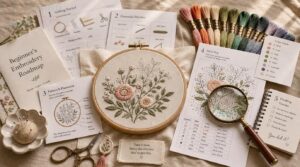
A good printed guide is basically your stitch roadmap. Every beginner embroidery kit worth its thread includes clear instructions with numbered sections, color key design, and visual cues like arrows for stitch direction. Legend clarity makes all the difference—you won’t second-guess yourself mid-pattern.
Durable print materials, reusable guides, and a smart instruction layout keep your step-by-step guide readable long after your first project starts. These elements ensure your roadmap remains practical and reliable, preserving its utility over time.
QR Video Tutorials
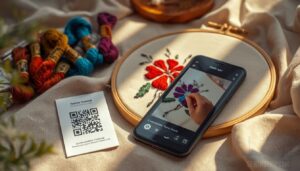
Scanning a QR code opens up a whole world of support right on your phone. Many kits link directly to YouTube video tutorials or private company libraries, giving you QR code video access to HD online instructional videos with close-up stitch demonstrations.
Evolving QR Updates keep links current, while Multilingual Subtitles, Interactive Pause Prompts, and Engagement Analytics make these step-by-step guides genuinely useful for every learner.
Step-by-step Skill Progression
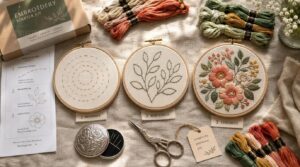
Think of skill progression like climbing a ladder — each rung builds on the last. A good beginner embroidery kit uses a progressive learning system that starts with running stitch, then layers in backstitch, satin stitch, and finally color planning with shading.
Stitch sequencing and thread slack control develop naturally through this step-by-step guide. This helps you move from wobbly lines to polished motifs, with clear instructions and layered techniques.
Practice Samplers for Beginners
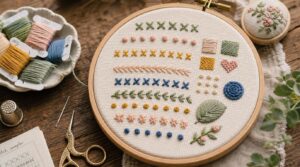
A practice sampler is your embroidery test drive. Most beginner embroidery kits include a Stitch Sampler Beginner Kit format, where pre-stamped 6×6-inch Aida fabric provides Sample Size Guidance built right in.
Color Palette Limits of 6–8 hues keep things manageable.
Stitch Timing Tips help prevent hand fatigue, while Reference Sample Uses let you revisit finished sections later as a personal how-to guide.
Troubleshooting Thread Tension
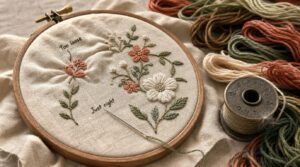
Thread tension trips up almost every beginner at some point. If your stitches pucker, check your Upper Tension first — small adjustments of half a unit make a real difference.
Bobbin Balance matters too; lint buildup quietly throws off your stitch.
Always confirm your Thread Path is clear and that Needle Compatibility matches your floss weight and Fabric Density before you start.
Choosing The Right Kit
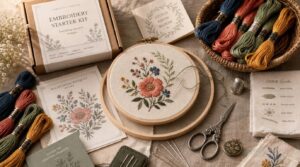
Picking the right embroidery kit comes down to a few key things that matter most to you. Everyone’s starting point looks a little different, so it helps to know what to look for before you buy.
Here’s what to keep in mind when narrowing down your choice.
Match Your Skill Level
Before you buy, check whether a kit’s skill level labels actually match your current skill level. Beginner-friendly designs with simple color palettes and scaled project sizes ensure early success.
A good beginner embroidery kit builds confidence through learning progression. Each stage introduces just enough new stitches to stretch your skills without hindering your progress.
Compare Price and Value
Once you’ve matched your skill level, price becomes the next puzzle to solve. Total project cost isn’t just the sticker price — it’s what you get for it.
- Supply longevity factor: durable hoops and quality floss stretches your budget further
- Bundle savings analysis: multi-packs like the Best Value Multi-Pack offer more patterns per dollar
- Brand warranty worth: reputable brands back their kits with returns and replacements
- Long-term value index: DMC-compatible thread resists fading across many projects
- Best Budget Friendly picks skip hoops but keep embroidery hobby costs low
A smart embroidery kit comparison balances upfront spending against real, budget-friendly crafting value.
Check Included Supplies
Beyond price, what’s actually inside the box matters just as much. Good starter kits clearly list fabric yardage, skein color coding, and needle size range right in the description.
Check that hoops, scissors, and threads are all accounted for. Ensure included scissors and threads are present, and verify scissor blade specifications and accessory bag material—so everything stays neatly organized, letting you focus on stitching, not searching.
Pick Preferred Design Themes
Design theme matters more than you think. Floral Motifs and Seasonal Themes are great for beginner-friendly designs because they use simple stitching patterns with clear boundaries. Geometric Patterns help you practice symmetry, while Whimsical Characters keep things fun.
Cultural Inspirations offer another avenue, particularly folk-style floral patterns that blend creative stitching with natural color mixing in embroidery. These themes allow for expressive, culturally rich designs while maintaining approachable techniques.
Consider Gifting Presentation
When you’re giving an embroidery kit as a gift, presentation makes all the difference. Elegant wrapping paper, custom ribbon tags, and themed tissue inserts transform a simple box into something memorable. The ETSPIL 4-Floral Pattern Kit stands out for its exceptional gift-ready packaging, earning its reputation as a top crafting gift idea.
- Eco-friendly packaging appeals to conscious recipients
- An individualized gift note adds warmth instantly
- Themed tissue inserts keep contents protected and beautiful
Beginner Embroidery Buying Tips
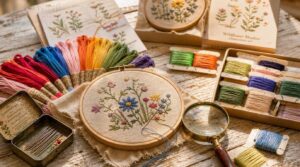
Picking the right embroidery kit comes down to a few smart habits before you spend a single dollar.
Knowing what to look for saves you from kits that frustrate more than they teach.
Here’s what to keep in mind as you shop.
Start With Simple Patterns
Your first stitch doesn’t need to be perfect — it just needs to happen. That’s why simple patterns are your best starting point. Four-Inch Layouts keep projects manageable, Single-Color Motifs reduce tangles, and Basic Stitch Repetition builds muscle memory fast. Minimalist Shape Outlines like hearts or leaves help maintain even tension without second-guessing every move.
Your first stitch doesn’t need to be perfect — it just needs to happen
| Pattern Confidence Steps | Beginner-Friendly Designs | What It Builds |
|---|---|---|
| Start with 4×4 layouts | Hearts, stars, leaves | Tension control |
| Use single-color motifs | Simple floral outlines | Thread confidence |
| Repeat one stitch type | Backstitch or running stitch | Muscle memory |
| Follow stamped guides | Pre-printed fabric panels | Stitch accuracy |
| Add one new stitch | Small sampler sections | Skill progression |
Most beginner embroidery kits include easy-to-follow instructions and step-by-step guides built around these Pattern Confidence Steps — making them ideal starter kits for anyone just picking up a needle.
Choose Quality Cotton Floss
Not all floss is created equal. Look for long-staple cotton threads — they’re stronger, smoother, and resist fraying mid-stitch. Mercerization Benefits include a lustrous finish and better shade consistency across your multicolored floss set. Six-strand floss lets you adjust thickness easily.
Most beginner embroidery kits use premium DMC standard, high-quality threads with reliable thread-color matching — making them worth every penny.
Prefer Sturdy Embroidery Hoops
Your embroidery hoop does more work than you’d think. Cheap plastic options skip Anti‑Warp Construction, so fabric loosens mid-stitch. Instead, look for Wood vs Metal choices — beech or maple offer a smooth grip, while corrosion-resistant materials like aluminum maintain Hoop Tension Stability session after session.
Most quality beginner embroidery kits include a sturdy embroidery hoop, but always check hoop size and hardware tightness before buying.
Look for Clear Tutorials
A good video tutorial can make or break your first project. Look for ones with a Clear Objective upfront, Numbered Steps, and High-Contrast Visuals that show exactly where your needle goes. These elements ensure clarity and guide your progress effectively.
On-Screen Text reinforces each move, while Mistake Highlights help you course-correct fast. These features prevent confusion and allow you to follow along without constant rewinding.
The best beginner embroidery kit tutorials also include a step-by-step guide with clear instructions. This supplementary material ensures you can practice confidently, even when offline.
Avoid Incomplete Supply Kits
A missing needle on day one kills your momentum fast. Before you buy, check that your starter kit includes all essential supplies — hoop, fabric, thread, needles, and scissors.
- Checklist Verification inside the box confirms nothing’s missing
- Inventory Labels on bags prevent mix-ups
- Quality Control before shipping ensures usable items
- Replacement Policy protects your project if something’s wrong
Packaging Transparency matters in any all-inclusive kit.
Frequently Asked Questions (FAQs)
Is embroidery a cheap hobby?
It won’t break the bank. Beginner embroidery starter kits start around $10–$15, offering an accessible entry point for newcomers.
Reusable tools like hoops and needles cut long-term costs, ensuring the hobby remains economical over time.
Bulk thread savings add up fast, further solidifying embroidery as a genuinely budget-friendly craft.
Are embroidery kits worth it?
Yes, beginner embroidery kits are worth it. They offer real cost efficiency by bundling everything you need, boosting creative satisfaction from day one.
Delivering solid material longevity — making them a smart hobby investment.
What is the easiest embroidery to learn?
Running stitch basics are the simplest place to start — just a straight line that does a thousand jobs.
From there, back stitch intro and chain stitch simplicity follow naturally for any beginner.
What do you need for embroidery starter kit?
A good embroidery kit needs a hoop, needles with the right needle-eye size, threads, scissors, and pre-stamped fabric.
Pen transfer tools, color-coded organization, and proper lighting for stitching make starting much easier.
How long does a basic project take?
Think a first project takes all weekend? Most simple designs wrap up in 2 to 4 hours.
Prep time, design complexity effect, and color changes’ impact all shape your session breakdown and project completion time.
What are common beginner mistakes?
Most beginners jump into overly complex patterns too soon. Inconsistent practice, improper fabric tension, and wrong needle size choices slow progress fast.
Skipping warm-ups also hurts fine motor control more than you’d expect.
Are there specific fabric considerations?
Fabric matters more than most people expect. Medium-weight cotton works best — it holds stitches without puckering.
Pre-wash the fabric before starting, and choose a tight-weave type to keep fabric tension even and prevent fabric edges from fraying.
Can kits be personalized?
Yes, many kits can be personalized. You’ll find Monogram Options, Custom Color Palettes, Tailored Instruction Cards, and Personalized Gift Packaging — making them ideal handmade gifts.
These features are accessible through a Kit Builder Tool for custom selections.
How to fix mistakes while embroidering?
Even the best stitchers slip up. Use small scissors for Mistake Cutting, fix Thread Replacement in reverse, and try Embellishment Masking with beads.
Good error prevention starts with thread tension control and needle size selection.
How long does embroidery typically take to learn?
Most people hit basic proficiency within one to four weeks. Your practice cadence matters more than total hours — short, consistent sessions beat occasional marathons every time along the learning curve.
Conclusion
Think of the best embroidery starter kits as your training ground—where tangled threads become finished flowers and uncertainty becomes confidence. The right kit won’t just hand you supplies; it’ll hand you a skill.
Whether you’re drawn to bold florals or simple samplers, the kits in this guide give you a real foundation.
Pick one that matches your pace, trust the process, and let your first stitch be the beginning of something you’ll actually keep making.