This site is supported by our readers. We may earn a commission, at no cost to you, if you purchase through links.

Most sewing frustrations trace back to tiny screw that most sewists never touch. The bobbin tension adjustment screw sits quietly on your bobbin case, smaller than a pencil eraser, yet it controls whether your stitches look crisp or like a bird’s nest exploded under your fabric.
Ignore it long enough and you’ll blame your thread, your needle, even your machine—when the fix was a quarter-turn away the whole time. Once you know how to read your stitches and work that screw with confidence, tension problems stop feeling like dark magic and start feeling like a solved puzzle.
Table Of Contents
- Key Takeaways
- What is a Bobbin Tension Adjustment Screw?
- Signs Your Bobbin Tension Screw Needs Adjusting
- Tools You Need Before Adjusting The Screw
- How to Adjust The Bobbin Tension Screw Step-By-Step
- How to Test Bobbin Tension After Adjusting
- Bobbin Tension Screw Adjustments by Machine Brand
- Common Bobbin Tension Screw Mistakes to Avoid
- Maintaining Your Bobbin Case and Tension Screw
- Frequently Asked Questions (FAQs)
- Conclusion
Key Takeaways
- That tiny bobbin tension screw controls thread tightness through a leaf spring, and a single quarter-turn can fix stitching problems you’ve been blaming on thread or needle for months.
- Before touching the screw, always check upper thread tension, presser foot positioning, and lint buildup first — the bobbin is rarely the first culprit.
- Use only quarter-turn increments, test on scrap fabric after each adjustment, and keep a second untouched bobbin case as your baseline to avoid overcorrecting.
- Thread weight, fabric thickness, humidity, and machine brand all affect how you fine‑tune bobbin tension — so recheck settings whenever any of those variables change.
What is a Bobbin Tension Adjustment Screw?
That tiny screw on your bobbin case does more than you’d think.
A small turn in either direction controls thread tension more than most people realize—so it’s worth understanding proper bobbin winding and case setup before you start troubleshooting.
It controls how tightly the bobbin thread feeds through during sewing — and getting it right makes all the difference.
Here’s what you need to know about it.
Where is The Screw Located on The Bobbin Case?
Finding the tension screw depends on your machine type.
- Front-loader orientation: The spring-face screw sits on the flat outer face of your removable metal bobbin case, right beside the thread-exit slot.
- Drop-in placement: Look near the 3 or 9 o’clock position around the bobbin circle.
- Case-side identification: The larger slotted screw on the spring is your adjustment screw — not the tiny fastening screw beside it.
A second bobbin case baseline can serve as a reference for fine‑tuning tension.
How The Screw Controls Thread Tightness
Once you’ve spotted the tension screw, here’s what it’s actually doing.
It presses against a metal leaf spring, controlling how freely your bobbin thread unwinds.
Tighten it clockwise, and Spring Gap Mechanics kick in — the spring compresses, increasing friction.
Loosen it counterclockwise, and Thread Tension Metrics drop, letting thread flow easier.
| Adjustment | Spring Gap Change | Tension Change |
|---|---|---|
| ¼ turn clockwise | −0.1 to −0.2 mm | +25–50 mN |
| ¼ turn counterclockwise | +0.1 to +0.2 mm | −20–40 mN |
| No adjustment | Baseline gap | 150–250 mN |
| Over‑tightened (½+ turn) | Fully compressed | Breakage risk |
| Factory setting | Standard gap | ~190–220 mN |
Quarter‑Turn Calibration keeps thread tension control precise — think of it like a volume knob, not an on/off switch. perform a drop test can confirm if the tension is too loose or tight.
Difference Between Bobbin and Upper Thread Tension
Now that you know how the screw controls spring pressure, here’s the bigger picture. Your upper thread winds through multiple guides and tension discs — a long, complex path.
Your bobbin thread? Short and straight. That Thread Path Length difference means upper tension manages 90% of balancing work. Bobbin tension fine‑tunes the rest, making both essential for achieving perfect Stitch Balance Indicators.
Signs Your Bobbin Tension Screw Needs Adjusting

Your bobbin tension screw is usually the quiet troublemaker behind some really frustrating sewing problems.
The good news is that your machine will actually tell you when something’s off — you just need to know what to look for.
Here are the three most common signs that your bobbin tension needs adjusting.
Thread Bunching Underneath The Fabric
Thread bunching underneath your fabric is a red flag you can’t ignore. Usually, it’s not the bobbin causing chaos — it’s something simpler.
- Loose upper thread tension pulls excess thread below
- Presser foot positioning while threading skips the tension discs entirely
- Poor bobbin insertion technique or lint accumulation lets thread pool freely
Fix these first before adjusting bobbin tension for perfect stitches.
Uneven or Looping Stitches on Fabric
Loops and uneven stitches are your machine’s way of waving a red flag. Before adjusting bobbin tension for perfect stitches, check these usual suspects first.
If you’re working through these fixes on a Singer 4423 heavy-duty sewing machine, the manual covers tension troubleshooting step by step so you’re not just guessing.
| Issue | Cause | Fix |
|---|---|---|
| Top-side loops | Loose bobbin tension | Tighten screw clockwise |
| Uneven stitches | Feed dog issues or lint | Clean feed dogs |
| Bobbin dots visible | Thread tension balance off | Adjust upper tension first |
| Irregular stitch spacing | Stitch density settings wrong | Match settings to fabric |
| Skipped stitches | Poor needle condition | Replace needle immediately |
Fabric type selection and tension troubleshooting go hand‑in‑hand — stitch quality suffers when they’re mismatched.
Thread Breaking During Sewing
When your thread keeps snapping mid-seam, your bobbin tension adjustment is usually part of the story. Excessive Upper Tension combined with a tight bobbin creates too much resistance — the thread simply gives up.
Needle Burrs, Thread Quality Issues, and an Improper Thread Path pile on fast. Speed‑Induced Stress makes it worse.
Smart tension troubleshooting means checking thread tension balance and bobbin case maintenance before assuming the worst.
Tools You Need Before Adjusting The Screw

Before you touch tiny screw, you need the right tools in hand.
Going in unprepared is how small adjustments turn into big headaches.
Here’s what you’ll want ready before you start.
Correct Screwdriver Size for Bobbin Case
Using the wrong screwdriver here is like using a butter knife to do surgery — messy and damaging.
For most bobbin cases, a 1/8-inch slotted screwdriver manages tension screw adjustments perfectly. Magnetic tip benefits are real: tiny screws won’t vanish into your machine. Janome machines need a triangle tip driver instead. Avoid Phillips head compatibility mistakes — wrong driver size errors strip screw heads instantly.
Using a Second Bobbin Case as Baseline
Think of your second bobbin case as a “tension anchor” — your personal reference point before anything goes sideways.
Here’s what to do with it:
- Baseline case selection — Pick the factory‑set case with green Loctite marker identification on the screw.
- Drop test comparison — Hold it by the thread tail; it should drop 3–4 inches smoothly.
- Thread weight matching — Factory baseline suits 60‑weight thread perfectly.
- Quick tension reset — Return to this case whenever adjustments go too far.
- Never adjust it — Keep this bobbin case untouched, always.
How to Adjust The Bobbin Tension Screw Step-By-Step
Now comes the part where everything clicks into place. Adjusting the bobbin tension screw isn’t complicated — you just need to know which way to turn and how much.
Here’s exactly what to do, step by step.
Turning Clockwise to Tighten Bobbin Tension
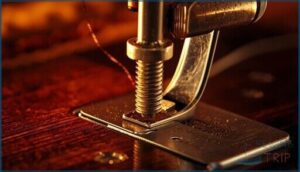
Clockwise is your best friend when bobbin thread keeps showing up where it shouldn’t. Every clockwise turn activates Spring Compression Mechanics — the screw presses the leaf spring tighter, increasing Thread Pull Measurement to that sweet spot around 22–23 grams. Use Clock Face Visualization to nail Quarter‑Turn Timing with confidence.
| Screw Head Identification | Clockwise Turns | Effect on Bobbin Tension |
|---|---|---|
| Flathead tension screw | 1/4 turn | Initial tightening boost |
| Midpoint on leaf spring | 1/8 turn | Fine‑tuning adjustment |
| Machine‑supplied screwdriver | Multiple increments | Fully balanced stitches |
Start with one quarter‑turn adjustment, then test before turning further.
Turning Counterclockwise to Loosen Bobbin Tension

Counterclockwise is your fix when stitches look tight or the top thread keeps snapping.
Turning the tension screw left triggers Spring Relaxation Mechanics — the spring eases its grip, lowering Thread Release Resistance to a gentler pull.
Always start with Lint Removal Prep first.
One Quarter‑Turn Increment is plenty.
Then do a quick Fabric Underside Inspection to confirm your bobbin tension is finally breathing easy.
Using Quarter-Turn Increments for Precision

Once you’ve loosened or tightened, resist the urge to keep turning. Quarter-turn increments are your best friend here — each 90-degree move shifts tension by 20–30 percent.
Picture Clock Face Markings on your screw head: move from 12 to 3, test, then decide.
This Iterative Test Cycle, paired with a Precision Screwdriver Choice, keeps your Incremental Screw Tracking honest and your Sensitivity Calibration spot‑on.
Performing The Drop Test to Check Tension

Once your quarter-turn is done, the drop test confirms whether your bobbin tension adjustment techniques have landed. Here’s how to read it fast:
- Drop Test Setup: Hold the thread tail, let the case hang over a Safety Surface like a folded towel.
- Bounce Distance: A gentle jounce should drop the case 1–3 inches, then stop.
- Reading Results: Plummets freely? Too loose. Won’t budge? Too tight.
Use Consistent Thread Weight every time for reliable stitch quality.
How to Test Bobbin Tension After Adjusting

made your adjustment — now it’s time to see if it actually worked. Testing your bobbin tension is how you know whether that tiny screw turn did the job or needs another nudge.
Here are three things to check after every adjustment.
What Correct Bobbin Tension Looks Like
When bobbin tension is dialed in, everything clicks — literally. Your stitch lock stays centered inside the fabric layers, never pulling toward either side.
The topside shows a clean, even line, while the underside mirrors it perfectly with an even underside line and no railroad tracks. No fabric puckering, no loops. A consistent drop test of 3–7 inches confirms balanced thread pull and solid tension balance.
Sewing a Diagnostic Stitch Test on Scrap Fabric
Now that you know what perfect tension looks like, put it to the test. Grab a scrap fabric matching your project’s weight — cotton broadcloth works great.
Load contrasting thread for easy inspection: light on top, dark in the bobbin. Sew straight and zigzag stitches, then flip and check both sides.
This diagnostic stitch test reveals your bobbin tension adjustment screw‘ true performance instantly.
Balancing Bobbin Tension With Upper Thread Tension
Think of upper and lower threads as dance partners — when one leads too hard, the whole routine falls apart. True thread balance means matching your bobbin tension to the upper dial, not fighting it.
Upper and lower threads are dance partners — when one leads too hard, the whole routine falls apart
- Stitch symmetry confirms proper machine calibration
- Fabric reaction reveals tension mapping in real time
- Thread compatibility affects how both threads lock together
Adjust one at a time, always.
Bobbin Tension Screw Adjustments by Machine Brand

Not every sewing machine manages bobbin tension the same way — and that’s where things get interesting.
Brother, Janome, and Singer each have their own quirks, and drop-in bobbins behave differently than front-loading cases. Here’s what you need to know for each one.
Adjusting The Screw on Brother Sewing Machines
Brother machines make tension calibration straightforward once you know the trick. Find the slotted tension screw on your removable bobbin case — it’s the unpainted one, not the Phillips screw nearby (leave that alone).
For quarter-turn adjustments, go clockwise to tighten, counterclockwise to loosen. Always do the drop test after each small turn to confirm your sewing machine tension settings are dialed in.
Bobbin Tension Screw on Janome Machines
Janome machines have a dual-screw design that trips up a lot of sewists. Here’s what you need to nail bobbin case calibration every time:
- Remove the throat plate for drop‑in models to access tension screw.
- Identify the larger screw — that’s your Spring Calibration control.
- Ignore the smaller holding screw during Case Removal.
- Turn clockwise to tighten Thread Compatibility across fabrics.
- Follow your Maintenance Schedule to prevent lint buildup.
Heavy-Duty Singer Bobbin Case Adjustments
Singer Heavy Duty machines — like the 4423 — are built like tanks, and their bobbin cases are no different.
Needle Plate Removal is your first step: unscrew the throat plate to reach the tension screw. That factory‑tight screw demands firm Screw Tool Selection — a flat‑head screwdriver with real grip. Use 1/8‑turn increments for precise Spring Calibration, perform your drop test, and keep up with Oil Application and Lint Prevention for solid bobbin case calibration.
Drop-in Bobbin Systems Vs. Front-Loading Cases
Drop-in and front-loading systems aren’t just different shapes — they’re entirely different experiences.
- Visibility Access: Drop-in covers are clear, so you monitor thread mid-project
- Screw Accessibility: Front-loading bobbin cases unsnap for direct external screw access
- Tension Precision: Front-loading bobbins allow finer tension adjustments for specialty threads
- Thread Direction: Drop-in bobbins unwind counterclockwise; front-loading unwinds clockwise
- Drop Test Methods: Only front-loading cases support the yo-yo drop test reliably
Common Bobbin Tension Screw Mistakes to Avoid

Even small screw adjustments can go sideways fast if you’re not careful. Most tension problems aren’t about the machine — they’re about a few easy-to-make mistakes that throw everything off.
Here’s what to watch out for before you touch that screw again.
Over-Tightening or Over-Loosening The Screw
Too much or too little — both wreck your stitches fast. Over-tightening causes screw strip damage and spring deformation risk, while loosening too far risks paint seal failure and needle vibration increase.
Either mistake invites lint trap blockage that fakes tension problems. Keep tension adjustments to quarter-turns only.
| Issue | Over-Tightened | Over-Loosened |
|---|---|---|
| Thread behavior | Top thread breaks | Bobbin shows on top |
| Stitch quality | Fabric puckers | Loose loops underneath |
| Machine risk | Screw strip damage | Bobbin case rattles |
| Fix | Back off quarter-turn | Tighten quarter-turn |
Skipping The Test Stitch Between Adjustments
Skipping a test stitch after each quarter‑turn adjustment is how small problems snowball fast. Error accumulation is real — consecutive untested turns can shift tension by 40‑gram force before you notice.
That’s fabric puckering, stitch irregularities, and seam strength loss all at once.
Run a quick diagnostic stitch test on scrap fabric after every single adjustment. No shortcuts.
Using Incompatible Bobbin Types
wrong bobbin type is like putting diesel in a gasoline engine — it just doesn’t work.
size mismatch, even 2.8 mm, causes wobbling, friction issues, and stitch skipping.
material weight matters too: metal bobbins in plastic‑calibrated machines create tension swings up to 25%.
Stick to your machine’s specified bobbin type, or you’ll be troubleshooting tension issues instead of sewing.
Maintaining Your Bobbin Case and Tension Screw

Your bobbin case does a lot of quiet, thankless work — and it deserves a little care in return. Like any hardworking tool, it needs regular attention to keep performing at its best.
Here’s what you should stay on top of.
Cleaning The Bobbin Case Regularly
Keeping your bobbin case clean is the simplest form of preventive maintenance you can do.
Start with a lint brush routine after every few bobbins — lint buildup sneaks in fast. Use vacuum groove cleaning to pull out stubborn fibers, then follow up with an oil‑dampened wipe on the tension spring.
Always do a safety power disconnect first. A monthly deep clean keeps everything running smoothly.
Inspecting The Screw for Wear or Damage
Once the bobbin case is clean, take a close look at that tiny screw. Check for screw head wear — a worn slot means your screwdriver will slip, throwing off torque consistency.
Run your fingernail along the threads; thread damage feels rough or uneven.
Do a quick corrosion check using alcohol, and roll the screw to perform a straightness test.
Catch problems early, and your bobbin tension stays reliable.
When to Replace The Bobbin Case Entirely
Sometimes, no amount of adjusting saves a damaged bobbin case.
Replace it when you spot three or more needle strike damage holes, worn thread guides with rough burrs, or a loose bobbin fit that lets the bobbin shift freely.
Persistent tension issues after max screw adjustment, or unusual machine noises like rattling and clicking, are your clearest signs.
A fresh case restores the best bobbin tension quickly.
Frequently Asked Questions (FAQs)
When should I adjust the bobbin tension?
Ironically, the best time to adjust bobbin tension is when you hope you won’t need to.
Watch for drop test failure, thread weight switch issues, fabric thickness change, or embroidery density shift disrupting your stitches.
What does a tension screw do on a sewing machine?
The tension screw controls spring pressure on your bobbin thread — it’s your stitch lock balance dial. Tighten it to grip thread more firmly; loosen it for freer thread feed regulation.
Can bobbin tension affect embroidery and decorative stitches?
Yes, absolutely.
Poor bobbin tension wrecks embroidery fast — causing loop formation, stitch puckering, and thread breakage. Lock point shift distorts designs.
Metallic thread tension needs up to 30 grams for clean machine embroidery results.
Does thread weight change how you adjust tension?
Thread weight absolutely changes how you adjust tension.
Heavier threads like 40 wt need looser bobbin tension, while finer 90 wt threads need it tighter. Thread weight impact on tension screw calibration is real.
How often should bobbin tension be rechecked?
Recheck bobbin tension after every thread change, cleaning session, or environmental shift.
High-volume sewers should test before major projects. Hobbyists can check every few sessions to keep stitches balanced and consistent.
Can humidity or temperature affect bobbin tension settings?
Absolutely.
High humidity causes Humidity‑Induced Swell in threads, tightening bobbin tension unexpectedly.
Temperature‑Driven Shrinkage in the cold stiffens thread too.
Keep a Seasonal Adjustment Log and recheck settings when weather shifts.
Is bobbin tension adjustment different for quilting projects?
Quilting quietly complicates everything.
Quilting layer thickness means your stitches must sink through more material, so free‑motion tension needs to be looser than standard sewing.
Thread weight pairing and specialty bobbin cases make quilting tension troubleshooting much smoother.
Conclusion
A thousand sewing problems can trace their roots back to that tiny bobbin tension adjustment screw you’ve been ignoring. Now you know better.
You can read your stitches like a map, make a quarter-turn with confidence, and actually know what you’re fixing—and why.
That’s the shift from frustrated guesser to someone who owns their machine.
Keep a second bobbin case handy, test on scrap fabric, and trust the process.
Your best stitches are ahead.
- https://www.maggieframes.com/blogs/embroidery-blogs/bobbin-casing-mastery-installation-tension-maintenance-guide
- https://www.hooptalent.com/hu/blogs/news/master-bobbin-tension-step-by-step-fix-for-perfect-stitches
- https://www.vintagesingerparts.com/products/new-replacement-bobbin-case-tension-adjusting-screw-fits-singer-models-221-222-301-part-201016
- https://support.ricoma.com/hc/en-us/articles/4408676078355-How-to-Fix-Bobbin-Thread-Tension
- https://www.threadsmagazine.com/2008/11/02/understanding-thread-tension