This site is supported by our readers. We may earn a commission, at no cost to you, if you purchase through links.
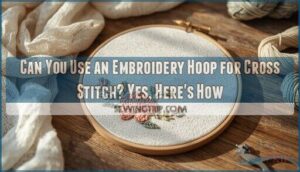
Most cross stitchers already own the answer to their hoop question—they just don’t know it yet. That embroidery hoop sitting in your craft drawer? It works beautifully for cross stitch, and stitchers have been using them interchangeably for decades. The confusion usually comes from packaging and marketing, not actual function.
An embroidery hoop holds your fabric taut, keeps your stitches even, and stops the whole thing from puckering into a wrinkled mess. Whether you’re choosing between wood and plastic, figuring out the right size, or wondering how to avoid those stubborn hoop marks, the details make all the difference.
Table Of Contents
- Key Takeaways
- Can You Use an Embroidery Hoop for Cross Stitch?
- Why Use an Embroidery Hoop for Cross Stitch?
- What Types of Embroidery Hoops Work for Cross Stitch?
- Which Materials Are Best for Cross Stitch Hoops?
- What Size Embroidery Hoop Should You Use?
- How to Properly Use an Embroidery Hoop for Cross Stitch
- Can You Cross Stitch Without an Embroidery Hoop?
- Tips to Prevent Hoop Marks and Fabric Damage
- Using Hoops to Frame and Display Cross Stitch
- Where to Buy Embroidery Hoops for Cross Stitch
- Frequently Asked Questions (FAQs)
- Conclusion
Key Takeaways
- Embroidery hoops work perfectly for cross stitch — the confusion comes from marketing, not function, so you can use what you already own.
- Keeping your fabric drum-tight in a hoop is what separates clean, even stitches from a puckered, distorted mess.
- Hoop size, material, and type all matter — match them to your project size, hand comfort, and how often you re-hoop.
- Always remove your fabric from the hoop between sessions and loosen tension when you’re done, or the marks can set for good.
Can You Use an Embroidery Hoop for Cross Stitch?
Yes, you absolutely can use an embroidery hoop for cross stitch — and honestly, it’s one of the best embroidery tools you’ll reach for. A hoop keeps your fabric taut, which directly affects stitch tension and how clean your finished piece looks.
For more on keeping your stitches clean and even, these hand stitch guides walk you through tension tips that pair perfectly with hoop work.
Most standard hoops work well with common cross stitch fabrics like Aida cloth. Whether you’re just starting out or refining your craft, good hoop maintenance and smart fabric selection make a real difference in your results.
Each approach to cross stitch has its own pros and cons for different methods, so finding what works for you is essential.
Why Use an Embroidery Hoop for Cross Stitch?
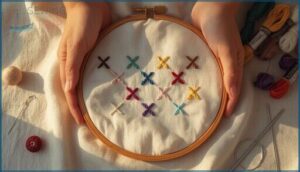
Using a hoop isn’t just a habit — it’s what separates a clean, polished stitch from a puckered mess. It gives you real control over your fabric so every stitch lands exactly where you want it.
Here’s why it makes such a difference.
Maintaining Fabric Tension
Think of your embroidery hoop as a tiny trampoline for your fabric. Good tension control keeps everything drum-tight so your stitches land exactly where you want them. Without it, fabric stretch creeps in and your whole design shifts.
Your embroidery hoop is a tiny trampoline for fabric, keeping tension drum-tight so every stitch lands exactly where you want it
Here’s what proper hoop adjustment does for your cross stitch:
- Prevents fabric relaxation mid-project
- Keeps stitch tension consistent across every row
- Stops weaving threads from pulling loose
If you’re interested in more details, you can explore the benefits of even tension for beginners.
Achieving Even Stitches
A taut hoop doesn’t just hold your fabric — it sets you up for stitches that actually look consistent. When fabric tension stays firm, your stitch direction stays honest, and thread management becomes easier to control.
| Technique | Why It Matters |
|---|---|
| Consistent stitch direction | Keeps rows uniform |
| Railroading thread | Improves even coverage |
| Stripping and recombining floss | Smooths cross stitch appearance |
| Matching strands to fabric count | Balances stitch tension |
| Short thread lengths | Reduces fraying mid-project |
Preventing Fabric Distortion
Even stitches mean nothing if your fabric warps around them. Distortion sneaks in when tension pulls unevenly or you yank the fabric on the bias instead of along the grain.
Grain alignment keeps those square Aida holes honest. Balanced tension — firm, not forced — protects the weave.
Add hoop padding to the inner ring for extra grip, and post-stitch care does the rest.
What Types of Embroidery Hoops Work for Cross Stitch?
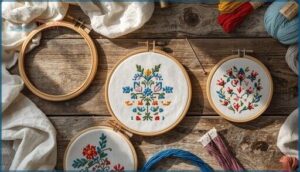
Not all hoops are built the same, and that actually works in your favor. Depending on your project and how you like to stitch, one type might feel like a breakthrough while another just gets in your way.
Here are the main options worth knowing.
Screw Tension Hoops
Screw tension hoops are the go-to choice for most cross stitchers — and for good reason. You get precise tension control by simply turning a brass or plastic screw, letting you dial in the perfect tautness for your fabric.
If budget matters, plastic embroidery hoops give you surprisingly solid tension control without the higher price tag of metal options.
- Available in hoop sizes from 3″ to 14″ for any project scale
- Inner ring ridge grips Aida cloth securely for better stitch quality
- Brass screws offer finer adjustments on delicate cross stitch fabrics
- Affordable frame options make them ideal starter embroidery hoops
Flexi Hoops
Flexi hoops snap into place like a lid on a container — no screws, no fuss. The flexible vinyl outer ring stretches over a rigid inner ring, locking your fabric in with serious grip. As one of the more decorative embroidery hoop types, flexi hoops double as finished frames for display.
| Feature | Flexi Hoop |
|---|---|
| Flexi Hoop Materials | Vinyl outer, rigid inner |
| Fabric Grip Techniques | Snap-lock tension |
| Embroidery Frame Options | Round and oval shapes |
| Cross Stitch Portability | Lightweight, display-ready |
Spring Tension Hoops
Think of spring tension hoops as the quick-draw option in your cross stitch toolkit. A metal inner ring snaps into a plastic outer ring instantly — no screw adjustments needed. That speed is great for short sessions, but the metal can leave creases on stiff Aida cloth.
Best uses for spring tension hoops:
- Travel and on-the-go stitching
- Small motifs needing fast setup
- Brief stitching sessions with frequent breaks
Q-Snap Frames
Q-Snap frames work more like a modular design system than a traditional hoop. Hollow plastic tubes connect through corner pieces to build a custom frame assembly that fits your exact fabric size.
The snap mechanism uses C-shaped clamps instead of a ring, so pressure spreads evenly across the edge.
Mix different tube lengths to match any project, and pair it with a stand for hands-free stitching.
Which Materials Are Best for Cross Stitch Hoops?
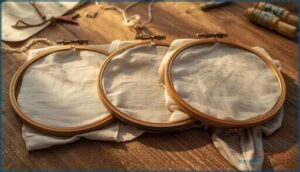
The material your hoop is made of matters more than most beginners expect. It affects how well the fabric stays put, how long the hoop lasts, and even how comfortable it feels in your hands.
Here’s how the three main options stack up.
Wood Vs. Plastic Hoops
Wood and plastic each bring something different to your cross stitch setup. A wood embroidery hoop — especially beechwood — offers natural craftsmanship, warm wood grain texture, and solid hoop durability that grips aida firmly. Bamboo hoops win on eco friendliness but can warp over time.
A plastic embroidery hoop resists moisture and warping, though budget plastic variants often lose tension fast. For longevity, quality wins every time.
Flexible Rubber Hoops
Flexible rubber hoops — or flexi hoops — grip your fabric like a vise without breaking a sweat. A rigid plastic inner ring and a stretchy vinyl outer ring snap together to hold even thick aida drum-tight. Great for long stitching sessions.
- Rubber tension stays firm without constant retightening
- Flexi hoop tips: tug fabric edges before snapping the outer ring
- Vinyl embroidery hoops double as display frames
- Lightweight flexi frame uses extend across many projects
Metal Hoops
Metal hoops bring serious fabric tension control to the table. Spring tension designs use a metal inner ring that clamps evenly around your cross stitch fabric — no screw tension needed. Just squeeze, insert, release. Clean and fast.
One catch: bare metal can stain light aida over time. Wrapping the inner ring with bias tape fixes that.
| Metal Hoop Trait | What It Means for You |
|---|---|
| Even clamping pressure | Consistent fabric tension control |
| No screw tension needed | Faster fabric changes |
| Risk of oxidation stains | Wrap ring before use |
What Size Embroidery Hoop Should You Use?
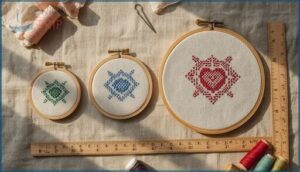
Picking the right hoop size can make or break your stitching experience. Too small and you’re constantly re-hooping; too large and your fabric flops around like it’s got somewhere else to be.
Here’s what to think about when sizing up your options.
Matching Hoop Size to Fabric Area
Before you buy a hoop, do a quick hoop size calculation based on your actual stitch area. Measure your finished design, then add 2 to 3 inches on every side for fabric tension control and comfortable handling. A 4 by 4 inch design, for example, fits well in a 6 to 8 inch embroidery hoop.
This stitch area planning keeps your cross stitch optimization on point — the fabric sits centered, tension stays even, and your needle moves freely.
For embroidery frame selection, always measure across the inner ring, not the outer edge, for accurate fit.
Choosing Hoop Size for Project Comfort
Once your design is measured, think about how the hoop will actually feel in your hand. Hoop size selection isn’t just about fit — it’s about comfort through the whole session. For most stitchers, 6 to 8 inches hits the sweet spot for hand grip comfort and fabric tension control.
Smaller hands usually do best around 5 to 7 inches, while larger hands manage wider hoops without strain. Going too big forces awkward reaching, which throws off your embroidery posture tips and tires you out fast. Match the embroidery hoop to your body, not just your cross stitch design.
How to Properly Use an Embroidery Hoop for Cross Stitch
Getting the hoop set up right makes everything else easier. There are a few key steps that keep your fabric secure, your tension even, and your stitching smooth.
Here’s what you need to know.
Securing Fabric in The Hoop
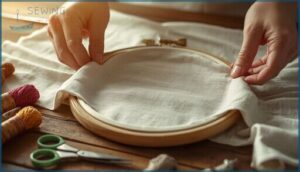
Think of hooping your fabric like making a bed — smooth, tight, and square from the start. Loosen the screw fully, lay your fabric over the inner embroidery hoop, then press the outer ring down.
For solid hoop tension control and edge securing, tug the fabric outward in small sections — top, bottom, left, right — before tightening. Proper tautness adjustment keeps your cross stitch lying flat and distortion-free.
Adjusting Tension Without Damage
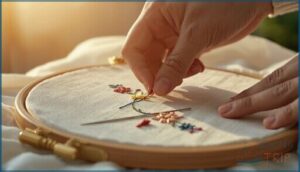
Once your fabric is in place, tension control becomes your best friend. Tighten the screw in small turns, checking after each adjustment — your embroidery hoop should feel drum-tight, not death-grip tight. Too much fabric stretch warps your grid; too little causes loose, floppy stitches.
- Turn the screw gradually for smooth hoop adjustment
- Test tautness by tapping — listen for a soft drum sound
- Retighten once mid-session as fabric relaxes under thread tension
- Loosen fully before removing to prevent stitch relaxation damage
Stitching Techniques in a Hoop
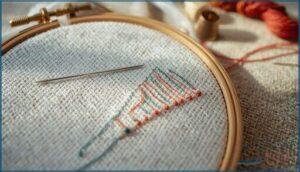
Hoop stitching rewards a little strategy. Keep your needle perpendicular to the fabric so the aida holes stay clean and your floss moves through without fraying. Right-handed? Set the screw at 10 o’clock. Left-handed? Rotate it to 2.
For stitch order, work left to right in half-stitches, then return with the top diagonal. Let your needle dangle every few stitches — it untwists the thread and keeps your crosses lying flat.
Can You Cross Stitch Without an Embroidery Hoop?
Yes, you can absolutely cross stitch without a hoop — and plenty of stitchers do it all the time. It comes down to knowing when it makes sense and what to use instead. Here’s a look at both.
When to Stitch Without a Hoop
Sometimes, skipping the embroidery hoop is the smartest move you can make. Small designs under three inches wide are often easier to handle through hand stitching — the whole piece fits comfortably between your fingers, so extra tools just get in the way.
Project portability matters too. Quick bookmarks, ornaments, or gift tags? Grab your fabric and go.
Stitch comfort is another real reason; holding a rigid hoop for hours can strain your wrist. Stitching without a hoop also protects delicate fabrics from pressure marks and keeps raised details like French knots from getting crushed.
Sometimes, less really is more.
Alternatives to Hoops (Frames, Q-Snaps)
If you’ve outgrown the hoop, there’s a whole world of cross stitch frames waiting for you. Q Snap Frames grip fabric along every side using C-shaped clamps, so you get even tension without hoop marks. Scroll Frames let you roll large projects as you go — perfect when your design is bigger than a dinner plate. Stretcher Bars hold fabric drum-tight with staples or lacing for serious, full-coverage work. Lap Stands free both your hands by holding any of these frames steady.
Each option gives you more control, less frustration, and room to stitch bigger and bolder.
Tips to Prevent Hoop Marks and Fabric Damage
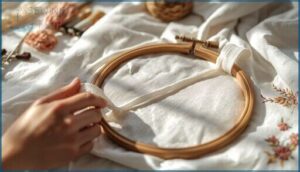
Hoop marks are one of those small frustrations that can sneak up on you mid-project.
The good news is they’re easy to avoid once you know what to watch for. A few simple habits will keep your fabric looking clean and your stitches damage-free.
Removing Creases After Stitching
Those ring-shaped hoop marks don’t have to be permanent. With a little care, your cross stitch fabric can look crisp and clean again.
- Gentle Washing — Soak the stitching in lukewarm soapy water for up to 60 minutes for full fabric relaxation.
- Steam Ironing — Press from the back for effective hoop mark removal without flattening stitches.
- Cross Stitch Blocking — Pin your damp embroidery flat to dry wrinkle-free.
Avoiding Over-Tightening
Cranking the screw too tight is one of the fastest ways to warp your fabric and crush your stitches. Ideal tension means drum-firm — not drum-destroyed. Use finger tightening only; screwdrivers push screw tension past safe limits fast.
Binding benefits wooden embroidery hoops especially, since wrapping the inner ring adds grip so you need less force. Stitch protection starts before your needle even touches the weaving.
Storing Projects Between Sessions
Tension handled, now think about what happens when you put your project down. Don’t leave fabric locked in the embroidery hoop between stitching sessions — hoop marks can set permanently after a week.
For solid fabric protection and craft organization, remove the hoop, roll the cross stitch loosely, and store it flat in a clean zip bag. Smart session planning keeps your embroidery projects fresh every time.
Using Hoops to Frame and Display Cross Stitch
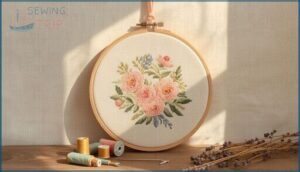
Your embroidery hoop doesn’t have to go back in a drawer when the stitching is done. It can pull double duty as a ready-made frame that shows off your work.
Here are a few ways to finish and display your cross stitch right inside the hoop.
Finishing Techniques in a Hoop
Hoop finishing transforms your cross stitch from a stitched piece into something ready to hang. Start by trimming the excess fabric to about 1–2 inches past the outer ring — just enough to work with, not so much that it bunches.
From there, you have two main paths: fabric gathering or lacing methods. Gathering uses a running stitch pulled tight to cinch the back neatly. Lacing threads back and forth like a shoelace for a flatter finish.
Either way, cap it off with a felt backing using a blanket or whip stitch to keep everything protected and polished.
Decorative Display Ideas
Once your piece is finished and backed, the fun part begins — showing it off. Wall Galleries look stunning when you mix 6-, 8-, and 10-inch hoops at staggered heights, spaced about 2–4 inches apart. It feels curated, not cluttered.
Tabletop Displays work just as well: lean a few hoops on a shelf alongside small plants or candles for easy Shelf Decor. Painted Hoops in matching tones tie different Cross Stitch designs together beautifully.
You can even rotate Themed Arrangements by season — swapping florals for winter motifs keeps your Framing feeling fresh all year without restitching a thing.
Where to Buy Embroidery Hoops for Cross Stitch
Finding the right embroidery hoop doesn’t have to feel like a treasure hunt. Whether you prefer shopping from your couch or browsing the aisles in person, there are solid options out there for every budget and skill level. Here’s where to start looking.
Online Retailers and Craft Stores
Finding the right embroidery hoop for cross stitch is easier than ever. Big box stores like Michaels, Joann, and Hobby Lobby carry basic stitching tools you can grab same day — great for emergencies. But if you want real variety in cross stitch supplies, online is where it’s at. Amazon and AliExpress offer budget hoop sets under ten dollars, while specialty shops like 123Stitch and Herrschners stock niche embroidery hoops alongside fabric and floss.
Here’s where serious stitchers tend to shop:
- Amazon for affordable multi-pack embroidery hoops
- Hobby Lobby for in-store kits and coupons
- 123Stitch for dedicated cross stitch supplies
- Etsy sellers for premium or hard-to-find styles
- Herrschners for one-stop needlework shopping
Choosing Quality Hoops for Your Needs
Not all stitching tools are created equal — and the wrong pick can quietly wreck your project. When choosing an embroidery hoop, match it to how you actually stitch. Hoop material matters: wood suits display finishes, rigid plastic manages humidity better, and flexi hoops work great for re-hooping often. Prioritize frame quality with smooth edges and metal screws for real tension control. Ergonomic design counts too — a 5 to 8 inch hoop fits most hands comfortably for long sessions.
| Feature | Best For | Recommended Type |
|---|---|---|
| Hoop Sizing | Small to mid projects | 6–8 inch hoops |
| Hoop Material | Durability | Rigid plastic or beech wood |
| Ergonomic Design | Long stitching sessions | Lightweight bamboo or plastic |
Frequently Asked Questions (FAQs)
Can embroidery hoops damage delicate or specialty fabrics?
Yes, embroidery hoops can damage delicate fabrics. Silk, velvet, and satin are especially vulnerable to hoop burn, permanent creasing, and crushed nap — so proper tension and fabric protection techniques matter.
How often should you reposition the hoop while stitching?
Move the hoop whenever stitches feel like a stretch to reach. There’s no magic number — just reposition when tension loosens or your working area drifts too far from center.
Do embroidery hoops work with magnetic needle minders?
Magnetic needle minders work great on embroidery hoops. The magnet clamps through your fabric, not the hoop itself, so material type rarely matters. Just place one piece on top, one behind.
Conclusion
Like any craftsperson who learns that the right tool was already in their hands, you now know the answer was never complicated. You can use an embroidery hoop for cross stitch—and use it well.
Tension, size, material, and care all shape the result. Avoid hoop marks, stitch with intention, and finish with pride. The hoop isn’t just a holder; it’s the quiet foundation every clean, even cross stitch is built on.
- https://www.anniesattic.com/using-an-embroidery-hoop/
- https://littlelionstitchery.com/embroidery-hoops/
- https://melocadesigns.com/blogs/news/embroidery-hoops-cross-stitching
- https://www.needlework-tips-and-techniques.com/how-to-use-embroidery-hoops.html
- https://studio-koekoek.com/how-to-frame-a-cross-stitch-project-in-an-embroidery-hoop/