This site is supported by our readers. We may earn a commission, at no cost to you, if you purchase through links.
You’ll find forty-two five-inch squares tucked inside most charm packs, each one pre-cut and ready to stitch. That’s roughly 0.73 yards of coordinated fabric—enough for a baby quilt or several blocks in a larger project. The standard charm pack size has become a quilter’s shortcut, trimming cutting time by more than half while keeping fabric selection simple.
But not all charm packs follow the same rules. Print scales shift between manufacturers, cutting tolerances vary by a sixteenth of an inch, and those small differences add up when you’re planning yardage for a queen-size quilt. Knowing exactly what you’re working with—from usable fabric after seam allowances to how many packs you’ll need—keeps your projects on track and your fabric budget intact.
Table Of Contents
- Key Takeaways
- What is a Charm Pack Size?
- How Many Squares in a Charm Pack?
- Yardage Included in a Charm Pack
- Types of Pre-Cut Fabric Packs
- Quilt Sizes and Charm Pack Requirements
- Calculating 5-Inch Squares for Quilts
- Benefits of Using Charm Packs
- Choosing The Right Charm Pack
- Pre-Washing and Preparing Charm Packs
- Market Trends in Charm Pack Sizes
- Frequently Asked Questions (FAQs)
- Conclusion
Key Takeaways
- Standard charm packs contain 42 five-inch squares (about 0.73 yards total), but manufacturer variations mean you’ll find 40-48 pieces depending on brand—always check the label before planning yardage for larger quilts.
- After accounting for quarter-inch seam allowances, each 5-inch square yields only 4.5 inches of usable fabric, so calculate your quilt size needs by multiplying finished dimensions and adding a 10% buffer for cutting errors.
- Charm packs eliminate 60% of cutting time compared to yardage while delivering pre-coordinated color schemes, making them cost-effective at $0.40-$0.75 per square with 5-10% less fabric waste than buying by the yard.
- Project requirements scale from 1-2 charm packs for baby quilts (38×46 inches) to 9-12 packs for king-size quilts (90×108 inches), with each pack covering approximately 0.73 yards of coordinated fabric across 42 squares.
What is a Charm Pack Size?
A charm pack is a bundle of pre-cut fabric squares that makes quilting faster and easier. Most charm packs follow a standard size, but you’ll find some variation depending on who makes them.
Here’s what you need to know about charm pack dimensions and how they’re measured.
Standard Charm Pack Dimensions
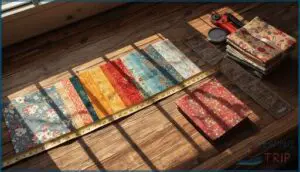
Standard charm packs give you 42 squares measuring 5 inches each—your foundation for quick quilt design. After you account for seam allowances, each square yields roughly 4.5 inches of usable fabric. Cutting tolerances stay within 1/16 inch, though print scale and edge irregularities can mask minor variances.
Fabric thickness ranges between 0.125 and 0.25 millimeters, keeping your fabric precuts manageable and consistent.
When working with charm packs, understanding the importance of systematic reviews can help in evaluating fabric quality and usage.
Variations by Manufacturer
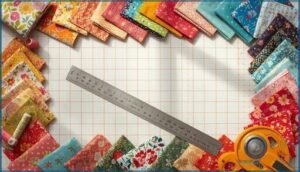
Charm pack sizes vary more than you’d expect across brands. Major manufacturers maintain 100% cotton fabric blends, yet you’ll find 42, 44, or 48 squares per pack within the same product line.
- Print scales differ, affecting visual density when you mix brands
- Cutting standards hold to ±1/16 inch tolerance, though machines vary by facility
- Quality control protocols determine which squares make it into your precut fabrics
These brand variations shape your fabric calculation and final quilt size. Understanding the text analysis process is essential for effective communication in quilting communities.
How Charm Packs Are Measured
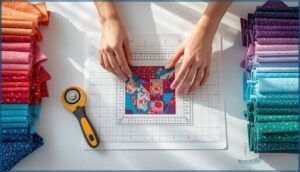
Manufacturers measure charm packs by cutting raw squares, then inspecting dimensions before packaging. You’ll receive fabric precuts sized at exactly 5×5 inches, though seam allowance reduces usable area by roughly 0.5 inches per side after stitching.
Square counting determines total yardage conversion—42 pieces equals about 0.73 yards. This fabric calculation method ensures precut accuracy across production runs, giving you reliable quilt size planning every time.
How Many Squares in a Charm Pack?
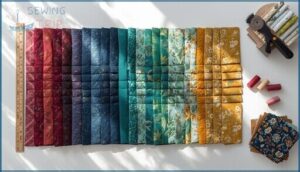
Most charm packs contain 42 squares, though you’ll find some with 45 depending on the manufacturer. This slight variation might seem minor, but it matters when you’re planning a quilt and counting your pieces.
Let’s break down what to expect so you can shop and plan with confidence.
Typical Number of Pieces
Most charm packs hold 42 to 44 fabric squares, though you’ll find some with as few as 36 or up to 48 pieces. This square count variance matters when planning your quilt size—especially for patchwork projects that rely on pack size standards.
To nail your fabric square measurement and quilt piece calculation, check the label before buying. Charm pack uniformity isn’t universal, but 40 squares is a safe baseline for fabric precuts.
Manufacturer Differences
You’ll notice fabric variations between Moda, Riley Blake, and other brands—piece counts range from 40 to 46 squares depending on trimming practices and bolt widths. Some manufacturers add bonus squares to offset trim waste, while colorfastness tests reveal subtle differences in print scale and dye consistency.
Look for certification standards and sourcing transparency on packaging to verify your fabric precuts meet your quilt size and fabric requirements.
Impact on Project Planning
Uncertainty can derail your quilt timeline when charm pack counts shift between brands. Nearly 7 in 10 projects face delays due to inconsistent piece counts, while color variance forces fabric substitutions in 4 out of 10 quilts.
Project delays you’ll encounter:
- Fabric precuts with non-standard counts disrupt quilt size calculation
- Color variance creates last-minute fabric requirements adjustments
- Trimming differences add extra sewing days for sizing uncertainty
- Pattern-specific square needs increase fabric waste and quilt complexity
- Variable piece quality demands backup fabric for seam allowances
Yardage Included in a Charm Pack
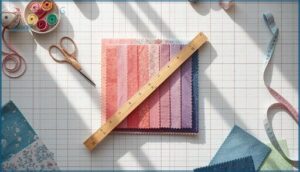
Understanding how much fabric you’re actually getting in a charm pack helps you plan projects without running short. A standard charm pack gives you roughly 3/4 of a yard of fabric, but comparing that to buying yardage off the bolt isn’t always straightforward.
Let’s break down the yardage equivalents, how charm packs stack up against traditional fabric cuts, and how to calculate what you’ll need for your next quilt.
Fabric Yardage Equivalents
You might think a 42-square charm pack equals 3/4 yard, but here’s the reality: it’s closer to 1.3 yards when you account for fabric efficiency. Each 5-inch square covers about 0.61 square yards total.
Use a yardage calculator to determine sewing yields for your quilting project. Fabric conversion depends on width—standard 44/45-inch fabric yields different results than wider bolts, affecting your quilt size estimator needs.
Comparing Charm Packs to Yardage
Think of it this way: buying a charm pack versus yardage is about sewing efficiency, not just numbers. You’ll get better fabric conversion from yardage for large quilts—less waste, more control.
But charm packs deliver instant fabric savings through coordinated prints and zero cutting time. For smaller quilting projects, they’re unbeatable. Larger quilt sizes? Yardage estimates favor buying by the yard.
Calculating Fabric Needs
Start your fabric calculation by measuring the finished quilt size you want. Multiply length by width, then convert to yardage. One charm pack gives you roughly 3/4 yard—so a throw needing 4 yards means 5–6 packs.
Add 10% extra for seam allowance and mistakes. This crafting strategy keeps your material optimization on track and your sewing efficiency high.
Types of Pre-Cut Fabric Packs
Charm packs aren’t the only pre-cut option you’ll find at fabric stores. Other formats offer different sizes and possibilities for your projects.
Here’s what you need to know about the most common pre-cuts and how they compare.
Charm Packs Vs. Mini Charm Packs
Charm packs deliver 42 five-inch squares from a single fabric line, giving you coordinated color harmony for larger quilts and project planning. Mini charm packs scale down to 30 pieces, perfect for color studies or smaller precuts experiments.
Both fabric precuts simplify fabric selection and quilting tips, but your quilt size dictates the choice—standard packs suit expansive layouts, while minis work for accent blocks and pack variations exploration.
Layer Cakes, Jelly Rolls, and Fat Quarters
Layer cakes provide 10-inch squares—usually 42 pieces—ideal for bold patchwork designs and fabric bundles exploration. Fat quarters range from 18×22 to 20×22 inches, giving you flexibility for appliqué and crafting supplies stockpiling.
Jelly rolls offer 2.5-inch strips spanning 40 to 42 cuts, perfect for borders and sewing notions-friendly strip piecing.
Each precut streamlines quilting tools usage and accelerates your project workflow.
Choosing The Right Pre-Cut Size
Now that you know your options, match precut benefits to your quilt planning goals. Consider these key factors for fabric selection:
- Project scale – Baby quilts need fewer charm packs; king sizes require layer cakes or yardage
- Design complexity – Intricate patterns favor smaller fabric precuts
- Sewing efficiency – Jelly rolls speed strip piecing; charm packs suit patchwork
- Budget constraints – Compare cost per square inch across precut types
- Fabric variety – Larger cuts offer more print showcase in craft projects
Choose the quilt size-appropriate format that maximizes your workflow.
Quilt Sizes and Charm Pack Requirements
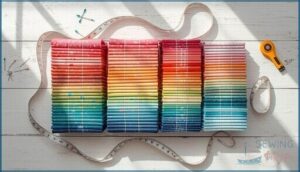
The size of your quilt determines how many charm packs you’ll need to complete the project. Different quilt dimensions require different numbers of 5-inch squares, and understanding these requirements helps you plan and budget accurately.
Let’s break down the charm pack needs for each standard quilt size.
Baby, Crib, and Lap Quilts
For smaller quilt patterns like baby blankets and nursery decor, you’ll need 8–12 charm packs for a baby quilt size (roughly 36 by 45 inches).
Crib designs usually require 12–18 packs to reach approximately 45 by 60 inches.
Lap quilting projects call for 18–24 charm packs, delivering a finished lap quilt around 50 by 65 inches, depending on your block layout and border choices.
Twin, Full, Queen, and King Quilts
When you’re ready to cover a standard bed, your fabric selection tips shift to larger-scale projects. Twin quilt patterns usually need 8 charm packs (around 336 five-inch squares), while full-size quilts call for roughly 8–9 packs. Queen quilt designs require about 12 packs, and king-size bed coverlets demand 14 or more, depending on your quilting techniques and sewing machine choices for piecing:
- Twin: 8 charm packs for 70×90 inches
- Full: 8–9 packs for 85×90 inches
- Queen: 12 packs for 90×108 inches
- King: 14+ packs for 108×108 inches
Sample Quilt Size Calculations
Take a 36×36-inch baby quilt as an example. Divide each dimension by five to get 7.2 blocks per side. Round up to eight, so you’ll need 64 five-inch squares (about 1.5 charm packs).
For a 60×80-inch throw, you’d use 12 by 16 blocks—that’s 192 squares, or roughly 4.5 charm packs, accounting for seam allowance and trimming.
Calculating 5-Inch Squares for Quilts
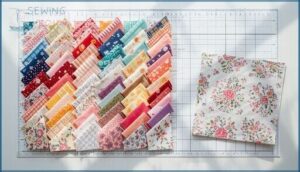
You can calculate exactly how many 5-inch squares you need for any quilt size. The formula is straightforward once you know your finished dimensions and seam allowances.
Here’s how to figure it out for the quilts you’re planning to make.
Formula for Quilt Size Calculation
You can calculate your quilt size by multiplying the finished square dimensions by the number of squares in each direction.
First, subtract your seam allowance—usually ¼ inch on each side—from the 5-inch charm square, leaving 4½ inches. Then use this fabric calculation: multiply 4½ by your total squares across, then by squares down.
This quilting math gives you the final quilt dimensions.
Examples for Common Quilt Sizes
Here’s how fabric calculations work for standard quilt patterns. A baby quilt (30″ x 40″) needs 48 charm pack squares in a 6 by 8 layout. Twin quilts (70″ x 90″) require about 252 squares—roughly six charm packs. Full quilts demand 357 squares arranged 17 by 21.
These quilt size charts help you plan fabric precuts for any quilt design you’re sewing.
Accounting for Seam Allowance
Your charm pack squares shrink from 5 inches to roughly 4.5 inches once you sew standard quarter-inch seam allowances on all sides. That’s why quilting math always accounts for sewing margins—fabric cutting mistakes and fabric shrinkage can throw off your quilt size by several inches.
Plan for a 10% buffer in charm pack squares to cover cutting errors and those inevitable quilting basics adjustments.
Benefits of Using Charm Packs
Charm packs aren’t just a convenience—they’re a breakthrough for quilters who want more time creating and less time measuring. Whether you’re new to quilting or working on your tenth project, these pre-cut bundles solve real problems that yardage can’t.
Here’s why so many quilters won’t start a project without them.
Time and Labor Savings
When you’re juggling life and a quilt, every minute counts. Charm packs slash your cutting time by about 60% compared to yardage, and that’s just the start:
- Your lap quilt assembles 40% faster with precuts versus fat quarters
- Layout planning shrinks by 30% thanks to uniform pieces
- Beginner instruction time drops roughly 25%
- Complete small to medium quilts 2–3 days sooner
That’s efficient quilting that gives you time back.
Color Coordination Made Easy
Pre-coordinated prints take the guesswork out of fabric selection. When 86% of quilters report better color harmony with charm packs, you know you’re on solid ground. You skip hours of second-guessing and jump straight into quilt design.
| Benefit | With Charm Packs | Without Charm Packs |
|---|---|---|
| Palette Planning | 63% finish in first draft | Multiple revisions common |
| Color Schemes | 72% use cohesive wheel | 41% achieve consistency |
| Decision Fatigue | Reduced by 54% | High stress, endless options |
| Themed Projects | 11% pre-defined themes | Start from scratch |
| Overall Harmony | 86% improved results | Hit-or-miss outcomes |
Your quilting flows when color coordination is already handled.
Cost-Effectiveness for Quilters
Coordinated colors also protect your quilting budget. You’ll pay $0.40 to $0.75 per square—far less than buying individual yardage and ending up with costly remnants.
Your fabric savings add up fast:
- Time-to-cut savings: 40–60 minutes per quilt compared to cutting from yard fabric
- Cost per block: Drops 12–18% when using two charm packs versus mixing yardage
- Waste reduction: 5–10% less fabric tossed, stretching your crafting value further
Smart quilters know sewing efficiency starts with the right material costs.
Choosing The Right Charm Pack
Not all charm packs are created equal. The fabric quality, color story, and print scale can make or break your finished quilt.
Here’s what to look for when you’re standing in the fabric aisle trying to choose the right pack for your project.
Assessing Fabric Quality and Print Scale
Quality fabric transforms your quilting project from ordinary to exceptional. Check that your charm pack uses 100% cotton quilting weight—it performs best under your needle. Print repeats should stay within 2 to 12 inches for scale uniformity across squares. Look for colorfastness that survives 15 washes without fading.
Here’s what matters most:
| Quality Factor | What to Check |
|---|---|
| Fabric Durability | 100% cotton, consistent weight |
| Print Repeats | 2–12 inch range, uniform scale |
| Color Consistency | Minimal fade after washing |
Selecting Color Schemes and Themes
Smart color harmony separates forgettable quilts from showstoppers. Pick a theme—florals, geometrics, or seasonal palettes—that tells your story. Most quilters lock in their fabric palette 2 to 4 weeks early, cutting impulse buys and ensuring design principles hold up through every block.
Your color coordination checklist:
- Choose one dominant hue with 2–3 supporting colors for quilt aesthetics
- Balance warm neutrals with cool accents for visual depth
- Select small-to-medium print scales under 6 inches for better block compatibility
- Use a central motif in at least a quarter of your charm pack fabrics
- Test color theory with swatches before committing to full yardage
Matching Charm Packs to Projects
Once you’ve nailed your color scheme, pair charm packs with project planning that actually works. A 42-square pack covers baby quilts in sampler layouts—roughly 1.5 to 2 square feet of patchwork surface. For lap quilts, you’ll need 3 to 4 packs, depending on block designs and sashing choices. Match print scale to finished size: larger motifs shine in fewer repeats, while smaller patterns let color matching flow naturally across quilting layouts.
Smart fabric selection cuts waste by 15% when you plan borders and sashing around your charm pack pieces—no guesswork, just efficient quilt patterns that work.
| Project Type | Charm Packs Needed | Finished Size (approx.) |
|---|---|---|
| Baby Quilt | 1–2 | 38 × 46 inches |
| Lap Quilt | 3–4 | 60 × 72 inches |
| Twin Quilt | 5–6 | 68 × 86 inches |
| Queen Quilt | 7–9 | 84 × 92 inches |
| King Quilt | 9–12 | 90 × 108 inches |
Pre-Washing and Preparing Charm Packs
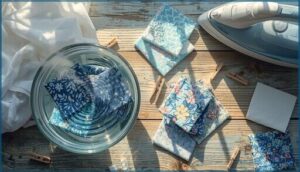
You’ve picked your charm pack, and now you’re wondering whether to toss those pretty squares in the wash before you start sewing. Pre-washing is one of those topics that splits quilters right down the middle—some swear by it, others skip it entirely.
Let’s break down what you need to know about preparing your charm packs so you can decide what works best for your project.
Pros and Cons of Pre-Washing
Pre-washing your charm pack removes chemical residues and excess dye, preventing dye migration and maintaining color stability across your quilt. However, fabric shrinkage of 3-5% can alter those precise 5-inch squares, and fraying edges may reduce usable fabric.
You’ll gain peace of mind about colorfastness, but lose the crispness that makes pre-cuts easy to handle. Weigh your priorities before deciding.
Preventing Shrinkage and Color Bleed
Mastering fabric care tips protects your charm pack investment from shrinkage control failures and color bleed disasters. Lock in color fastness with these laundry precautions:
- Test each fabric square for dye fixation by dampening a corner with cold water
- Wash darks separately to prevent color coordination mishaps in quilt making
- Use color catchers to trap loose dyes during the first wash
- Skip fabric softener—it interferes with fabric selection quality
- Air dry to minimize shrinkage in your quilting projects
Tips for Handling Pre-Cuts
Gentle handling protects your pre-cut investment before you start quilting. Store charm packs flat in fabric storage bins away from sunlight. Keep cutting tools sharp for trimming stray threads.
| Quilting Tips | Tool | Purpose |
|---|---|---|
| Stack squares | Rotary mat | Trim edges |
| Pin pairs | Wonder clips | Hold fabric |
| Press gently | Low iron | Avoid distortion |
Use these sewing notions and crafting hacks. Your patchwork deserves this care.
Market Trends in Charm Pack Sizes

Charm packs aren’t just sitting on shelves—they’re flying off them. The quilting world has embraced these pre-cuts in ways that are reshaping how manufacturers design, produce, and market fabric collections.
Let’s look at what’s driving demand, where innovation is heading, and when quilters are stocking up.
Popularity Growth Among Quilters
Charm packs have become the go-to choice for quilters looking to simplify fabric selection. In the past year, 72% of quilters used charm packs in at least one project, and sales jumped 18% year-over-year in 2024.
Market analysis shows charm packs now account for 26% of pre-cut fabric sales, driven by strong consumer behavior favoring convenience and color coordination in the quilting community.
Innovations in Pre-Cut Fabrics
Fabric manufacturers now prioritize sustainable fabrics and eco-friendly materials in charm packs, cutting water usage and sourcing responsibly. Digital printing technology delivers sharper motifs across themed collections, while colorfastness testing ensures your fabric precuts won’t bleed after washing.
You’ll find improved color-friendliness ratings that simplify fabric selection for any quilt size. These innovations make charm packs more reliable and beginner-friendly than ever.
Seasonal Demand Patterns
You’ll notice demand peaks shift with the calendar—autumn brings a 12% year-over-year jump in quilting supplies as crafters prep for holiday sales. November and December see 28% higher turnover in themed charm pack collections.
Spring quilt festivals drive another 5–8% uplift across North America and Europe. Floral fabric prints turn faster in spring, while consumer behavior leans toward cozy autumnal charm packs before gifting season hits.
Frequently Asked Questions (FAQs)
Can charm packs be used for clothing projects?
Why limit yourself to quilts? You can absolutely use charm packs for clothing designs—think patchwork pockets, appliqué details, or fabric selection for accessory making.
Just remember: garment patterns need more yardage than small sewing projects allow.
How do you store charm packs long-term?
Store your charm packs in airtight containers inside a cool, dark closet. Keep humidity around 50% with silica sachets. Label each bundle clearly.
Rotate fabric every six months to prevent fading and maintain longevity.
Are charm packs available in organic cotton fabrics?
Yes, you’ll find organic cotton charm packs from several fabric brands. Look for GOTS certification labels to verify authentic organic status.
These eco-friendly sustainable fabrics support green quilting with natural textiles while maintaining standard 5-inch sizing.
Do charm packs work for English paper piecing?
Charm packs work beautifully for EPP techniques and hexagon patterns. The 5-inch squares give you pre-coordinated fabric selection for paper piecing tips, though you’ll trim slightly when cutting your patchwork shapes for English paper piecing projects.
Conclusion
You’d think five-inch squares would complicate quilting, but charm pack size actually simplifies it. No more wrestling with rotary cutters or second-guessing yardage. You get coordinated fabric, consistent cuts, and time back at your sewing machine.
Whether you’re stitching a baby quilt or planning blocks for a queen, those forty-two squares give you a reliable starting point. Master the math once, and you’ll stop guessing—your projects will come together faster, cleaner, and exactly as planned.