This site is supported by our readers. We may earn a commission, at no cost to you, if you purchase through links.
Your machine offers 50+ stitch options, but you keep using the same three. That’s like owning a toolbox and only reaching for a hammer—it works until you strip a screw. Choosing machine stitch options isn’t about memorizing every decorative pattern; it’s about matching the right stitch to your fabric’s personality.
Silk chiffon needs a gentle touch, while denim demands muscle. Miss that match and you’ll fight puckered seams, snapped threads, and that maddening skip-stitch dance.
The difference between frustration and flow comes down to understanding what each stitch actually does—and when your project’s begging for it. Once you crack the code behind stitch length, width, and tension, your machine transforms from temperamental beast to reliable partner.
Table Of Contents
- Key Takeaways
- Key Factors in Choosing Machine Stitches
- Understanding Common Machine Stitch Types
- Matching Stitches to Fabric and Project
- Adjusting Machine Settings for Stitch Quality
- Troubleshooting Common Stitch Selection Issues
- Tips for Confident Stitch Selection
- Frequently Asked Questions (FAQs)
- Conclusion
Key Takeaways
- Match stitch length to fabric weight—lightweight fabrics need 2.0–2.5 mm, medium weights work at 2.5–3.0 mm, and heavy materials require 3.0–4.0 mm to prevent puckering or perforation.
- Straight stitches snap on stretch fabrics, so use zigzag or dedicated stretch stitches with ballpoint needles to maintain fabric elasticity and prevent thread breakage.
- Thread tension controls stitch quality more than any other setting—raise it one notch when bottom loops appear, lower it when top thread shows through, and always test adjustments on scraps first.
- Your sewing machine manual’s stitch reference charts eliminate guesswork by translating fabric type into specific needle sizes, tension ranges, and stitch configurations for repeatable professional results.
Key Factors in Choosing Machine Stitches
Your stitch selection isn’t random—it’s built on a few solid factors that determine whether your seam holds or falls apart. Get these basics right, and you’ll save yourself from frustrating do-overs and wonky results.
Start with choosing the right thread for your material—it’s the foundation that determines how well your stitches perform over time.
Master a few solid factors in stitch selection, and you’ll avoid frustrating do-overs and wonky seams
Here’s what you need to keep in mind before you touch that dial.
Getting familiar with the basics of operating an industrial sewing machine will save you time and prevent costly mistakes right from the start.
Fabric Type and Weight
Fabric weight sets the baseline for every stitch you choose. Delicate silks demand finesse; canvas needs strength. Here’s why fabric density, fiber types, and weave patterns matter for thread interaction:
Matching your basic serger sewing machine stitches to the fabric type prevents puckering on lightweight materials and ensures secure seams on heavier ones.
- Lightweight fabrics (voile, challis) need short stitches around 2.0–2.5 mm
- Medium weights (cotton, linen) work best at 2.5–3.0 mm
- Heavyweights (denim, canvas) require 3.0–4.0 mm lengths
- Knits need stretch-capable stitches with ballpoint needles
Master fabric handling—your fabric type dictates everything. For sewing heavy fabrics, consider using a heavy duty motor to handle thick materials.
Project Purpose and Functionality
Your sewing objectives shape every stitch decision. Garment functionality drives the whole process—everyday wear demands durable straight stitches, while home decor lets you showcase decorative patterns.
User needs matter. Will you stress those seams? Project outcomes depend on matching fabric end use to machine settings, stitch length, and thread tension.
Formal pieces need invisible hems; workwear requires reinforced seams for maximum seam strength. Understanding the various stitch selection options is essential for achieving the desired results.
Seam Strength and Durability
Your seams take a beating—choosing strong stitches prevents fabric resistance failures. Seam strength depends on stitch length, thread tension, and stitch optimization. Shorter stitch lengths distribute stress better, boosting durability factors markedly.
Polyester threads outperform cotton in seam testing, resisting thread breakage under load. Match your fabric type to the right stitch—lockstitches excel for wovens, while stretch stitch configurations handle knits without compromising seam integrity.
Stretch and Flexibility Requirements
Your fabric’s ability to move—or not—dictates whether you need a stitch that stretches or one that locks everything in place. Knit fabric demands flexible seams with elastic recovery.
Straight stitches snap when stretched—choose a stretch stitch or zigzag stitch instead. Adjust thread tension and stitch length to preserve fabric elasticity.
Test stretch fabrics before committing; your seams should move with the material, not fight it.
Understanding Common Machine Stitch Types
Your machine offers way more than just a basic stitch. Each option solves specific challenges—from holding heavy seams together to finishing stretchy hems without a fight.
If you’re not sure which stitch does what, this guide to sewing machine stitch types and their functions breaks down exactly when to use each one.
Let’s break down the workhorses you’ll actually use and when they earn their spot in your rotation.
Straight Stitch Uses
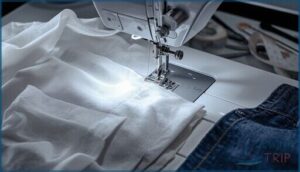
Think of the straight stitch as the workhorse of your sewing machine—it’s the foundation stitch you’ll reach for in nearly every project. You’ll use it for garment assembly, seam finishing, and topstitching. Fabric construction demands different stitch lengths—adjust your machine settings based on fabric type. Lighter fabrics need shorter lengths; heavier materials require longer ones.
For example, when you’re ready to hem jeans without losing the original hem, you’ll rely on a longer stitch length to handle multiple denim layers smoothly.
Master the straight stitch for:
- Crisp, professional seams that hold garments together with unwavering strength
- Precise topstitching that transforms ordinary projects into polished masterpieces
- Interfacing methods that add structure exactly where you need it
- Perfect stitch tension that prevents puckering and thread breakage
Zigzag and Stretch Stitches
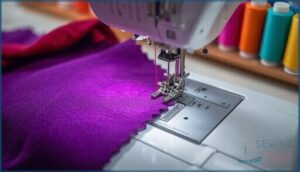
Edge finishing meets elasticity with these powerhouse stitches. Zigzag settings control fabric elasticity—adjust stitch width from 0 to 7mm for seam reinforcement. Stretch fabrics demand dedicated stretch stitch patterns that move backward and forward, creating density that prevents thread breakage.
Your machine settings matter: narrow zigzag works fast, while lightning-style stretch stitch mimics professional ready-to-wear. Test both on scraps—stitch length and thread tension determine your final seam quality.
Decorative and Specialty Stitches
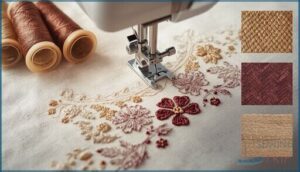
Personality transforms plain fabric into artistry. Modern machines offer 20 to 300+ decorative stitches—open patterns for delicate heirloom sewing and dense satin stitch for bold embroidery techniques. Use a wing needle on woven fabric for lacy effects that mimic decorative edging from another era.
Your stitch selection guide starts here: match thread tension and sewing machine settings to pattern density, then test on scraps before committing.
Blind Hem and Overlock Stitches
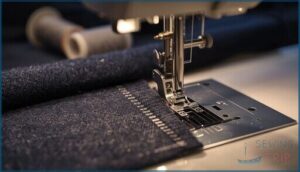
Invisible hems need finesse. A blind hem stitch combines straight stitches with a single zigzag bite that catches just a few threads—your dress pants get a clean finish while the fabric edge stays secure.
Overcast stitches wrap around raw edges with two to five threads, preventing fraying on knits.
Match thread selection to fabric type, then adjust stitch tension for perfect seam security every time.
Matching Stitches to Fabric and Project
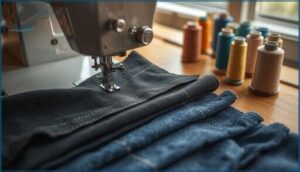
Your fabric isn’t just material—it’s the blueprint for every stitch decision you make. Heavy canvas laughs at delicate settings, while silk demands a feather-light touch.
Let’s match your machine’s capabilities to what’s actually sitting under that presser foot.
Selecting Stitches for Delicate Fabrics
Delicate fabrics demand finesse. For silk and chiffon, set your straight stitch to 1.5–2 mm and lower that thread tension. A Microtex 60/8 needle paired with fine thread prevents visible holes.
Try French seams or narrow rolled hems for sheer fabric handling—they enclose raw edges beautifully. Test zigzag stitch width (2–3 mm) on scraps first. Lightweight techniques protect your delicate stitching every time.
Choosing Stitches for Heavy Materials
Heavy fabric sewing takes muscle. Denim, canvas, upholstery—these materials need longer straight stitch lengths (3–4 mm) to prevent perforation and bunching. Here’s your power lineup:
- Needle selection: Use 100/16 to 110/18 for fabric density penetration
- Thread strength: Choose polyester or bonded nylon for seam strength
- Stitch reinforcement: Apply bar tacks at stress points
- Test scraps: Verify stitch length and tension before committing
- Flat fell seams: Combine fabric type handling with visible topstitching durability
Your machine won’t complain—your seams will thrive.
Stitch Options for Stretch and Knit Fabrics
Stretch fabrics demand flexibility. Your straight stitch won’t cut it—threads snap when fabric elasticity kicks in.
Use a narrow zigzag stitch (1–2 mm width) or built-in stretch stitch for knit fabric stitches that move with the material. Twin-needle stitching creates professional hems on knitwear construction projects. Adjust stitch length to 2.5–3 mm and ease thread tension slightly.
Test your stretch seam techniques on scraps—sewing knits successfully means your seams bend without breaking.
Decorative Stitches for Creative Projects
Beyond function lies fabric embellishment—decorative stitches turn basic projects into textile art. Your sewing machine settings release creative sewing potential with built-in stitch patterns ranging from subtle to ornate.
Master decorative techniques with these steps:
- Test thread and fabric compatibility on scraps first
- Use stabilizer backing to prevent puckering
- Adjust stitch density for pattern clarity
- Maintain consistent speed for clean execution
Balance complexity with fabric stability—ornate stitches demand respect.
Adjusting Machine Settings for Stitch Quality
You’ve picked the perfect stitch for your fabric and project—now it’s time to dial in your machine settings. Getting stitch length, width, and tension right transforms your seams from mediocre to professional.
Let’s break down the three critical adjustments that’ll give you impeccable stitch quality every time.
Setting Stitch Length and Width
Precision in machine settings separates amateur seams from professional results.
Stitch length usually ranges from 0.0 to 5.0 mm—set yours at 2.0–3.0 mm for woven fabrics. Fabric density demands adjustment: delicate materials need shorter lengths (1.5–2.5 mm) to prevent puckering, while heavier weights handle 3.5–4.0 mm comfortably.
Your stitch width controls lateral spread, affecting seam allowance flexibility and stitch visibility dramatically.
Thread Tension Adjustments
But stitch length alone won’t save a seam—tension balance controls everything. Thread flow through your machine affects fabric interaction and stitch formation quality.
Dial your top thread tension up one notch if you see bottom loops; drop it down when top thread peeks through. Small tension adjustment tweaks beat wild swings every time.
Test on scraps first—your fabric will thank you.
Needle and Thread Compatibility
Your needle selection and thread management make or break stitch formation. Mismatch them, and you’ll chase skipped stitches all day.
Here’s what compatibility charts won’t tell you:
- Thread weight dictates needle size—heavy topstitching thread demands larger eyes than standard weight
- Fabric fiber determines needle type—ballpoint for knits, sharp for wovens
- Undersized needles with thick thread create puckering nightmares
Check manufacturer compatibility charts before threading up.
Troubleshooting Common Stitch Selection Issues
Even with the right stitch selected, things can still go wrong. Your machine might skip stitches, create puckered seams, or break thread at the worst possible moment.
Let’s troubleshoot the most common stitch problems so you can fix them fast and get back to sewing with confidence.
Identifying Skipped or Uneven Stitches
When your seams show gaps or vary in length, you’re facing skipped or uneven stitches. Stitch inspection reveals the culprit—often a needle not catching the bobbin thread.
Check your thread routing through every guide, verify needle alignment, and inspect for burrs on the needle plate. Match needle size to fabric type and adjust thread tension for consistent results. Your sewing machine settings matter here.
Fixing Puckering and Thread Breakage
Frustration builds when your fabric bunches or threads snap mid-seam. Puckering Prevention starts with Needle Selection—grab a higher size and match it to your fabric type.
Lower your thread tension slightly to ease seam stress. Check Thread Compatibility between bobbin and spool weights.
Balance your Fabric Feed with even presser foot pressure, whether you’re running a stretch stitch or zigzag stitch. Your machine settings control everything.
When to Change Stitch Settings
Your machine talks through defects—loops underneath scream loose Thread Tension, while puckering whispers too tight. Thread Breakage signals you’ve crossed into the red zone. Skipped stitches? Reset your Machine Calibration.
Change Sewing Machine Settings when switching Fabric Thickness, from cotton to denim. Fabric Type dictates everything, so adjust stitch length and tension before you commit.
Your Stitch Selection Guide starts with reading what’s already gone wrong.
Maintenance Tips for Consistent Results
Machine Cleaning starts in the bobbin area—lint buildup kills stitch accuracy fast. Use a soft brush on feed dogs and needle plate after every project.
Needle Care means replacing bent or dull needles immediately. Change them based on fabric type and how often you sew.
Tension Adjustment issues? Schedule professional Servicing when problems persist despite your best troubleshooting efforts.
Tips for Confident Stitch Selection
You’ve learned the stitches, adjusted your settings, and fixed the problems. Now it’s time to build real confidence in your choices.
These three strategies will help you work faster, adapt on the fly, and never second-guess your stitch selection again.
Using Machine Guides and Charts
Your sewing machine settings manual isn’t just decoration—it’s your roadmap to perfect stitches. Stitch reference charts decode fabric weight into preset choices, translating project goals into stitch length, width, and tension adjustment ranges.
Guide usage means comparing visual diagrams for chart interpretation and setting optimization. Machine calibration becomes simple when you match needle size and presser foot recommendations to your material. These tools prevent guesswork entirely.
Adapting Stitches for Project Needs
Once you’ve mastered those charts, real-world adaptation begins. Fabric analysis drives every tweak you’ll make—fiber content dictates needle calibration and thread selection immediately.
Heavy canvas demands reinforced straight stitch seams with wider zigzag stitch edges, while delicate silks need shortened lengths. Your sewing machine settings become surgical tools through tension control and stitch optimization:
- Document fiber content before starting any project
- Match ballpoint needles to knits for elasticity retention
- Shorten stitch length on lightweight fabrics to prevent puckering
- Increase thread strength and stitch width for heavy materials
- Test tension adjustments on scraps before committing to garments
Recording Preferred Settings for Future Use
After you’ve dialed in those perfect adjustments, your preference tracking system becomes invaluable. Create fabric profiles in a dedicated log organization—record stitch selection, tension settings, and thread specs for each material.
Build setting templates with needle sizes and stitch archives noting what worked. This maintenance and troubleshooting reference transforms sewing machine operation from guesswork into repeatable mastery, saving hours on future projects.
Frequently Asked Questions (FAQs)
How do you choose stitches for combining different fabrics?
Your fabric combination acts like a puzzle—each piece needs the right connection. Match stitch types to weight differences, test stretch versus woven joins, and always run samples before committing to final seams.
What stitches work best for curved seams?
Narrow zigzag stitches handle gentle curves best—they minimize fabric distortion while allowing movement. For knits, use stretch stitches or three-step zigzag.
Test stitch tension on scraps first to prevent puckering along curved seams.
Can you use decorative stitches on sheer fabrics?
You’d think delicate equals off-limits, but decorative stitches absolutely work on sheer fabrics.
Use lightweight stabilizers, reduce tension control, select fine needles (60/8 or 70/10), and test sheer embellishments before committing your final piece.
Which stitches are best for topstitching details?
You want straight stitch with longer lengths (0–0 mm) for bold visibility. Twin-needle or double rows add that pro edge reinforcement. Use contrast decorative threads to make topstitch techniques really pop.
How do you select stitches for quilting projects?
Start with straight stitch for piecing—it delivers superior seam strength.
For raw-edge appliqué or edge finishing, zigzag stitches work beautifully.
Match thread selection and machine calibration to your fabric analysis for impeccable results.
Conclusion
The next time you thread your machine, you’ll see those 50+ stitches differently—not as overwhelming options, but as tools waiting for the right job. Choosing machine stitch options becomes instinct once you’ve matched a few fabrics to their perfect partners.
Your settings will shift from guesswork to muscle memory. That temperamental beast? It’s already transforming into the reliable workhorse you needed all along. Just keep the owner’s manual close until it clicks.
- https://www.schmetzneedles.com/needle-know-how/
- https://www.singer.com/blog/sewing-tips-and-techniques/understanding-thread-tension
- https://winslets.com/blogs/sewing-basics/machine-preparation-for-knits-vs-wovens
- https://support.brother.com/g/b/faqend.aspx?c=au&lang=en&prod=hf_fs80xeas&faqid=faqh00000004_006
- https://www.twigandtale.com/blogs/twig-and-tale-blog/tips-for-sewing-with-lightweight-slippery-fabric