This site is supported by our readers. We may earn a commission, at no cost to you, if you purchase through links.
You won’t master garment construction, tackle intricate quilting projects, or launch your custom embroidery business with a machine that buckles under pressure. When you compare Bernina and Janome sewing machines, you’re weighing two manufacturing giants that approach precision from entirely different angles—Swiss engineering that prioritizes metal construction and microprocessor-controlled stitch regulation versus Japanese innovation built on accessible servo technology and testing protocols that simulate years of real-world use.
Bernina commands premium prices with aluminum-alloy frames and twenty-year mechanical warranties, while Janome delivers reliable performance at entry points that won’t drain your budget. Yet both brands have cultivated fierce loyalty among sewists who refuse to compromise on stitch consistency.
Your choice hinges on whether you value the investment-grade durability of a machine engineered to outlast decades of heavy production work or the advanced features and straightforward operation that let you focus on creativity rather than troubleshooting tension dials.
Table Of Contents
Key Takeaways
- Bernina positions itself as a premium investment with Swiss-engineered aluminum-alloy frames, 20-year mechanical warranties, and precision stitch regulation systems designed for professional-grade durability, while Janome offers accessible entry prices with Japanese innovation focused on user-friendly computerized controls and reliable performance at lower cost thresholds.
- Both brands deliver consistent stitch quality through different engineering approaches—Bernina’s proprietary Stitch Regulator and metal construction prioritize micro-level precision for demanding projects, whereas Janome’s AcuFeed System and intuitive threading mechanisms emphasize straightforward operation and fabric compatibility across quilting and embroidery applications.
- Your choice fundamentally depends on whether you prioritize long-term resale value and build materials engineered to withstand decades of heavy production use (Bernina’s die-cast aluminum frames and CNC-machined components) or feature-rich accessibility that lets you master techniques without extensive technical knowledge (Janome’s computerized systems with programmable stitch patterns).
- Service infrastructure matters significantly after purchase—Bernina maintains authorized dealer networks with factory-trained technicians and superior warranty coverage, while Janome’s larger global user base translates to broader aftermarket accessory compatibility and more readily available third-party parts through open ecosystem design.
Brand Backgrounds and Reputations
When you’re choosing between Bernina and Janome, you’re not just picking a machine—you’re aligning yourself with a manufacturing philosophy that’s been refined over decades. Bernina brings Swiss precision and a legacy that dates back to 1893, while Janome delivers Japanese innovation with roots in 1921.
Choosing between Bernina and Janome means aligning with either Swiss precision since 1893 or Japanese innovation since 1921
Understanding where these brands come from, what they stand for, and how the sewing community views them will help you make a choice that matches your goals and expectations.
Bernina’s Swiss Precision and Legacy
Swiss Engineering meets heritage craftsmanship when you explore Bernina’s lineage. Born in Switzerland in 1893, Bernina built its reputation on precision stitching and metal frames that outlast the competition. This legacy fuels your creative power through:
- Heavy-duty metal construction for unshakeable stability
- In-house precision engineering that delivers consistent stitch quality
- Sophisticated features backed by extensive warranties and dealer support
These legacy machines give you professional-grade control. The company’s commitment to quality is reminiscent of scientific study audits that verify methodological rigor.
Janome’s Japanese Innovation and Reliability
While Bernina commands respect through European tradition, Janome seizes your creative freedom with Japanese engineering that’s been refining precision manufacturing since 1921. You get cutting-edge designs built on Tokyo-born reliability tests and quality control that verifies feed mechanisms, stitch plates, and bobbin timing before machines leave the factory—sophisticated features meeting sewing machine quality standards you can trust.
| Janome Strength | Your Advantage | Technical Edge |
|---|---|---|
| Precision engineering standards | Consistent stitch accuracy across fabrics | Metal frames reduce vibration |
| Intuitive threading systems | Faster setup, fewer operator errors | Smooth feed mechanisms prevent skipped stitches |
| Japanese innovation legacy | Dependable long-term performance | Warranties cover mechanical components for years |
Industry Recognition and Brand Loyalty
That innovation heritage translates into measurable market reputation and user engagement for both brands. Industry recognition speaks volumes—Bernina earns Swiss engineering awards and premium-segment accolades from sewing magazines, while Janome captures Japanese textile association honors for interface design and reliability. Your brand loyalty shows up in five concrete ways:
- Higher satisfaction scores among quilters choosing Bernina for stitch control precision
- Lower five-year maintenance costs reported by Janome users in brand comparison forums
- Strong dealer loyalty programs driving repeat purchases and service visits
- Active online communities sharing customer testimonials and troubleshooting tips
- Stable positive sentiment across social media, with Bernina positioned as luxury and Janome as accessible value
Awards analysis confirms both deliver—just for different sewers.
Machine Types and Key Features
When you’re choosing between Bernina and Janome, understanding what each brand brings to the table starts with the machines themselves and what they can actually do for your projects. Both manufacturers offer mechanical and computerized options, along with specialized features for embroidery, quilting, and precision work that set them apart in different ways.
Let’s break down how these two brands stack up across machine types, capabilities, and the exclusive technologies that give each one its edge.
Mechanical Vs. Computerized Models
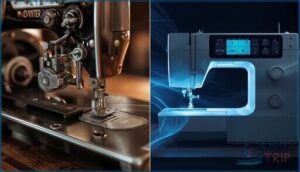
You’ll face two distinct sewing machine types when comparing Bernina and Janome: mechanical sewing relies on belt-driven mechanisms with manual needle positioning and preset stitches, while computerized sewing delivers digital stitching through servo control and automatic tensioning.
Mechanical advantages include simpler calibration and tactile feedback, whereas computerized controls offer programmable stitch patterns, memory functions, and width adjustments that transform your creative possibilities.
Embroidery and Quilting Capabilities
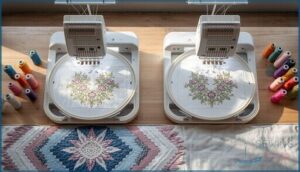
Embroidery machines from both manufacturers deliver impressive creative range, with Bernina offering embroidery fields up to 400 × 210 mm and Janome extending to 400 × 230 mm depending on your model selection.
Quilting features include spacious throat space for free motion work, stitch regulator systems on premium lines, and adjustable thread tension controls that maintain consistency across layered fabrics and machine embroidery projects.
Exclusive Technologies and Accessories
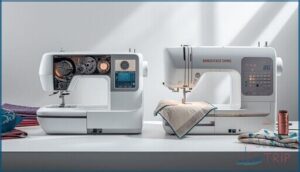
Proprietary engineering sets these two brands apart, with Bernina delivering the Stitch Regulator for consistent free-motion quilting and Janome countering with its AcuFeed System to prevent puckering across multiple fabric layers.
- Bernina’s BSR maintains uniform stitch length regardless of your quilting speed
- Janome’s Automatic Winder and thread tension controls simplify setup on computerized models
- Firmware Updates let you expand Bernina’s stitch libraries via USB memory
- Networked Accessories such as embroidery modules extend capabilities on both platforms
- Precision Engineering ensures sophisticated features integrate seamlessly with your existing workflow
Performance, Quality, and Durability
When you’re investing in a sewing machine, you want performance that delivers every single time you sit down to work. The real test of quality shows up in stitch consistency, the materials used in construction, and how long the machine holds up under regular use.
Let’s break down how Bernina and Janome stack up in three critical areas that separate workhorses from machines that disappoint.
Stitch Quality and Consistency
When you’re hunting for precision, stitch formation separates the serious machines from the toys. Bernina’s feed dog system delivers consistent thread tension and exceptional embroidery accuracy across fine fabrics, while Janome sewing machines shine with reliable quilting precision and straightforward tension control.
Both brands maintain fabric compatibility through mechanical models and computerized lines, though Bernina’s Stitch Regulator gives you edge-to-edge control when you need sewing machine features that won’t quit.
Build Materials and Longevity
Metal frames define your machine’s staying power—Bernina relies on aluminum alloys for rigidity, while Janome deploys steel components in its mid-range models. Both brands engineer wear resistance through die-cast arms and CNC-machined parts, with longevity tests showing owners routinely report 15–20 years of reliable operation.
Frame construction matters because material durability determines whether your sewing machine becomes a workhorse or a paperweight.
Maintenance Requirements and Warranties
You’ll see different philosophies in maintenance schedules—Bernina recommends professional servicing every 1,000 hours or annually, while Janome suggests 1–2 year intervals for domestic models.
Warranty claims require proof of purchase and authorized service documentation, with Bernina offering a 20-year warranty on mechanical parts and Janome providing a 25-year warranty on select high-end machines, ensuring spare parts and repair costs remain predictable through established service networks.
Pricing, Value, and Target Users
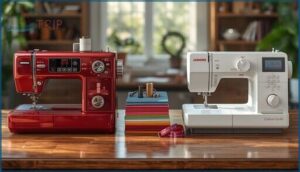
Your budget shapes which machine you can bring home, but value isn’t just about the price tag—it’s about matching the right tool to your skill level and ambitions.
Janome delivers accessible entry points that won’t drain your wallet, while Bernina markets itself as a long-term investment for sewists who demand precision without compromise.
Let’s break down how these brands stack up across price ranges, who they’re really built for, and what you’re getting for your money.
Budget Options Vs. Premium Models
Both brands offer sewing machines at multiple price points, giving you control over your investment. Janome’s budget models under $1,000 deliver solid features without breaking the bank, while Bernina’s entry-level machines in the same range showcase Swiss engineering.
Mid-range options from $1,000–2,500 bring notable upgrades, and premium models above $2,500 represent top-tier performance in this sewing machine comparison.
Value for Beginners and Professionals
Your skill level shapes which brand wins this matchup. Beginners often praise Janome’s easy-to-use mechanical models, with straightforward threading and controls that build confidence fast. Professionals lean toward Bernina when precision matters, accessing sophisticated stitch regulation and dual feed systems that handle demanding projects.
Budget options from Janome let you master fundamentals before upgrading, while Bernina delivers features that grow with your expertise from day one.
Long-Term Investment Considerations
Resale value tells you what happens after the honeymoon ends. Bernina machines hold their worth thanks to Swiss build quality and durability, while Janome units retain decent prices through solid dealer networks.
Total cost includes maintenance schedules and warranty terms—Bernina offers 20 years on mechanical parts.
Business users can leverage depreciation rates and tax incentives, turning your sewing machine buying guide into smart financial planning.
User Experience and Support
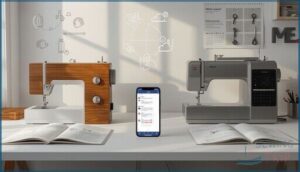
Buying the right machine is only half the battle—you need to know it won’t leave you stranded when questions arise or problems surface. The difference between brands often shows up after the purchase, when you’re learning the ropes or troubleshooting an issue at midnight before a deadline.
Let’s compare how Bernina and Janome support you through the ownership experience, from your first stitch to years down the road.
Ease of Use and Learning Curve
You’ll find that learning curve differences between these brands stem largely from user interface design and operation modes. Janome machines typically feature straightforward, easy-to-use controls that make sewing simplicity a priority for beginners, while Bernina’s sophisticated computerized systems demand more initial study despite offering extensive tutorial guides and learning resources.
Your sewing machine selection should align with your technical comfort level, as both brands deliver excellent user experience and support through distinct approaches to accessible design.
Customer Service and Dealer Networks
Beyond mastering controls, you need reliable warranty support and repair options when issues arise. Both brands maintain authorized dealer networks with factory-trained technicians, though Bernina’s 20-year mechanical warranty outpaces standard coverage.
Customer feedback in sewing machine reviews and sewing community forums highlights three service quality factors:
- Regional distributor presence ensures faster parts availability
- Dealer-installed accessories reduce compatibility concerns
- Telephone and email hotlines provide troubleshooting guidance
Your local dealer network strength directly impacts long-term user experience and support.
Frequently Asked Questions (FAQs)
Which brand offers better thread tension control?
Ironically, the tension you’ll worry about most won’t be yours—it’s the thread’s. Bernina’s servo-driven systems deliver micro-adjustments and rock-solid consistency, while Janome’s computerized controls adapt reliably across standard tasks.
Do Bernina machines have quieter operation overall?
Bernina’s precision engineering and quill-mounted motor design deliver excellent noise reduction and vibration control, creating softer sound profiles than many Janome models.
Especially older mechanical variants, though newer computerized Janome machines markedly improve operational silence.
Which brand has more compatible aftermarket accessories?
Think of accessories as your creative arsenal—you’ll find Janome opens more doors.
Thanks to its larger global user base and open accessory ecosystem, Janome offers broader aftermarket support, third-party options, and interchangeable parts than Bernina’s proprietary system.
Are replacement parts easier to find locally?
You’ll find that both Bernina and Janome maintain extensive regional dealer networks across major urban markets, ensuring local parts availability.
Lead times range from same-day pickup to several business days for specialty components and sewing accessories and supplies.
Conclusion
Your machine will either become the workhorse that powers a thousand projects or the dusty regret gathering cobwebs in your craft room.
When you compare Bernina and Janome sewing machines, you’re choosing between Swiss endurance engineered for professional studios and Japanese versatility designed for accessible innovation.
Match your ambitions to metal construction and lifetime support, or prioritize feature-rich operation that won’t require a second mortgage. Your fabric awaits the right partner.