This site is supported by our readers. We may earn a commission, at no cost to you, if you purchase through links.
That "easy" label on a sewing pattern envelope can lie. Pick up what looks like a simple blouse, and you might find yourself staring down 18 pattern pieces, bias-cut panels, and a collar that needs interfacing before you’ve even threaded your machine.
The difference between beginner and intermediate sewing patterns runs deeper than a skill badge—it shapes every decision from fabric selection to final pressing.
Piece count, seam complexity, garment structure, and how much the instructions hold your hand all stack up to either build your confidence or quietly drain it. Knowing what to look for before you cut saves fabric, time, and a fair amount of frustration.
Table Of Contents
- Key Takeaways
- Beginner Vs Advanced Sewing Patterns
- Pattern Pieces and Construction Steps
- Fit, Shape, and Garment Structure
- Techniques Required at Each Level
- Fabric Choices and Handling Difficulty
- Instructions, Markings, and Pattern Support
- Choosing The Right Pattern Level
- Frequently Asked Questions (FAQs)
- Conclusion
Key Takeaways
- Pattern piece count is your fastest difficulty signal — beginner patterns use 4–10 pieces with simple seams, while advanced ones multiply quickly with facings, linings, and assembly steps that depend on each other.
- The gap between skill levels isn’t just about complexity — it’s about what your hands know how to do, from basic straight seams and elastic waists to bias binding, interfacing, and tailored collars.
- Your fabric choice can quietly make or break a project — forgiving materials like cotton let you focus on technique, while slippery or stretchy fabrics add a whole extra layer of challenge on top of the pattern itself.
- Picking a pattern above your current skill level doesn’t just waste fabric — it chips away at your confidence, so match your project to where you actually are, then level up deliberately.
Beginner Vs Advanced Sewing Patterns

Picking the right sewing pattern isn’t just about finding something you like — it’s about matching it to where you actually are right now. The gap between beginner and intermediate patterns is bigger than most people expect, and knowing what separates them saves you a lot of frustration.
Understanding those gaps gets a lot easier when you have beginner sewing pattern and fabric selection tips to ground your choices before you start cutting.
Here’s what to look for at each level.
What Makes a Pattern Beginner-level
Beginner sewing patterns take the guesswork out of starting. They’re built around a simple cutting layout, clear size charts, and minimal markings — so you spend less time decoding symbols and more time actually sewing.
| Beginner Pattern Feature | Why It Helps You |
|---|---|
| Easy fabric recommendations | Reduces handling mistakes |
| Straightforward construction | Builds sewing skill progression |
| Low piece count | Fewer seams to match |
Pattern difficulty rating and beginner sewing techniques work together here, making pattern difficulty classification feel like a guide, not a gatekeeper.
What Makes a Pattern Advanced-level
Sophisticated patterns ask more of you — and that’s the point. You’re working with grainline adjustments for bias cut panels, complex stay stitching on curved seams, and specialized interfacing techniques for collars and lapels. Couture edge finishes, precise pattern adjustments, and complex fabric handling techniques come standard.
| Sophisticated Pattern Element | Technique Required | Why It’s Harder |
|---|---|---|
| Bias cut panels | Grainline adjustments | Shifts stretch direction |
| Structured collars | Specialized interfacing | Needs shape retention |
| Curved seam finishes | Couture edge finishes | Demands precision pressing |
Complex garment construction and complex pattern design reward patience — not excellence.
Why Difficulty Ratings Matter
Knowing how complex a pattern is before you cut a single piece of fabric changes everything. A good sewing pattern difficulty guide facilitates confidence building, time estimation, and budget planning all at once — helping you avoid costly mistakes.
| Rating Benefit | What It Helps You Do | Why It Matters |
|---|---|---|
| Skill Milestones | Track your sewing progress | Keeps motivation steady |
| Fabric Waste Reduction | Match complexity to experience | Saves money and material |
| Time Estimation | Plan sessions realistically | Prevents unfinished projects |
Skill development in sewing moves faster when you’re matching sewing skill level to project difficulty.
Common Labels Like Easy, Intermediate, Advanced
Those difficulty ratings mean little without clear labels to decode them. Most patterns use a straightforward scale — Easy, Intermediate, Complex — sometimes with color coding or icon indicators to signal level at a glance.
| Label | Piece Count | Key Signal |
|---|---|---|
| Easy | 6–10 pieces | Simple seams, elastic closures |
| Intermediate | 12–20 pieces | Darts, zippers, facings |
| Complex | 20+ pieces | Custom fit, couture finishes |
Label consistency matters for user perception — it’s your sewing pattern difficulty guide in shorthand.
Pattern Pieces and Construction Steps
One of the clearest ways to spot a beginner pattern versus a more experienced one is to count the pieces. The more pieces, facings, and internal layers involved, the more complex the build.
Here’s how pattern piece count and construction steps actually shape the difficulty of a project.
Fewer Pieces in Beginner Patterns
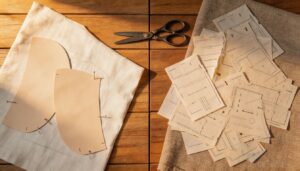
Most beginner sewing patterns keep things simple by using just two to four pattern pieces per garment. Lower piece totals mean fewer seam lines to track, easier fabric placement, and reduced transfer markings to worry about.
Simplified cutting guides walk you through straightforward layouts, so pattern reading feels manageable from the start. Fewer pieces genuinely build your confidence before complexity creeps in.
More Panels, Facings, and Linings
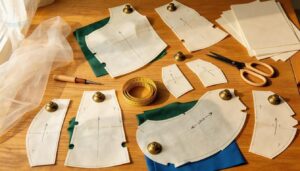
Moving into sophisticated garment construction means your pattern pieces multiply quickly. Panels, facings, and linings each serve a distinct purpose — and together they shape how a garment fits, finishes, and feels.
For beginners tackling multi-piece patterns, starting with beginner-friendly fabrics like cotton makes managing all those panels and facings far less overwhelming.
- Panel Grain Alignment controls drape across vertical and horizontal seam lines
- Facing Interfacing Selection reinforces necklines and armholes against stretching
- Facing Seam Finishes create clean inner edges without bulk showing through
- Lining Weight Distribution adds stability and opacity to lightweight fabric layers
- Panel Topstitching emphasizes seam lines and aids pattern adjustments for fit
Simple Assembly Versus Multi-stage Construction
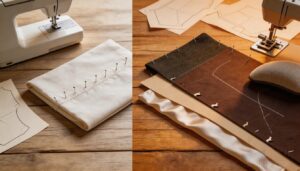
Think of simple assembly as a straight road — one direction, one lane. Finish each seam and move forward without circling back.
Multi-stage construction is different: lining, interfacing, and outer shell each need their own sequence.
| Feature | Simple Patterns | Complex Garment Construction |
|---|---|---|
| Stage sequencing | Single pass | Distinct phases |
| Tool requirements | Basic machine | Walking foot, tailor’s ham |
| Time management | 2–4 hours | 40+ hours |
| Error propagation | Easy to fix | Cascades across stages |
| Structural integrity | Basic | Reinforced through layers |
How Piece Count Affects Difficulty
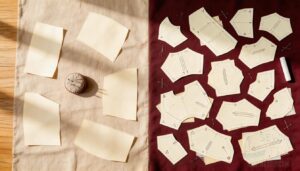
Piece count is one of the clearest signals of pattern difficulty. Beginner patterns generally use 4–10 pieces, keeping Seam Alignment Complexity low and Cutting Time Increase manageable.
Complex patterns multiply that number substantially, introducing Marking Density Challenges, Fabric Waste Potential, and tight Assembly Dependency Chains where one misstep affects everything downstream.
Watch for these piece-count difficulty signals:
- More pieces mean more seams requiring precise grain alignment
- Fabric Waste Potential rises with complex, multi-piece layouts
- Cutting Time Increase compounds when pieces are small or oddly shaped
- Marking Density Challenges appear as notches, darts, and dots multiply
- Assembly Dependency Chains form when earlier steps must finish before later ones can begin
Extra Steps Like Underlining and Structure
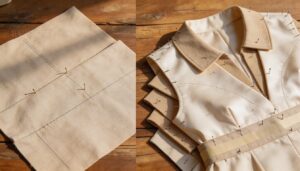
Sophisticated patterns don’t just add pieces — they add whole layers. Underlining Process involves cutting a full interlining layer to stabilize lightweight fabrics and prevent seam stretch.
Stiffening Materials like canvas or tape support collars and waistbands through Layered Construction. Bias Facings, Reinforcement Stitching at stress points, and precise pattern markings all demand skills no beginner pattern will prepare you for.
Fit, Shape, and Garment Structure
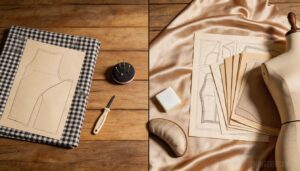
How a garment fits comes down to choices made long before you pick up a needle. Beginner and intermediate patterns approach shape and structure in very different ways, and those differences show up in every seam.
Here’s what to look for.
Loose Silhouettes Versus Tailored Shapes
Loose silhouettes are the friendlier starting point for beginner sewing projects — seams sit away from the body, hemline dynamics stay simple, and small cutting errors disappear in the extra volume.
Fitted garments flip that entirely. Drape vs structure becomes a real challenge: fabric weight impacts shapes every dart, fit adjustments multiply, and sophisticated garment construction demands precise shoulder line treatment throughout.
Elastic Waists Versus Fitted Waistbands
Waistband construction is where beginner and experienced patterns really split apart.
- Elastic waists stretch to fit multiple sizes — no fit adjustments needed.
- Fitted waistbands lock in a fixed circumference, demanding precise Ease Adjustments.
- Silhouette Impact shifts from relaxed to structured instantly.
- Resizing Methods differ too — swap elastic versus resew darts for Finishing Details.
Straight Seams Versus Shaped Seams
Fitting choices go beyond waistbands — seams shape the whole garment. Beginner patterns mostly follow a straight line, which keeps seam tension predictable and edge finish options simple.
Complex patterns introduce shaped seams that curve around the body, demanding careful pattern notching, pressing techniques, and bulk management to lie flat. That contouring is what gives custom pieces their clean, body-skimming silhouette.
Darts, Pleats, and Princess Seams
Seams don’t just connect fabric — they sculpt it.
Darts control bust and shoulder shaping, with dart intake usually running 1 to 2 cm depending on fabric stiffness.
Pleats add volume through careful pleat depth, usually 1.5 to 3 cm.
Princess seam contour replaces darts entirely, flowing shoulder-to-hem.
Mastering these in complex garment construction requires precise interfacing placement and accurate seam allowance — skills beginner sewing projects rarely demand.
Why Advanced Patterns Need Better Fitting
All that shaping work — darts, princess seams, pleats — means nothing if the fit is off by even a few millimeters. Sophisticated garment construction demands more than good technique; it demands precision.
- Precision Measurements — Body mapping catches bust, waist, and hip differences early.
- Symmetry Checks — Both garment sides should mirror within 2–3 mm.
- Panel Alignment — Multi-panel seams must meet exactly to hold the intended silhouette.
- Seam Allowance Tuning — Small changes affect drape across multiple construction points.
- Creating Custom Fit Adjustments — Sophisticated pattern design enables custom alterations without breaking design lines.
Techniques Required at Each Level
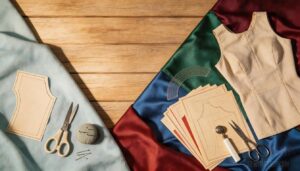
The gap between beginner and expert patterns isn’t just about how many pieces you’re cutting — it’s really about what your hands need to know how to do. Each skill level calls for a different set of techniques, and some you won’t touch until you’re ready for them.
The real difference between skill levels isn’t piece count — it’s what your hands know how to do
Here’s a breakdown of what’s required at each stage.
Basic Seams, Hems, and Buttons
Think of basic garment construction as your foundation. As a beginner, you’ll focus on straight seams with correct seam allowance adjustment, simple turned hems, and shank button usage to keep closures clean.
Once comfortable, explore understanding seam finishes like French seam technique for sheer or a rolled hem guide for delicate edges.
Edge stitching tips help everything look polished and intentional.
Zippers, Buttonholes, and Pockets
Once you move past basic seams, zipper types, buttonhole finishes, and pocket placement become your next real test. Beginners start with simple inseam pockets and coil zippers in forgiving fabrics.
Experienced sewers tackle invisible zippers, bound buttonholes, and welt pockets — all of which demand precise seam reinforcement and careful alignment. Your pattern difficulty rating will tell you exactly which of these to expect.
Interfacing, Collars, and Cuffs
Collars and cuffs are where beginners and experienced sewers part ways most clearly. Fusible interfacing types range from lightweight to medium weight, and choosing the right one affects how crisp your collar stand construction looks.
Interfacing grain direction resists stretching, while topstitching edge details define the shape.
Cuff placket placement and using interfacing in garments correctly — that’s genuinely experienced pattern adjustment territory.
Bias Binding and Seam Finishes
Bias binding is one of those techniques that looks simple but quietly separates confident sewers from beginners. Here’s how seam finishes scale with skill:
- Bias Edge Cleanliness – Trim seam allowances first, then press firmly for a sharp, durable edge
- Invisible Binding Methods – Narrow 3–6mm bindings disappear on lightweight fabrics
- Seam Reinforcement Techniques – Flat felted seams wrapped in binding add couture-level durability
- Decorative Contrast Binding – Refined pattern adjustments use contrast binding along collars and plackets
- Flat Felted Seam finishing – Reduces bulk beautifully at intersections on fashion fabrics
Tailoring and Couture-style Details
Tailoring and couture techniques are where sewing stops being functional and starts becoming artistry. At this level, you’re working with hand-rolled hems, pad stitching along lapels, and hidden stitches that secure linings invisibly.
Couture pattern sheets often include underlining guides and shoulder gussets for precise shaping.
Refined garment construction assumes you understand pattern grading, deliberate fabric selection, and why every pressing step matters.
Fabric Choices and Handling Difficulty
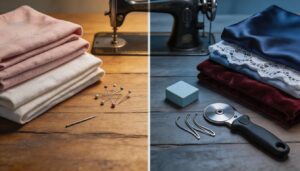
The fabric you choose can make or break a sewing project, especially when your pattern calls for something your skills aren’t quite ready yet. Not all materials behave the same way under the needle, and some are far more forgiving than others.
Here’s what you need to know about matching your fabric to your skill level.
Forgiving Fabrics for Beginners
Some fabrics practically teach you to sew. When you’re starting out, fabric selection can make or break your confidence. Three forgiving options worth knowing:
- Cotton muslin — loose weave, easy to press, very beginner-friendly
- Flannel — soft texture does an excellent job hiding flannel mistakes
- Broadcloth — smooth surface accepts clean broadcloth seams effortlessly
Voile drape and linen blend prewash options suit easy intermediate projects as your fabric handling improves.
Why Cotton is Easier to Sew
Cotton earns its beginner-friendly reputation for good reason. Its stable grainline keeps pattern pieces aligned as you cut, and easy needle passage means fewer skipped stitches mid‑seam.
Pressing produces a crisp seam finish without much effort — simple pressability at its best.
Broad availability across weights makes fabric selection straightforward. That consistency lets you focus on technique, not troubleshooting the material.
Stretch Fabrics and Tension Challenges
Stretch changes everything. Unlike cotton, working with stretchy fabrics means your machine settings, stitch selection, and even needle types matter more than usual.
off-grain and bias grain alignment become an instant problem — seams wave, hems distort. Here’s what to get right:
- Use a ballpoint needle to protect fibers
- Switch to a narrow zigzag for seam elasticity
- Adjust presser foot pressure to prevent tunneling
- Apply stabilizer use at necklines to control stretch
Silk, Chiffon, and Slippery Materials
Silk and chiffon are a step beyond stretch. Slippery materials shift under the presser foot, fray instantly, and punish unsteady hands. Teflon foot helps feed them evenly.
Low-heat pressing with a cloth protects the delicate sheen alignment. Roll hem finishing keeps edges clean without bulk. Stabilizing underlining adds body to chiffon. These fabrics belong firmly in modern garment construction.
Matching Fabric Type to Pattern Level
pattern level has a fabric that fits it best. Weight matching and fiber selection guide that pairing — cotton for beginners, structured wools or draped silks for experienced garments.
Before cutting anything precious, muslin testing saves real heartache. Grain alignment and stabilizer use matter more as complexity grows.
Choosing appropriate fabrics for your pattern’s difficulty rating makes every sewing session feel worthwhile.
Instructions, Markings, and Pattern Support
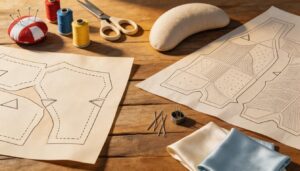
The instructions inside a pattern tell you just as much about its difficulty level as the pattern pieces themselves. Beginner patterns tend to hold your hand through every step, while more complex ones assume you already know the ropes.
Here’s how the two compare across the most telling details.
Step-by-step Guidance in Beginner Patterns
Beginner patterns are basically a knowledgeable friend talking you through every move. They use Clear Numbered Steps and Simple Language, so you’re never guessing what comes next. Consistent Terminology and Approachable Formatting keep things approachable throughout.
- Steps run in logical order — prep to finish
- Instructions are complete sentences, not vague hints
- Tip Placement reinforces technique right after key steps
- Familiar sewing terms build Pattern reading and interpretation confidence
Visual Diagrams and Layout Guides
Good diagrams do half the teaching for you. Beginner patterns use high-contrast line standards, a labeled scale bar, and color coding schemes so each piece reads clearly at a glance.
grid alignment system shows exactly where fabric edges meet, while fabric nap shading tells you which way to orient directional materials. Clear cutting layout diagrams, visual guides, and step-by-step written instructions with photos or illustrations remove the guesswork entirely.
Fewer Symbols and Transfer Markings
Unlike complex modern patterns, beginner designs rely on a reduced notation system and minimalist iconography — fewer symbols mean you spend less time decoding and more time sewing.
Direct fabric marking with erasable chalk or water‑soluble pens replaces complicated transfer steps.
Clear alignment cues like bold notches and printed guidelines make pattern markings easy to follow, so simplified transfer tools are all you really need.
Advanced Patterns With Less Hand-holding
Sophisticated patterns trust you to fill in the gaps. Instructions name a technique — say, layered interlining techniques or non-linear assembly flow — without walking you through every motion. Pattern grading strategies, hidden construction cues, and custom seam allowances are marked but rarely explained.
That’s where pattern reading and modification skills earn their keep. Sophisticated garment construction assumes you’ve logged enough hours to problem-solve independently.
PDF Printing and Pattern Assembly Basics
Every PDF sewing pattern prints on standard A4 or Letter pages, so check your margin settings — usually 0.5 to 0.75 inches — and disable page scaling before printing. Tiling alignment marks at each sheet’s edge guide you through compiling PDF sewing patterns into one large piece.
Many files include an assembly diagram and separate seam allowance layers, making downloading and printing patterns straightforward for any skill level.
Choosing The Right Pattern Level
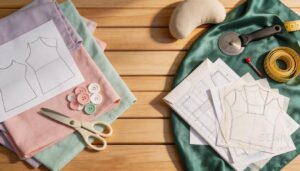
Picking the right pattern level is one of the best things you can do for your sewing journey. It saves you from frustration, wasted fabric, and half-finished projects stuffed in a drawer.
Here’s what to know before you choose.
Skills to Master Before Moving Up
Before you move up a level, a few skills need to feel second nature—not just familiar.
- Thread Tension Mastery: balanced stitches on every fabric weight
- Notch Transfer Accuracy: markings land exactly where they should
- Fabric Grain Alignment: pieces cut true to the grainline
Nail these basic techniques alongside layered interfacing application and pattern scaling techniques, and intermediate garment construction methods will feel far less intimidating.
Signs a Beginner is Ready for Advanced Projects
Once those foundational skills feel automatic, you’ll notice real signs of readiness creeping in.
| Readiness Sign | What It Looks Like |
|---|---|
| Stitch Tension Control | Balanced stitches across multiple fabric weights |
| Accurate Body Measurements | Fitting adjustments land correctly first try |
| Pattern Modification Skills | You alter hems and seams with confidence |
| Consistent Pressing Technique | Seams lie flat without re-doing |
| Successful Test Garments | Muslins fit well with minimal changes |
That’s your green light for complex garment construction.
Best Starter Projects for Confidence
Once you’re ready to build real sewing confidence, start small.
A tote bag starter project teaches straight seams and topstitching without overwhelm. A pillow cover project adds clean finishing practice.
Try elastic waist pants for your first garment — the forgiving fit removes pressure.
A knit headband, simple rectangle, or pocket organizer intro rounds out your beginner-friendly pattern features toolkit beautifully.
Risks of Choosing a Pattern Too Hard
Picking a pattern above your skill level can quietly unravel your sewing confidence.
A significant skill gap means you’ll hit Pattern Misreading early — dense markings, unfamiliar symbols, and unclear assembly order all compound quickly.
Tool Inadequacy follows when complex notions like interfacing get misapplied.
The result? Excessive Fabric Waste, a Time Overrun, and a half-finished project that makes you want to quit.
How to Progress Without Wasting Fabric
Wasting fabric often comes down to skipping the small habits that protect it. Use scrap utilization by practicing seams on leftover muslin before cutting into your main cloth.
Test garments in cheap cotton to confirm fit without risk. Efficient nesting and pre-wash planning keep your layout tight and shrinkage predictable.
Good marking efficiency means fewer re-cuts — and steady, confident progress toward sophisticated garment construction.
Frequently Asked Questions (FAQs)
Can I mix beginner and advanced pattern elements?
Yes, you can.
Staged construction, hybrid fabric selection, and sectional difficulty mapping let you blend beginner and expert elements smoothly.
Testing on muslin first protects your final fabric while supporting progressive skill integration.
How do I resize a sewing pattern at home?
Trace the original first — never cut the tissue.
Use grading rules to shift sizes, redraw scale lines with a clear ruler, and make fit adjustments gradually for a clean, accurate result.
What tools are essential for pattern sewing success?
Sharp scissors, a precise tape measure, a transparent ruler, a notions kit with chalk and pins, and a sewing machine with adjustable settings are the core tools you’ll reach for every time.
How do sewing patterns differ across clothing brands?
Every brand has its own sizing grids, notation conventions, and symbol color coding.
Pattern grading, scale measurement units, and size block variations all differ, so always check finished measurements before cutting.
Are vintage patterns harder than modern sewing patterns?
Vintage patterns are generally harder. Vintage sizing, historical grading, and traditional closures demand real skill.
Without modern diagrams or clear annotation styles, your pattern reading and skill development get tested fast.
Conclusion
Precise pattern selection prevents frustrating fiascos. By pinpointing the difference between beginner and higher-level sewing patterns, you’ll confidently choose projects that match your skills. Consider piece count, construction complexity, and required techniques.
As you progress, master new methods and materials. The difference between beginner and higher-level sewing patterns isn’t just about labels—it’s about growth.
With practice and patience, you’ll stitch your way to success, turning challenges into triumphs with every seam.