This site is supported by our readers. We may earn a commission, at no cost to you, if you purchase through links.
You can’t choose the right material if you don’t speak its language. A bolt of fabric isn’t just “soft” or “stretchy”—it’s a 200 GSM jersey knit with four-way mechanical stretch and moisture-wicking properties. That precision matters when you’re comparing swatches, talking to suppliers, or trying to recreate a beloved garment.
The textile industry has developed an entire vocabulary to describe what makes one fabric drape like water while another stands rigid as cardboard. This fabric dictionary breaks down the terms you’ll encounter, from fiber types and weave structures to the measurement systems that define weight, strength, and texture.
You’ll learn to identify materials by their construction, understand what those cryptic fabric labels actually mean, and communicate exactly what you need.
Table Of Contents
Key Takeaways
- Fabric terminology spans from basic fiber types (natural like cotton and wool, synthetic like polyester and nylon) through construction methods (woven, knit, nonwoven) to precise measurements like GSM and denier that define weight and texture.
- Understanding fabric classification systems—including ISO standards, physical properties (absorbency, strength, elasticity), and construction techniques—lets you communicate exact material requirements to suppliers and make informed sourcing decisions.
- Natural fibers each bring distinct advantages: cotton offers breathability and absorbency, linen provides sustainability and strength, wool delivers warmth through keratin structure, while silk creates luxury drape from protein filaments.
- Modern textile innovation balances performance with sustainability through recycled synthetics, bio-based materials, and closed-loop manufacturing processes that reduce environmental impact without sacrificing durability or function.
What is Fabric? Core Definitions and Terms
You can’t build with fabric until you know what it actually is. At its heart, fabric is material made from fibers—but the technical definitions, historical roots, and industry standards give that simple idea much more depth.
Once you understand fabric fundamentals, smart sourcing strategies help you find quality materials that match your project needs and budget.
Let’s start with the foundational terms that shape how we talk about and work with textiles today.
Getting comfortable with common sewing terminology helps you follow patterns accurately and communicate clearly with other makers.
Dictionary Definition of Fabric
At its heart, fabric is a material you create by interlacing fibers into a textile structure—think of it as the foundation beneath every garment and home good you touch. The term captures both the raw fibers when spun and the finished cloth that emerges.
Many fabrics today are blends—combining fibers like cotton and polyester to create different fabric blends that balance comfort, strength, and cost.
- Fabric Definition: Material produced through weaving, knitting, or nonwoven methods
- Material Science: Encompasses fiber composition and resulting sheet properties
- Textile Structure: Distinguished by construction technique and intended use
- Fabric Etymology: Traces back to Latin roots meaning “to construct” or weave
Fabric Vs. Textile Vs. Cloth
You’ll encounter fabric, textile, and cloth used interchangeably in everyday conversations, but textile science draws clear lines between them. Fabric is the flexible material you get from weaving, knitting, or felting fibers. Textiles encompass the entire discipline—fibers, production processes, and material properties. Cloth refers to the finished, user-ready sheet you’d cut and sew.
Industry standards treat fabric and cloth as synonyms in consumer contexts, while textile remains the umbrella concept covering fiber analysis and weaving techniques throughout the value chain.
Choosing the right material for bags, hats, or home décor starts with understanding fabric selection principles for accessories that balance durability with your sustainability goals.
Etymology and Historical Usage
Understanding where our textile vocabulary comes from reveals how deeply cloth shapes human culture. The word fabric traces back to Latin textus, meaning “woven thing,” reflecting ancient weaving techniques that connected communities across continents.
Textile vocabulary traces humanity’s cultural bond with cloth, from Latin textus through ancient trade routes to today’s global language
Three key moments transformed fabric terminology:
- Ancient trade routes spread silk and linen terms across civilizations
- Industrial Revolution machinery standardized production vocabulary worldwide
- Synthetic fiber invention merged chemistry with traditional textile language
Today’s fabric dictionary blends heritage craft names with modern material science.
Fabric Terminology Standards (ISO)
While textile language evolved organically for centuries, modern manufacturing demands precision. That’s where ISO framework steps in. Organizations worldwide rely on ISO 13912 and ISO 1184 to standardize fabric classification and terminology guidelines.
You’ll find these quality control standards defining everything from fiber content to fabric structure. ISO 23862 even governs fabric construction testing methods. This shared vocabulary ensures designers, manufacturers, and labs speak the same material science language.
Natural Fabrics: Types and Characteristics

Natural fabrics come from plants, animals, and insects, each bringing its own texture, strength, and feel to the cloth you wear and use every day. Understanding these fibers helps you make smarter choices about durability, comfort, and care.
Some fabrics, like viscose and rayon, blur the line between natural and synthetic by starting with plant fibers but undergoing chemical processing.
Let’s look at the most common natural fabrics and what makes each one unique.
Cotton Fabric Properties
Cotton stands apart as a fabric star because of its natural cellulose structure—you’ll find 90-96% purity in most fibers. Its breathability and absorbency make it ideal for clothing, while yarn strength depends on staple length.
The mercerization process boosts luster and dye uptake. Cotton blends with polyester add wrinkle resistance, balancing comfort with durability across textile applications.
Linen and Bast Fibers
You’ll recognize linen as one of textile sustainability’s champions—it’s a bast fiber pulled from the flax plant’s stem through fiber extraction methods like retting.
Flax cultivation requires less water than cotton, and the resulting fabric outperforms in absorbency and strength. Linen fibers maintain their durability even when wet, making this natural yarn ideal for weaving long-lasting textiles that breathe beautifully.
Wool and Animal Fibers
Wool production transforms keratin-rich fibers from sheep, cashmere goats, yaks, and angora rabbits into resilient yarn you’ll find woven throughout textile history.
Fiber grading evaluates diameter and staple length, determining whether wool becomes bulky sweater fabric or fine suiting material.
Today’s sustainable sourcing prioritizes animal welfare through certified supply chains, ensuring fiber processing respects both the creatures and craftsmanship behind every woven thread.
Silk and Luxury Natural Fabrics
Silk production begins with Bombyx mori cocoons, where protein filaments measuring 10 to 25 micrometers create the luminous drape you’ll recognize in charmeuse and duchesse weaves.
Luxury textiles like pashmina and vicuña offer outstanding warmth-to-weight ratios, while sustainable fashion increasingly demands traceability in fabric sourcing.
These natural fibers command premium positioning through origin storytelling and ethical cultivation practices that honor traditional weaving methods.
Synthetic and Manufactured Fabric Types

Synthetic fabrics emerge from chemical processes rather than natural sources, giving you options that natural fibers can’t always match. These manufactured materials range from fully synthetic polymers to semi-synthetic blends that combine natural cellulose with chemical processing.
Understanding the differences between petroleum-based synthetics, performance fibers, and advanced sustainable options helps you choose the right fabric for any project.
Polyester and Petroleum-Based Fabrics
Polyester leads synthetic fibers as the textile industry’s workhorse—strong, wrinkle-resistant, and derived from petroleum. You’ll find it dominating athletic clothing and upholstery because it resists abrasion and dries quickly.
But there’s a cost: manufacturing consumes fossil fuels, and microplastic pollution from washing harms oceans.
Fabric recycling and petroleum alternatives are emerging to address these challenges, pushing toward eco-friendly textiles without sacrificing performance.
Nylon, Acrylic, and Performance Synthetics
Nylon production revolutionized performance textiles by delivering superior strength-to-weight ratios—ideal for activewear and industrial applications. You’ll recognize its abrasion resistance in everything from swimwear to aerospace interiors. Acrylic fibers offer wool-like warmth with vibrant color uptake, while synthetic blends marry durability with comfort. Modern fabric sustainability initiatives now prioritize recycled nylon and bio-based monomers, reducing petrochemical dependence without sacrificing the toughness athletes and adventurers demand.
- Nylon’s tenacity: Higher abrasion resistance than most natural fibers keeps gear lasting longer
- Acrylic warmth: Lightweight bulk mimics wool’s insulating properties in cold-weather knits
- Moisture management: Low regain in nylon and acrylic means quick-dry performance for sweaty conditions
- Synthetic blends: Combine nylon’s strength with elastomers for stretch and recovery in athletic material
- Recycled options: r-nylon and closed-loop processes address environmental impact through sustainable weaving practices
Rayon and Semi-Synthetic Fibers
Where nylon pushes performance boundaries, rayon production brings natural cellulose back into textile innovation. These semi-synthetic fibers—viscose, lyocell, modal—start as wood pulp, then transform through regenerated cellulose chemistry.
You’ll appreciate their silk-like drape and breathability in blouses and linings. Fiber blends marry rayon’s softness with durability, while the viscose process or closed-loop weaving and knitting deliver fabric that feels luxurious yet affordable.
Sustainable and Innovative Fabrics
Beyond semi-synthetics, you’ll find circular economy innovation reshaping green textiles. Recycled polyester cuts virgin material use by up to 70%, while bio-based fabrics from renewable resources—PLA, mycelium composites—reduce emissions by 20–50%.
Sustainable fashion now weaves eco-friendly textiles into performance finishes, extending life and closing loops. Fabric construction and production embrace sustainable manufacturing, proving eco-friendly materials can deliver both function and responsibility.
Fabric Construction Methods Explained
You can’t understand fabric without knowing how it’s built. The way fibers come together determines everything from how a material drapes to how it wears over time.
Let’s look at the main construction methods that transform raw fibers into the fabrics you see and use every day.
Woven Fabric Structures (Twill, Satin, Plain)
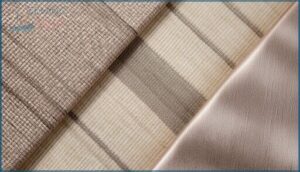
You’ll find three foundational weave patterns that shape how woven fabric behaves: plain, twill, and satin. Each transforms yarn interlacing into distinct fabric structures with unique textile mechanics.
- Plain weave creates maximum fabric density through alternating over-under thread count patterns, delivering stability but limiting flexibility
- Twill weave produces diagonal lines and enhanced drape through offset weaving techniques
- Satin weave features long floats for lustrous surfaces and excellent air flow in fabric construction
Understanding the weave structure basics is essential for selecting the right fabric for specific applications.
Knit Fabric Construction
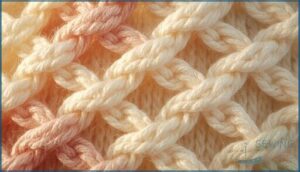
While woven fabrics lock threads in perpendicular grids, knit fabrics loop yarn into interconnected chains that stretch, breathe, and move with your body. Understanding fabric stretch properties is essential for textile applications.
Two primary knit patterns define construction: weft knitting (horizontal loops) and warp knitting (vertical chains). Knitting machines control yarn tension and needle size to adjust fabric stretch and drape.
| Knit Type | Key Characteristics |
|---|---|
| Weft Knit | Stretches in all directions; used for t-shirts |
| Warp Knit | Stable lengthwise; ideal for athletic wear |
| Single Jersey | Lightweight with natural curl at edges |
| Interlock | Double-layer construction for durability |
Nonwoven and Felted Fabrics
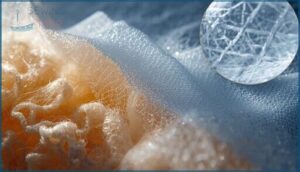
Nonwoven materials skip the loom entirely—fibers bond through heat, pressure, or chemicals instead of weaving. You’ll recognize felt as the classic example: wool fibers interlock via moisture and friction during felting.
Meltblown processes create ultra-fine webs for medical masks, while thermal bonding fuses synthetic fibers for diapers.
Fiber cohesion determines whether your nonwoven fabric filters air or cushions furniture.
Specialty Weaves and Patterns (Brocade, Ripstop)
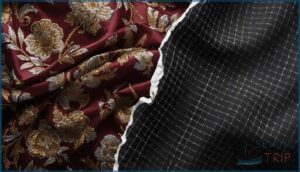
Brocade design transforms fabric into art—supplementary threads create raised motifs with metallic shimmer, rooted in Renaissance weaving traditions. Meanwhile, ripstop fabric takes a different path: reinforcing grids prevent tears from spreading, making your outdoor gear nearly indestructible.
These weave patterns showcase textile innovation at opposite ends—one prioritizes ornamental complexity, the other demands fabric reinforcement through engineered durability over decorative knitting techniques.
Fabric Properties and Classification Systems
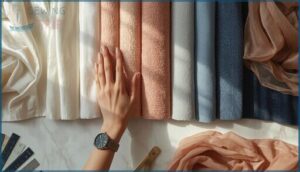
Understanding how fabrics behave and perform starts with knowing their essential properties. Every fabric has measurable characteristics that determine where and how you can use it, from the fibers’ absorbency to the cloth’s weight and texture.
These classification systems help you compare fabrics, choose the right material for your project, and communicate clearly with suppliers and manufacturers.
Physical Characteristics (Absorbency, Strength, Elasticity)
You can judge a fabric’s real-world performance by testing three core properties. Absorbency determines Moisture Management—cotton wicks sweat naturally, while polyester repels water. Tensile Testing reveals Fabric Durability through strength measurements: nylon outperforms wool under stress. Elastic Recovery shows how material bounces back after stretching.
Through careful Fiber Analysis, you’ll understand how texture and structure shape each fabric’s behavior.
Fabric Weight and Denier Measurements
Understanding Fabric Density starts with two key metrics: GSM Standards (grams per square meter) and the Denier Scale. GSM measures Weight Measurement across woven clothing material—cotton generally ranges 120–600 GSM. Denier quantifies Material Thickness in yarns; higher numbers mean coarser fibers.
The textile industry uses both to specify fabric structure, ensuring your material delivers the right performance for each weaving application.
Texture and Surface Finishes
You can measure Surface Roughness in fabric through tactile finishes—smooth mercerization, napped brushing, or tufted surfaces each deliver distinct Fabric Smoothness levels.
Finishing Techniques like calendaring alter texture and Material Durability, shifting air permeability and contact angles.
Whether you’re working with cloth from weaving or knitting, Textile Patterns emerge through surface treatments that define hand feel and longevity after laundering.
Fabric Width and Industry Standards
Fabric Measurement starts with width, and width standards shape everything from cutting to costing. Industrial Sizing anchors the Textile Industry Overview: typical Manufacturing Tolerances span just millimeters, ensuring repeatability across looms. You’ll find three key standards driving Fabric Structure and Properties in the Clothing Manufacture Process:
- 44–45 inches (112 cm) for lightweight apparel, where narrow widths enhance Material Science and Fabric Production efficiency.
- 54–60 inches (137–152 cm) for upholstery and furnishings, reducing seams and waste.
- 150 cm and 280 cm European roll widths, aligned with Textile Regulation and equipment constraints in weaving mills worldwide.
Frequently Asked Questions (FAQs)
What is the definition of fabric in the dictionary?
At its heart, fabric is a material made by weaving, knitting, or felting fibers together.
The Cambridge Dictionary defines it as cloth or textile materials used for creating clothing and furnishings.
What is the meaning of fabric in Oxford dictionary?
According to the Oxford English Dictionary, fabric means material made from fibers or yarns for clothing and textiles.
The noun also describes a material’s texture, structure, weave, finish, and composition as a whole.
What is fabric terminology?
The ISO technical committee standardizes over 1,000 textile terms. Fabric terminology is your shared language for describing fiber analysis, weaving techniques, and cloth properties—from denier measurements to twill patterns—ensuring designers, manufacturers, and retailers communicate precisely about textile standards and fabric classification.
What is the textile dictionary?
A textile dictionary is your go-to reference for understanding fiber science, material properties, and industry terminology. It standardizes fabric glossary terms—from weaving methods to clothing construction—so designers, manufacturers, and educators share a common language grounded in textile standards.
How does fabric impact the environment?
Like footprints left behind on a journey, every textile leaves traces on our planet. Your fabric choices shape carbon footprint, fabric waste, and water use.
Sustainable textiles and eco-friendly fashion offer greener manufacturing through responsible weaving and mindful material selection.
What are common fabric manufacturing processes?
You’ll encounter three main fabric manufacturing processes: spinning fiber processing converts raw materials into yarn, weaving methods and knitting techniques build textile production structures, and finishing treatments improve fabric through dyeing and chemical applications for enhanced performance.
How do fabric finishes affect durability?
Like armor for thread, fabric finishing transforms vulnerable fibers into resilient materials. Durability enhancement through fiber treatment boosts wear resistance by 20–30%, while abrasion testing confirms how protective finishes extend fabric life through weaving and knitting cycles.
What innovations are shaping the fabric industry?
You’re witnessing a revolution in sustainable materials, digital printing, and smart textiles. Nano technology facilitates eco-friendly production, while sophisticated supply chain management drives sustainable fashion forward.
These eco-friendly textiles reshape what fabric can achieve.
How do cultural traditions influence fabric design?
Think of fabric as a living archive—each thread records ancestral stories. Traditional patterns carry regional symbolism, while weaving techniques preserve cultural identity. Motifs signal ceremonies, trade routes, and spiritual beliefs through fashion design.
How do I identify fabric content without a label?
You can identify fabric content through burn tests, weave analysis, and texture examination.
Study the fiber’s response to flame, inspect thread count patterns, and assess the cloth’s drape to determine its composition accurately.
Conclusion
Think of fabric knowledge as a map: once you learn to read it, entire supply chains open up. This fabric dictionary gives you the vocabulary to decode labels, compare materials with precision, and communicate your exact requirements to manufacturers.
You’ll move from vague descriptions to technical specifications, from guessing at fiber content to understanding construction methods. The language of textiles isn’t just terminology—it’s the foundation for making informed decisions about every material you touch.