This site is supported by our readers. We may earn a commission, at no cost to you, if you purchase through links.
That small triangle of fabric bunching at the corner of your handmade pillow isn’t a sign you lack talent—it’s physics working against you. Every time you fold two pieces of fabric at a right angle and stitch them together, you’re compressing multiple layers into a tiny point that wants to twist, fray, or turn out blunted.
The difference between a corner that looks homemade and one that rivals ready-to-wear isn’t luck or years of experience. It’s understanding how fabric behaves under tension and knowing three specific techniques that transform bulky intersections into crisp, clean angles.
Once you master the mechanics of trimming bulk, controlling your stitch placement, and turning points without distorting the grain, hand sewing corners neatly becomes second nature.
Table Of Contents
- Key Takeaways
- Essential Tools for Neat Corner Sewing
- Choosing Fabrics and Threads for Corners
- Preparing Fabric Before Sewing Corners
- Sewing Outward Right-Angled Corners by Hand
- Mastering Inward and Curved Corners
- Techniques for Sharp Narrow and Pointed Corners
- Creating Boxed and Mitered Corners
- Pressing Corners for a Professional Finish
- Troubleshooting Common Corner Sewing Issues
- Frequently Asked Questions (FAQs)
- Conclusion
Key Takeaways
- Sharp corners depend on trimming seam allowances diagonally across the point before turning, leaving just 1-2 millimeters to prevent fraying while eliminating bulk that causes rounded or blunted angles.
- Stop stitching with your needle down at the exact pivot point, rotate the fabric 90 degrees around that anchored needle, then resume stitching to maintain alignment and prevent fabric shifting at right-angled corners.
- Use a blunt-tipped point turner or wooden chopstick to gently push out corner tips from the inside, working gradually to avoid puncturing the seam while achieving crisp, professional points.
- Press corners with steam using a lift-and-press motion rather than sliding the iron, then let the fabric cool completely to lock in sharp creases and prevent distortion of the finished angle.
Essential Tools for Neat Corner Sewing
Before you stitch a single corner, you need the right tools at your fingertips. The difference between a lumpy, amateur corner and a crisp, professional one often comes down to what you’re working with.
Let’s look at the essential tools that’ll help you achieve sharp, clean corners every time.
Point Turners and Alternatives
For crisp corners, you’ll want a specialized point turner—usually 13–16 cm long with a tapered tip that won’t pierce your fabric. Can’t find yours? Wooden chopsticks, plastic knitting needles, or even makeup brush grips work beautifully as alternative pointers.
These corner turning tools push out sharp points safely when you pivot at right angles, mastering essential sewing corner basics without damaging delicate seams. To achieve professional results, understanding sewing corner techniques is essential for any garment.
Scissors and Seam Rippers
Sharp dressmaking shears are your first line of defense—they cut seam allowances within a millimeter, setting you up for perfect corners. Dull blades cause 30% more yarn breakage and fraying at points, so keep up with scissor maintenance.
Sharp dressmaking shears cut seam allowances within a millimeter for perfect corners, while dull blades cause 30% more fraying at points
When mistakes happen, reach for an ergonomic seam ripper with a ball-tipped arm for seam ripper safety and fabric protection—the rounded end slides along stitches without tearing your work. Using the right seam ripper tools can make a significant difference in achieving professional-looking results.
Pressing Tools for Crisp Edges
Once you’ve trimmed away excess fabric, pressing transforms your corners from good to great. A domestic steam iron set between 110 °C for synthetics and 220 °C for cotton flattens seam allowances without distortion.
Point pressers support narrow tips, while clapper tools lock in crisp edges as fabric cools. Cold pressing with firm pressure after steam ironing sets your corner creases permanently, eliminating bulk where seam allowance meets presser foot.
Choosing Fabrics and Threads for Corners
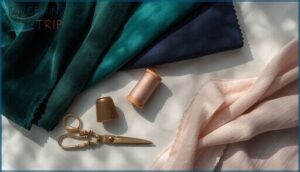
The fabric and thread you choose can make or break your corner work, especially when you’re stitching by hand. Some materials cooperate beautifully at sharp angles, while others bunch, fray, or lose their shape no matter how careful you are.
Let’s look at what works best for clean, durable corners that hold up over time.
Best Fabric Types for Clean Corners
You’ll find that woven textiles create the cleanest corners, with medium-weight cottons leading the pack. Quilting cotton and cotton blends resist distortion at right angles, while linen choices hold crisp edges thanks to their natural stiffness. Synthetic options like polyester maintain shape through washing.
If you’re working with drapy rayons, pair them with firmer fabric manipulation layers—that extra support transforms soft fabric crafting techniques into professional-looking points.
Thread Selection for Durability
Your thread’s fiber type directly impacts seam efficiency and corner durability. Polyester thread delivers roughly 30% greater tensile strength than cotton at comparable sizes, making it your go-to for stress points. For hand sewing techniques that demand resilience, consider these material selection priorities:
- Polyester offers enhanced tensile testing results and minimal moisture absorption
- Nylon provides highest abrasion resistance but degrades under UV exposure
- Cotton works for lightweight fabric projects with gentler wear patterns
- Match thread weight to fabric thickness to prevent corner distortion
Choose wisely—your sewing corners will thank you.
Interfacing for Structured Points
Fabric reinforcement transforms weak points into durable, crisp corners. Fusible interfacing types reduce elongation in structured areas without compromising seam efficiency—tests show woven fusibles maintain corner stability better than sew-in varieties for hand sewing techniques.
For open-weave fabric, thermoplastic tapes boost reinforced seams by over 50%, creating perfect corners that resist slippage. Match interfacing weight to your project; heavier weaving demands lighter support to preserve natural drape while strengthening pivot points.
Preparing Fabric Before Sewing Corners
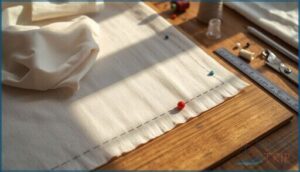
Before you make a single stitch, your fabric needs three critical prep steps that’ll make or break the sharpness of your corners. Each one builds on the last, setting you up for control and precision when the needle hits fabric.
Let’s walk through marking, cutting, and securing your work so nothing shifts or puckers mid-stitch.
Marking Seam Allowances Accurately
Every stitch begins with a mark—and your corner will only be as sharp as the line you draw. Use a tracing wheel and dressmaker’s carbon to transfer seam allowances through two fabric layers at once, reducing placement error.
Test washable markers on scraps first; residual marks often linger at seam intersections. For precision tracing, thread-trace your seam allowance line to guide accurate measurement and fabric notching at each corner point.
Cutting Techniques for Sharp Angles
Sharp angles collapse under bulk—that’s why angle trimming and fabric grading matter before you pivot. Proper seam reduction keeps your corner techniques clean and your points precise.
- Diagonal trimming across the tip: Cut away the corner point about 3 mm above your stitching line, leaving just enough seam allowance to prevent fraying while minimizing bulk.
- Graded layers for multi-fabric seams: Trim each layer to a different width in stair-step increments, keeping the innermost layer narrowest.
- Corner clipping on curves: Notch perpendicular cuts nearly to the seam line, releasing tension without weakening your sewing corners.
Pinning and Basting for Stability
You can’t steer fabric that shifts mid-stitch—that’s where pinning and basting techniques earn their keep. Place pins perpendicular to your seam allowance every 2.5 cm to lock layers, especially on slippery silk or thick wool.
For sewing corners demanding precision, hand baste close to—but not on—your final seam line. Proper fabric control prevents puckering, stabilizes seam stability, and simplifies trimming and pressing later.
Sewing Outward Right-Angled Corners by Hand
Outward right-angled corners show up in everything from pillowcases to tote bags, and getting them crisp takes a steady hand and the right approach. You’ll want to master the rhythm of stitching, stopping, and pivoting before you trim away excess fabric and coax out a sharp point.
Here’s how to work through each stage with confidence.
Step-by-Step Stitching Guide
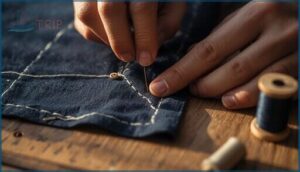
When hand sewing corners, precision matters more than speed. Start by marking your seamlines with tailor chalk, then align corner points using perpendicular pins for fabric preparation.
Maintain stitch control by keeping your stitch length between 1/16th and 1/8th inch throughout each seam. Pull thread almost tight through both layers before forming the next loop—this seam reinforcement prevents puckering while ensuring your corner stitching stays strong and even.
Stopping and Pivoting at The Corner
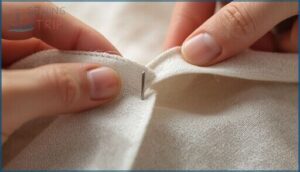
As you reach the pivot point—exactly where your seam allowances meet—stop with your needle down through both fabric layers. This pivot accuracy locks fabric stability and prevents shifting.
Lift your work slightly, rotate it ninety degrees around that anchored needle, then resume stitching along the new edge. Taking your final four or five stitches slowly gives you corner reinforcement and the seam control needed for sewing perfect corners.
Trimming and Turning Out Points
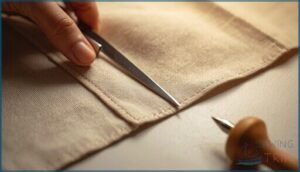
Once your stitching is complete, trim the seam allowance diagonally across the point, cutting within one to two millimeters of your pivot stitch. This corner trimming achieves bulk reduction by letting the layers meet rather than overlap.
Use a point turner to gently coax out the tip—push gradually from inside to preserve fabric stability.
Press flat, and you’ve mastered sewing perfect corners through careful trimming and notching, plus controlled pressing techniques.
Mastering Inward and Curved Corners
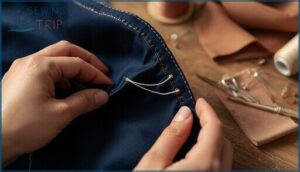
Inward and curved corners present their own unique challenges, but they’re not as tricky as they look once you know the basics. The key is working with the fabric’s natural tendencies instead of fighting against them.
Here’s how to handle these trickier angles with confidence and precision.
Snipping Seam Allowances Correctly
For inward corners and curves, clip placement makes all the difference. Use sharp scissors to snip perpendicular to your seam allowance, stopping 1–2 mm before the stitch line—this snip depth prevents fraying while releasing tension.
Space clips every 6–13 mm along curves, closer on tighter radii. Corner reinforcement means shorter stitches near the peak.
These trimming and sewing techniques let your handcrafted corner techniques shine without weakening the seam.
Preventing Fabric Distortion
Even with perfect snipping, fabric tension can pull corners askew. Stay-stitch bias edges 1/8 inch from your seam line—this prevents 40% of corner stretching.
Loosen your thread tension by 10-20% when working delicate materials, and finger-press seams flat before applying heat.
Hold fabric taut while stitching to limit diagonal skew to 3 mm. These distortion prevention steps maintain bias control and seam stability through every pivot.
Achieving Smooth Inner Angles
Smoothness begins with clip management—cut into your seam allowance within 3 mm of stitching at the exact pivot point, releasing tension so fabric relaxes into the angle. Add seam reinforcement with a second stitch line if needed, then press from both sides to flatten bulk.
Perfect corners emerge when trimming meets careful pressing, transforming clipped inner angles into crisp, professional edges.
Techniques for Sharp Narrow and Pointed Corners
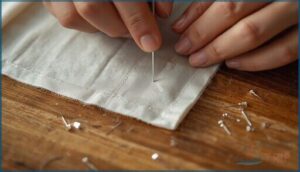
Sharp pointed corners—like collar tips and decorative details—demand precision and a light touch. The fabric layers stack up at narrow angles, so you need to trim strategically, turn carefully, and sometimes add reinforcement to keep that crisp point intact.
Here’s how to handle each step without fraying threads or poking holes through your work.
Diagonal Trimming for Reduced Bulk
Trimming corners at a 45-degree angle from each seam line is your secret weapon against bulky points. Cut diagonally across the corner, leaving about 1/4 inch seam allowance beyond your stitching—any closer risks fabric fraying.
For longer, narrow points, extend your diagonal cuts further along each side to distribute bulk evenly. This simple trimming technique transforms rounded corners into sharp, professional angles every time.
Using a Point Turner Safely
With your corners trimmed, slide a blunt-tipped point turner gently into the angle—never force it. Plastic or bamboo tools distribute pressure better than sharp substitutes like scissors, protecting your seam from punctures.
Work gradually, shaping the bulk with your fingers first, then sharpen the tip with controlled movements. This fabric protection method and proper sewing tool ergonomics prevent blowouts while delivering perfect corners every time.
Reinforcing Delicate Points
Sharp collar tips and narrow angles need extra seam security to withstand stress. Bar tacks prevent thread breakage at vulnerable points where fabric direction shifts abruptly.
Strengthen delicate corners with these corner techniques:
- Stitch multiple short passes over the same small area for point strengthening
- Use high-quality thread to improve corner stability and fabric protection
- Position tacks strategically at stress-prone angles for perfect corners every time
Creating Boxed and Mitered Corners

Boxed and mitered corners are two techniques that transform flat fabric into three-dimensional shapes or create crisp, refined edges. Each method fulfills a distinct purpose, from adding depth to bags and cushions to finishing hems with flawless precision.
Let’s walk through how to construct both styles and when to reach for each one.
Boxed Corner Construction Steps
You’ll find boxed corners transform flat fabric into three-dimensional bags with surprising ease.
Start by aligning your side seam with the bottom seam to form a triangle, then measure from the point—half your desired depth—to mark your boxed seam line. Pin across that perpendicular line, checking fabric grain alignment stays true, then backstitch by hand along the mark for boxed seam reinforcement.
Trim away excess, leaving proper seam allowance management for a clean finish.
Mitered Corner Folding Methods
Mitered seam construction creates the flattest, most polished corner you’ll ever stitch—imagine transforming bulky hem layers into a single crisp diagonal fold. Start with your double hem allowances marked, fold fabric right sides together matching your drawn diagonal line, then backstitch along that 45-degree angle.
- Trim excess to ¼ inch from stitched line
- Push corner tip fully out with point turner
- Press miter flat before refold to set fabric mitering methods
Precise folding tips demand you clip that corner point diagonally—this reduces nine layers to just four at your finished edge.
When to Use Each Technique
Your project’s volume requirements drive corner selection. Boxed corners add measurable depth when you need a 2–6 inch base for tote bags or pouches, while mitered corners keep quilts and table linens perfectly flat.
Fabric choice matters too: structured canvas grips boxed construction’s extra seam strength, but lightweight cottons shine with mitered techniques that reduce bulk.
Match your corner technique to both design considerations and the load your finished piece will carry for perfect corners every time.
Pressing Corners for a Professional Finish

Pressing isn’t just the final touch—it’s what transforms a hand-sewn corner from acceptable to outstanding. The right pressing techniques lock your stitches in place, sharpen angles without crushing delicate points, and give your work that crisp, professional edge.
Let’s walk through three essential pressing methods that’ll enhance every corner you sew.
Using a Tailor’s Ham for Curves
When you’re pressing curved corners or shaped seams, a tailor’s ham becomes your best ally. This firm, densely packed cushion—usually measuring about 7.5 by 4 by 5 inches—mimics the body’s natural contours, letting you mold fabric without flattening its dimensional shape.
Drape your curved seam over the ham’s matching curve, then press with steam to set the fabric manipulation beautifully and preserve those professional finishing techniques.
Pressing Seams Without Flattening Points
While a ham shapes curves, flat seams demand different heat control and corner protection. Press straight down—never slide—to preserve those 90-degree angles you’ve sewn. Set your iron below 180°C and lift between moves to prevent crushing raised seam allowances at the point.
Try finger-pressing first to distribute layers evenly, then use a light touch with the iron. Your fabric handling makes all the difference in keeping points sharp.
Setting Stitches With Steam
Steam pressing transforms stitches from surface threads into embedded, durable seams. Lift the iron and press—never slide—to set each stitch without stretching the fabric.
Cotton tolerates high heat near 400°F, while wool and silk need medium settings with a pressing cloth. Test your steam settings on scraps first, then let corners cool completely before handling to lock in those crisp, professional edges.
Troubleshooting Common Corner Sewing Issues
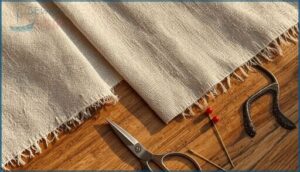
Even with careful preparation, corner sewing can throw you a curveball—frayed edges, blunt points, or seams that pull unevenly.
Don’t worry, these issues are fixable and preventable once you know what to watch for. Here’s how to troubleshoot the most common problems and keep your corners crisp.
Avoiding Fraying and Weak Seams
Weak seams and fraying can derail even your most careful corner work, but you can prevent both with smart fabric choice and thread selection. Here’s how to keep edges intact and seams strong:
- Use quality thread with tensile strength above 25 gf/mm for reliable seam reinforcement
- Hand overcast raw edges to reduce fraying by 80% after washing
- Leave a 1/8-inch seam allowance beyond stitching to prevent unraveling
- Apply staystitching one inch from corner points for added stability
- Choose tightly woven fabrics over satin, which loses up to two inches per end from fraying
These sewing techniques protect your corners from the start.
Fixing Blunt or Misshapen Corners
Corner repair starts with diagnosing the problem—bulk, poor trimming, or weak point shaping. Reopen the seam and miter-trim allowances so edges meet without overlap, cutting bulk by 80%. Use a blunt point turner to reshape the angle, then press from the right side with steam to set the edge.
Clipped corners and diagonal seam reinforcement transform blunt tips into perfect corners with crisp, professional definition.
Maintaining Even Seam Allowances
Across the full seam, use your machine’s throat plate markings to hold a steady 5/8 inch or 3/8 inch seam allowance. Wandering edges throw off corner alignment and weaken seam strength.
Mark pivot points with tailor’s chalk, reduce stitch length approaching the turn, and let fabric grain guide your needle.
Consistent allowances mean sharp corners that won’t pucker or pull when you trim and turn them right-side out.
Frequently Asked Questions (FAQs)
How do you sew sharp corners?
To achieve perfect corners with sharp angles, trim seam allowances diagonally across the point before turning, reducing bulk.
Then use a point turner to gently push out the corner, maintaining structural integrity and edge finishing precision.
How do you sew a right angled corner?
Stitch directly to your marked pivot point, then lift your needle and rotate the fabric 90 degrees while keeping that anchor secure.
Trim seam allowances diagonally to reduce bulk, then turn and press for crisp edge finishing.
How do you turn corners on a sewing machine?
Stop with your needle down at the exact pivot point, lift the presser foot, rotate your fabric ninety degrees, then lower the foot and continue stitching for sharp, precise corners every time.
How do you sew perfect corners & pivot points?
Perfect corners and pivot points depend on fabric preparation and stitch control. Mark your pivot point accurately, reduce your stitch length to about 5 millimeters near the angle, then stop with the needle down before turning.
How do you hand sew corners on stretchy fabrics?
Stretchy fabric can be a real “give and take” at corners—use a closely spaced backstitch to build thread slack into your seam, accommodating fabric elasticity while maintaining corner reinforcement and preventing distortion under tension.
What stitch type works best for corner strength?
For high-stress corner strength, backstitch delivers the tightest, most durable seam.
Blanket stitch and whipstitch prevent fraying at exposed edges, while fell stitch secures linings.
Add bar tacks at reinforced seams for heavy-duty projects.
Can you sew corners without marking seam lines?
Yes, you can sew corners without marking seam lines by relying on presser-foot guides, machine bed markings, or measuring tools. However, marking at least the pivot point ensures corner accuracy and prevents compound errors in seam allowance consistency.
How do you repair corners that have come apart?
Start your corner repair by turning the garment inside out and removing loose threads. Assess the damage, then restitch along the original seam line using doubled thread and a backstitch for strength.
Reinforce weak points with interfacing for lasting seam repair.
Conclusion
The moment you trim away that first wedge of excess fabric and turn out a corner that sits flat and sharp, something clicks. Hand sewing corners neatly stops feeling like guesswork and starts feeling like control—over tension, bulk, and finish.
You’ve moved past hoping your projects look handmade in a good way. Now you’re working with the fabric’s behavior, not against it, and every point you create proves it.
- https://www.universalgripco.com/astm-d1683
- https://www.testresources.net/applications/standards/iso/iso-13935-seam-tensile-properties-of-textiles
- https://www.testinglab.com/en-iso-13935-seam-tensile-strength-determination-of-fabrics
- https://kikakumaster.com/astm/astm-d6193/
- https://rsisinternational.org/journals/ijriss/articles/impact-of-various-stitch-classes-and-seam-types-on-seam-strength/