This site is supported by our readers. We may earn a commission, at no cost to you, if you purchase through links.
A Chanel jacket contains over 180 hours of hand‑stitching before it ever reaches a fitting room. That single fact reframes everything you think you know about what separates an exceptional garment from a well‑made one—it isn’t the fabric, the pattern, or even the design.
It’s the construction underneath, invisible to everyone except the person who built it.
Couture sewing construction methods demand that kind of commitment: grain‑perfect cuts, hand‑basted seams, iterative fittings, and finishing techniques refined over decades in Parisian ateliers.
Master these principles, and you stop making clothes—you start engineering them.
Table Of Contents
Key Takeaways
- Couture construction is built on invisible decisions — grain-perfect cuts, hand-basted seams, and iterative fittings — that determine how a garment moves, holds, and lasts, not just how it looks.
- The muslin toile isn’t optional; it’s where fit is solved before expensive fabric is ever touched, testing shoulder alignment, ease distribution, and mobility in real conditions.
- Hand techniques like thread tracing, hand-picked zippers, and blind catchstitching aren’t decorative choices — each one serves a specific structural purpose that machine sewing simply can’t replicate.
- Finishing methods — French seams, Hong Kong binding, faced hems, and Petersham stays — treat every interior edge as a construction decision, not an afterthought, and that’s what separates a garment that endures from one that merely looks good at first glance.
Couture Sewing Foundations

Couture sewing isn’t just a technique — it’s a whole different way of thinking about how a garment comes to life. Before you touch a single piece of fabric, you need to understand the principles and habits that separate couture construction from everything else.
That mindset shift starts with the details — things like hand-basting, thread tracing, and the finishing touches covered in these couture sewing techniques for flawless fabric finishes.
Here’s what forms the true foundation of this craft.
Couture Construction Principles and Workflow
Couture isn’t just sewing—it’s a disciplined workflow built on intention. Every garment moves through defined stages: custom pattern drafting, muslin testing, Fit Evaluation Protocols, and hand construction, before a single cut touches your final fabric.
Here’s what that workflow demands:
- Fabric Grain Alignment on every pattern piece
- Structural Interfacing Strategies applied by hand
- Layered Drape Engineering through underlining and interlining
- Seam Allowance Optimization for clean, durable joins
- Iterative fittings that perfect silhouette at each stage
The process also emphasizes muslin testing workflow to perfect fit before final sewing.
Differences Between Couture and Regular Sewing
Regular sewing gets you dressed. Couture gets you fitted — and that difference lives in every decision you make.
The Stitch Density is finer, the Fit Iterations are multiple, and your Hand Machine Balance leans heavily toward hand work.
Interfacing Technique is basted, never fused.
Finish Longevity is built in through French seams and Hand Stitching.
That’s the Comparison of couture versus regular sewing in practice.
Fabric Selection for Luxury Garments
Once fit is dialed in, the fabric you choose either honors that work or undermines it.
For couture garments, luxury fabric selection starts with fiber provenance — where a fiber comes from, shapes its drape characteristics, dye richness, and longevity.
Silk’s fluid weight-handfeel, merino’s natural elasticity, and cashmere’s fine weave structure each behave differently under your hands.
Sustainability certifications increasingly matter here too.
Preparing Delicate Fabrics Before Cutting
That fabric choice sets your standard — now your pre-wash protocol protects it. For delicate silks and chiffons, cool water with mild detergent removes finishing chemicals without disturbing fabric drape.
Air-dry flat, then press using a heat protection layer — your pressing cloth — set to the correct temperature. Grainline alignment and stabilizer application along bias edges follow, ensuring clean, distortion‑free cutting every time.
Choosing Support Fabrics and Notions
Every structural choice you make here determines whether a garment holds its shape or quietly collapses. Interfacing selection, stay tape choice, and silk organza stabilizer placement aren’t afterthoughts — they’re your engineering foundation.
- Use horsehair canvas for custom-fitted jackets needing shape without stiffness.
- Choose silk organza as interfacing on sheers for clean structural reinforcement.
- Apply woven stay tape at waistbands for boning and stays support.
- Reserve couturier elastic for subtle lining and shaping at bust or waist.
Patternmaking and Fitting
Patternmaking is where couture sewing truly separates itself from everything else — no standard sizes, no guessing, just a pattern built around one specific body.
Getting the fit right takes more than careful measuring; it demands a structured process of drafting, testing, and refining before a single inch of your real fabric gets cut.
Having the right tools matters just as much as the process—a set that includes fabric scissors sized for embroidery work makes every stage of cutting and detailing far more precise.
Here’s what that process looks like, step by step.
Drafting Custom Blocks for The Client
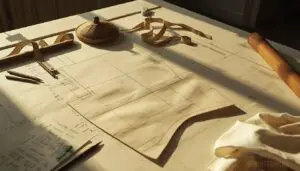
Think of a custom block as the architectural blueprint your entire garment builds from. In couture garment construction workflow, you draft each bodice or sleeve block to the client’s precise measurements, establishing a clear Origin Placement so every seam and dart aligns predictably.
Metadata Attributes capture the client’s name, measurements, and revision level, while Nested Assemblies allow complex structures to remain fully editable within your Client Library.
Creating and Fitting The Muslin Toile

Cutting into expensive fabric without a toile is like painting a masterpiece on a canvas you can’t replace. Muslin making gives you a safe, low-stakes environment for precision fitting and Draping Weight Simulation before a single scissor touches your final cloth.
Your Toile Proportion Check should evaluate:
- Shoulder seam alignment and torso length
- Waist, bust, and hip ease distribution
- Sleeve cap height and armhole fit
Use Flexible Fit Pinning directly on the body to catch posture-specific drag lines. An Adjustment Annotation System — clear markings on the toile itself — transfers every correction accurately. Don’t skip your Mobility Fit Assessment; always test seated and bending movement. This preparation and muslin testing in couture stage is where fit testing transforms good intentions into a garment that truly works.
Multiple Fitting Stages and Silhouette Refinement
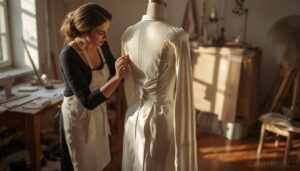
Each fitting stage builds on the last, so treat the process as a conversation that your garment is having with the body.
Stage Evaluation begins with Silhouette Balance and Proportion Calibration — shoulder line, bust ease, torso length.
Subsequent fittings enhance waist suppression and hip contouring through Mobility Testing in seated and standing postures.
Fit Documentation after every session locks in pattern adjustments and dart techniques, protecting every precision fitting decision you’ve made.
Accurate Fabric Marking and Pattern Symbols
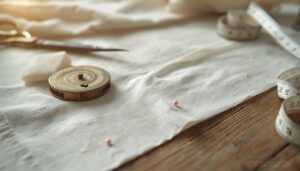
Marking your fabric accurately is the bridge between a perfect pattern and a perfect garment.
Notch placement ensures pieces align without guesswork, while grainline alignment controls how your fabric drapes and hangs.
Use tailor’s tacks for dart symbol usage on delicate cloth, chalk wheels for stable wovens, and water-soluble pens where precision matters most.
Seam allowance markings and fold line indicators complete the map your scissors will follow.
Dart Control, Shaping, and Balance Adjustments
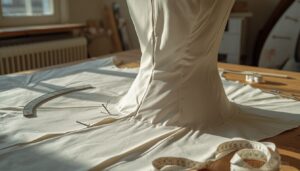
Dart placement is the quiet architecture of a well-fitted garment — shift the balance point forward and you get a stable, structured silhouette; move it back and the fabric softens into a gentle arc.
Your shaping strategies should follow the fit measurement process closely, redistributing weight distribution through hand sewn darts and precise pattern adjustments, and dart techniques to improve the couture garment construction workflow from toile to final cloth.
Hand Construction Methods
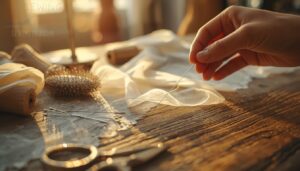
Hand construction is where couture sewing truly separates itself from everything else — it’s slower, more deliberate, and the results show it. Each technique you’ll use in this section has a specific purpose, whether that’s holding fabric in place temporarily or creating a finish that will last decades.
Hand construction is where couture slows down, grows deliberate, and builds finishes that last decades
Here are the core hand construction methods you need to know.
Hand Basting for Temporary Assembly
Hand basting is the backbone of couture garment construction workflow — temporary stitches that hold everything in place while you fine-tune.
For basting thread selection, choose a contrasting cotton so you can spot and remove it easily. Keep stitch spacing guidelines between ¼ and ½ inch for clean alignment.
Multi-layer stabilization, temporary seam marking, and zipper fit testing all depend on this foundational hand stitching step.
Thread Tracing for Precise Transfer
Where hand basting leaves off, thread tracing takes over — and this is where marking fabric accurately becomes an art form. Using a silk trace needle with fine cotton or waxed thread, you run temporary running stitches directly along your pattern lines.
Waxed thread benefits include reduced breakage on curved edge alignment. Skip water‑soluble pens on delicate fabric; thread tracing keeps construction clean.
Maintain thread tension control throughout, and temporary stitch removal stays simple.
Hand-picked Zipper Installation
Once your pattern lines are traced, installing a handpicked zipper is where couture stitching methods for durable seams truly earn their reputation. Zipper Tape Preparation starts with pressing the tape flat, then interfacing selection ensures your seam allowances don’t stretch. Stitch Density Control and Tension Balancing keep stitches uniform at roughly 1.5–2mm apart, while Seam Allowance Pressing sets a clean, invisible finish.
- Press zipper tape before placement to eliminate puckers
- Match interfacing weight to prevent ridging along the zipper edge
- Stitch from bottom upward in deliberate, even passes
Couture Seam Construction for Durable Joins
With the zipper set, your attention shifts to building seams that genuinely last. Couture stitching methods for durable seams rely on Interlocking Stitch Systems that spread tension across the join rather than concentrating it at one point.
| Technique | Purpose |
|---|---|
| Stress Distribution Techniques | Prevent seam failure at shoulder and armhole areas |
| Seam Reinforcement Layers | Add strength without visible bulk |
| Thread Tension Management | Eliminate puckering along long vertical seams |
Underlining, Easing, and Hand-applied Shaping
Sculpting a garment from the inside out starts with underlining — cut slightly smaller than your fashion fabric to reduce bulk, then basted carefully for Underlining Grain Matching.
Easing Stitch Techniques distribute fullness smoothly along curved seams, while Hand Pinch Sculpting shapes darts and panels with natural fall.
Steam Set Finishing locks every curve, and Lightweight Interlining Options keep the drape honest.
Finishing and Edge Treatments
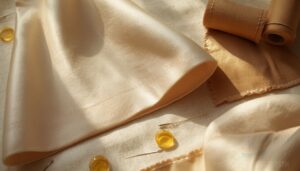
The way you finish a garment says just as much as the way you begin it. In couture, every hem, seam, and bound edge is treated as its own small construction — not an afterthought.
Here’s what you need to know to close out your work with the same care you put into every stitch before it.
Blind Hem, Catchstitch, and Figure-eight Hems
Three stitches define couture hemming methods: the blind stitch, blind catchstitch, and figure-eight stitch — each built around stitch visibility control and hem edge tension.
Thread color matching is non‑negotiable.
The blind catchstitch adds elasticity for heavier fabrics; the figure‑eight stitch resists fabric slip on crepes.
Always prioritize seam allowance pressing before any edge finishes to keep the hem crisp and invisible.
Faced Hems for Curved Edges
Faced hems are where couture hemming methods earn their name. For curved edges, Curve Bias Cutting the facing allows it to flex without pulling — paired with Tension Pinning Technique every few millimeters for even ease distribution.
Key steps include:
- Apply Interfacing Stabilization to prevent sagging
- Understitch Edge Control to stop rolling
- Hand basting before final attachment
- Steam-press the curve flat
- Bias Binding Alternative on tight curves
French Seams for Clean Interiors
French seams are the quiet signature of a disciplined interior. Two-Pass Construction locks raw edges inside two successive seam lines — first wrong sides together, then right sides — delivering Interior Smoothness Benefits with no exposed threads.
| Step | Seam Width Precision |
|---|---|
| First pass | 3/8 inch (9–10 mm) |
| Trim & press | Remove bulk evenly |
| Second pass | 1/4 inch (6 mm) |
| Final press | Flat, clean finish |
This Fray Resistant Finish makes French seams indispensable for Lightweight Fabric Suitability — silk, voile, chiffon — anywhere Couture garment construction demands an interior as refined as the exterior.
Hong Kong Binding and Self-bound Seams
Hong Kong binding is the mark of a couture interior that means business. Where French seams suit delicate sheers, Hong Kong binding manages unlined jackets, vests, and trousers with equal elegance, wrapping each seam allowance in bias cut technique strips — generally 1 to 1¼ inches wide — before stitching in the ditch to secure them flat.
- Binding width selection controls seam bulk management, keeping heavier fabrics from puckering or rolling at the interior edge.
- Curved seam binding requires easing the bias strip gently around bends, maintaining smooth tension without distortion.
- Contrasting silk in interior color accents transforms a plain interior into a quiet flourish of craftsmanship.
Self-bound seams take a different approach: one seam allowance folds over the other, encasing the raw edge entirely — a refined, minimal finish for lightweight wovens where edge finishes and seam finishing techniques must preserve drape above all else. Both methods reflect couture sewing at its most intentional.
Linings, Waistbands, and Petersham Stays
Linings do more than hide seam allowances — breathable lining fabrics like cupro and lightweight viscose wick moisture while preserving drape.
Couture waistbands depend on structured waistband construction: interfacing resists stretch, waistband topstitch detailing crisp the edge, and Petersham placement tips guide you to stitch the stay just above the seam line.
Interlinings, boning, and padding complete the structural reinforcement underneath.
Top 4 Couture Sewing Tools
The right tools don’t just make couture sewing easier — they make precision possible. Every technique you’ve learned in this guide depends, in part, on having the right equipment in your hands.
Here are four tools worth adding to your atelier.
1. Beaditive Magnetic Pin Cushion
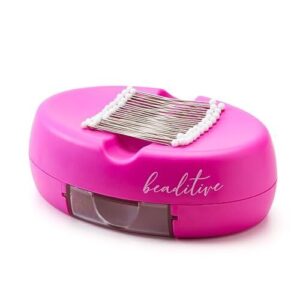
precision is everything, a stray pin on the floor is more than an annoyance — it’s a hazard and a workflow interruption.
Beaditive Magnetic Pin Cushion (Model P-101) keeps that from happening.
Its magnetized surface holds pins and needles firmly in place, and flipping it upside-down sweeps up any that escape. The hinged front drawer stores extras separately, and at 4.09 × 2.76 inches, it fits neatly beside your cutting table or inside your sewing bag.
At $12.99, it’s a practical daily tool.
| Best For | Sewists and crafters who want a tidy, grab-and-go pin storage solution that also doubles as a quick cleanup tool when pins hit the floor. |
|---|---|
| Primary Material | Plastic & permanent magnet |
| Primary Use | Pin organization |
| Storage Included | Built-in magnetic surface |
| Durability Rating | Moderate |
| Price Range | Under $15 |
| Beginner Friendly | Yes |
| Additional Features |
|
- The magnetic surface keeps pins and needles right where you need them, no digging around
- Flipping it upside-down picks up scattered pins fast — genuinely handy
- Small enough to toss in a sewing bag and take anywhere
- The hinged drawer can be stiff and has broken on some users over time
- Included pins are decent, but don’t expect anything premium
- At $12.99, it’s a little pricier than similar options out there
2. Colored Ball Glass Sewing Pins
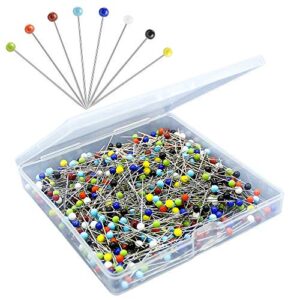
Where the magnetic cushion keeps your pins organized, the pins themselves still need to perform — and colored ball glass sewing pins deliver where it counts.
The stainless-steel shafts stay sharp through dozens of fittings, piercing multiple layers without bending.
Glass heads resist heat up to around 210 degrees, so you can press right over them.
The six-color set also lets you code different seam allowances or fitting stages at a glance — a small detail that quietly saves real time.
| Best For | Sewists and quilters working with regular to heavy fabrics who want sharp, durable pins they can color-code across multiple projects. |
|---|---|
| Primary Material | Stainless steel & glass |
| Primary Use | Fabric pinning |
| Storage Included | Snap-close plastic box |
| Durability Rating | High |
| Price Range | Under $15 |
| Beginner Friendly | Yes |
| Additional Features |
|
- Stainless-steel shafts stay sharp and don’t bend, even through thick layers
- Six colors make it easy to sort pins by project, seam allowance, or fitting stage
- 500 pins with a snap-close storage box is great value for busy hobbyists or studio use
- Glass heads can chip or break if dropped or handled roughly
- Some buyers have reported receiving closer to 400 pins instead of the full 500
- Not the best choice for delicate or sheer fabrics due to occasionally rough head surfaces
3. Snavida Fabric Shears Sewing Kit
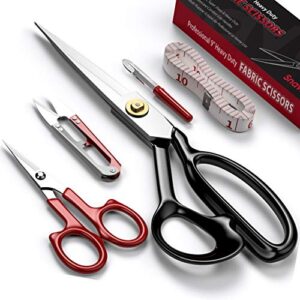
Sharp blades matter just as much as sharp pins. The Snavida Fabric Shears Kit gives you high-carbon steel blades with a titanium coating — built to slice cleanly through up to 32 fabric layers, including denim and canvas, without dragging or fraying.
The ergonomic soft-grip grips balance the weight so your hand doesn’t tire mid-cut.
At $16.98, the set includes 9-inch shears, 5.2-inch precision scissors, and a measuring tape — everything within reach when you’re working through a complex layout.
| Best For | Sewers and crafters who regularly cut through heavy or multi-layer fabrics like denim, canvas, or leather and want a solid all-in-one kit without spending a lot. |
|---|---|
| Primary Material | High-carbon titanium-coated steel |
| Primary Use | Fabric cutting |
| Storage Included | Dedicated storage box |
| Durability Rating | High |
| Price Range | Under $20 |
| Beginner Friendly | Yes |
| Additional Features |
|
- Cuts through up to 32 fabric layers cleanly — no dragging, no fraying, just smooth single-pass cuts.
- Ergonomic weighted handles take the strain off your hand during long cutting sessions like quilting or pattern layout.
- Comes with everything you need: 9-inch shears, 5.2-inch precision scissors, and a measuring tape, all under $17.
- The 9-inch shears are on the heavier side, so anyone dealing with arthritis or limited grip strength may find them tiring to use.
- The small precision scissors aren’t as sharp as higher-end options, which can be frustrating for detailed or fine-finish work.
- The measuring tape and accessories feel a bit flimsy — functional, but probably not built to last for years of heavy use.
4. KR LIF Mesh Ironing Press Cloth
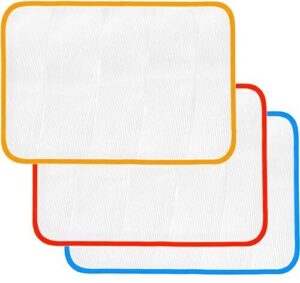
Every seam you press is a commitment — and the KR LIF Mesh Ironing Press Cloth makes sure heat does its job without wrecking your work. The see-through polyester mesh distributes steam evenly while keeping the iron plate away from zippers, beadwork, and delicate surfaces.
At 24 × 16 inches, it covers full garment sections comfortably.
It’s machine-washable, reusable, and built for repeated sessions.
Just watch your heat settings — the mesh can’t handle temperatures pushed beyond its range.
| Best For | Sewers and garment makers who regularly press delicate fabrics, seams, and hardware-heavy pieces and want to protect both their clothes and their iron. |
|---|---|
| Primary Material | Heat-resistant polyester mesh |
| Primary Use | Fabric pressing |
| Storage Included | Reusable cloth set |
| Durability Rating | Moderate |
| Price Range | Under $20 |
| Beginner Friendly | Yes |
| Additional Features |
|
- Shields silk, lace, and synthetics from direct heat so you’re not gambling with your nicest fabrics
- Safe to iron right over zippers and snaps without scratching the iron plate
- Machine-washable and reusable, so it holds up through a lot of sessions
- Mesh can melt if you crank the iron too high, so you have to stay mindful of your heat setting
- Color is random — no say in what you get
- At 24 × 16 inches, it’ll feel small fast if you’re working on curtains or bedding
Frequently Asked Questions (FAQs)
How do you source authentic couture-quality fabrics?
Source authentic couture-quality fabrics directly from high-end mills or authorized dealers who provide mill certificates, lot numbers, and origin documentation — that paper trail is what separates genuine couture weight from an imitation.
Whats the average cost of a couture garment?
So what does couture actually cost?
Most gowns fall between sixty thousand and eighty thousand dollars, with intricate wedding pieces often exceeding two hundred thousand — a reflection of the thousands of hours and masterful craftsmanship behind every seam.
Can couture techniques be used for home sewing?
Absolutely — and many home sewers already do it without realizing.
Techniques like hand basting, slip stitching, and muslin tiles are completely achievable at home, bringing that same precision and refinement to your own projects.
How many fittings does a couture piece require?
A couture piece generally requires three to four fittings before cutting into final fabric, with additional mid-construction sessions and a final check — meaning six or more fittings total for complex designs.
What career paths exist in couture construction?
Think couture is just sewing pretty dresses? Try again. You can build a career as an atelier director, patternmaking specialist, hand sewing master, fittings coordinator, or atelier project manager.
How is boning installed in couture bodices?
Boning slides into fabric channels stitched along the bodice seams, cut slightly short of each channel’s end so the tips never poke through, then capped to protect both fabric and wearer.
What embellishment techniques define haute couture garments?
Hand-applied beading, tambour embroidery, silk-thread motifs, and layered appliqué define haute couture embellishment — each technique executed slowly, deliberately, and entirely by hand to build surface richness that no machine can replicate.
How do couture makers source luxury fabrics?
Couture makers source luxury fabrics through long-standing relationships with mills like Loro Piana and Lyon silk producers, attending trade fairs such as Première Vision to secure exclusive runs, custom colorways, and small-batch weaves reserved specifically for couture orders.
What role do custom mannequins play in construction?
Custom mannequins mirror your client’s exact proportions, letting you test drape, seam placement, and silhouette before cutting a single inch of precious fabric — catching costly fit errors early.
How is beadwork applied without distorting the fabric?
Applying beadwork without distorting fabric starts with the right foundation — a woven interfacing beneath the beaded area anchors each bead securely and prevents sinking, keeping your surface flat and your drape intact.
Conclusion
Like a seam pressed from the inside out, couture sewing construction methods shape a garment in ways no one sees but everyone feels. Every grain-perfect cut, every hand-basted fitting, every blind hem worked in silk thread—these aren’t decorations.
They’re decisions that determine how a garment moves, holds, and endures.
You now have the technical foundation to build with that same intention.
Stop sewing. Start engineering.
- https://www.harpersbazaararabia.com/couture/what-is-haute-couture
- https://so-sew-easy.com/lost-art-hand-sewing/
- https://www.youtube.com/watch?v=D4ga_iL8AbQ
- https://www.reddit.com/r/sewing/comments/tvt1tb/how_many_hours_does_it_take_you_to_sew_an_average/
- https://www.threadsmagazine.com/2020/02/10/couture-hand-stitches-the-backstitch-and-the-pickstitch