This site is supported by our readers. We may earn a commission, at no cost to you, if you purchase through links.
Skipping stabilizer doesn’t just risk a wrinkled design—it can destroy a garment entirely. 15,000-stitch logo on jersey fabric without proper cut-away backing will pucker, shift, and fray within two washes.
The fabric moves; the stitches don’t. Something has to absorb that conflict, and without stabilizer, the embroidery loses every time.
Stabilizer is the silent variable controlling stitch tension, edge definition, and long-term durability. Get it wrong—wrong type, wrong weight, wrong placement—and even a perfectly digitized design falls apart. Get it right, and your work holds clean lines through years of wear.
Table Of Contents
- Key Takeaways
- Stabilizer Directly Shapes Your Embroidery Quality
- The Main Types of Embroidery Stabilizers Explained
- Backing Vs. Topping — Placement Changes Everything
- Match Your Stabilizer to Your Fabric Type
- Design Density is The Factor Everyone Ignores
- Stabilizer Weight Matching Prevents Most Quality Failures
- Common Stabilizer Mistakes and How to Avoid Them
- Special Situations That Require Stabilizer Adjustments
- Choosing The Right Stabilizer Brand and Storing It Properly
- Frequently Asked Questions (FAQs)
- Conclusion
Key Takeaways
- Stabilizer isn’t optional backing — it’s what keeps every stitch from pulling, puckering, or falling apart after two washes.
- Match your stabilizer type to your fabric: cut-away for stretch, tear-away for wovens, and wash-away for sheers — getting this wrong wrecks even a perfect design.
- Design density drives stabilizer weight; anything over 15,000 stitches needs heavy or double-layer support, not whatever’s already on your shelf.
- Store stabilizers at 60–75°F with controlled humidity, and always run a test swatch before production — skipping either step turns small mistakes into expensive rework.
Stabilizer Directly Shapes Your Embroidery Quality
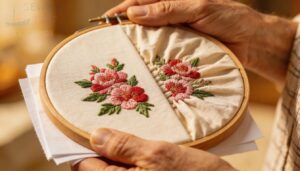
Stabilizer isn’t just a backup player — it’s the reason your embroidery holds together or falls apart. Get it wrong, and even a perfect design will pucker, shift, or lose its shape by the third stitch.
Choosing the right stabilizer for your specific fabric and design is easier when you have a solid reference, like this guide to embroidery stabilizers for small businesses that breaks down exactly which types prevent puckering and shifting.
Stabilizer doesn’t support your embroidery — it’s the reason it holds together at all
Here’s exactly how stabilizer controls your results.
How Stabilizer Prevents Puckering and Distortion
Every stitch pulls your fabric — grain alignment fights that pull by keeping the stabilizer’s grain perpendicular to the stretch direction. Proper hoop tension paired with the right stabilizer weight creates stitch tension balance across the whole design.
Edge support stops distortion from radiating outward.
Match your stabilizer to your fabric types correctly, and fabric puckering and fabric distortion simply don’t get a foothold.
Why Missing Stabilizer Ruins Even Great Designs
Skip the stabilizer and even a spotless design falls apart. Hoop pressure alone can’t hold fabric steady — without proper backing, stitch pull drags threads in every direction.
You get design shift, edge fraying, and fabric distortion that no amount of tension adjustment fixes afterward. Thread breakage follows.
Puckering prevention starts before the first stitch, not after the damage is done.
Using a cutaway stabilizer for stretchy fabrics provides lasting support through washes.
The Link Between Stabilizer Choice and Stitch Definition
Wrong stabilizer doesn’t just cause puckering — it blurs your stitches entirely. Poor grain alignment impacts, shifting fibers mid‑stitch, and needle plate interaction suffers when backing is too thin. Thread tension balance collapses fast.
- Heat transfer effects stiffen fabric when stabilizer is too heavy for delicate designs
- Post wash residue from wrong backing softens stitch edges over time
- Design density and stabilizer weight must align — mismatches blur satin columns instantly
The Main Types of Embroidery Stabilizers Explained
Not all stabilizers are built the same, and picking the wrong one is where most embroidery problems start. Each type is designed for a specific job — and once you know what that job is, the right choice becomes obvious.
Here’s a breakdown of the four main types you’ll actually use.
Tear-Away Stabilizer — Best for Woven Fabrics
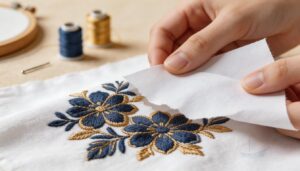
Tear-away stabilizer is your go-to for woven fabrics — cotton, linen, percale, sateen. holds steady through stitching, then peels away cleanly.
layer removal technique is simple: tear with the weave direction alignment to avoid pulling threads.
It nails thread tension balance and stitch visibility control without sacrificing fabric drape preservation. Dense fills, clean edges, zero distortion.
Cut-Away Stabilizer — Permanent Support for Stretch Fabrics
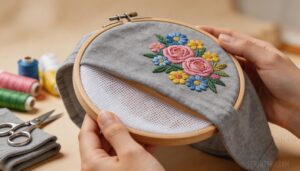
Unlike tear-away, cutaway stabilizer stays put — permanently bonded beneath stretchy fabrics like jersey, spandex, and knits. That’s what makes it essential for fabric distortion prevention.
It manages repeated washing, resists heat, and enables colorfastness compatibility without breaking down.
Weight matching matters here: choose medium to heavy for dense fills. The result? Continuous edge support, post-embroidery flexibility, and stitch quality that holds up long-term.
Wash-Away Stabilizer — Ideal for Sheers and Lace
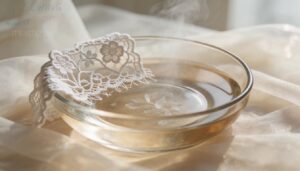
Sheer fabrics expose everything — including backing you don’t want showing. That’s where wash-away stabilizer earns its place.
It dissolves completely in warm water, with temperature-accelerated wash speeding up the stabilizer dissolution rate considerably.
For freestanding lace, it’s the only option — no fabric, just thread. You get clean lace edge definition, thread visibility enhancement without residue, and zero fabric distortion.
Eco-friendly wash-away formulas make cleanup simple.
Fusible and Adhesive Stabilizer Variants
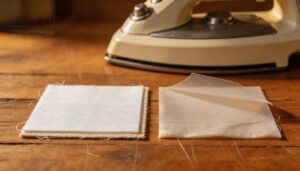
Two stabilizer variants often get lumped together — they’re not the same thing.
Fusible stabilizer bonds to fabric using heat (275–350°F), creating a permanent layer. Adhesive stabilizer grips without heat, peels away cleanly after stitching.
Here’s when each wins:
- Heat Activation Range suits fusible on stable wovens needing rigid base support.
- Fabric Sensitivity makes adhesive the safer pick for delicate or heat‑reactive synthetics.
- Removal Techniques differ — adhesive releases clean; fusible stays permanently bonded.
Match the method to your fabric.
Backing Vs. Topping — Placement Changes Everything
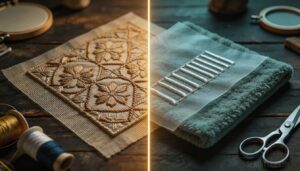
Where you put your stabilizer matters just as much as which type you choose. Underneath the fabric, on top of it, or used to float the piece entirely — each placement does a different job.
Here’s when to use each one.
When to Use Stabilizer Underneath The Fabric
Most of your fabric distortion problems start before you even thread the needle. Placing stabilizer underneath is your first line of defense — it manages fabric stretch management, controls thread tension, and provides delicate fiber support from below.
| Situation | Use Underneath |
|---|---|
| Knits stretching | Cut-away backing |
| Woven cotton shifts | Tear-away underlay |
| Dense fills above 15k stitches | Heavy cut-away |
| Slippery or sheer fabrics | Light wash-away |
Underlay grain orientation matters too — align it perpendicular to the fabric stretch. That reduces pull dramatically. Matching stabilizer to fabric types isn’t guesswork; it’s stabilizer selection based on design density and stabilizer weight grading working together.
When to Place Stabilizer on Top of The Fabric
topping stabilizers sit on top of your fabric — not underneath. They’re your secret weapon for Edge Crispness Control on textured surfaces where stitches sink and disappear.
| Situation | Topping Type | Benefit |
|---|---|---|
| Towels/fleece | Water soluble topping | Prevents stitch sink-in |
| Metallic threads | Heat away topping | Metallic Thread Support |
| 3D motifs | Spray baste layer | 3D Motif Lift control |
Delicate Fabric Protection and Hoop Alignment Guidance improve when your topping stays flat and residue‑free after removal.
Using Adhesive and Sticky Stabilizers to Float Fabric
Sticky stabilizers do something most sewers overlook — they let your fabric float, free from hoop pressure and drag.
| Situation | Float Benefit |
|---|---|
| Sheer Fabric Float | Reduces stabilizer imprint lines |
| Float Height Adjustment | Controls edge distortion |
| Repositionable Adhesive Limits | Allows 4–6 repositions |
| Moisture Tack Effect | Humidity dulls grip fast |
| Adhesive Residue Removal | Damp cloth clears film |
This fabric support material eliminates fabric distortion without bulk. That’s the stabilizer impact on stitch quality, working invisibly.
Match Your Stabilizer to Your Fabric Type
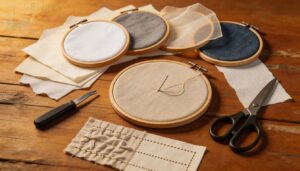
The fabric sitting in your hoop determines everything about which stabilizer belongs under it. Get that match wrong, and even a perfect design falls apart — puckered edges, warped outlines, the works.
Here’s exactly how to pair each fabric type with the right support.
Knits, Jersey, and Spandex — Always Use Cut-Away
Knits, jersey, and spandex stretch up to 50% — and that movement destroys embroidery without the right support.
Cut away stabilizer for stretch fabrics is non-negotiable here.
It controls fabric relaxation after stitching, helps thread break prevention, and maintains stitch definition.
Match stabilizer weight to your fabric weight, mind hoop tension, and align the grain perpendicular to the stretch.
Stabilizer impact on stitch quality in action.
Silk, Chiffon, and Organza — Tear-Away or Wash-Away Only
Delicate fabrics like silk, chiffon, and organza demand tear-away or washaway stabilizer — nothing heavier. Light stabilizer protects drape preservation and hand feel while ensuring residue elimination after finishing.
Washaway dissolves cleanly, maintaining light transmission and sheen control without stiffness.
Wrong stabilizer weight grading on these fabric types causes immediate fabric distortion.
Keep it light, keep it right.
Denim, Leather, and Heavy Fabrics — Double-Layer Cut-Away
Heavy fabrics like denim and leather punch back.
One layer of cutaway stabilizer won’t hold.
Double stabilizing gives you two layers of cut-away that absorb needle deflection control, lock in stitch alignment precision, and handle heat dissipation management on thick surfaces.
Grain direction alignment matters here too — keep it perpendicular to stretch.
Edge roll reduction follows naturally.
Two layers.
No shortcuts.
Towels and Fleece — Combine Topping With Backing
Towels and fleece aren’t like denim — they’re soft, fluffy, and deceptive. That pile swallows stitches whole if you skip topping.
- Use a washaway stabilizer as topping to control fiber shedding and prevent stitch burial
- Layer a cutaway stabilizer underneath for stabilizer grain alignment and permanent backing support
- Keep light topping bulk minimal — heavy topping ghosts dense areas
Water-soluble stabilizer rinses clean. Done right, your stitches sit on top, not inside.
Design Density is The Factor Everyone Ignores
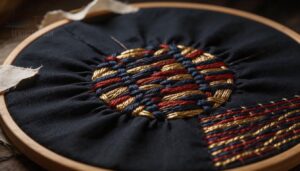
Most embroiderers obsess over fabric type and forget to think about stitch count — and that’s where things fall apart. Your design’s density puts real physical stress on the fabric, and your stabilizer has to match that load.
Here’s what changes based on how dense your design actually is.
Low Stitch Count Designs and Light Stabilizer Use
Low stitch count doesn’t mean no support — it means smarter support. Light stabilizer preserves fabric drape preservation while keeping stitch quality clean on small motifs.
For minimalist design support, one thin layer is usually enough. Match your weight matching to design density, not habit.
Proper thread tension adjustment and motif placement strategy together boost edge definition enhancement without crushing the fabric beneath it.
High Stitch Count Designs Above 15,000 Need Heavy Support
Once you hit 15,000 stitches, everything changes.
Dense designs demand heavy stabilizer — specifically 2.0 ply count selection — to stop fabric show-through, cold.
Double stabilizing keeps tension even across long runs. Machine speed adjustment and thread tension calibration prevent thread breaks.
Heat dissipation strategies reduce stress on fabric. Hoop compression management stops ugly hoop marks.
Weight matching here isn’t optional — it’s what separates clean stitch quality from a wrecked project.
Fill Coverage Above 70% Demands Medium to Heavy Stabilizer
Fill coverage past 70% puts serious stress on your fabric. Every stitch row compounds the pressure — and without medium to heavy stabilizer, you’ll see puckering fast.
Stabilizer compression spreads needle impact evenly. Hoop tension balance stops fabric flutter. Thread tension tuning keeps satin stitches flat. Fabric stretch control prevents edge pull on dense designs.
Get these four right:
- Match heavy stabilizer to heavy stitch count design
- Tune thread tension down slightly with stable backing
- Monitor needle heat management at high speeds
- Check stabilizer impact on stitch quality on a test swatch first
Double Stabilizing for Ultra-Dense Embroidery Designs
Some designs just don’t forgive a single layer. Double stabilizing for ultra-dense designs means pairing cut-away beneath with a lighter topping above — that’s your layered tension control working both sides at once.
Designs over 15,000 stitches stay flat, edges sharpen through edge crispness optimization, and thread break prevention improves dramatically.
Stabilizer weight selection determines everything here. Two smart layers beat one heavy guess.
Stabilizer Weight Matching Prevents Most Quality Failures
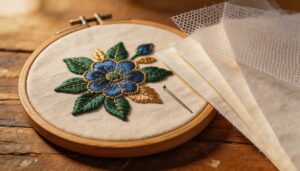
Getting the weight right is where most embroidery projects either hold together or fall apart. It’s not just about picking a stabilizer — it’s about the right amount of it.
Here’s what you need to know to nail that balance every time.
The Feel Test — Avoiding Cardboard Rigidity or Lettuce Flop
Your hands already know the answer — you just have to ask them. The feel test is simple: hoop your swatch, stitch a sample, then press it. That’s your Pressure Test, Flexibility Check, and Drape Assessment rolled into one.
Use this Stiffness Scale during Swatch Evaluation:
- Cardboard feel — way over-stabilized
- Slight resistance — perfect
- Smooth give — acceptable
- Soft flop — under-stabilized
- Curling edges — tension imbalance
Stabilizer weight and fabric compatibility live in that press.
Layering Thin Stabilizers for Adjustable Support
Think of layering thin stabilizers like building a sandwich — each layer adds exactly what you need, nothing more.
| Layer Setup | Cross‑layer Angles | Best For |
|---|---|---|
| Single light sheet | 0° (no rotation) | Simple, low‑density designs |
| Sequential Layering (2 sheets) | 45° grain alignment shift | Medium knits, adjustable backing |
| Support Gradient (3 sheets) | 90° rotation each layer | Dense fills, stretch fabrics |
This stabilizer layering technique keeps your backing soft, not board‑stiff.
How Over- and Under-Stabilizing Both Damage Results
Layering gives you control — but only if you get the balance right.
Too much stabilizer causes excessive stiffness, which cracks under flexing and triggers stitch migration in dense fills. Too little means fabric creep and hoop slip, pulling satin borders out of alignment.
Both failures distort your finished piece.
Stabilizer weight and fabric compatibility aren’t optional — they’re the whole game.
Common Stabilizer Mistakes and How to Avoid Them
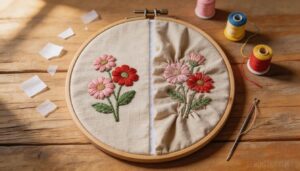
Most embroidery problems trace back to the same handful of mistakes — and they’re all avoidable. Knowing where things go wrong puts you ahead of 90% of stitchers who just guess and hope.
Here’s what to watch out for.
Using Tear-Away on Stretchy Fabric Warps Outlines
Grab a stretch fabric and run tear-away under it — you’ll watch the outline warp in real time. Tear-away stabilizer can’t hold stretchy fabrics still. The grain alignment fights you, halo removal becomes a frustration, and fabric distortion sets in fast.
For embroidery quality that lasts, stabilizer selection matters. Use cut-away instead. Peel technique and edge reinforcement won’t save a wrong choice.
Skipping The Test Swatch Before Final Production
Skipping a test swatch is how costly rework starts. One missed swatch run opens the door to production delays, quality assurance gaps, and color migration risks nobody catches until hundreds of pieces are trimmed.
Run a proper stitch test first:
- Cut swatches from your actual production fabric roll
- Hoop and run the full embroidery sequence at project speed
- Inspect for puckering, distortion, and backing adhesion
- Document tension adjustments and stabilizer choices
- Use results to close operator training gaps before the final run
Your tear test and stitch test together confirm stabilizer impact on stitch quality and durability before anything goes wrong at scale.
Applying Too Many Layers Creates Bulk and Tension Issues
More isn’t always better. Stacking beyond two layers triggers real problems — stiffness increase of 20–40%, edge ridges that throw off line work, and moisture trapping that fuzzes thread edges.
| Layer Problem | What It Costs You |
|---|---|
| Heat Buildup | Scorch risk in 1–3 seconds |
| Needle Skipping | 8–12% more misalignment |
Stabilizer layering guidelines exist for a reason. One right layer beats three wrong ones.
Removing Stabilizer Incorrectly Damages Embroidered Fabric
Ripping stabilizer out fast is a rookie mistake. Aggressive pulls cause thread slippage, visible fiber pull damage, and loose stitch edges — especially on satin fills.
Adhesive residue left behind stiffens the fabric and traps odors.
Heat shrinkage effects hit hardest on synthetics when you remove it warm.
Use proper stabilizer removal techniques: trim close, pull slow, and keep fabric flat to avoid distortion.
Special Situations That Require Stabilizer Adjustments
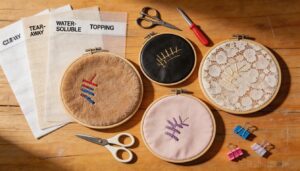
Some projects don’t play by the usual rules, and that’s when stabilizer choices get real. Towels, leather, lace, and light-colored garments each come with their own set of problems.
Here’s how to handle the ones that trip up even experienced embroiderers.
Embroidering Bath Towels With Wash-Away Topping
Terry cloth is basically a stitching nightmare — all those loops want to swallow your design whole. That’s where wash-away stabilizer earns its keep.
Lay it over the nap before you stitch. It suspends your thread above the loops, protecting stitch tension and definition.
Pre-wash treatment shrinks the towel first. Post-embroider care is simple: soak 5–15 minutes, and it’s gone.
Leather Projects — Magnetic Hoops and Heavy Cut-Away
doesn’t forgive mistakes. Clamp it too tight, and you’re left with hoop marks that won’t disappear.
That’s why magnetic hoop setup exists — opposing magnets hold the piece flat without crushing the surface.
Pair that with heavy cut-away stabilizer (around 3.2 oz) underneath, and you’ve got serious leather tension control.
Use light adhesive spray to prevent shifting, and stitch depth prevention stays consistent throughout.
Freestanding Lace and 3D Designs Using Wash-Away Only
Freestanding lace FSL is pure wash away stabilizer — no fabric, no backing, just stitches holding themselves together. Stitch balance is everything here.
Negative space control keeps open motifs from sagging once the stabilizer dissolves.
For 3D embroidery projects, use layered wash-away to support height.
Temperature soak matters too — too hot, too fast, and delicate edges distort before edge finishing even begins.
No-Show Mesh Cut-Away for Light-Colored Garments
No-show mesh cut-away is the quiet workhorse for light-colored garments. Solid backing shows through pale fabric — mesh doesn’t. Here’s what it performs well:
- Mesh Visibility stays near zero on white or cream shirts
- Light Fabric Handfeel stays soft — no cardboard stiffness after trimming
- Edge Wobble Control keeps small lettering crisp and clean
- Airflow Comfort stays intact since mesh is low-profile
Stitch Ripple Reduction improves dramatically too. It’s your go-to light stabilizer for breathable cotton and linen blends.
Choosing The Right Stabilizer Brand and Storing It Properly
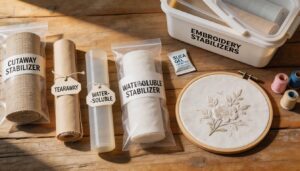
Brand and storage decisions matter more than most embroiderers realize. The wrong stabilizer — or one that’s been sitting in a damp closet — can quietly ruin a clean design.
Here’s what to look for before you buy and how to keep what you have working properly.
What to Look for When Buying Embroidery Stabilizer
Not all stabilizers are created equal — and buying the wrong one wastes your time and ruins your project.
When choosing the right embroidery stabilizer, check these three things: material consistency, tackiness level, and colorless backing. Uneven texture signals weak stitch support. Poor tackiness means fabric shift. Dye transfer stains light garments.
| What to Check | Why It Matters | What to Avoid |
|---|---|---|
| Material Consistency | Stabilizer impact on stitch quality | Uneven light/dark spots |
| Solubility Rating | Fabric type compatibility | Residue on shears |
| Price-Performance Ratio | Stabilizer weight value | Cheap, inconsistent sheets |
Match stabilizer types and their uses to your actual fabric.
Why Big-Box Store Stabilizers Often Underperform
Big-box stores look convenient, but the stabilizer quality often falls short. Inconsistent fiber quality means uneven support across the sheet — and you won’t notice until stitches pucker.
Weight labeling gaps leave you guessing. Adhesive formulation flaws cause fabric shift mid-run. Dye migration issues stain light garments.
Avoiding low-quality stabilizers from big-box stores protects your stabilizer’s impact on stitch quality when stabilizer selection actually matters.
Storing Stabilizers to Maintain Consistent Quality
Once you’ve sourced quality stabilizer, don’t ruin it with bad storage. Temperature Control and Humidity Management matter more than most people realize — keep rolls between 60–75°F with 40–60% humidity.
- Airtight containers with desiccant packs protect Packaging Integrity.
- FIFO Inventory Rotation prevents aging stock from slipping into production.
- Shelf Life Monitoring catches degraded adhesive before it costs you a ruined run.
Frequently Asked Questions (FAQs)
Do you embroidery on top of stabilizer?
Usually, no. The stabilizer goes underneath as embroidery backing.
But on pile fabrics, you place a Heat‑Activated Topping or wash‑away sheet on top for Stitch Depth Management and clean Pile Fabric Handling.
Does stabilizer choice impact machine speed and performance?
Yes. Wrong stabilizer weight raises needle deflection risk, spikes heat buildup, and forces feed rate adjustment. That combo kills stitch quality fast and drives up thread breakage across dense runs.
How does grain direction influence final stitch alignment?
Grain alignment controls stitch precision. When your hoop orientation matches the fabric grain direction, stitch skew reduction happens naturally.
Misalign them, and fabric tension interaction pulls stitches sideways. Grain-aware design eliminates that distortion before it starts.
Can stabilizers be reused across multiple embroidery projects?
Reusing stabilizer sounds smart — until your stitches shift mid-run.
Tear-away scraps work with patch techniques under 5,000 stitches.
Cut-away’s lifespan ends after one pass.
Wash-away scrap recycling dissolves leftovers into fabric stiffener.
How does stabilizer affect embroidery durability after repeated washing?
Cut-away stabilizer holds stitch integrity through 50+ wash cycles with under 3% dimensional drift. Washaway dissolves completely, leaving no fabric creep. Thread retention fails fast without proper backing.
Conclusion
The ball is in your court now. Mastering stabilizer isn’t rocket science, but it does take practice and patience.
When you get it right, your embroidery designs will shine like a pro’s. Remember, how does stabilizer affect embroidery quality? It makes or breaks the final product.
Choose the right type, weight, and placement, and you’ll be creating stunning, long-lasting designs. Fix it right, and your work will stand the test of time, with every stitch telling a story.
- https://allstitch.com/collections/water-soluble-stabilizers-for-machine-embroidery
- https://www.superiorthreads.com/education/water-soluble-stabilizer
- https://makema.de/en/collections/vliese-wasserloeslich
- https://www.magnetichoop.com/pl/products/wash-away-embroidery-stabilizer-water-soluble-backing-for-lace-cutwork-sheer-fabrics-and-freestanding-lace-12x25yd-roll
- https://alinaline.com/free-standing-lace-embroidery-facts