This site is supported by our readers. We may earn a commission, at no cost to you, if you purchase through links.
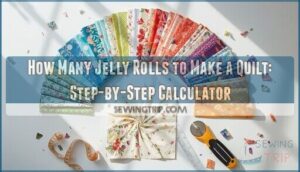
You stare at those gorgeous fabric strips rolled up like a rainbow burrito, then at your quilt pattern, then back at the jelly roll. The question hits: is one enough? Spoiler alert—it rarely is, and buying too few means scrambling for matching fabric later (good luck with that). Most quilters learn this lesson the expensive way.
The number of jelly rolls you need depends on your quilt size, pattern complexity, and how much fabric waste you’re willing to accept. A baby quilt might devour one pack, while a queen-size project can gulp down three or more. Getting this calculation right from the start saves you money, time, and the heartbreak of a half-finished masterpiece.
Table Of Contents
- Key Takeaways
- What is a Jelly Roll in Quilting?
- How Many Jelly Rolls for Each Quilt Size?
- Calculating Jelly Rolls Needed for Your Quilt
- How Quilt Patterns Impact Jelly Roll Requirements
- How Much Area Does One Jelly Roll Cover?
- Are Jelly Rolls Enough for a Complete Quilt?
- Tips for Choosing Jelly Rolls for Quilts
- Common Mistakes When Estimating Jelly Rolls
- Essential Tools and Techniques for Jelly Roll Quilts
- Frequently Asked Questions (FAQs)
- Conclusion
Key Takeaways
- A single jelly roll (40 strips at 2.5″ × 42″) covers roughly 3,200 square inches after seam allowances, which means baby quilts need 1-2 rolls while queen-size projects require 3-4 rolls minimum.
- Your pattern choice directly impacts fabric waste—straight strip quilts maximize efficiency and can reduce waste by 15-30%, while complex designs with angled cuts devour significantly more fabric.
- Most jelly rolls won’t complete an entire quilt on their own because you’ll need additional yardage for borders, backing, and binding that patterns assume you’ll purchase separately.
- Underestimating seam allowances and ignoring pattern-specific fabric waste are the two most common mistakes that leave quilters short on strips mid-project, so always calculate with a 10% buffer and account for your specific pattern’s cutting requirements.
What is a Jelly Roll in Quilting?
You’ve probably heard quilters raving about jelly rolls, but what exactly are they? These pre-cut fabric bundles have changed the game for quilters who want coordinated fabrics without the hassle of measuring and cutting dozens of strips.
Let’s break down what makes a jelly roll worth adding to your quilting toolkit.
These pre-cut strips open up a range of quilting techniques using jelly rolls that save time while delivering beautiful, professional results.
Standard Jelly Roll Size and Strip Count
A standard jelly roll gives you 40 precut fabric strips—each measuring 2.5 inches wide by 42–44 inches long. That strip length variance means you’re working with roughly 40–42 yards of total roll yardage, making jelly roll dimensions incredibly efficient for quilt size calculation.
Many beginners rely on beginner-friendly quilt patterns that specifically call for jelly rolls to streamline their first projects and avoid overwhelming fabric calculations.
The consistent fabric strip width eliminates tedious cutting, so you can dive straight into jelly roll quilting with precut fabric efficiency that saves hours.
Beginners can explore easy quilting projects that showcase how jelly rolls transform simple designs into stunning finished quilts.
Benefits of Using Jelly Rolls
Beyond cutting hours off your prep work, jelly rolls give you creative freedom with fabric variety—40 coordinated strips that solve color coordination headaches in one shot.
You’ll breeze through jelly roll quilt patterns with quilting efficiency that lets you focus on piecing instead of planning.
Time savings and ready-made fabric strips mean more quilts, less hassle, and perfect matches every time.
How Many Jelly Rolls for Each Quilt Size?
The number of jelly rolls you need depends entirely on the size of quilt you’re making. Smaller quilts like baby blankets use less fabric, while king-size projects require considerably more strips.
Here’s a breakdown of typical jelly roll requirements for each standard quilt size.
Baby, Lap, Throw, Twin, Queen, and King Quilts
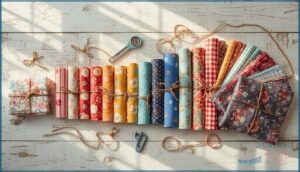
Each quilt size variation demands different jelly rolls and fabric selection to nail your vision. Here’s what you need to own your next project:
- Baby quilts: 1–2 jelly rolls cover most strip patterns (30–36 inches)
- Lap quilts: 2–3 rolls for 50–60 inch designs
- Throw quilts: 2–3 rolls, 50×70 inch layouts
- Twin quilts: 3–4 rolls for 68×86 inch coverage
- Queen/King quilts: 4–8 rolls depending on scale
Quick Reference Chart for Jelly Roll Needs
You need a clear roadmap to hit your fabric goals. This chart breaks down jelly roll needs by quilt dimensions—baby through king—so you can grab what you need and start sewing.
Each size shows strip yield and fabric coverage based on typical layouts.
Use this quilt size guide as your jelly roll calculator for fast, confident fabric estimation and quilt dimensions planning.
Calculating Jelly Rolls Needed for Your Quilt
You don’t need guesswork to figure out how many jelly rolls your quilt needs. A simple calculation based on your quilt’s size gets you the right number every time.
Once you’ve calculated your fabric needs, improving your quilting skills online can help you master the pressing techniques that make those jelly roll strips come together beautifully.
Here’s how to measure your quilt, factor in seam allowances, and do the math yourself.
Step-by-Step Jelly Roll Calculation
You can master fabric requirements with a simple jelly roll quilt calculator that breaks down strip calculations into clear steps. Here’s your roadmap to sewing efficiency:
- Determine your finished quilt dimensions in inches
- Divide quilt width by 2.5 to find strips per row
- Multiply rows by strips for total jelly roll strip needs
- Divide total by 40 strips per roll
- Round up for accurate fabric calculation for quilts
Measuring Quilt Dimensions
Grab your measurement tools and let’s nail down those quilt dimensions with precision. You’ll want to know your target quilt size—whether that’s a standard baby, twin, or queen.
Common quilt dimension standards range from 36×54 inches for cribs to 104×93 inches for king beds. Write down your exact width and length in inches before moving to your fabric calculation.
This clarity powers your entire jelly roll quilt calculator process.
Accounting for Seam Allowances
Before you calculate your jelly roll needs, factor in that quarter-inch seam allowance sewn into most precut strip widths. This standard keeps your quilt math straightforward—no extra adjustments unless your pattern calls for something different.
Multiple seams will nibble away at each fabric strip’s usable width, so your jelly roll quilt calculator must account for sewing accuracy to hit your target quilt dimensions and prevent fabric shrinkage surprises.
How Quilt Patterns Impact Jelly Roll Requirements
Not all quilt patterns use jelly rolls the same way. Some designs let you breeze through your strips with minimal waste, while others demand extra fabric for angled cuts or intricate piecing.
Let’s look at how pattern choice affects how many jelly rolls you’ll actually need.
Strip Quilts Vs. Complex Patterns
Strip quilts let you take control with straight seams and full-length strips—you’ll finish faster because there’s no fussy block piecing.
Complex patterns demand more cutting, trimming, and matching points, which eats up time and tests your sewing accuracy.
Strip piecing keeps it simple: sew edge to edge, press, and you’re done. That’s pure quilt efficiency, giving you fabric savings and pattern simplification in one bold move.
Using jelly roll strips can greatly improve your quilting experience.
Fabric Waste and Pattern Efficiency
Smart pattern planning slashes fabric waste and maximizes every strip in your jelly roll. When you design with strip efficiency in mind, you’ll cut waste by 15–30 percent and save material for future projects.
- Strip orientation: Alternate directions to reduce trim waste by 5–10 percent
- Fabric optimization: Match quilt size to jelly roll strip counts before cutting
- Waste reduction: Efficient layouts trim queen-quilt waste from 2 yards to under 1 yard
- Pattern planning: Use cutting diagrams that align with your jelly roll quilt calculator
- Quilt designing: Choose quilt patterns that respect standard fabric strips dimensions
How Much Area Does One Jelly Roll Cover?
You need to know how much ground one jelly roll actually covers before you can plan your quilt. The math isn’t complicated, but it makes all the difference between running short or having plenty to work with.
Let’s break down the total yardage you’re working with and what that means for the most common quilt sizes.
Total Yardage in a Jelly Roll
Understanding yardage estimation gives you control over your quilting math. A standard jelly roll packs roughly 2.75 to 3 yards of fabric across 40 strips—each measuring 2.5 inches by 42 inches. That strip length adds up fast.
This fabric calculation matters because fabric efficiency directly impacts your quilt size potential. Knowing your total yardage helps you plan smarter, avoiding shortages when you’re deep into your jelly roll quilt calculator. Using a jelly roll guide can help you make more accurate calculations.
Coverage for Common Quilt Sizes
Now let’s talk coverage metrics—what one jelly roll actually builds. After seam allowances eat into your fabric calculation, you’re left with roughly 3,200 square inches of finished quilt top. Here’s how strip efficiency breaks down by quilt size:
- Baby quilts (36″ × 54″) need just 20 strips—half a pack
- Lap quilts (50″ × 64″) consume one full jelly roll
- Twin quilts (64″ × 88″) require 70 strips, or 1.75 packs
- Queen quilts (86″ × 93″) demand three jelly rolls for adequate coverage
Quilt pattern impact matters too—strip quilts optimize every inch.
Are Jelly Rolls Enough for a Complete Quilt?
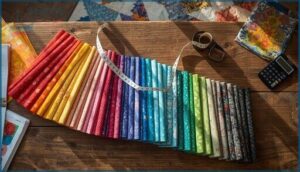
Most quilters hit a moment of doubt right about here—wondering if those colorful strips alone will get them to a finished quilt, or if they’re about to run out of fabric halfway through. Here’s the truth: jelly rolls rarely cover everything on their own.
Most jelly roll quilt patterns assume you’ll add background fabric, borders, or binding. That’s where fabric efficiency meets reality. A lap quilt might work with one jelly roll if your pattern is strip-based and tight on design, but larger quilt sizes almost always demand extra yardage.
Before you panic about your quilting budget, run the numbers with a jelly roll calculator. Check your pattern’s fabric needed list. Plan for borders and backing separately. Strip usage varies wildly depending on layout, so don’t assume those 40 strips will stretch to cover a queen without backup.
Tips for Choosing Jelly Rolls for Quilts
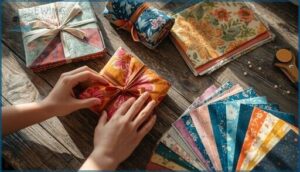
Not all jelly rolls are created equal, and picking the right one can make or break your quilt project. You want strips that work with your pattern, not against it, and fabrics that won’t leave you second-guessing every seam.
Here’s what to look for when you’re standing in the fabric store or scrolling through options online.
Fabric Quality and Color Coordination
Your jelly roll’s fabric quality can make or break your finished quilt, so you’ll want to check thread count, weight, and color fastness before you commit. Look for coordinated dye lots that won’t bleed when washed.
Smart fabric selection means mixing prints at different scales—pair bold florals with subtle textures. Color theory matters here: choose jelly rolls where strips build contrast and visual interest across your quilt patterns.
Matching Jelly Rolls to Quilt Patterns
Once you’ve nailed fabric selection and color coordination, pattern matching becomes your next power move. Check that your jelly roll’s 40 strips align with your pattern’s requirements—some quilt designs demand precise strip counts for block construction.
Strip layout matters too: straight strip quilts optimize efficiency, while angled cuts waste fabric. Choose jelly roll quilt patterns designed specifically for 2.5-inch strips to own perfect pattern matching.
Common Mistakes When Estimating Jelly Rolls

Even experienced quilters sometimes trip up when calculating jelly roll needs, and these mistakes can leave you short on fabric or stuck with extra rolls you didn’t need.
The good news? Most errors follow predictable patterns, and once you know what to watch for, you can dodge them entirely. Let’s look at the two most common missteps that throw off your fabric count.
Underestimating Fabric Needs
Running short on fabric halfway through your quilt is like hitting a wall mid-sprint—frustrating and avoidable. Strip calculations that skip seam allowances can push your actual needs up by 10%, triggering fabric shortages when you least expect them. Here’s what drives most planning errors:
- Ignoring seam allowances in your quilt calculator strips away usable fabric fast
- Skipping buffer estimates leaves zero room for trimming or mistakes
- Trusting patterns blindly without checking your specific quilt size and fabric requirements
- Forgetting layout waste from jelly roll quilt calculator assumptions
- Underbuying jelly rolls when fabric selection and management demand extras
Ignoring Pattern Fabric Waste
Diagonal cuts and complex blocks devour fabric fast—rail fence and log cabin patterns can waste 15–20% more than straight strip layouts. Your jelly roll quilt calculator won’t flag this unless you account for pattern efficiency and seam allowance planning upfront.
Fabric waste calculation matters: strip usage optimization separates smooth builds from projects that stall when fabric needed exceeds what your quilt dimensions suggest.
Essential Tools and Techniques for Jelly Roll Quilts
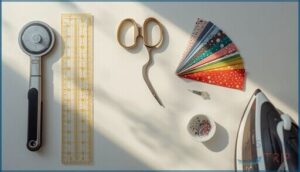
You don’t need fancy equipment to work with jelly rolls, but a few basic tools make the job faster and cleaner. Mastering simple techniques like accurate cutting and smart pressing gives you control over every seam and strip.
Let’s walk through the essentials that turn your precut strips into a quilt you’re proud to show off.
Cutting and Sewing Precut Strips
Precut strips let you skip the measuring and get straight to the fun part. With jelly rolls, the 2.5-inch strip width is already locked in, so you just need to handle them smart. Here’s what matters:
- Keep a sharp rotary blade and clean cutting mat for crisp edges
- Use a consistent 1/4-inch seam allowance to maintain accurate block sizes
- Check your package—some jelly rolls vary in strip count or dimensions
- Align fabric grain properly to prevent stretching during sewing
- Master basic sewing techniques to piece strips smoothly and efficiently
Pressing and Assembling Jelly Roll Quilts
Consistent seam pressing prevents wavy rows and fabric ripple. Press each seam before joining strips—decide whether to press open or to one side based on your jelly roll quilt patterns.
Here’s how seam direction impacts block assembly and strip alignment:
| Press Direction | Best For |
|---|---|
| Open seams | Reducing bulk in thick intersections |
| To one side | Traditional strip quilting with chain-piecing |
| Alternating rows | Creating nestled seams during quilt layering |
| Consistent direction | Maintaining fabric handling predictability |
| Pattern-specified | Following proven quilting techniques |
Use medium heat with controlled pressure for clean, flat results.
Frequently Asked Questions (FAQs)
Are there any additional fabrics I can add to my jelly roll?
Like adding spices to a favorite recipe, you can blend fat quarters, charm squares, or coordinating yardage with your jelly rolls.
Fabric mixing creates color harmony while maintaining seam allowance consistency for stunning quilt embellishments.
Are there any free jelly roll quilt patterns available?
Yes, hundreds of free jelly roll quilt patterns exist online. Fat Quarter Shop, Moda Fabrics, and Missouri Star offer downloadable PDFs and video tutorials.
These beginner quilting resources simplify fabric selection and showcase creative precut fabric designs.
What are some of the different quilt sizes I can make with a jelly roll?
You can create baby quilts, lap throws, twin, queen, and king-size quilts with jelly rolls.
Each quilt size variation demands different fabric strip usage—from one pack for smaller projects to four for expansive king quilts.
Is it easy for a beginner quilter to use jelly rolls?
Absolutely. Jelly rolls are perfect for beginners because they eliminate complex cutting and fabric selection.
You’ll jump straight into sewing with coordinated strips, making your first quilt faster and building essential quilting techniques with confidence.
Can you mix jelly rolls from different brands?
You can absolutely mix jelly rolls from different brands—fabric police don’t exist. Just check seam allowances, watch for dye consistency, and aim for color harmony.
Brand compatibility matters less than your creative vision in quilt making.
How do you store leftover jelly roll strips?
Store leftover jelly roll strips in labeled zip-top bags to prevent moisture damage.
Wrap fabric strips with rubber bands, keep bags upright in clear bins away from sunlight, and rotate stock by using oldest strips first.
What backing fabric works best with jelly rolls?
Your jelly roll’s vibrant dance deserves a partner that won’t steal the show.
Choose 100% quilting cotton for backing—it’s durable, easy to wash, and lets your pieced strips shine without competing for attention.
Do jelly rolls work for curved piecing patterns?
You can tackle curved piecing with jelly rolls by fusing templates to strips or trimming for curve accuracy.
Fabric flexibility and proper seam allowance handling make these precuts work beautifully for creative quilt pattern design.
Can you dye or overdye jelly roll strips?
Like opening Pandora’s box, dyeing jelly roll strips is possible but risky. Overdye effects can shift colors unpredictably on printed fabrics.
Test samples first, follow safety precautions, and expect fabric bleeding with precut edges.
Conclusion
Think calculating how many jelly rolls to make a quilt sounds tedious? It’s actually your secret weapon against midproject panic. You’ve got the formulas, the charts, and the pattern tricks—now you can shop with confidence instead of guesswork.
No more frantic fabric hunts or shelved projects. Measure your quilt dimensions, factor in your pattern’s appetite, buy what you actually need, and get sewing. Your next quilt deserves a strong start, not a maybe-this-will-work gamble.
- https://iseestarsquilting.com/jelly-roll-patterns/
- https://darcyquilts.com/10-jelly-roll-quilt-patterns-and-tutorials/
- https://sewcanshe.com/30-best-free-jelly-roll-quilt-patterns-for-fast-easy-projects/
- https://x.com/godofprompt/status/1990526288063324577
- https://www.sciencedirect.com/science/article/pii/S0749208123000268