This site is supported by our readers. We may earn a commission, at no cost to you, if you purchase through links.
Knitting a project without calculating how many stitches you need is like cutting fabric without measuring first—you’ll either run short or end up with excess bulk that throws off the entire fit. The difference between a sweater that hugs perfectly and one that sags at the shoulders often comes down to a dozen stitches, maybe fewer.
Most knitters learn this the hard way, frogging hours of work because they skipped the gauge swatch or eyeballed their stitch count. The math isn’t complicated, but it does require precision: your yarn weight, needle size, tension habits, and project width all feed into a formula that determines exactly how many stitches to cast on.
Once you understand the relationship between gauge and stitch count, you’ll approach every pattern with confidence, adjusting numbers to suit your materials and measurements instead of hoping the instructions work out.
Table Of Contents
- Key Takeaways
- How to Calculate Stitches Needed for Knitting
- Factors That Affect Stitch Number
- Making and Measuring a Gauge Swatch
- Adjusting Stitch Count for Different Projects
- Tips for Maintaining Consistent Stitch Count
- Using Digital Tools for Stitch Calculation
- Common Stitch Calculation Problems and Solutions
- Frequently Asked Questions (FAQs)
- Conclusion
Key Takeaways
- Your stitch count depends on a simple formula—multiply your gauge (stitches per inch from a blocked swatch) by your project’s width, then adjust for pattern multiples and ease to ensure the finished piece fits exactly as intended.
- Yarn weight, needle size, and your personal tension all directly affect how many stitches fit per inch, so you’ll need to swatch with your actual materials and measure carefully before casting on to avoid hours of frogging later.
- Different stitch patterns eat up yarn differently—lace uses fewer stitches per inch while cables pull stitches together and require more, meaning you can’t rely on a single gauge measurement across multiple pattern types.
- Digital stitch calculators streamline the math and reduce errors, but you should always verify their output against your physical swatch since real-world tension variations can throw off even the most accurate algorithm.
How to Calculate Stitches Needed for Knitting
Calculating the right number of stitches starts with a simple formula that connects your project’s width to your gauge measurements. You’ll need to measure your desired width, determine your stitch rate from a gauge swatch, and apply the calculation SN = (W × SR) / SW.
Once you’ve mastered calculating stitches, getting comfortable with sewing machine basics for beginners will help you adjust stitch settings confidently as you work.
Let’s break down each component so you can confidently plan any knitting project.
For more insight into how different parts come together in crafting, check out this guide on essential sewing machine components for beginners.
Understanding The Stitch Count Formula
You’ll start with a simple foundation: stitches per inch multiplied by your project’s width equals total stitches. To find stitches per inch, divide your gauge measurement (usually stitches per 4 inches) by four.
For wider garments like loose pants or palazzo styles, you’ll need to adjust your stitch count accordingly to accommodate the extra fabric width.
This stitch calculation forms the backbone of every knitting stitch calculator and stitch count calculator.
Understanding stitch rate factors, yarn thickness, and fabric density analysis ensures your stitch gauge delivers accurate stitch width calculation and proper stitch count.
Measuring Project Width and Gauge
Once you’ve mastered the formula, measure your project width accurately—use a flexible tape to capture the exact inches you need your finished piece to span. Next, knit a gauge swatch using your chosen yarn and needles, then count stitches per inch carefully. That’s your stitch gauge, the foundation for knitting accuracy.
- Measure multiple 4-inch sections across your swatch and average the stitch density for reliable fabric width estimates
- Block your swatch first so yarn tension relaxes naturally, mimicking how your finished project will behave
- Record both stitches per inch and rows per inch; stitch width changes with needle size or yarn tension adjustments
Using a Stitch Count Calculator
If manual calculations feel tedious, a Stitch Count Calculator streamlines the process—just enter your desired width in inches, your Stitch Gauge (stitches per inch), and row gauge.
Digital Tools and Knitting Software instantly estimate total Knitting Stitches needed, handling Gauge Conversion between metric and imperial units.
Cross-check Calculator Basics results against your swatch to confirm Stitch Estimation accuracy before casting on with your chosen Yarn Weight.
Factors That Affect Stitch Number
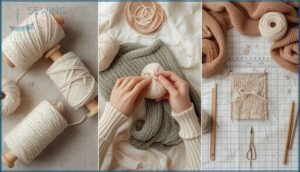
Your stitch count isn’t determined by a single factor; it’s shaped by several interconnected variables that work together to create the fabric you’re aiming for. Each element, from the materials you choose to the way you hold your needles, influences how many stitches you’ll cast on.
Let’s look at the three main factors that directly affect your stitch number.
Your yarn weight—whether you’re using sport weight, DK, or bulky yarn—plays a big role in how many stitches fit per inch.
Yarn Thickness and Needle Size
Yarn weight and needle diameter work hand in hand to control your stitch gauge. Thicker yarns paired with larger needle sizes create a looser fabric, while thinner yarns with smaller needles produce tighter stitches.
Different fiber types—wool, cotton, acrylic—behave uniquely at the same needle size, affecting tension control and drape.
Always swatch with multiple needle sizes to find the combination that hits your target gauge measurement perfectly.
Once you’ve nailed your gauge, apply those same precision habits to pattern matching at the seams for a polished, professional finish.
Stitch Type and Pattern Design
Stockinette, ribbing, and cables all eat up different amounts of yarn per inch, which means your stitch count shifts depending on the pattern you choose. Lace patterns create open, airy fabric that requires fewer stitches per inch, while cable knitting pulls stitches together, demanding more cast-on numbers.
Color work and texture mixing compress your gauge differently than plain knitting stitches, so you’ll need a stitch count calculator to verify yarn estimation before starting any complex stitch variations.
Tension and Knitting Technique
Tension control separates smooth, even fabric from wobbly disasters that won’t match your stitch gauge. Your yarn handling, knitting posture, and grip directly impact stitch uniformity, preventing fabric distortion that throws off your stitch rate calculations.
Here’s what affects your knitting stitches most:
- Hand positioning – keeps tension consistent across rows
- Knitting techniques – continental vs. English styles create different tension
- Regular swatching – verifies your personal tension before casting on
Making and Measuring a Gauge Swatch
A gauge swatch is your roadmap to accurate sizing, serving as the foundation for calculating how many stitches you’ll need for any project. Without it, you’re basically guessing, and that often leads to garments that don’t fit or accessories with unexpected dimensions.
Let’s walk through why gauge swatches are essential, how to create one properly, and the best way to measure your stitches and rows per inch.
Why Gauge Swatches Matter
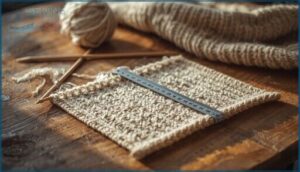
You might wonder why experienced knitters always swatch before starting a garment. A gauge swatch ensures gauge accuracy and reveals yarn behavior that directly affects your finished dimensions—just half an inch off in gauge can balloon into several inches of difference in a sweater.
A gauge swatch is essential, as even a small error can turn into major sizing problems in your finished project
This small sample shows fabric characteristics, tests stitch gauge with your yarn weight, and confirms your stitch count will produce the fit you expect. Understanding gauge measurement techniques is vital for achieving accurate results.
Steps to Create an Accurate Swatch
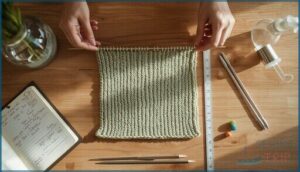
Creating an accurate swatch requires more than just casting on and knitting a few rows—proper swatch preparation and fabric assessment determine whether your finished project will fit.
Follow these steps to guarantee reliable stitch gauge and stitch count:
- Cast on 26 to 38 stitches depending on your pattern’s gauge, giving you at least six inches of knitting width.
- Select yarn weight and needles that match your pattern specifications for accurate stitch patterns.
- Knit at least six to eight inches in height, maintaining consistent tension throughout to reveal true fabric behavior.
- Apply blocking techniques that match your finishing method—wet block or steam the swatch as you’ll treat the garment.
- Let it dry completely before taking any stitch measurement, allowing fibers to settle into their final dimensions.
These knitting techniques and tips produce swatches that mirror your actual project conditions. To achieve accurate measurements, consider the swatch size guidelines for your project.
Measuring Stitches and Rows Per Inch
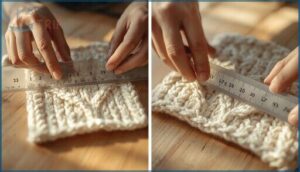
Once your swatch is blocked and dry, lay it flat and place a rigid ruler horizontally across the center. Count the V-shaped stitches over four inches to determine stitch gauge, then divide by four for stitches per inch—this stitch accuracy forms the foundation of knitting precision.
Next, align your ruler vertically to count rows over four inches for row gauge, ensuring proper fabric density and row counting for reliable stitch patterns across any yarn weight.
Adjusting Stitch Count for Different Projects
Once you’ve mastered your gauge swatch, you’ll need to adapt your stitch count to suit different types of projects, since a sweater demands different calculations than a scarf or hat.
The adjustments you make depend on whether you’re creating garments or accessories, how much shaping your design requires, and what your specific pattern recommends.
Let’s walk through how to modify your stitch count for various knitting projects.
Garments Vs. Accessories
Ever wondered why Garment Sizing demands more calculation than Accessory Fit? When planning a knitting project, stitch count for sweaters and cardigans is driven by bust circumference and ease, while scarves rely on fixed Project Width and Stitch Gauge.
Yarn Choices and Yarn Weight shape both Knit Complexity and Fabric Drape, making accurate stitch count essential for every piece.
Shaping, Increases, and Decreases
Once you’ve cast on the right number of stitches for your garment or accessory, shaping techniques like increases and decreases sculpt the fabric to follow curves, create tapers, and achieve the silhouette your pattern demands.
Increase methods such as yarn overs or make-one stitches add width, while decrease patterns like knit-two-together reduce stitch count.
Symmetry planning ensures balanced curve management, maintaining your established stitch gauge and stitch rate throughout shaping sequences.
Pattern-Specific Recommendations
Beyond shaping fundamentals, written patterns already incorporate ease and stitch distribution adapted to specific garment types. A raglan sweater divides yoke stitches roughly one-third front, one-third back, and one-sixth per sleeve after accounting for eight raglan seam stitches.
Pattern modifications for yarn weight require a fresh gauge swatch, recalculating stitch count by multiplying your measured stitch gauge times target width to preserve fit.
Tips for Maintaining Consistent Stitch Count
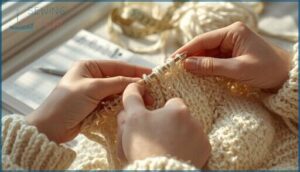
Keeping your stitch count consistent throughout a project requires attention to detail, regular monitoring, and a willingness to catch mistakes early. Even experienced knitters face challenges with maintaining uniformity, but a few practical strategies can help you stay on track.
Let’s explore three essential techniques for ensuring your stitch count remains accurate from cast-on to bind-off.
Managing Tension Throughout The Project
Tension control starts with consistent yarn handling. Wrap the yarn around your pinky and over your index finger to stabilize your stitch rate and produce uniform loops. Keep your needle movement close to the tips to avoid stretching stitches.
Regularly inspect your fabric for tension stripes, running your hand over each section to feel for tight or loose areas that disrupt stitch gauge.
Checking Stitch Count Regularly
After you’ve got your tension under control, make stitch tracking a habit at the end of each section. Count your stitches and compare your stitch density to the pattern’s stitch gauge and row gauge requirements—aim for within two stitches per inch.
Record each check in your project logging system to spot drift early. If your stitch rate shifts, adjust your needle size or yarn weight before continuing.
Fixing Common Stitch Count Mistakes
Off-gauge work catches even experienced knitters, but swift stitch error correction keeps projects on track. When your stitch count drifts, check these tension management steps:
- Compare your knit fabric analysis to the pattern’s stitch gauge and row gauge using stitch audit tools.
- Switch needle sizes if your yarn substitution changed the original yarn weight specifications.
- Rip back to the error point and recount.
- Use a stitch count calculator to verify target dimensions.
- Create a fresh gauge swatch before continuing.
Using Digital Tools for Stitch Calculation
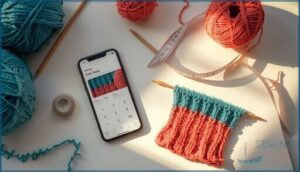
Digital tools take the guesswork out of stitch calculations, giving you accurate counts in seconds instead of minutes spent with a pencil and paper. These calculators handle the math while you focus on the creative aspects of your project, reducing errors and saving time during the planning stage.
You’ll find several reliable options available, each offering different features to support your knitting workflow.
How Stitch Count Calculators Work
You input your stitch gauge and row gauge—measured in stitches per inch—along with your target fabric width, and the Stitch Count Calculator translates these numbers into the total stitch count you’ll need to cast on.
Calculator algorithms factor in stitch density and yarn weight, linking yarn characteristics to your measurements.
Gauge calibration ensures accuracy, though real-world tension variations mean you should always double-check with a swatch.
Recommended Apps and Online Tools
Several apps simplify stitch count and gauge calculations. The Stitch Counter app includes a built-in Gauge Calculator and saves multiple project profiles for quick reference. LoveCrafts offers an online tool that recommends stitch counts based on yarn weight and stitch gauge.
The Ravelry Planner links you to community-tested swatches, while Knit Helper tracks per-project gauge and provides visual swatch guides.
Integrating Calculators With Project Planning
When you link your stitch count calculator to project planning software, gauge changes automatically update your entire knitting roadmap, eliminating mid-project surprises.
Digital integration maps stitch forecasting to milestones, while validation routines check calculator outputs against your manual measurements.
This planning optimization saves hours of recalculating yarn weight and project width, letting you focus on the craft itself.
Common Stitch Calculation Problems and Solutions
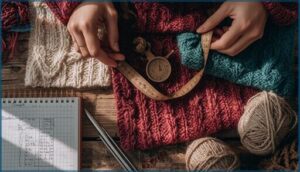
Even the most experienced knitters run into stitch calculation challenges, whether it’s a gauge that doesn’t match the pattern, an unexpected yarn substitution, or a finished project that doesn’t fit quite right.
These common problems can derail your work, but each one has a straightforward solution if you know what steps to take. Here’s how to troubleshoot the most frequent stitch calculation issues and get your project back on track.
What to Do if Your Gauge is Off
When your swatch doesn’t match the pattern’s stitch gauge, don’t panic—you’ve got options. Compare your current gauge to the target, then choose smaller needles if your knit fabric is too loose or larger ones if it’s too tight.
Fabric tension matters here, so make one stitch adjustment at a time and recheck your row gauge before moving forward with your project.
Adjusting for Yarn or Needle Changes
Switching yarn or needles mid-project can throw your fabric tension off balance, so recalculate your stitch density right away. When gauge shifts more than 10 percent, divide your original stitch count by the ratio of new to old needle size, then test with a fresh swatch.
Document your yarn thickness, needle conversion details, and gauge adjustment to keep your stitch gauge consistent throughout.
Preventing Sizing Errors in Finished Projects
Once you’ve locked in your gauge and adjusted for any material swaps, the final step is blocking your work before seaming. This lets you measure the actual dimensions and catch sizing issues before they become permanent.
Pin your pieces flat, verify stitch accuracy against your pattern’s fabric density, and compare row gauge to your swatch. This prevents project scaling disasters that waste yarn estimation and hours of careful knit tension.
Frequently Asked Questions (FAQs)
How many stitches for circular knitting projects?
You multiply your stitch gauge per inch by the desired circumference, then adjust for negative ease and pattern multiples to achieve a perfect circular fit on your needles.
Do stitch markers affect total stitch count?
Stitch markers don’t count as stitches—they’re reference tools you slip along your needle. However, beginners sometimes mistakenly count markers, throwing off stitch accuracy.
Always tally only your yarn loops to maintain proper stitch gauge and prevent knitting errors.
How to calculate stitches for colorwork patterns?
A fair isle yoke often demands 200 stitches arranged into ten 20-stitch repeats. Calculate your circumference from stitch gauge, then divide by the motif width—choosing whole repeats ensures colorwork math aligns with graphic alignment and pattern scaling for motif centering excellence.
When should I recount stitches during knitting?
You should verify your stitch count immediately after cast on verification, following each increase/decrease operation, when working circular knitting with complex patterns, and whenever gauge checks reveal inconsistent stitch rate or stitch gauge measurements.
Can I convert crochet patterns to knitting stitches?
Converting crochet patterns to knitting requires pattern adaptation, not direct stitch conversion.
Gauge matching is essential—swatch until your stitch gauge and fabric structure align with the original dimensions, then recalculate row gauge and stitch count accordingly.
Conclusion
The next time you cast on without checking your numbers, you’ll remember the unraveling. Calculating how many stitches needed isn’t busywork—it’s the foundation that keeps your project on track from first row to bind-off.
Your gauge swatch, needle choice, and tension all speak the same language once you learn to read them. Measure deliberately, adjust confidently, and trust the math.
The sweater that fits perfectly starts with stitches counted right.