This site is supported by our readers. We may earn a commission, at no cost to you, if you purchase through links.

Most home cooks grab a box of Jello without checking the weight, assuming all boxes contain the same amount. They don’t. A standard small box holds 3 ounces of gelatin powder, while large boxes pack 6 ounces, and family-size versions contain 12 ounces.
These differences matter when you’re following a recipe or trying to figure out how many servings you’ll get. The confusion gets worse when you’re converting between box sizes or substituting one for another. Understanding what’s actually in each box helps you measure accurately, scale recipes correctly, and avoid ending up with a wobbly mess or rock-hard disaster.
Table Of Contents
Key Takeaways
- Jello boxes come in three standard sizes—small size (3 oz), large size (6 oz), and family-size (12 oz)—and you’ll get four servings from a small box, eight from a large one, and sixteen from the family size when you follow package directions.
- One tablespoon of Jello powder equals roughly 0.52 ounces, so a 3-ounce box holds about 1/3 cup of powder while a 6-ounce box contains 2/3 cup, which matters when you’re converting between sizes or substituting bulk gelatin.
- You can swap water for juice, soda, milk, or alcohol in equal amounts (1 cup for 1 cup), but sweet liquids need 10% less sugar and stronger flavors like tea may require dilution to get the texture right.
- Proper preparation means dissolving the powder in 140-158°F water for 2 minutes until completely clear, then chilling at 35-40°F for at least 4 hours—skipping these steps or using a freezer creates grainy, uneven results instead of the smooth wobble you want.
Jello Package Sizes
You’ll find Jello boxes in three main sizes at your local grocery store, each designed for different needs. The standard small box works great for everyday desserts, while larger options help when you’re feeding a crowd.
The small 3-ounce box is perfect for quick treats and serves about four people when prepared according to package directions.
Some stores also carry bulk gelatin powder, though availability can shift depending on where you live.
Standard Box Sizes
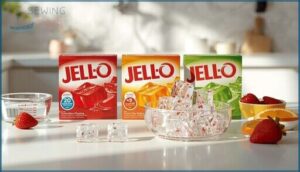
When you pick up a Jello box at the store, you’ll find two main package sizes: the standard 3-ounce box and the family-size 6-ounce version. These box dimensions haven’t changed much over the decades, which makes following recipes pretty straightforward.
Some stores also carry 12-ounce packages if you’re making Jello for a crowd or want to stock up. If you want to compare Jello with other products, understanding common standard box sizes and uses can be helpful.
Bulk Gelatin Options
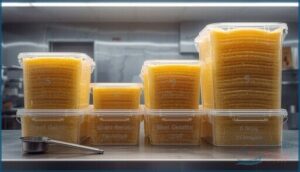
Bulk suppliers offer gelatin wholesale in larger packaging and sizes than standard Jello boxes. You’ll find food grade gelatin products from 5 pounds to 25 kilograms, perfect for industrial uses like commercial kitchens or large gatherings.
Gelatin strength matters here—look for 200 to 300 Bloom ratings on the box sizes. These gelatin mix options give you precise control over your Jello package information, letting you measure exactly what your recipe needs while cutting costs substantially.
For example, some bakeries and restaurants use sheet gelatin in bulk packaging to simplify precise measurement and inventory for large-scale recipes.
Regional Variations

You’ll notice Jello package sizes shift slightly depending on where you shop. Regional flavors and cultural differences play a role—Utah stocks more variety since Jello became the official state snack, while coastal areas favor citrus profiles.
Geographic availability affects local ingredients too, leading to seasonal preferences in different markets. Here’s what changes by region:
- Box dimensions stay standard (3-6 oz small, 12 oz large)
- Flavor selection expands in high-demand areas
- Packaging and storage labeling varies by state requirements
How Much Jello in Box
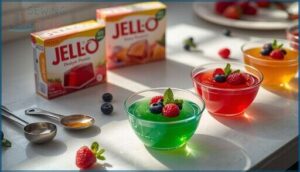
If you’re sizing up Jello box contents for your next dessert, here’s what you need to know about Jello weight and serving sizes. The small 3 oz Jello box makes about 2 cups—perfect for four half-cup servings. The larger 6 oz package doubles that, giving you 4 cups and eight servings.
Sugar-free boxes weigh less but still yield 2 cups. For unflavored gelatin, 1 tablespoon equals about 0.25 oz. Knowing these Jello measurements helps you match recipes to any box size.
Jello Box Equivalents
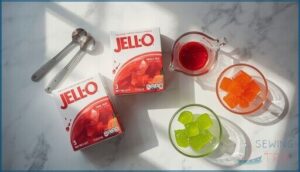
When you’re scaling a recipe or working with what’s already in your pantry, knowing how different Jello box sizes relate to each other saves time and guesswork.
A 3-ounce box is basically half of a 6-ounce box, which makes doubling or halving recipes pretty straightforward.
Here’s how to convert between sizes and swap in bulk gelatin or different liquids when you need to.
Small to Large Box Conversions
When you’re doubling a recipe or shopping for the best deal, understanding jello box sizes and measurements helps you get the gelatin ratios right. A standard 3 oz box equals one-quarter of a 12 oz package, while a 6 oz box cuts it in half.
These volume measurements make box conversion tips straightforward—four small boxes match one large box in servings and ounces. Think of it as simple multiplication: just scale your water proportionally. This packaging efficiency lets you swap sizes without recalculating your entire recipe.
Bulk Gelatin Measurements
When you’re working with commercial-grade gelatin, a digital scale becomes your best friend for consistent results. Food measurement guides recommend weighing powder instead of using cups, since gelatin measurement accuracy directly impacts texture and set time.
Here’s how to handle bulk conversions:
- Track gelatin weight precisely — 1 tablespoon equals roughly 0.52 ounces or 15 grams
- Match powder ratios — use 1 tablespoon per 2 cups of liquid for standard firmness
- Invest in measurement tools — a 0.01g digital scale ensures repeatable outcomes when scaling recipes
Substituting Liquids
You can replace water with nearly any liquid, but recipe adjustments depend on liquid density and flavor profiles. Use equal substitute ratios—1 cup for 1 cup—to maintain the proper water ratio in your gelatin measurement.
| Substitute | Effect on Texture | Gelation Time |
|---|---|---|
| Fruit juice | Slightly softer set | Add 10 minutes |
| Broth | Firmer, savory texture | Standard timing |
| Milk or nut milk | Creamier mouthfeel | Add 5–10 minutes |
For texture modification, reduce sugar by 10% when using sweet liquids. Strong-flavored recipe ingredients like tea or cider may need dilution with extra water. These food measurements guarantee your gelatin sets properly every time.
Gelatin Content Varies
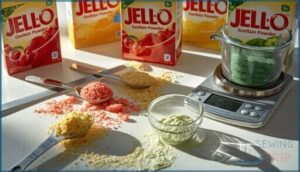
Not all Jello boxes contain exactly what the front label suggests.
Manufacturing variations and measurement differences can affect how much gelatin powder you actually get.
Here’s what you need to know about converting measurements and understanding what’s really inside each package.
Tablespoon to Ounce Conversions
Converting tablespoons to ounces isn’t guesswork when you understand liquid density and gelatin’s unique properties. One tablespoon of jello powder equals roughly 0.52 ounces, while one ounce converts to about 3.02 tablespoons.
For accurate food measurements, follow these measurement tips:
- Level your spoons for precise volume equivalents
- Remember dry gelatin differs from liquid measurements
- One envelope contains 2.25-2.5 teaspoons
- Use conversion charts or kitchen scales when precision matters
- Account for recipe ingredients requiring exact ounces
Gelatin Powder Measurements
Gelatin powder measurements demand precision measurements, not guesswork. A small 3-ounce box contains roughly 1/3 cup of jello powder, while 6-ounce boxes hold 2/3 cup.
But here’s what matters: powder density varies between gelatin types and brands, affecting your gelatin ratio. For reliable food measurements and quantities, use measurement tools like kitchen scales alongside conversion charts. You’ll get consistent results every time.
Packaging Discrepancies
Box Size Variance happens more often than you’d think. Recent packaging errors show weight discrepancies between labeled and actual contents—you might find a 5.9 oz box marked as 6 oz.
Watch for these label inconsistencies:
- Zero Sugar family boxes shrunk from 3.5 oz to 1.5 oz
- Package sizes stayed similar despite reduced contents
- Shelf life issues can affect powder density over time
Always verify your Jello box servings before measuring.
Serving Sizes Differ

Here’s the thing about Jello servings: what counts as “one serving” changes depending on how you’re using it.
A single 3-ounce box might feed four people at dinner or make just a dozen party shots.
Your serving size depends entirely on whether you’re filling individual cups, molding a fancy dessert, or pouring into shot glasses.
Individual Cup Servings
Pre-portioned cups simplify serving portion decisions at your next gathering. Standard store-bought Jello cups contain 3 to 4 ounces of prepared gelatin, while children’s dessert options work well at 2 ounces. You’ll find clear plastic cup packaging displays those colorful layers beautifully, and most package sizes include 12 to 24 servings for easy planning.
- Cup size variations range from 2-ounce snacks to 8-ounce treats
- Gelatin content stays consistent across different dessert options
- Food measurements matter less when you grab pre-made cups
Jello Shots and Molds
When you’re ready to mix fun with flavor, Jello shots and molds transform standard gelatin into crowd-pleasing treats. A 3 oz Jello package yields about 30 one-ounce shots using equal parts boiling water and liquor. Silicone mini muffin molds release cleanly, while plastic cube trays create uniform portions perfect for layered Jello recipes.
| Mold Type | Capacity |
|---|---|
| Silicone mini muffin | 1-2 oz per cavity |
| Plastic cube trays | 1-2 oz portions |
| Flexible loaf molds | Up to 6 oz servings |
| Jelly shapes (stars, spheres) | 1-3 oz each |
For party serving ideas, chill your gelatin dessert mix for 2 to 4 hours until fully set. Create eye-catching Jello art designs by layering contrasting flavors—just let each layer firm up 15 to 60 minutes before adding the next. Label alcohol content clearly so guests can enjoy responsibly. Mold release tips: wash with warm soapy water after each use and avoid sharp objects that damage silicone surfaces.
Serving Size Adjustments
You don’t have to stick with the box directions in terms of serving sizes. Adjust the liquid measurements to create firmer or softer portions depending on your dessert serving sizes and planning needs. Want smaller portions? Use less water to yield six servings instead of eight. Feeling a crowd? Double the recipe quantities while keeping your gelatin ratios consistent.
- Split a 6 oz box into two batches for better portion control across different flavors
- Add 25% less water for firmer gelatin that holds up in warm weather
- Combine two 3 oz boxes when batch scaling for parties of 15 or more
- Measure cold water carefully since liquid measurements directly affect your final texture
Jello Preparation Tips

Getting the measurements right is only half the battle—you also need to handle the actual preparation correctly. The way you dissolve the powder, manage the temperature, and time your refrigeration makes a real difference in how your Jello turns out.
Here’s what you need to know to get consistent, smooth results every time.
Dissolving Gelatin Mix
Getting your gelatin to dissolve completely isn’t complicated, but skipping steps leads to gritty, clumpy results. The secret to proper gelatin solubility starts with water temperature—you need it at 140 to 158°F, just below a simmer.
Here’s your foolproof process:
- Bloom first: Sprinkle your Jello powder evenly over cold water and wait 5 to 10 minutes
- Heat gently: Warm the bloomed gelatin mix until it’s completely clear
- Whisk thoroughly: Stir for a full 2 minutes to guarantee dissolution time is adequate
- Check for specks: Any undissolved powdered gelatin means you need more heat
- Don’t boil: High temperatures destroy gel strength
This mixing technique works whether you’re using a small box or bulk JellO powder. The transformation from granules to smooth liquid tells you everything’s working.
Speed-Set Method
When you’re short on time, the Speed-Set Method relies on rapid movement between temperatures—dissolving your gelatin in 3/4 cup boiling water, then adding ice cubes to reach 1 cup total. This technique triggers faster muscle recruitment of gel formation, cutting hours to minutes.
| Standard Method | Speed-Set Method |
|---|---|
| 4+ hours chilling | 1-2 hours chilling |
| Cold water added | Ice cubes added |
| Slower set time | Rapid gel formation |
Your Jello box sets firm without sacrificing texture.
Refrigeration Time
After the speed-set method, your Jello needs proper Chill Time to finish the job. Plan for at least 4 hours of Refrigeration Tips at 35-40°F for full Gelatin Setting.
Shallow dishes firm up faster than tall molds—cooling methods matter. Skip Freezer Effects entirely; freezing creates grainy texture instead of the smooth wobble you want. Metal pans speed things along, while glass takes longer.
Check for firmness after 4 hours; if it’s still pale or runny, give it another 30-60 minutes. Patience delivers perfect dessert preparation every time.
Jello Box Size Guide
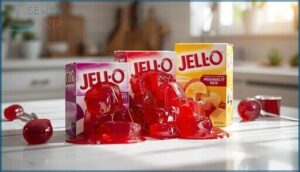
You’ll find Jello boxes in three main sizes at most grocery stores. Each size gives you a different amount of prepared gelatin, so knowing what you’re working with helps you plan better.
Here’s what you need to know about small, large, and family-size boxes.
Small Box Sizes
When you grab a small Jello box off the shelf, you’re looking at 3 oz of gelatin powder tucked inside. These compact food packaging options measure roughly 4 x 4 x 2 inches, similar to standard snack sizes. Each Jello package yields about 4 servings once prepared.
You’ll find consistent box dimensions across different flavors, making storage straightforward. The box closure keeps powder fresh for months. Need more? Two small boxes equal one 6 oz family size. These shipping-friendly sizes keep costs down while delivering the wiggle you want.
Large Box Sizes
Large Jello boxes pack twice the powder you need for crowd-pleasing desserts. A 6 oz package holds just under 1 cup of gelatin and makes 8 servings, while 12 oz options double that yield. These family-size boxes measure around 5 x 6 x 3 inches—compact enough for easy storage yet sturdy for shipping.
- Box dimensions: Roughly 5 x 6 x 3 inches for 6 oz
- Powder content: Just under 1 cup in a large box
- Prepared yield: 4 cups from one 6 oz Jello package
- Packaging materials: Durable cardboard with moisture-resistant coating
- Storage tips: Keep your Jello box sealed in a cool, dry spot
Family Size Boxes
Think of a family-size box as your party prep shortcut—it holds 6 ounces of gelatin powder and delivers 8 to 12 servings when you follow standard prep ratios. You’ll mix it with 2 cups of boiling water and 2 cups of cold water for a firm set.
These boxes measure roughly 7 to 9 inches tall with resealable packaging on some brands, making large batch prep easier. Brand content varies, so check your Jello package label for exact measurements and conversions.
Store unopened boxes in a cool, dry spot to keep the powder fresh for months.
Frequently Asked Questions (FAQs)
How much gelatin is in a box of Jello?
A standard 3-ounce Jello box contains enough gelatin powder to make four half-cup servings. Family-size boxes with 6 ounces double that yield, giving you eight servings of perfectly wobbly dessert.
How much Jello does a 6 ounce box of Jello make?
When you mix a 6-ounce Jello box with 4 cups of liquid, you’ll get 4 cups of prepared gelatin—enough for 8 half-cup servings, perfect for family desserts or small gatherings.
How many boxes of Jello do I Need?
Start with your guest count—each 6-ounce box accommodates 8 people at ½ cup portions.
For firmer texture or recipe requirements, grab an extra small box. Budget planning beats running short with leftover gelatin.
How many cups in a box of Jello?
Getting the full picture matters when measuring Jello box yields. A standard 3-ounce box makes about 4 cups of prepared gelatin, while a 6-ounce family size delivers roughly 8 cups total.
How many ounces of Jello do I Need?
You’ll need about 3 ounces for every 4 servings. A small box covers a family dinner, while a large 6-ounce box accommodates 8 guests.
For bigger gatherings, grab a family-size box or double up.
Is Jello Kosher or Halal?
Most Jello isn’t kosher or halal because gelatin sources matter.
You’ll need kosher symbols or halal certification on packaging to confirm compliance.
Check labels for fish-based gelatin or plant alternatives meeting religious dietary restrictions.
What is the Name Origin of Jello?
Back in 1897, Pearle Wait whipped up a fruity gelatin treat in LeRoy, New York.
His wife May coined the catchy name “Jell-O,” and the Genesee Company turned it into an American kitchen classic.
Is It Possible to Substitute Liquids in Jello Recipes?
You can swap water for juice, soda, or alcohol in jello recipes, but maintain the gelatin-to-liquid ratio.
Liquid substitutions affect flavor profiles, gel strength, and texture changes—clear juices work best for boozy variations.
What is the Only Jello Museum in the US?
Fans flock to the JellO Gallery Museum in Le Roy, New York—Jello’s official birthplace.
This charming destination showcases vintage boxes, gelatin exhibits, food culture history, and quirky advertising that shaped America’s wobbly dessert obsession.
What Happened to the Company Green Jelly After a Lawsuit by Kraft?
After Kraft sued over trademark infringement in the 1990s, the band reached a legal settlement that forced branding changes.
They dropped parody packaging imagery, updated logos, and revised merchandise—while playfully embracing their “World’s Worst Band” reputation.
Conclusion
Imagine this: you’re mid-recipe, staring at your pantry, wondering if that dusty box will work. Now you know exactly how much jello is in a box—3 ounces for small, 6 for large, 12 for family size.
You can swap sizes confidently, measure servings accurately, and nail the texture every time. No more guessing games or gelatin disasters. Just grab the right box, follow the conversions, and watch your dessert set up perfectly.