This site is supported by our readers. We may earn a commission, at no cost to you, if you purchase through links.
Every crafter knows the sting of slicing into a brand-new cutting mat, only to see deep grooves appear after a few weeks. But here’s the twist: self-healing mats aren’t just clever marketing—they’re built to bounce back, keeping your workspace neat and your cuts clean.
With the right care, these mats can last years, saving you money and frustration.
Whether you’re piecing together a quilt or prepping a scrapbook, knowing how to care for a self‑healing cutting mat means less hassle and sharper results.
Let’s walk through the steps to keep your mat in top shape, so every project starts on solid ground.
Table Of Contents
Key Takeaways
- Rotating your mat on a monthly schedule and storing it flat prevents uneven wear and warping, extending its life well beyond the average three-to-five years.
- Sharp blades are just as important as mat care—dull blades dig deeper grooves that the mat can’t heal, so swap them out regularly to protect the surface.
- A simple cleaning routine using mild soap, water, or a diluted vinegar solution removes fibers and residue without damaging the mat’s self-healing layer.
- Heat and direct sunlight are silent killers—keep your mat away from windows and hot surfaces, since even brief exposure can soften the material and fade grid lines permanently.
What is a Self-Healing Cutting Mat?
A self-healing cutting mat is one of those tools that quietly makes every project better.
If you want tips on keeping your mat in top shape, check out these accurate fabric cutting methods and mat care advice.
It’s built to take the hits so your work surface stays smooth and reliable cut after cut. Here’s what makes these mats worth understanding before we get into how to care for one.
How Self-healing Mats Work
When you cut on a self healing cutting mat, the micro‑cellular structure and polymer layer dynamics come into play. The mat’s surface shifts, absorbs the blade’s pressure, and then closes the groove—thanks to its elastic recovery process.
A self-healing cutting mat absorbs each blade’s pressure and silently reseals, keeping your surface smooth cut after cut
This pressure distribution grid keeps cuts shallow and smooth, making cutting mat maintenance and material durability easy for your ongoing projects.
They also protect work surfaces[https://www.wawak.com/cutting-measuring/cutting/self-healing-cutting-mats/) from scratches and damage.
Key Materials and Design Features
You’ll notice a Self Healing Cutting Mat feels sturdy under your hands. Its PVC surface resists blade marks and keeps grid layout lines sharp. The cork backing grips your table, while a polyurethane core seals up small nicks.
For added material durability, look for a fluorinated coating and a reinforced border. A silicone mat scrubbing pad helps keep everything clean.
Benefits for Sewing and Crafting Projects
That sturdy surface isn’t just for show—it’s your ticket to Precision Cutting and Fabric Protection. With a Self Healing Cutting Mat, you get:
- Gridlines for accurate layouts
- Non-slip backing for stable cuts
- Color Coordination to organize projects
- Project Versatility for quilting, scrapbooking, and more
Proper Cutting Mat Care means fewer replacements, easier Tool Maintenance, and real Cost Savings for Sewing and Crafting.
Essential Daily Care Tips
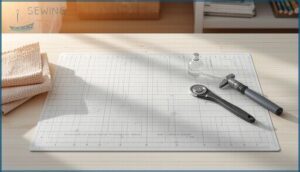
Taking care of your self-healing cutting mat each day keeps it working like new.
A few simple habits can make all the difference.
Here’s what you should do to protect your mat and get the best results every time.
Rotating The Mat to Prevent Uneven Wear
Ever wondered why your grid lines fade faster on one side? Edge Pressure Balance at work.
Rotate your self healing cutting mat using a Quarter Turn Schedule—every month, flip and log it. This Mat Maintenance habit keeps wear even, preserves rebound, and helps accurate cuts.
Try this practical Rotation Log table for easy tracking:
| Rotation | Mat Flip Technique | Wear Monitoring |
|---|---|---|
| Week 1 | Quarter Turn | Check edges |
| Week 2 | Flip & Turn | Inspect lines |
| Week 3 | Quarter Turn | Test pressure |
| Week 4 | Flip & Log | Update log |
Using Sharp Blades for Cleaner Cuts
Keeping your rotary cutter blades sharp is essential for clean cuts and mat maintenance. Sharp blades glide smoothly, reducing fraying and fabric lift—think of it as your Edge Maintenance Routine.
Pairing sharp blades with a top-rated cutting mat for quilters helps your edges stay true and extends the life of every blade you own.
Choose quality blade materials, like high carbon steel, for lasting sharpness.
Light, steady Cutting Pressure Control prevents mat damage.
Always follow Blade Safety Practices and clean blades regularly with the right cleaning tools.
Avoiding Direct Sunlight and Heat Exposure
Even a quick burst of sunlight can fade grid lines and soften your SelfHealing Cutting Mat.
For proper cutting mat care and maintenance, use these UV Protection Strategies:
- Place your mat in a shaded area—avoid south-facing windows.
- Monitor room temperature; keep it below 90°F for Heat-Resistant Storage.
- Start a Sunlight Exposure Log to track seasonal changes and prevent warping.
Storing The Mat Flat or Properly Rolled
Storing your SelfHealing Cutting Mat the right way protects the cutting surfaces you rely on every day.
Flat Storage Benefits are real — lay it on a clean, dry shelf with a breathable cover to block dust.
If space is tight, use the Loose Rolling Technique around a core that’s wide enough to avoid creasing.
Either way, keep it in a climate-controlled environment for lasting cutting mat care.
Step-by-Step Cleaning Instructions
Keeping your cutting mat clean doesn’t have to be complicated. A simple routine can make a real difference in how long it lasts and how well it performs. Here’s exactly how to do it, from a quick debris sweep all the way to drying it the right way.
Removing Loose Debris and Fibers
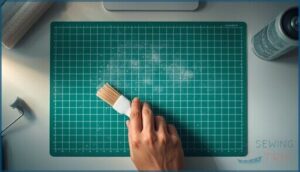
Before you reach for any cleaning solution, start by clearing the surface of loose fibers and dust. Self‑healing cutting mats trap debris fast, and skipping this step makes deeper maintenance harder.
- Brush types matter — use a soft nylon or rubber‑bristle scrubber brush along grid lines.
- Lint roller use lifts fine threads in one quick pass.
- Compressed air technique blasts dust without moisture exposure.
Build a simple debris‑removal schedule: a quick 5‑minute check before every session keeps your microfiber cloth method more effective later.
Cleaning With Mild Soap and Water
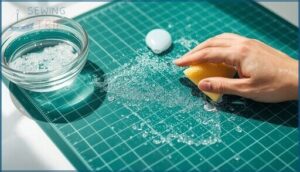
Ever notice how grime clings to your selfhealing cutting mats?
Mix one drop of mild dish soap per cup of lukewarm water for the perfect Soap Dilution Ratio.
Grab a soft sponge and use a Gentle Circular Motion.
Rinse Thoroughness Check: keep rinsing until no suds remain.
Air Dry Flat—never roll wet mats.
This Cleaning Solution keeps your surface smooth.
Deep Cleaning With Vinegar Solutions
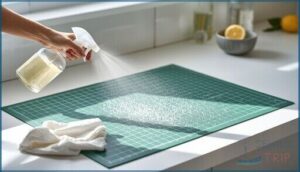
White vinegar is your secret weapon for a deeper clean. Mix equal parts vinegar and water — that’s your go-to Vinegar Dilution Ratio for safe, effective results on selfhealing cutting mats.
- Spray the solution evenly across the surface
- Follow Soaking Time Guidelines: let it sit 5–10 minutes
- Use Stain Penetration Techniques — gently press a soft cloth into stubborn spots
- Apply Post‑Clean Rinsing Methods: rinse thoroughly with cool water
- Always test a small patch first — a key Safety Precaution for Mat Materials
Drying Methods to Prevent Warping
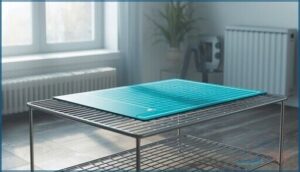
Once your cutting mat is clean, let it air dry flat—never upright or near heat. For best results, mimic spacer stacking: place your mat on a rack, allowing air flow underneath. Humidity control matters; keep your drying area cool and steady. Imagine your mat as a weaving project—consistent moisture and temperature gradient keep it straight and ready for DIY crafting.
| Air drying | Spacer stacking | Humidity control |
|---|---|---|
| Flat rack | Even gaps | Steady levels |
| No heat | Underneath air | Cool room |
| No sun | Prevent warp | Prevent mold |
How to Remove Stains and Residue
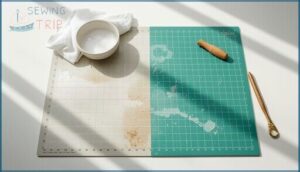
Even the best cutting mats end up with stains and sticky spots after a while.
Getting rid of them doesn’t have to be tricky if you know what works.
Here’s how you can tackle the most common messes without hurting your mat.
Tackling Ink and Marker Stains
When ink or marker stains show up on your fabric cutting mat, don’t let them settle in. Start with pre‑blotting technique, then use solvent selection carefully, spot‑testing each stain. Quick‑dry markers help limit bleed‑through.
For stubborn marks, a silicone mat scrubbing pad works wonders. Always check edge seals after cleaning—keeping your crafting tool care routine tight.
- Pre‑blotting technique for fresh stains
- Careful solvent selection and stain spot‑testing
- Quick‑dry markers to prevent deep stains
- Silicone mat scrubbing pad for gentle cleaning
- Edge seal inspection after each cleaning
Eliminating Sticky Tape or Glue Residue
Sticky tape or glue residue can really test your patience. Try the Natural Vinegar Method—mix vinegar with warm water, then wipe with a soft cloth.
For stubborn spots, use a Silicone Cleaner Application or Isopropyl Alcohol Technique. A DIY Baking Soda Paste works well for sticky films.
Finish with mild dish soap and a silicone mat scrubbing pad for thorough cleaning and maintenance. Applying gentle hairdryer heat can loosen adhesive before cleaning.
Preventing Damage During Stain Removal
Cleaning stains is easy to rush—don’t. A little care now saves your mat from lasting damage.
- Always do solvent spot testing on a hidden corner first.
- Use gentle blotting, never scrubbing, to lift stains without grinding them in.
- Enzyme cleaner use works best at room temperature—temperature control matters.
- A protective barrier placement under your mat catches drips before they spread.
Rinse with cool water, then dry flat.
Top Products for Cutting Mat Care
There are a few standout products that make caring for your cutting mat easier and more effective.
Whether you need a cleaner, a fresh blade, or a reliable mat, you’ll find options to suit your needs.
Here’s a look at some favorites worth considering.
1. MR LION Silicone Makeup Brush Cleaner
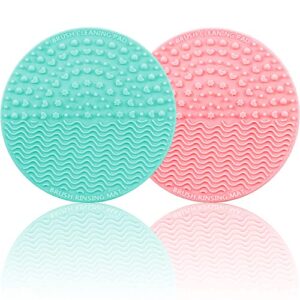
Ever thought a makeup brush cleaner could double as a mat care tool? The MR LION Silicone Makeup Brush Cleaner is more than meets the eye. Its textured silicone lifts stubborn fibers and grime from your cutting mat’s surface without scratching.
The compact pad fits easily in your hand, and the suction cup keeps it steady while you work. Just add a little mild soap and water, then gently scrub—your mat comes out refreshed. It’s quick, gentle, and handy for everyday mat maintenance.
| Best For | Anyone who uses makeup brushes regularly and wants a quick, no-fuss way to keep them clean at home or on the go. |
|---|---|
| Material | Silicone |
| Primary Use | Brush Cleaning |
| Portability | Travel-friendly |
| Weight | 2.4 oz |
| Surface Design | Multi-texture |
| Ease of Use | Handle & suction cup |
| Additional Features |
|
- The multi-texture silicone surface does a solid job breaking down makeup, oil, and buildup from all kinds of brushes
- The suction cup sticks to flat surfaces so you can scrub hands-free without chasing the pad around the sink
- Eco-friendly silicone material is durable, easy to rinse, and safe to use with your everyday shampoo or brush cleaner
- The suction cup struggles on curved or uneven sink surfaces, so it won’t stay put everywhere
- It can pick up stains over time, which isn’t a dealbreaker but doesn’t look great
- If you leave it sitting in water, it gets slimy fast—definitely rinse and dry it after each use
2. Gypsy Quilter Heart Mat Cleaner
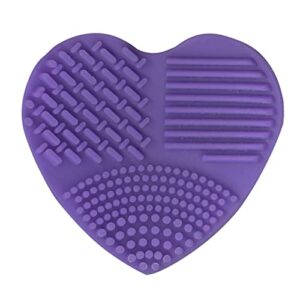
The Gypsy Quilter Heart Mat Cleaner is one of those tools that earns its spot in your sewing kit fast. That purple silicone pad — shaped like a heart and just over 3 inches wide — fits your fingers perfectly through the center opening.
Use circular motions to lift fabric fibers, lint, and pet hair right out of your mat’s grooves. It’s gentle enough not to damage the surface, and you can rinse it clean with warm soapy water when you’re done.
| Best For | Quilters, crafters, and anyone who wants to keep their cutting mats clean and in good shape with minimal fuss. |
|---|---|
| Material | Silicone |
| Primary Use | Mat Cleaning |
| Portability | Portable |
| Weight | 1.13 oz |
| Surface Design | Heart-shaped pad |
| Ease of Use | Simple rolling motion |
| Additional Features |
|
- Removes lint, threads, and pet hair quickly from cutting mats
- Easy to hold, use, and clean thanks to its heart-shaped silicone design
- Portable and handy for cleaning other surfaces like ironing boards
- May struggle with deeply embedded lint or debris
- Small size might be limiting for larger mats or big cleaning jobs
- Price can be high compared to similar cleaning tools
3. June Tailor Quilting Cut and Press Mat
A dual-purpose workhorse like the June Tailor Quilting Cut and Press Mat can really simplify your setup. One side offers a self-healing cutting surface with clear grid lines for precision, while the flip side gives you a cushioned, heat-resistant pressing area.
You get a handy, portable solution that’s perfect for small spaces or taking to classes. The reinforced edges help prevent curling, and the compact size is just right for squaring up blocks or quick pressing—no need to shuffle between separate mats.
| Best For | Quilters, sewists, and crafters who need a compact, portable surface for both cutting and pressing in small spaces or on the go. |
|---|---|
| Material | Cotton and Plastic |
| Primary Use | Cutting & Pressing |
| Portability | Portable with handle |
| Weight | Not specified |
| Surface Design | Gridded surface |
| Ease of Use | Carrying handle |
| Additional Features |
|
- Combines a hard cutting mat and cushioned pressing surface in one, saving space and setup time.
- Portable size with a carrying handle makes it easy to bring to classes, retreats, and guild meetings.
- Great for small projects like quilt blocks, kanzashi flowers, perler beads, and other detailed pressing or trimming tasks.
- Small 11" x 11" grid isn’t ideal for long seams or larger fabric pieces.
- Won’t fully replace a standard ironing board for assembling or pressing a full quilt.
- Cutting surface can wear out over time if you do a lot of heavy cutting on it.
4. Omnigrid Portable Cutting Pressing Station
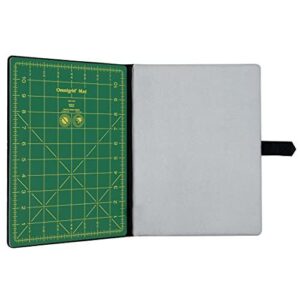
The Omnigrid FoldAway Portable Cutting Pressing Station might be the smartest two-in-one tool you didn’t know you needed. It pairs a gridded cutting mat with a non-stick ironing surface right next to each other — so you can trim, then press, without moving from your spot.
At under 12 by 18 inches, it’s compact enough for a class bag but practical for home use too.
The fold-and-go design makes packing up genuinely painless.
| Best For | Quilters and crafters who work on small projects and want a compact, portable two-in-one cutting and pressing surface they can keep beside their sewing machine or take to classes. |
|---|---|
| Material | Plastic |
| Primary Use | Cutting & Ironing |
| Portability | Foldable for travel |
| Weight | 1.48 lbs |
| Surface Design | Grid marked surface |
| Ease of Use | Hook and loop closure |
| Additional Features |
|
- 2-in-1 design with side-by-side cutting mat and non-stick pressing surface saves time and space.
- Foldable, lightweight, and compact, making it great for classes, travel, and small sewing spaces.
- Ideal for trimming, foundation piecing, and working on small quilting or crafting projects right next to your machine.
- Limited surface size means it’s not practical for larger projects or bigger fabric pieces.
- Only has inch measurements, which isn’t ideal if you prefer or need metric.
- May slip a bit while using an iron or rotary cutter, and it carries a California Prop 65 warning about potential chemical risks.
5. Headley 45mm Rotary Cutter Blades
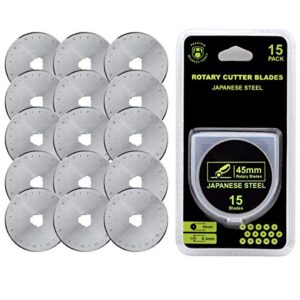
A dull blade is a cutting mat’s worst enemy. The Headley 45mm Rotary Cutter Blades are a smart, budget‑friendly way to keep both your cuts and your mat in good shape.
Made from Japanese SKS‑7 steel, they stay sharp through dozens of passes — even across multiple fabric layers. They fit standard 45mm grips from Fiskars and Olfa, so swapping them out is quick and easy.
Each pack of 15 comes in a storage box, so you’re always stocked and ready.
| Best For | Home sewists, quilters, and crafters who want sharp, budget-friendly 45mm blades that can handle multiple layers of fabric and other materials without replacing them constantly. |
|---|---|
| Material | Japanese Steel (SKS-7) |
| Primary Use | Fabric Cutting |
| Portability | Compact storage box |
| Weight | 2.08 oz |
| Surface Design | Length markings |
| Ease of Use | Pre-oiled blades |
| Additional Features |
|
- Cuts smoothly through several layers of fabric, fleece, vinyl, and more, so you get clean lines with fewer passes.
- Made from durable Japanese SKS-7 steel, so they stay sharp for a long time and help protect your cutting mat.
- Great value pack of 15 blades with a handy storage box, making it easy and affordable to keep backups on hand.
- Blades come heavily oiled, which can feel greasy and a bit messy to handle at first.
- Not individually wrapped, so blades can stick together and need extra care when separating.
- Only fits 45mm rotary cutter handles and may not feel quite as premium as name-brand blades like Olfa or Fiskars.
6. OLFA Self Healing Rotary Cutting Mat
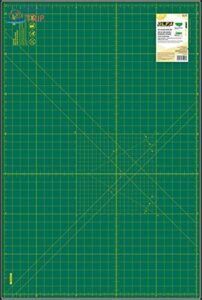
If you’re going to invest in a quality mat, the OLFA Self-Healing Rotary Cutting Mat is worth every penny.
It’s built with multi-layer PVC that absorbs blade impact and reseals after each cut, so your surface stays smooth session after session.
The 24" x 36" double-sided design gives you grid lines on one side for precise work and a clean surface on the other. At just 1.5mm thick, it’s flexible but durable — and it protects your blades too.
| Best For | Quilters, sewers, and crafters who use rotary cutters and want a reliable surface that protects both their work and their blades. |
|---|---|
| Material | Plastic/Rubber |
| Primary Use | Fabric Cutting |
| Portability | Flat storage required |
| Weight | 2.3 lbs |
| Surface Design | Double-sided grid |
| Ease of Use | Self-healing surface |
| Additional Features |
|
- Self-healing surface reseals after cuts, so it stays smooth and lasts a long time
- Double-sided design gives you grid lines when you need precision and a clean surface when you don’t
- Protects your rotary blades, which means you’re not replacing them as often
- At 1.5mm thick, it’s on the thinner side and some users notice cut marks over time
- Can warp if stored upright or left in direct sunlight, so storage matters
- May have a noticeable odor when brand new, though it fades with time
Frequently Asked Questions (FAQs)
How long to soak a self-healing mat?
Picture your mat sinking into a cool bath—fifteen to twenty minutes is just right.
This soak lets moisture and vinegar loosen stubborn fibers and grime, reviving the surface without risking warping or oversaturation.
How long does a self-healing mat last?
high-quality self-healing mat usually lasts three to five years with steady use and proper care.
Daily heavy cutting can shorten its life to one or two years, while lighter hobby use stretches it well beyond five.
Can you repair a mat with deep cuts?
Sometimes deep cuts can be patched, especially if they’re not all the way through. For example, flexible adhesive and a vinyl patch work well.
If the mat feels bumpy after repair, though, you’ll want to think about replacing it.
How often should mats be conditioned in water?
Most mats do well with conditioning every two to four weeks during heavy use. In drier conditions or low-humidity spaces, every six to eight weeks is usually enough.
What causes mats to lose their self-healing ability?
repeated cuts wear down the mat’s internal structure, debris clogs the grooves, and heat or sunlight breaks down elasticity — all of which stop those tiny cuts from closing back up.
Can you use both sides of a cutting mat?
You’d almost think a double-sided mat could last forever—most are designed for use on both sides.
Flip yours to spread out wear, but always check for clean surfaces to avoid transferring debris to your fabric or blades.
Conclusion
Like a well-worn tool that rewards the hands that tend it, your cutting mat gives back exactly what you put in. Knowing how to care for a self healing cutting mat isn’t just about maintenance—it’s about protecting every project before it even begins.
Rotate it, clean it, store it flat, and keep your blades sharp. Do those things consistently, and your mat stays your most reliable surface for years of precise, satisfying work.