This site is supported by our readers. We may earn a commission, at no cost to you, if you purchase through links.
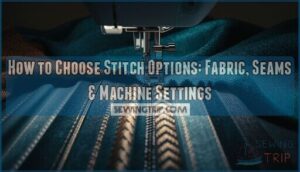
Your seam just snapped on your favorite stretch dress—again. The culprit? A straight stitch that can’t flex with the fabric. Most sewers blame their skills or their machine, but the real issue is stitch selection.
Different fabrics speak different languages, and using the wrong stitch is like trying to have a conversation in Mandarin when everyone else speaks Spanish. Canvas laughs at delicate stitches, while silk puckers under heavy-handed ones.
Once you understand how fabric weight, project function, and stretch requirements dictate your stitch choices, you’ll stop fighting your machine and start creating seams that actually hold up to real-world wear.
Table Of Contents
Key Takeaways
- Stitch selection depends on four key factors: fabric type and weight, project purpose, seam strength requirements, and how much stretch or flexibility the finished piece needs to handle.
- Woven fabrics work best with straight stitches for structure and zigzag for finishing, while knits demand stretch stitches or zigzag to prevent broken seams when the fabric moves.
- Machine settings—stitch length, thread tension, and needle-thread compatibility—matter just as much as choosing the right stitch, since wrong settings cause puckering, breakage, or weak seams regardless of stitch type.
- Testing your stitch selection on fabric scraps before committing to your project prevents costly mistakes and helps you dial in the perfect combination of stitch type, length, and tension for professional results.
Key Factors for Choosing Stitch Options
Choosing the right stitch isn’t guesswork—it’s about matching your machine settings to what you’re actually sewing. The fabric in your hands, the job it needs to do, and how much wear it’ll face all point you toward the best stitch option.
Let’s break down the four factors that’ll guide every stitch decision you make.
Fabric Type and Weight
Fabric type and weight are your foundation. Think of weight measurement as your fabric’s fingerprint—measured in ounces per square yard, it tells you exactly what you’re working with.
Weave patterns, fiber types, and fabric density all shape how your thread count interacts with stitches. Delicate silks need finesse, while canvas demands strength.
Master fabric handling, and you’ll nail fabric manipulation every time.
Project Purpose and Function
Your project goals drive everything. Function first, always.
A gym bag needs durability and strong seam strength for constant wear, so fabric choice matters. Formal garments demand low stitch visibility with refined finishes. End use shapes your entire sewing stitch selection guide—children’s clothes need washability, while decorative pillows don’t.
Match fabric type and sewing machine settings to garment construction demands.
Seam Strength and Durability
Backstitch at seam ends locks everything down—it’s your insurance against thread breakage. Stitch density matters more than you’d think: too sparse and you’ll see material failure under stress; too tight and fabric fraying starts.
High-tensile polyester thread paired with proper thread tension reduces seam fatigue dramatically. Don’t skip seam finishing techniques like serging—they prevent unraveling and keep your work intact through repeated wear.
Stretch and Flexibility Needs
Your project lives or dies by how well stitches move with fabric. Straight stitches snap under stress on stretch fabrics—that’s where zigzag or stretch stitch saves the day.
Elastic recovery matters: knit structure and thread elasticity determine whether seams bounce back or stay distorted. Core-spun threads boost seam flexibility by 10-20%, while proper thread tension prevents puckering.
Match your stitch to fabric stretch for garments that actually last.
Matching Stitches to Fabric Types
Your fabric tells you which stitch to use—you just need to know how to listen. Woven cottons and stretchy knits don’t play by the same rules, and what works beautifully on silk can wreck denim.
Let’s break down how to match your stitch selection to whatever fabric lands on your sewing table.
Woven Fabrics Vs. Knit Fabrics

Think of woven versus knit fabrics like comparing a basket to a sweater—one’s rigid, the other gives.
Here’s what you need to know about choosing stitches for each fabric type:
- Wovens need structure: Use a straight stitch for seams, then zigzag stitch for seam finishing to prevent fraying along the fabric grain
- Knits demand flexibility: Grab a stretch stitch or zigzag to match the fabric drape and natural give
- Stitch tension matters: Adjust based on weave patterns and yarn types to avoid puckering
Handling Delicate or Heavy Materials
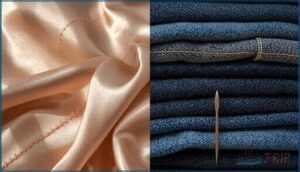
Precision in fabric handling transforms your material selection from guesswork into confidence. Delicate stitching on silk or chiffon? Use a size 9–11 needle and lower your thread tension to avoid puckering—a narrow zigzag works beautifully for seam finishing.
Heavy duty sewing demands the opposite: grab a 90/14 needle (or bigger!), lengthen your stitch, and consider polyester thread for textile care that lasts through serious wear.
Preventing Fraying and Puckering
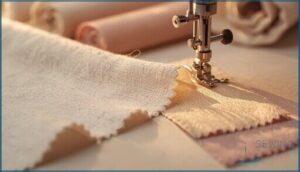
Raw edges unravel fast without proper fray prevention. Lock them down with a zigzag stitch aligned to the fabric edge, or use a narrow overlock before you seam. Puckering control starts with balanced thread tension and the right stitch length for your fabric type.
Edge finishing essentials:
- Apply seam reinforcement with a secondary stitch row on vulnerable areas
- Use stretch stitch or narrow zigzag on knits to prevent curling
- Match needle size to fabric weight—avoid fiber breakage
- Stabilize woven edges with spray starch during handling
Fabric stabilization plus smart seam finishing equals clean, durable results every time.
Comparing Common Stitch Types
You’ve got your fabric matched to the right stitch—now let’s break down what each stitch actually does. Think of this as your decoder ring for that intimidating stitch dial on your machine.
Here’s how the workhorses compare to the specialty players, so you know exactly when to use what.
Straight Stitch Vs. Zigzag Stitch
Your sewing machine offers two workhorses: the straight stitch and the zigzag stitch. The straight stitch creates a single thread path—perfect for woven fabrics where seam security matters most. The zigzag alternates needle position, accommodating fabric stretch without breaking.
Stitch length and tension settings affect both options differently. Choose based on fabric type and whether you need flexibility or a locked seam. Thread choice matters too!
Overlock and Stretch Stitches
Your serger transforms edge finishing with overlock mechanics—trimming and enclosing fabric edges using 3-4 serger threads.
Stretch stitches and overcast stitch options on your sewing machine settings provide stitch elasticity, essential for stretch fabrics like knits and activewear. These stretch stitches allow seams to move without breaking.
Choose narrow zigzag or dedicated stretch stitch patterns to maintain flexibility while preventing fraying on stretch fabric edges.
Decorative and Specialty Stitches
Your machine’s decorative stitches transform plain fabric into something special—think scallops, feathers, and embroidery options that add personality without hand-sewing hours. These fabric embellishments require stitch customization through your sewing machine settings (width and length adjustments matter here!). Use stabilizers during embroidery to prevent puckering.
Decorative edging works beautifully on hems and collars, while stretch stitches combine function with flair on athletic wear.
Selecting Stitches for Seams, Hems, and Finishes

Now that you know which stitches work best with different fabrics, it’s time to match them to specific tasks. The stitch you choose for a seam won’t be the same one you use for a hem or edge finish.
Let’s break down the best options for each situation so you can sew with confidence.
Seaming Techniques for Different Projects
Your project determines your seam. Lightweight wovens like cotton lawn thrive with flat-felled seams for durability, while French seams give sheer fabrics a clean finish—critical for proper garment construction.
Knits need zigzag or stretch overlock stitches to preserve elasticity.
For home decor, reinforce heavy upholstery blends with double-stitched seams.
Match your sewing techniques and stitch selection to fabric selection for professional seam finishing every time.
Hemming Options and Their Uses
After you nail your seams, you’ll tackle hemming—and here’s where things get personal. Blind hemming creates invisible seams on dress pants, while rolled hems give lightweight silk a delicate finish. Stretch hemming with a stretch stitch keeps jersey moving freely. Try decorative edges on kids’ clothes for visual interest.
The blind hem stitch delivers professional results when you want that clean, undetectable look every time.
Finishing Raw Edges Effectively
Raw edges demand attention—they’ll unravel faster than you think. Your edge finishing techniques protect seams and prevent fraying with smart raw edge management.
- Zigzag stitch wraps thread around edges for solid fray prevention methods
- Overcast stitch reinforces delicate fabrics with fabric stabilization
- Straight stitch plus serger overlock delivers professional seam reinforcement
Choose based on fabric weight and project wear.
Adjusting Machine Settings for Best Results
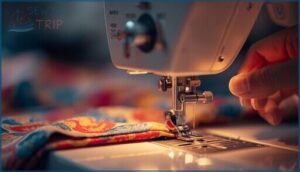
You’ve picked the right stitch for your fabric—now it’s time to make your machine work with you, not against you. Getting the settings dialed in makes the difference between a seam that holds strong and one that puckers or breaks.
Let’s walk through the key adjustments that’ll give you professional results every time.
Stitch Length and Density Adjustments
Your stitch length and density settings are the secret to professional-looking seams. For most woven fabrics, aim for 2.5–3.0 mm to balance seam stability and fabric tension. Heavier materials? Bump it up to 3.0–4.0 mm.
Adjust your sewing machine’s density settings to prevent puckering on delicates—too tight creates bunching, too loose weakens seams. Always test stitch calibration on scraps before committing to your project!
Thread and Needle Compatibility
Wrong thread and needle choices sabotage your stitches before they hit fabric. Pairing needle sizes (70/10 for chiffon, 90/14 for denim) with thread types prevents skipped stitches and breakage.
- Cotton thread? Use 80/12 sharp needles for woven fabrics—perfect compatibility
- Metallic thread? Grab specialized needles with larger eyes to stop fraying mid-seam
- Knits demand ballpoint needles to separate fibers instead of slicing through them
Match fabric weights to needle materials for impeccable results!
Tension Settings for Various Stitches
Stitch balance hinges on proper thread tension—the invisible force that makes or breaks your sewing precision. Most sewing machines offer a tension scale in your manual. Set higher tension for dense wovens to avoid loops underneath, lower for knits to prevent surface show-through.
| Stitch Type | Tension Strategy |
|---|---|
| Straight stitch | Standard calibration per fabric |
| Zigzag/decorative | Slightly looser upper tension |
| Stretch stitches | Balanced tension for fabric stretch recovery |
Machine calibration adjusts stitch length and machine settings together—don’t tweak tension alone! Proper stitch selection starts here.
Troubleshooting Stitch Selection Issues
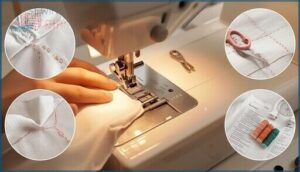
Even with the right stitch selected, you’ll still run into the occasional hiccup—it’s just part of sewing. The good news is that most stitch problems have straightforward fixes once you know what to look for.
Let’s walk through how to spot issues, solve them quickly, and keep your machine running smoothly.
Identifying Common Stitch Problems
Ever wonder why your sewing machine suddenly acts up? Stitch alignment goes wonky when feed dogs slip or presser foot pressure needs tweaking. Needle issues (bent or wrong size) cause skipped stitches, while loops underneath scream bobbin tension problems.
Fabric puckering happens with excessive thread tension or mismatched needles.
Thread breakage? That’s usually cheap thread meeting a rough needle eye—your machine’s way of saying “help!
Thread breakage is usually your machine telling you that cheap thread and a rough needle eye don’t mix
Solutions for Uneven or Skipped Stitches
Think your machine’s betraying you? Most uneven or skipped stitches vanish with simple fixes. Start by re-threading your sewing machine—threading issues cause 80% of problems. Next, swap in a fresh needle (every 8-12 hours matters). Then adjust thread tension gradually until top and bottom stitches balance.
Thread quality makes or breaks your troubleshooting efforts!
- Check needle selection matches your fabric weight
- Test stitch length and stitch width on scrap fabric first
- Guide fabric gently without pulling or pushing
- Clean the bobbin area to remove lint buildup
Maintenance Tips to Prevent Stitch Issues
Your machine needs love to perform consistently. Clean lint from feed dogs and hook area after every heavy project—buildup throws off tension calibration and causes skipped stitches. Replace needles every 8-12 hours of sewing (bent ones snag fabric).
Re-thread completely when switching thread types. Check presser foot pressure matches your fabric weight.
Regular machine maintenance beats troubleshooting common issues every time!
Frequently Asked Questions (FAQs)
Can I combine different stitches in one project?
Combining stitches adds both function and flair. Use straight stitches for sturdy seams, zigzag for stretch areas, and decorative topstitching for visual interest—mixing techniques elevates your fabric blending and seam integration beautifully.
How do thread colors affect stitch visibility?
Thread color contrast with fabric hue dramatically affects stitch visibility. High contrast makes stitches pop, while matching tones blend seamlessly.
Always run visibility tests on swatches, checking thread tension and colorfastness before committing.
What stitches work best for curved seams?
About 60% of sewing mistakes happen on curves. A narrow zigzag stitch (5–0mm width) manages gentle curves smoothly, while stretch stitches maintain elasticity on knit fabrics without puckering or distortion.
Should beginners avoid certain stitch types entirely?
You don’t need to completely avoid complex stitches, but postpone decorative options and overlock until you’ve mastered straight and basic zigzag on stable woven fabrics—stitch complexity increases beginner risks unnecessarily.
Do specialty feet change which stitches I use?
Specialty presser feet guide fabric movement and edge control, making certain stitches work better. Walking feet pair beautifully with straight stitches for layers, while overedge feet practically demand overlock stitches for clean finishes.
To guarantee methodological rigor in our analysis, we consider the importance of scientific study audits when evaluating sewing techniques.
Conclusion
Your sewing machine is an orchestra, and choosing the right stitch is like selecting the perfect instrument for each movement. You wouldn’t use a tuba where a violin belongs.
Now that you understand how to choose stitch options based on fabric behavior, project demands, and machine capabilities, you’re conducting—not guessing.
Test your stitches on scraps first. Adjust as you go. And remember: even professional sewers experiment. The difference? They know what they’re listening for.
- https://www.schmetzneedles.com/needle-know-how/
- https://www.singer.com/blog/sewing-tips-and-techniques/understanding-thread-tension
- https://thriveworkwear.com/blogs/resources/reinforced-stitching-workwear
- https://www.best-dressed-bears.com/blogs/news/choosing-the-right-sewing-machine-needle-for-your-project
- https://www.gloryallan.com/blogs/news/the-ultimate-list-of-essential-sewing-tools-for-home-sewists