This site is supported by our readers. We may earn a commission, at no cost to you, if you purchase through links.
That crew neck sitting too high on your throat, the boxy fit swallowing your shoulders, the generic shape that makes every tee look the same—these aren’t permanent features. Learning how to cut tshirt neck openings transforms basic garments into pieces that actually flatter your frame, breathe with your body, and reflect your personal aesthetic.
A few strategic snips can drop a suffocating neckline into a relaxed scoop, carve out a lengthening V-shape, or expose your collarbones with an off-shoulder cut. You’re not just altering fabric, you’re reclaiming creative control over your wardrobe, turning forgettable basics into statement pieces that fit your body and your vision.
Table Of Contents
- Key Takeaways
- Why Cut a T-Shirt Neckline?
- Essential Tools for Cutting T-Shirt Necks
- Choosing The Best T-Shirt for Cutting
- Popular T-Shirt Neckline Styles
- Planning and Marking Your New Neckline
- Step-by-Step Guide to Cutting T-Shirt Necks
- Finishing and Securing The New Neckline
- Creative Tips for Customizing Necklines
- Frequently Asked Questions (FAQs)
- Conclusion
Key Takeaways
- Cutting your own t-shirt necklines transforms basic garments into custom pieces that flatter your frame, improve comfort through better fit and breathability, and lets you express personal style while rescuing forgotten shirts from your drawer.
- Success depends on using the right tools—sharp fabric-only scissors, flexible measuring tapes, and chalk markers—combined with proper prep like prewashing, pressing wrinkles flat, and pinning layers to prevent lopsided cuts.
- Popular neckline styles like V-necks, scoops, and off-shoulder cuts each create different visual effects, with V-necks elongating your torso, scoops softening features, and asymmetrical designs adding edge to your wardrobe.
- Finishing raw edges with binding, bias tape, or stitching prevents fraying and stretching over time, turning a quick modification into a durable wardrobe staple that survives countless wears and washes.
Why Cut a T-Shirt Neckline?
You don’t have to settle for the neckline your t-shirt came with, and there are real reasons to grab your scissors and start cutting. Whether you’re after a better fit, a fresh look, or a way to rescue a shirt that’s been sitting in your drawer, customizing the neckline puts you in control.
If you’re ready to dive in, start with the basics of how to sew a neckline so your custom cut looks professional instead of frayed.
Let’s look at why this simple modification is worth your time and how it can transform both your wardrobe and your approach to fashion.
If you’re looking for more ways to refresh what you already own, these creative sewing ideas for clothing repair offer practical techniques that go beyond basic fixes.
Benefits of Neckline Customization
Cutting your own neckline unlocks a kind of creative freedom that store-bought tees just can’t deliver, letting you dial in the exact fit, style, and vibe you’ve been picturing in your head. This freedom is especially evident when exploring various DIY t-shirt designs.
You’re taking control of your personal style, stepping away from fashion trends that don’t speak to you, and creating custom looks that reflect genuine self-expression through t-shirt modification and neckline cutting techniques that transform ordinary tailored clothing into something unmistakably yours.
Start with basic sewing skills for custom clothing to gain the confidence you need before cutting into your favorite pieces.
Style and Comfort Considerations
Beyond personal expression, the right neckline cutting techniques blend neckline aesthetics with real comfort factors that transform how your t-shirt neckline feels all day. A well-executed v-neck or scoop visually elongates your neck while improving thermal regulation around your shoulders, reducing that trapped-heat sensation that tight crew necks create.
If you have skin sensitivity, widening the collar minimizes friction and chemical contact, and strategic DIY t-shirt neckline cutting actually balances body proportions by adjusting visual emphasis across your chest and shoulders. Understanding different neckline styles is essential for achieving the perfect cut.
Upcycling and Sustainable Fashion
Every snip you make rescues a perfectly good shirt from the landfill, turning a forgotten hand-me-down into your go-to Saturday piece while slashing the hidden costs of fast fashion. T-shirt modification is genuine clothing upcycling that challenges throwaway culture head-on, because sustainable fashion starts with reimagining what you already own:
Every snip rescues a shirt from the landfill and challenges throwaway culture by reimagining what you already own
- Textile reuse cuts water waste by thousands of gallons per garment
- DIY fashion eliminates shipping emissions and plastic packaging entirely
- Upcycled clothing extends garment lifespan by years, not months
- Eco fashion builds creative confidence while protecting your wallet and the planet
Essential Tools for Cutting T-Shirt Necks

Before you make your first cut, you’ll need to gather the right tools to transform your t-shirt without ruining it. The difference between a clean, professional-looking neckline and a frayed disaster comes down to what you’re using to cut, measure, and finish your project.
Let’s break down the essential supplies that’ll set you up for success.
Start with high-quality threads, sharp needles, and stabilizers—these embroidery tips and tricks can help you choose the right materials for each project.
Choosing The Right Scissors
Your scissors are the make-or-break tool in this transformation, so don’t reach for those kitchen shears. Fabric scissors with sharp, dedicated blades slice cleanly through jersey knit without crushing or fraying the edges, while dull household scissors will leave you with stretched, jagged cuts that look amateurish.
Here’s how to choose your cutting companion:
| Feature | Why It Matters | What to Choose |
|---|---|---|
| Blade Sharpness | Dull blades compress knit loops instead of slicing them, creating distorted edges that unravel quickly | Sharp, fabric-only scissors that you never use on paper or plastic |
| Blade Length | Longer blades cut faster on large areas; shorter blades give you control on curves and details | 8-10 inch tailor scissors for balanced reach and precision on t-shirt necklines |
| Edge Type | Micro-serrated blades grip slippery knits and prevent fabric from sliding during cuts | Standard knife-edge for most cuts; micro-serrated for extra control on smooth cotton |
| Grip Design | Poorly designed grips cause hand fatigue and reduce cutting accuracy over repeated projects | Ergonomic grips that fit your hand comfortably and minimize finger strain |
| Material Quality | Harder steel holds a sharper edge longer, maintaining clean cuts across multiple projects | Professional-grade fabric shears with thick, stable blades that won’t flex under pressure |
Keep one pair reserved exclusively for fabric—the moment you cut paper, you’ve dulled the edge and compromised every future neckline.
Measuring and Marking Tools
Precision starts before your fabric scissors ever touch the shirt—you need flexible rulers and measuring tapes to map your neckline, plus chalk markers or fabric chalk to draw it.
A standard measuring tape (usually 60 inches long) curves with your body’s contours, while grid rulers mark straight reference lines and equal distances from center front, ensuring your V or scoop doesn’t end up lopsided.
Optional Finishing Materials
You can leave raw edges to curl naturally on knit fabrics, but fusible interfacing, bias tape, and stretch binding give you clean, polished finishes that won’t fray or lose their shape after washing.
Consider these edge finishing options:
- Sewn bands from matching or contrast fabric that frame your neckline
- Lace inserts or decorative edging for feminine, vintage-inspired cutouts
- Interfacing materials that stabilize stretchy knits without stiffness
- Braided neckline trim you can hand-stitch or glue on
Choosing The Best T-Shirt for Cutting

Not every t-shirt will give you clean cuts and professional results, so choosing the right one from the start saves you time and frustration. The fabric you pick, the fit of the shirt, and how you prep it all influence whether your new neckline turns out sharp or sloppy.
If you’re working with delicate or slippery materials, techniques for handling silk fabrics can help you control stretchy cotton knits too.
Let’s break down what to look for before you make that first cut.
Fabric Type and Stretch
Before you grab your fabric scissors for neckline alteration, check what you’re working with. Single jersey knits stretch more around the body than vertically, so your cuts will pull differently depending on fiber blends.
Cotton-elastane mixes with 5–10 percent spandex give you t-shirt modification freedom with better recovery behavior, while pure cotton has a tendency to bag out after cutting, compromising your t-shirt customization goals.
Fit and Size Considerations
Start with a shirt that’s already a little loose—baggy fits give you modification wiggle room without strangling your chest fit after cutting.
When planning your t-shirt neckline cutting project, consider these garment sizing essentials for successful shirt modification techniques:
- Oversized t-shirts offer extra fabric volume around shoulders, letting you widen openings without compromising body proportion
- Women’s cuts usually feature wider neckbands than unisex styles, affecting neckline balance post-alteration
- Size up if switching between cut styles to accommodate fabric stretch and maintain comfortable chest drape
Prepping Your T-Shirt
Before fabric scissors touch your T-Shirt, proper fabric preparation means the difference between clean edges and wavy disasters. Wash and tumble dry on your usual setting to release shrinkage, then press with a warm iron to smooth wrinkles that distort measuring techniques. Fold at center front, align shoulder seams perfectly, and pin layers together—this neckline stabilizing method’s foundation prevents lopsided cuts and ensures your chalk marks guide symmetrical results every time.
| Preparation Step | Why It Matters |
|---|---|
| Prewash in cold water | Removes shrinkage before cutting |
| Press with steam iron | Eliminates wrinkles distorting measurements |
| Fold at true center | Creates mirrored layout for symmetry |
| Pin front and back | Prevents fabric shifting during marking |
| Mark with tailor’s chalk | Provides visible, washable cutting guidelines |
Popular T-Shirt Neckline Styles
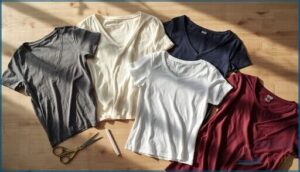
Before you grab your scissors and start cutting, you need to know which neckline style you’re actually going for, because each one creates a completely different vibe and requires its own approach.
The right neckline can take your t-shirt from basic to bold, flattering your frame while giving you that custom fit you’ve been craving.
Let’s break down the most popular styles you can create, so you can choose the one that matches your vision and confidence level.
Crew Neck
Think of the crew neck as your blank canvas—a round, snug neckline sitting just above your collarbone that works on every body type. This classic style layers beautifully under jackets, making it the perfect starting point for DIY t-shirt neckline cutting adventures.
Here’s why crew neck styles dominate your wardrobe:
- Timeless versatility that transitions from casual to polished
- Close fit that won’t gape or shift throughout your day
- Ideal neckline depth for showcasing statement necklaces
- Easy fabric choices across cotton, blends, and knits
- Simple cutting techniques transform it into scoop or V-neck designs
V-Neck
You’ll find V-neck styles irresistibly flattering—the angled lines visually elongate your torso, drawing eyes upward to highlight your collarbone. Perfect for broadening your neckline style guide, this DIY t-shirt neckline cutting technique transforms basic tees into elegant pieces that layer seamlessly under blazers or stand alone with confidence.
| V-Neck Feature | Your Styling Advantage |
|---|---|
| Neckline depth | Creates slimming vertical lines |
| Cutting techniques | Symmetry tips prevent lopsided angles |
| Fabric selection | Cotton knits hold V shape beautifully |
| T-shirt modification techniques | Easy progression from crew necks |
Scoop Neck
Scoop neck basics deliver a softer revolution—this deeper, wider curve opens up your neckline depth far beyond standard crew constraints, beautifully framing your collarbone and upper chest.
Perfect fabric selection matters here, cotton knits naturally roll into gentle curves when cut, while cutting techniques focus on smooth arcs traced with a plate.
Your neckline style guide expands dramatically with this t-shirt modification technique, showcasing jewelry and creating feminine, breathable style variations.
Off-the-Shoulder
Want a bolder statement? Off-shoulder necklines drop the fabric below your shoulders, creating dramatic shoulder cutouts that work beautifully with asymmetrical neck variations following current fashion trends.
This DIY modification transforms skin-tight tees through strategic t-shirt neckline cutting—measure down from each shoulder seam, mark your curve, and execute these style hacks with confidence. Your t-shirt modification techniques just leveled up into statement-making territory.
Choker Neck
Combining statement hardware with strategic fabric removal, the choker neck creates an edgy look through a cut-out V or scoop paired with a narrow band hugging your neck base. This streetwear-inspired neckline trend emerged in the late 2010s, turning graphic tees into fashion hacks that frame your décolletage while maintaining that rebellious choker vibe.
- Grab fabric pens and sharp scissors for your DIY t-shirt neckline cutting session
- Mark your desired V-neck depth while keeping the choker band intact
- Cut carefully around the neckline, leaving approximately one inch for the band
- This choker v-neck style works best on crew neck foundations
- Experiment with various neckline trends to discover your signature edgy looks
Planning and Marking Your New Neckline
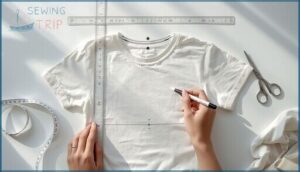
Before you pick up those scissors, you need a clear game plan—because once you cut, there’s no turning back. The secret to a professional-looking neckline isn’t just confidence, it’s precision in your measurements and marks.
Let’s break down the three essential steps that’ll keep your new neckline perfectly balanced and exactly where you want it.
Measuring for Symmetry
Measuring for symmetry is the difference between a pro-level neckline and a lopsided disaster, so grab your measuring tape, ruler, and chalk to take control. Start by folding your tee in half, matching side seams to align the center front and back within 2 to 3 mm, then mark your midpoint with washable chalk for a repeatable reference that keeps both sides mirror-perfect.
| Measurement Point | Tool to Use | Target Precision |
|---|---|---|
| Center front to shoulder | Measuring tape | Equal within 1–2 mm each side |
| Neckline depth from base seam | Ruler | Identical distance left and right |
| Horizontal width at key points | Clear gridded tape | Match at multiple checkpoints |
| Final symmetry verification | Overlay comparison | Visual and physical smoothness |
Press that folded crease with a warm iron to create a temporary guide that won’t shift while you work, reducing placement error by several millimeters and giving you a rock-solid foundation for neckline alignment.
Measure standard front widths of 3 to 4 inches from the center toward each shoulder, keeping distances identical, and check your symmetry at multiple horizontal points before committing to cutting precision. Pin or weigh down your fabric to prevent layer shifting, a common culprit behind asymmetrical cuts in knit fabrics, and always re-measure key distances on both sides to catch discrepancies before making irreversible T-shirt modification techniques real.
Drawing The Cutting Line
Once your symmetry is locked in, grab chalk or a heat-erasable fabric marker to draw the final neckline path with controlled, confident strokes that define your T-shirt neckline cutting destiny.
Connect your marked dots into one smooth curve, testing different cutting guides like curved rulers or flexible templates to keep your DIY T-shirt neckline cutting line flowing naturally from shoulder to center depth without awkward angles.
Tips for Accurate Marking
You can dodge uneven cuts and lopsided necklines by following a few pro tricks that transform shaky chalk marks into razor-sharp guides, giving you the confidence to cut like you’ve been doing this for years.
Press your ruler flat against the fabric to prevent shifting, use symmetry checks by folding your T-shirt vertically to compare both sides, and keep your chalk sharp for crisp marking tools precision throughout your T-shirt modification journey.
Step-by-Step Guide to Cutting T-Shirt Necks
Now that you’ve marked your neckline with precision, it’s time to pick up those scissors and make your vision a reality. The cutting process requires patience and a steady hand, but once you understand the fundamentals, you’ll be able to tackle any neckline style with confidence.
In the following sections, you’ll learn exactly how to position your shirt, execute clean cuts, and fine-tune the shape until it fits like it was custom-made for you.
Laying Out The T-Shirt
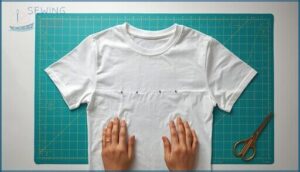
A clean, hard, flat surface is your foundation for precision—think of it as your command center for transforming that tee.
Lay your t-shirt on a cutting mat, smoothing every wrinkle flat with your hands. Align shoulder seams and side hems perfectly, checking that both layers mirror each other.
Pin the fabric at quarter points around the neckline area, securing everything before your fabric scissors make their first move.
Making The Initial Cut
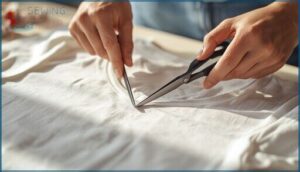
Start with a small starter snip at center front, no more than 1 cm deep, using the tip of your fabric scissors for control. This is where DIY T-Shirt Neckline Cutting transforms from idea to reality.
Lift only the front layer if you want different neckline depths front and back, then follow your chalk line slowly, keeping blades close to the fabric. Cutting techniques demand patience—fabric removed can’t be replaced, so conservative cuts win every time.
Adjusting for Shape and Depth

After the initial cut, slip the shirt on to check Depth Control and Neckline Curvature—your mirror tells the truth scissors can’t predict. Knit Fabric Stretch often relaxes deeper by up to half an inch during wear, so trimming conservatively prevents regret later, especially for TShirt Neckline Cutting that reveals more collarbone than intended.
- Use Symmetry Measurement from center to shoulders, confirming equal distances on both sides
- Adjust curves gradually with small snips, avoiding sharp angles that stress the fabric
- Plan for Edge Finishing techniques that may visually shorten depth by an eighth inch
These TShirt Modification Techniques and TShirt Cutting Techniques empower your DIY TShirt Neckline Cutting precision every time.
Finishing and Securing The New Neckline
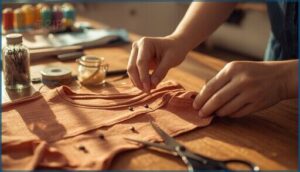
Once you’ve cut your new neckline, you’ll need to decide how to finish those raw edges so your t-shirt looks polished and lasts through countless wears and washes. The finishing method you choose depends on your skill level, the look you’re after, and how much time you want to invest in the project.
Let’s explore your options for securing that fresh neckline and keeping it from unraveling.
Raw Edge Vs. Sewn Finish
After making your cuts with fabric scissors, deciding between a raw edge and sewn binding shapes your t-shirt’s longevity and vibe. Raw edges curl and stretch on knit fabrics, creating that intentionally undone look, but they won’t hold their shape forever. Sewn finishes like binding or bands lock in edge stability, resist fabric distortion, and boost finish durability.
Here’s what each option brings to your DIY t-shirt neckline cutting project:
| Finish Type | What It Offers |
|---|---|
| Raw Edge | Fast execution, casual rolled aesthetic, eventual stretch-out over time |
| Sewn Binding | Enhanced durability, controlled neckline shape, professional appearance |
| Raw + Topstitch | Minimal curl reduction, slight reinforcement, maintains relaxed feel |
| Full Band | Maximum stability, prevents gaping, requires intermediate sewing skills |
T-shirt modification with t-shirt cutting techniques demands this choice upfront, because once you commit to a raw neckline on jersey knit, reversing fabric distortion gets tricky.
Adding Neck Bands or Binding
When you’re ready to refine that raw edge into something that won’t stretch out after three washes, binding or adding a neckband gives your DIY neckline the polished durability it deserves. These finishing methods transform T-shirt customization from a temporary experiment to a wardrobe staple.
- Ribbed knit bands stretch with body movement while maintaining neckline shape.
- Bias tape binding wraps raw edges in fabric interfacing for clean sewn edges.
- Self-fabric strips, pulled from the T-shirt itself, keep your clothing modification cohesive.
- Contrast binding techniques let you inject personality through color blocking.
Neckband types vary in complexity, but each sewing technique locks down those cuts you worked so hard to measure.
Preventing Fraying
Binding won’t save you if the fabric itself wants to unravel. Fray prevention starts with fabric selection—knits with spandex offer enhanced edge stability over pure cotton. After cutting your neckline with sharp fabric scissors, apply a zigzag or serged seam finishing immediately.
Fray reduction techniques like fray check seal loose fibers, while washing inside out protects your clothing alteration. Choose your sewing techniques wisely.
| Method | Durability | Skill Level |
|---|---|---|
| Zigzag stitch | High, stretches with fabric | Beginner |
| Fray check product | Medium, requires reapplication | Novice |
| Serged edge | Excellent, professional finish | Intermediate |
Creative Tips for Customizing Necklines
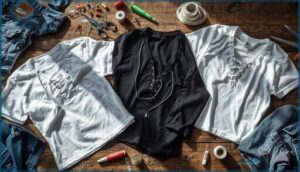
You’ve mastered the basics of cutting and finishing, so now it’s time to push your neckline customization into uncharted territory where your personality truly shines through.
The techniques below will help you transform a simple cut into a statement piece that no one else will be wearing.
Here’s how to take your T-shirt from basic to bold with creative touches that showcase your unique style.
Layering and Decorative Elements
Once you’ve mastered the basics of neckline cutting, you can layer decorative touches like lace trim, fabric flowers, or colorful bias tape to transform your t-shirt from simple to show-stopping.
Here are five fabric embellishments that enhance any t-shirt neckline:
- Lace inserts woven along a v-neck or scoop neck edge
- Braided neckline strips using contrast fabric
- Decorative trims like rickrack or ribbon
- Beaded accents hand-stitched at key points
- Layering techniques combining multiple textile designs for depth
Experimenting With Asymmetry
Asymmetry injects instant rebellion into any t-shirt modification, and you’ll find that diagonal lines or one-shoulder cuts create visual balance by disrupting predictable patterns.
Start with a basic scoop neck, then extend one side into an off-shoulder drop while keeping the other side higher, forming a dramatic asymmetrical neckline that turns heads and showcases your creative control over conventional shapes.
Combining Cutting With Sewing Techniques
Sharp scissors give you freedom to reshape fabric, but pairing those cuts with simple sewing techniques locks in durability and elevates your t-shirt from DIY experiment to polished wardrobe staple. Apply fusible interfacing techniques along raw edges before adding stretch stitching to prevent curling, or finish your neckline with bias binding for professional seam reinforcement that transforms basic t-shirt modification into lasting clothing alteration methods you’ll wear proudly.
- Stabilize first, stitch second – Iron-on fabric stabilizers prevent knit edges from warping before you add any stitches.
- Master the zigzag stretch stitch – This flexible seam moves with your fabric, keeping sewn edge finishing intact through every wear and wash.
- Bind curved necklines with bias tape – Pre-made binding wraps smoothly around scoops and v-necks, concealing raw edges with minimal effort.
- Reinforce stress points at shoulders – Double-stitch where neckline meets shoulder seams to stop tears before they start during t-shirt customization projects.
Frequently Asked Questions (FAQs)
How do I know which style of T-shirt neck suits me?
Your face shape, body type, and neck proportion reveal which t-shirt neckline flatters you most. V-necks elongate, scoop necks soften angular features, crew necks balance, and asymmetrical necklines add edge to your personal style.
Can I cut the T-shirt neck of any fabric?
Not every fabric plays nice with t-shirt neckline cutting—knit structure and fabric stretch matter most. Cotton jersey tolerates fabric scissors beautifully, but woven materials fray fast, demanding careful edge finishing and specialized cutting techniques.
How do I finish the edges of the T-shirt neck?
Your cut neckline needs protection from fraying, so apply bias tape, a narrow zigzag stitch, or a turned hem with topstitching—each method balances stretch, durability, and that polished look you’re after.
Can I cut the T-shirt neck of a graphic T-shirt?
You can reshape that printed treasure—just steer clear of graphics near the collar, since fabric stress can crack or peel artwork, turning your favorite design into a casualty of customization risks and poor print preservation planning.
Can you cut necklines on polyester t-shirts?
Yes, you can cut polyester necklines with sharp scissors designed for synthetic fibers, but pre-wash first to stabilize the fabric, then finish edges with binding or a zigzag stitch to prevent fraying and curling.
How do you fix a neckline cut too deep?
When you’ve gone too far with your scissors, don’t panic. Stitch on a complementary fabric patch, add decorative binding to raise the edge, or sew bias tape around the opening to rescue your neckline from disaster.
Whats the best way to cut stretchy fabrics?
Stretchy material acts like elastic under tension, so lock your rotary blade or fabric scissors perpendicular to the grain, add stabilizing tissue beneath, and glide smoothly without pulling—this prevents wavy edges and maintains your scoop neck or v-neck symmetry.
Should you wash the t-shirt before cutting it?
Absolutely wash your t-shirt before modification. Pre-washing benefits include shrinkage control, lint reduction, and color preservation, ensuring your fabric preparation is complete.
Clean t-shirts also provide accurate marking lines for DIY fashion projects and neckline customization.
How do you cut necklines on printed graphic tees?
Graphic tee cutting demands careful neckline preservation. Sketch a gentle U-shape around the design using chalk, maintaining 1 to 2 inches from the collarbone. Then, finish edges with zigzag stitching to prevent fraying.
Conclusion
Every uncut neckline is a blank canvas waiting for your vision, holding potential locked inside seams and hems.
Now that you know how to cut tshirt neck openings with precision and confidence, those forgotten basics transform into custom pieces that move with you, fit your frame, and tell your story.
Grab your scissors, trust your measurements, and reshape your wardrobe one strategic cut at a time—because the best-fitting garments are often the ones you create yourself.
- https://www.ellieandmac.com/blogs/blog/how-to-hack-a-scoop-neckline-into-a-lined-v-neck
- https://champu.in/blog/how-to-cut-a-v-neck-in-a-t-shirt/
- https://www.doinaalexei.com/beginnersewingtutorialblog/4-ways-to-clean-finish-the-raw-edge-of-a-curved-neckline
- https://www.wikihow.com/Cut-a-T-Shirt-Into-a-V-Neck
- https://en.wikipedia.org/wiki/Boat_neck