This site is supported by our readers. We may earn a commission, at no cost to you, if you purchase through links.
I still remember the first time I tried to make a fabric bowl and watched it collapse into a sad, wrinkled mess within hours. Turns out, there’s a massive difference between making fabric stiff and making it hard enough to actually hold its shape for years.
The secret lies in understanding how to harden fabric permanently through chemical bonding rather than temporary stiffening agents that wash out or break down over time. Once you grasp the science behind cross-linking fibers—and pick the right method for your project—you can create sculptures, bowls, decorative pieces, and structural elements that’ll outlast your patience for dusting them.
Table Of Contents
- Key Takeaways
- What Does It Mean to Harden Fabric Permanently?
- Which Fabrics Respond Best to Hardening?
- What Are The Best DIY Fabric Hardening Methods?
- Which Commercial Products Permanently Harden Fabric?
- How to Apply Fabric Hardener for Lasting Results
- Can You Use Interfacing or Boning to Harden Fabric?
- How to Care for Permanently Hardened Fabric
- Creative Project Ideas Using Hardened Fabric
- Frequently Asked Questions (FAQs)
- Conclusion
Key Takeaways
- Permanent fabric hardening relies on chemical bonding that creates cross-links within fibers, unlike temporary methods (starch, hairspray) that wash out—permanent treatments survive repeated washing and maintain rigidity for years.
- Natural fabrics like linen and cotton muslin absorb stiffening agents most effectively due to high cellulose content, while synthetic fabrics require resin-based stiffeners but risk yellowing and heat warping.
- DIY methods (glue-water ratios, cornstarch paste, gelatin) work as effectively as commercial products (Mod Podge Stiffy, Aleene’s, Beacon Stiffen Stuff) when you match the technique to your project’s flexibility needs.
- Immersion application provides uniform deep-fiber saturation with longer drying times, while surface application sets faster but risks cracking—proper shaping, humidity control (40-50%), and avoiding water exposure preserve stiffened fabric indefinitely.
What Does It Mean to Harden Fabric Permanently?
When you harden fabric permanently, you’re locking it into a rigid shape that won’t soften again—even if it gets slightly damp or sits in storage for years. This is totally different from temporary stiffening, where a quick spray of hairspray or light starch washes right out.
Let’s break down what makes hardening permanent and where you’ll actually use this technique in your projects.
Difference Between Temporary and Permanent Stiffening
The difference between temporary and permanent stiffening boils down to chemistry and durability factors. Temporary methods—like cornstarch or hairspray—rely on soluble stiffening agents that wash out or wear away, losing 50-90% of their stiffness after the first cleaning (trust me, I’ve tested this!).
Permanent stiffening fabric uses chemical bonding techniques, creating cross-links within fibers that survive repeated washing. Material selection matters here: permanent stiffening agents form covalent bonds through fabric modification, maintaining rigidity through fabric stiffening techniques that resist moisture. These methods contrast with temporary bonding approaches, where choosing the right fabric glue for patches depends on flexibility needs and whether the hold should withstand laundering cycles.
Permanent fabric stiffening uses chemical bonding to create cross-links within fibers that survive washing and resist moisture
Stiffness testing shows permanent treatments keep their structure for years, not weeks.
Common Uses for Permanently Hardened Fabric
Once you’ve locked in that permanent stiffness, the creative possibilities multiply fast! I’ve seen hardened fabric transform everything from delicate doily bowls to architectural fashion embellishments that hold their drama through every wear.
Here’s where permanent fabric sculpting really shines: You can even use it on organized fabric stashes to create custom storage solutions that hold their shape perfectly.
- Textile art and decorative accents – freestanding sculptures, relief panels, and decorative fabric art that resist sagging for years
- Holiday craft displays – cheesecloth ghosts, gift toppers, and seasonal centerpieces that survive storage without losing shape
- Wearable pieces – statement headpieces and avant-garde costume elements with structural integrity
The permanence means you’re building something that lasts, not just decorating temporarily. A serger locks in those clean edges and sturdy seams that hold up through countless washes, which is why many sewists find that investing in both a serger and sewing machine elevates their projects from homemade to handmade.
Which Fabrics Respond Best to Hardening?
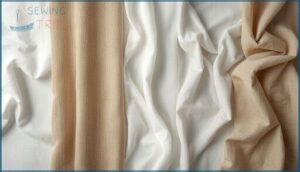
Not all fabrics react the same way when you stiffen them—some absorb solutions beautifully and hold their shape like champs, while others fight back or stay stubbornly limp. The fiber content, weave density, and texture all play a role in how permanent your results will be.
Let’s look at which fabrics work best for hardening projects, starting with natural options. Cotton and linen are popular choices because they absorb stiffening agents well, and pairing them with the best fabric glue for denim can help reinforce seams without adding bulk.
Best Natural Fabrics for Stiffening
When you’re choosing a fabric type for permanent fabric stiffening, linen’s your champion—high cellulose content means starches bond like crazy to those fibers. Cotton muslin also responds beautifully; its consistent weave patterns give you even stiffness testing results every time.
Hemp and ramie (less common, I know) hold their shape impressively with natural stiffeners, which makes them ideal for textile crafts and fabric art. Silk? It’ll stiffen, but be careful—high concentrations can damage delicate fibers.
Material science tells us fabric density matters too; tighter weaves mean better dimensional stability once you’ve hardened them.
Synthetic Fabrics and Considerations
Synthetic fabrics—polyester, nylon—behave differently than naturals when you’re stiffening fabric for crafts. Resin-based stiffeners create chemical fabric bonding with the fibers, forming that rigid, plastic-like layer (sometimes permanent!). But here’s the catch: heat resistance matters big time. High temps during drying can warp thermoplastics if your fabric stiffener isn’t heat-stable.
Fiber chemistry also means synthetics may yellow over time from UV exposure—not ideal. Adhesive treatments boost material durability, sure, but they can leave a visible film that changes your fabric type’s texture. Pretreat with a surfactant for better synthetic treatments and penetration. You can explore best practices for applying fabric paint across different materials to avoid these common pitfalls and keep colors vibrant longer.
What Are The Best DIY Fabric Hardening Methods?
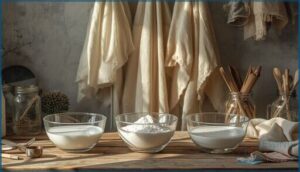
You don’t need to run out and buy fancy products to stiffen your fabric—plenty of household staples work beautifully. I’ve tested most of these methods in my own workshop, and honestly, some DIY solutions hold up just as well as store-bought options.
Let’s walk through three reliable techniques you can start using today with ingredients you probably already have.
Glue and Water Technique
You’ll love this one because it’s so simple! Mix your PVA white glue with water at a 1:2 ratio—one part glue, two parts water—to get a light stiffening effect. Want it firmer? Adjust those glue ratios.
Lay your fabric flat, brush on your DIY stiffener (or dunk it!), and let it dry completely. The PVA effects create a clear, flexible set that won’t yellow.
Cornstarch and Flour Stiffeners
Kitchen staples work wonders here! Cornstarch and flour mixtures are natural adhesives that create affordable DIY stiffeners using ingredients you already own.
Here’s your quick guide to starch solutions:
- Cornstarch paste: Mix 1 tablespoon cornstarch with 1/4 cup cold water, then add 1/4 cup boiling water for gelatinization.
- Flour mixture: Combine 1 tablespoon flour with 1/2 cup cold water and 1/2 cup boiling water for a matte finish.
- Test first: Always check fabric texture on a small swatch—natural fibers absorb more.
- Layer it: Apply thin coats for controlled fabric stiffening without warping.
Gelatin and Rice Starch Methods
Gelatin mixtures deliver flexible stiffening for lightweight fabrics. You’ll dissolve 5–10% gelatin in warm water, then brush or dip your material. Rice starch solutions work similarly but dry less tacky.
Want the best of both? Hybrid films combine gelatin and rice starch for improved rigidity without the sheen, though you’ll need to control viscosity carefully.
Always test fabric coating first—moisture sensitivity varies by weave!
Which Commercial Products Permanently Harden Fabric?
If DIY recipes feel too unpredictable, you’ll want a commercial product that delivers consistent results every time. These formulas are pre-mixed, shelf-stable, and designed specifically to create permanent stiffness without the guesswork.
Let’s look at three reliable options that craft enthusiasts and textile pros actually use.
Mod Podge Stiffy
If you’re diving into fabric sculpture or craft projects, Mod Podge Stiffy is your go-to fabric stiffener. This water-based formula works beautifully with cotton, cheesecloth, and even yarn—just immerse your fabric, squeeze out the excess, and shape it.
I love that it’s pre-mixed (no DIY Stiffy recipes needed!), making textile art projects super straightforward. Plus, it dries clear and firm every time.
Aleene’s Fabric Stiffener and Draping Liquid
When you need flexible fabric draping with lasting hold, Aleene’s Fabric Stiffener gives you that perfect semi-permanent stiffness. This liquid application works wonders for fabric sculpting projects where you want controlled shaping—think flowing angel wings or draped fabric bowls.
Just brush it on, shape your piece, and let it dry. It’s gentler than some stiffening methods but still delivers reliable results for decorative draping techniques.
Beacon Stiffen Stuff
Beacon Stiffen Stuff brings serious fabric rigidity to your crafting table—this clear coating dries rock-solid for projects that need to stand up, literally. Unlike gentler options like Mod Podge Stiffy, this stiffening method creates rigid designs that hold their shape indefinitely.
Perfect for:
- Standing fabric sculptures
- Dimensional lace ornaments
- Rigid fabric bowls
- Hardened doily structures
- Permanent craft displays
It’s one of those fabric stiffening products that doesn’t mess around!
How to Apply Fabric Hardener for Lasting Results
You’ve picked your hardener, and now it’s time to actually use it—which, honestly, can make or break your whole project.
The way you apply the stiffener, shape your fabric, and let it dry will determine whether you end up with a crisp, professional finish or a lumpy mess.
Let’s walk through the techniques that’ll give you lasting, even results every time.
Immersion Vs. Surface Application
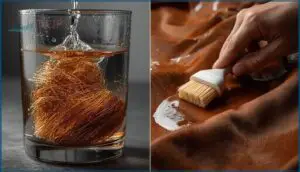
Your choice between immersion and surface application reshapes how stiffening agents work. Immersion—dunking your whole fabric—saturates fibers deeply, giving you uniform stiffness throughout and longer drying times. Surface application, brushing or spraying on top, sets faster but risks cracking at bends. Think of it like this: immersion builds strength from within, surface application adds armor on the outside.
| Method | Fabric Penetration | Stiffness & Cure |
|---|---|---|
| Immersion | Deep fiber saturation | Uniform rigidity; slower drying times |
| Surface Application | Coating exterior only | Faster set; prone to cracking on folds |
| Best For | Durable, flexible projects | Quick decorative pieces with less handling |
Shaping and Drying Techniques
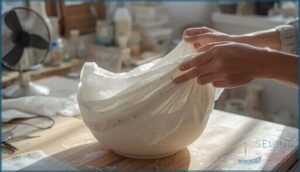
Once your fabric is soaked, fabric molding becomes your best friend—drape it over a form and pin edges to hold shape while drying. Tension management matters here; stretch it gently, not like you’re wrestling dough!
Heat setting works on synthetics if you’re cautious. Control drying by using a fan in low humidity—it speeds stiffness optimization without warping. Overnight patience pays off.
Tips for Even Coverage
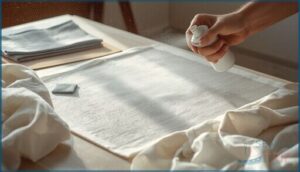
Shaping’s just step one—you want consistent stiffening, right? Here’s how to nail even application with any fabric treatment method:
- Spray it on lightly. Use a fine mist 6–12 inches away, avoiding heavy pooling from stiffener mixing mishaps.
- Layer gradually. Multiple thin coats beat one thick goop-fest every time.
- Pre-wash your fabric. Surface finishing starts with clean, finish-free material for proper fabric preparation.
- Test first. A scrap piece reveals how stiffening agents behave before you commit.
- Press after drying. Low heat sets everything uniformly across your fabric stiffener project.
Can You Use Interfacing or Boning to Harden Fabric?
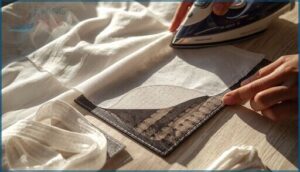
You don’t always need liquid stiffeners to harden fabric—sometimes the best approach is built right into the material itself. Interfacing and boning are two structural methods that can give your fabric serious staying power, especially for garments and projects that need to hold their shape.
Let’s look at how each one works and when you might want to combine them for extra support.
Fusible Vs. Sew-in Interfacing
You’ve got two main interfacing types to pick from, and each brings a different level of fabric stability. Fusible interfacing uses adhesive methods—just press it with heat, and boom, it’s bonded. Sew-in interfacing requires traditional sewing techniques to attach.
Both work as stiffening agents for stabilizing fabrics, but fusible gives you speed while sew-in maintains your original texture without heat distortion.
Boning for Garment Structure
When stiff fabric alone won’t cut it, boning steps in to deliver serious garment shaping power. Steel or plastic boning types slide into sewn channels along seams, giving you structural integrity in bodices and corsets.
This sewing technique locks fabric support right where you need it—waistlines, bust panels, closures. It’s old-school garment construction that works like a charm for stiffening fabric beyond what interfacing alone can do!
Combining Methods for Extra Rigidity
Why settle for one method when layering techniques can deliver rock-solid results? Fabric fusion with stiffener blends and interfacing multiplies rigidity—perfect for mixed media crafting projects demanding serious structure.
- Stack fabric stiffener over fusible interfacing for higher bend stiffness
- Combine stiffening agents like glue and cornstarch for reinforced hardness
- Apply multiple coats with 24-hour drying between layers
- Use rigidity testing on scraps before your final piece
- Cure fully (48 hours minimum) to lock in maximum firmness
Different stiffening methods work together beautifully!
How to Care for Permanently Hardened Fabric
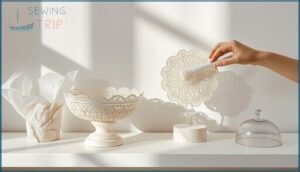
You’ve put in the work to harden your fabric—now let’s make sure it stays that way. Stiffened projects need a little extra TLC since water and rough handling can undo all your efforts.
Here’s what you need to know about cleaning, protecting, and storing your finished pieces so they look great for years.
Cleaning and Maintenance Tips
Think of hardened fabric like a sculpture—it needs regular fabric dusting with a soft brush to stay spotless. You’ll want to skip the washing machine entirely! Gentle cleaning with a damp microfiber cloth works wonders for spot treatment.
Store your pieces in breathable containers away from humidity, and check them monthly as part of your maintenance schedules. If edges crack, apply compatible fabric glue for quick repair techniques.
Avoiding Water Damage
Water exposure is your stiffened project’s worst enemy, honestly! Proper fabric sealing with a water repellent topcoat can boost moisture control by 60%, which is huge.
Focus on humidity management—keep pieces in ventilated spaces with desiccants to reduce dampness by 25–30%.
These fabric treatment steps preserve your textile stabilization work, extending lifespan by 12–18 months. Trust me, it’s worth the effort!
Storing Stiffened Projects
Proper storage methods make or break your fabric preservation efforts! Follow these artifact handling best practices for archival storage:
- Store flat in cool, dry spaces to prevent moisture warp.
- Use acid-free tissue between layered items for textile care and maintenance.
- Keep humidity control around 40–50% to reduce tackiness.
- Inspect every 6–12 months for mold or structural changes.
Your fabric stiffener work deserves lasting protection!
Creative Project Ideas Using Hardened Fabric

You’ve mastered the techniques, now let’s talk about what you can actually make with all that stiffened fabric. I’ve seen crafters create everything from stunning home decor to quirky holiday pieces that make people stop and ask, “Wait, how’d you do that?”
Here are some of my favorite project categories to get your creative wheels turning.
Home Decor and Art Pieces
You can transform hardened fabric into stunning wall hangings, decorative bowls, or sculptural accents that command attention! Using Fabric Stiffener like Mod Podge, shape your textile art into three-dimensional forms that hold their structure permanently.
I love how fabric sculpting lets you create artful displays—think draped vessels or elegant curves—perfect for DIY home decor that showcases your creativity.
Crafting with Fabric Stiffener opens up endless possibilities for fabric decoration projects.
Holiday and Seasonal Crafts
Holiday Crafts let you create festive Fabric Ornaments that last year after year. You can make Stiffened Garlands, angels, or snowflakes using cheesecloth or cotton—perfect for Winter Displays!
Seasonal Decor becomes extra special when you craft your own three-dimensional wreaths or centerpieces. I’ve found that Crafting with Fabric Stiffener really shines for Handmade Gift Ideas.
Just remember, these Creative Fabric Projects stay beautiful when you store them flat between seasons!
DIY Gift and Fashion Accessories
Beyond seasonal decor, you’ll love making Fabric Jewelry like stiffened lace bracelets or Fabric Stiffener-treated bows for Fashion Embellishments. Gift Wrapping gets a personal touch with hardened fabric ribbons!
I use Mod Podge or Aleenes StiffenQuick for Accessory Making—perfect for DIY Fabric Projects like chokers or hair clips. Textile Crafts with permanent Fabric Stiffening create memorable handmade gifts that really stand out.
Frequently Asked Questions (FAQs)
Can hardened fabric be softened again later?
Want to undo your work? It depends on what you used. Water-based stiffeners (glue, starch) wash out easily, but resin-based treatments need solvents or professional cleaning—and repeated softening weakens fabric fibers over time.
Does humidity affect permanently stiffened fabric over time?
Yes, humidity absolutely impacts stiffened fabric over time. High moisture softens many hardeners, especially glue-based ones. Keep your projects in climate-controlled spaces—around 40–50% humidity—for best stiffness retention and longevity.
To guarantee the longevity of your fabric, consider the importance of methodological rigor in maintaining its stiffness.
Is hardened fabric safe for childrens craft projects?
Most fabric stiffeners contain acrylic polymers or formaldehyde—not exactly snack material!
Choose non-toxic, kid-friendly brands like Mod Podge for craft projects, supervise application closely, and verify complete drying in well-ventilated spaces before little hands get involved.
Can you dye fabric after applying stiffener?
It depends on the stiffener type. Water-based products like Mod Podge allow dyeing after thorough rinsing, but oil-based stiffening agents resist dye uptake.
Test fabric porosity first—chemical interactions affect color fastness.
Does stiffened fabric lose rigidity in hot weather?
Most stiffeners soften when temperatures climb above 104°F, especially in humid air. Cotton and natural fibers lose rigidity faster than synthetics—so pick heat-stable formulations if your project faces warm conditions.
Conclusion
Picture your fabric sculpture standing tall on that shelf five years from now, still crisp as the day you shaped it. That’s the power of understanding how to harden fabric permanently—you’re not just coating fibers, you’re engineering structure that lasts.
Whether you’re reaching for white glue or commercial stiffener, you’ve now got the knowledge to pick the right method, apply it correctly, and create pieces that’ll outlive your expectations.