This site is supported by our readers. We may earn a commission, at no cost to you, if you purchase through links.
A cape isn’t a complicated garment—it’s basically a circle of fabric with a hole cut out for your neck. That simplicity is exactly what makes it such a satisfying first project, and such a powerful last one too.
The tricky part isn’t the sewing. It’s understanding how your fabric choice shapes everything: how the cape hangs, whether it survives rain, how it catches light on a stage. Boiled wool behaves nothing like satin. Velvet will turn on you if you cut it wrong. Felt doesn’t even need a needle.
Once you understand those differences, knowing how to make a cape out of fabric becomes less about following rules and more about making deliberate choices—from the first measurement to the final clasp.
Table Of Contents
Key Takeaways
- Fabric choice drives everything about a cape — how it drapes, weathers, and performs — so match your material to the job before you cut a single inch.
- A circular cape pattern built from your neck circumference and desired length is the foundation; get that math wrong, and no amount of good stitching fixes it.
- Assembly order matters: align grain, control nap direction on velvet, press seams open, clip curves, and understitch the lining before you ever touch a clasp.
- The closure and finishing details — toggle, ribbon casing, hood, or embellishment — aren’t afterthoughts; they’re what turns raw fabric into something intentional and wearable.
Choose The Best Cape Fabric
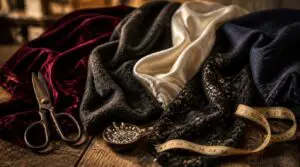
The fabric you choose shapes everything — how the cape drapes, holds up, and feels to wear. Different projects call for different materials, whether you’re sewing a warm winter wrap or a showstopping costume piece. Here are the main fabric types worth knowing before you cut a single inch.
Knowing how different fabrics behave when draped can also help you pick the right material for your climate and how you plan to wear the cape.
Warm Wool and Boiled Wool
Wool is the quiet workhorse of outerwear fabrics. For a DIY cape that stands up to real weather, boiled wool is hard to beat — its felted fibers trap air in dense pockets, keeping you warm even when damp. It also sheds light wind and light rain naturally.
This material functions as a moisture-wicking material to help regulate your body temperature. Spot clean minor stains; machine wash gently and air dry flat.
Satin, Velvet, and Tulle
Where wool controls the cold, these three manage the drama.
Satin’s glossy surface comes from long thread floats — cut on grain to keep that fluid drape intact. Velvet nap direction must stay consistent across every piece, or the color shifts between panels. Tulle stacks into volume without adding real weight.
- The way velvet shifts shade as you move through a room
- Satin catching light mid-sweep like it was made for it
- Tulle floating as if it has its own gravity
Nylon for Weather Protection
Drama has its place, but sometimes you need a cape that works in actual weather.
Nylon experiences rain without soaking through — especially when treated with a DWR coating, which makes water bead and roll off the surface. Ripstop construction stops small tears from spreading. It breathes well enough for active wear, dries fast, and resists UV degradation over time.
Felt for No-sew Capes
No needle required. Felt is the go-to for a quick no-sew cape because its edges don’t fray — cut it, and it stays clean.
- Felt thickness (1–3mm) shapes silhouette without bulk
- Fabric glue seals edges and holds trims securely
- Hypoallergenic and non-itchy, safe for kids’ costume making
- Adhesive gems or layered felt pieces customize any DIY cape
Medium-weight felt drapes naturally over clothing and moves freely.
Match Fabric to Purpose
Think about what your cape actually needs to do before you commit to any fabric.
A velvet or satin choice suits formal or costume wear — beautiful drape, rich texture, but zero weather resistance. Nylon is great for rain. Wool keeps you warm. Lightweight linen or cotton breathes for warm-climate wear, while jersey moves with your body for active use. Match the textile to the moment.
Every fabric has its moment: velvet commands a stage, nylon weathers a storm, wool holds the cold at bay
Measure and Draft Your Cape
Before you cut a single piece of fabric, you need a pattern that actually fits. Getting your measurements right is what separates a cape that drapes beautifully from one that bunches at the neck or hangs off your shoulders. Here’s how to measure up and draft your shape from scratch.
Measure Neck Circumference

Wrap a flexible measuring tape around your neck just below the Adam’s apple — bare skin only, no clothing between tape and throat.
Once you have the fit right, these clean seam finishing tips for sewing projects help keep the neckline neat and comfortable.
For accuracy:
- Stand relaxed, shoulders down, eyes forward
- Exhale normally before reading the measurement
- Take two readings; if they differ by more than 5 mm, take a third
Write down the closest two and average them.
Choose Cape Length

Length shapes everything — how the cape moves, how it fits your frame, and whether it becomes a hazard on stairs.
Under 5’4", keep it knee length or shorter. Taller wearers can carry floor-length drape cleanly. Always leave at least two inches of clearance from the ground. Heavy fabrics like wool pull downward, so go shorter. Light fabrics like chiffon can handle more length.
Calculate Neck Radius
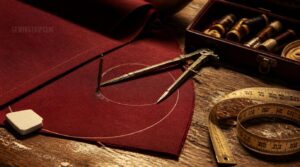
Divide your neck circumference by 2 × pi — that’s your neck radius. So a 14-inch neck gives you roughly 2.2 inches. This number controls the size of the hole your head actually fits through.
Mark that radius from a center point on folded fabric. Get it wrong, and the whole cape sits off.
Draft Circular Cape Pattern
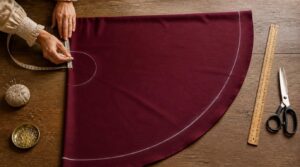
Fold your fabric in half, then in half again — you’re working from a single center point that becomes the back neck.
From there, swing your neck radius (say, 2.2 inches) in an arc for the inner circle, then mark your cape length outward for the outer edge. These two concentric circles give you the full drape. Add shoulder notches at the fold line so the cape hangs straight.
Add Hood Pattern Pieces
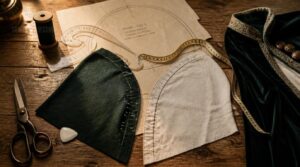
A hood starts with tracing your cape neckline curve onto paper — that curve becomes the base of your hood pattern. Cut a piece 17 inches tall by 22 inches wide, then add a center back seam for shaping. Include ¼-inch seam allowances around all edges.
For lining, cut separate inner and outer pieces to keep the hood from feeling stiff at the neck.
Top 6 Cape-Making Supplies
The right supplies can make or break your cape — not just in how it looks, but how long it holds up. Before you cut a single piece of fabric, it’s worth knowing which materials and tools are actually worth reaching for. Here are six that earn their place on the worktable.
1. Hercules Type III Paracord 550 Survival Rope
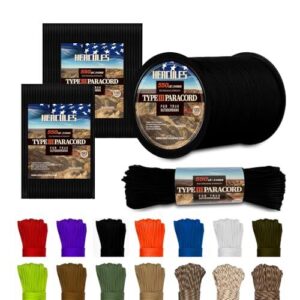
Paracord isn’t just for survival kits. This 4mm nylon rope threads cleanly through a fabric casing to create a gathered neckline — pull it tight, tie it off, and you’re done.
The 550 lb breaking strength means it won’t snap under tension, and its quick-drying nylon resists mold if your cape ever gets caught in the rain. Cut it to length, then melt the ends with a lighter to stop fraying.
| Best For | Outdoor enthusiasts, survivalists, and DIY crafters who need a reliable, versatile cord for everything from emergency kits to handmade accessories. |
|---|---|
| Material | Nylon |
| Primary Color | Multicolor |
| Dimensions | 50 ft, 4mm diameter |
| DIY Craft Use | Bracelets, lanyards, keychains |
| Costume Suitability | Utility and survival gear |
| Durability | Braided nylon sheath resists fraying |
| Additional Features |
|
- Incredibly strong at 550 lbs breaking strength, so it holds up under serious tension without snapping
- Quick-drying nylon resists mold and odor, making it ideal for wet or unpredictable weather conditions
- Reflective specks add a handy visibility boost in low-light situations
- Long lengths can tangle easily if not stored carefully, which gets frustrating fast
- Cut ends must be melted or burned to prevent fraying, requiring an extra step and a flame source
- Cutting through the thick braided sheath requires sharp or specialized tools — a dull blade won’t cut it
2. Self Locking Bodkin Elastic Threader
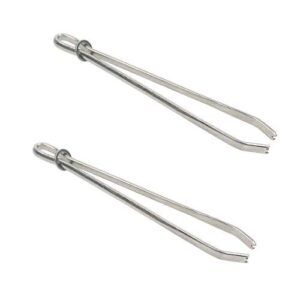
Once you’ve threaded paracord into a casing, you’ll hit a wall the moment you switch to narrow elastic or ribbon — that’s where a self-locking bodkin earns its place.
This 78mm silver-plated tool grips elastic or ribbon with serrated jaws, then a sliding ring clamps it locked. Push it through, pull it out, release. The one-handed locking mechanism means you’re not wrestling the material loose mid-thread — a small thing that saves real frustration.
| Best For | Sewers and crafters who regularly work with elastic waistbands, drawstrings, or ribbon casings and want a reliable, frustration-free threading tool. |
|---|---|
| Material | Silver Plated Metal |
| Primary Color | Silver |
| Dimensions | 78mm length |
| DIY Craft Use | Threading elastic and drawstrings |
| Costume Suitability | Garment repair and construction |
| Durability | Self-locking silver plated metal |
| Additional Features |
|
- The self-locking sliding ring keeps elastic or ribbon firmly gripped throughout the entire threading process — no slipping mid-task
- Slim 78mm profile fits through tight casings and narrow hems where bulkier tools can’t go
- Tweezer-style design makes it useful beyond threading — great for turning bias tubing or retrieving lost elastic from waistbands
- At 78mm, it’s on the short side, which can make longer threading jobs more awkward and time-consuming
- Grip strength isn’t consistent across all materials, so slippery or very thin fabrics may not hold as securely
- The small size can be tricky to handle for anyone with limited dexterity or larger hands
3. Gold Metallic Foil Lame Spandex

Gold metallic foil lame spandex is the fabric that turns a cape into a statement. The shiny foil side catches light from every angle — perfect for stage, cosplay, or anything that needs to command a room.
The 96% polyester, 4% Lycra mix gives you four-way stretch, so it drapes and moves without pulling. At 60 inches wide, you get generous coverage from a single cut. The non-fraying edges mean less cleanup, less fuss.
| Best For | Dancers, cosplayers, and costume makers who want a bold, eye-catching fabric that moves with the body and holds its shape under stage lights or camera flashes. |
|---|---|
| Material | 96% Polyester, 4% Lycra |
| Primary Color | Gold |
| Dimensions | 60 inches wide |
| DIY Craft Use | Capes and costume accessories |
| Costume Suitability | Dancewear and cosplay |
| Durability | Resists flaking and peeling |
| Additional Features |
|
- Four-way stretch makes it ideal for form-fitting pieces that need to move freely
- Non-fraying edges save time during cutting and sewing
- Machine washable and durable — the foil finish resists flaking even after repeated wear and washing
- The metallic shine is only on one side, so visible seams or reversed panels will show a duller, orangey-yellow backing
- Stretch may be slightly uneven depending on the direction you’re pulling
- Edge quality can vary, with occasional jagged cuts or small imperfections near the selvedge
4. Glitter Star Moon Sequin Tulle
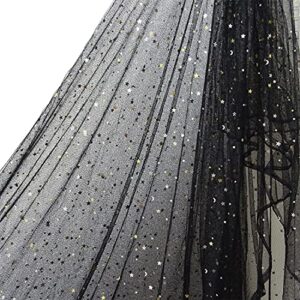
Star and moon sequins scattered across sheer tulle — it’s the night sky you can wear. This glitter star moon sequin tulle comes in a generous 5 x 1.6 meter panel, plenty for a full decorative cape overlay.
Layer it over a solid base fabric for depth. The soft, flexible mesh cuts cleanly with scissors. Just handle it gently — the sequins can snag.
| Best For | Costume designers, crafters, and DIYers who want an eye-catching glitter fabric for performance wear, princess skirts, wedding accessories, or creative photography backdrops. |
|---|---|
| Material | Polyester |
| Primary Color | Multi with Silver Reverse |
| Dimensions | 5 x 1.6 meters |
| DIY Craft Use | Hair clips, bows, and flowers |
| Costume Suitability | Performance and princess costumes |
| Durability | Durable repeated-use construction |
| Additional Features |
|
- Generous 5 x 1.6 meter panel gives you plenty of material for full skirts, capes, or backdrop projects
- Soft, flexible mesh cuts cleanly with scissors and layers beautifully over solid base fabrics
- Low-shedding glitter design keeps the sparkle on the fabric — not all over your hands and workspace
- Sequins can snag easily, so cutting and handling requires a slow, careful approach
- Sheer tulle needs a base fabric underneath, so it’s rarely a standalone material
- Delicate construction means it may not hold up well to heavy use or rough wear
5. Iridescent Hologram Laser Knit Crepe
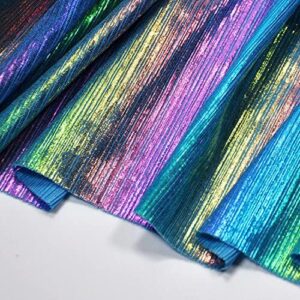
Few fabrics stop people mid-scroll like this one. The iridescent hologram laser knit crepe shifts from pink to purple to blue depending on the light — no dye tricks, just reflective microcoatings built into the knit itself.
At 58 inches wide and 72 inches long, you have serious real estate for a full dramatic cape. The crepe base drapes smoothly over shoulders without clinging. Hand wash only, and keep it away from sharp edges — snagging is its one weak point.
| Best For | Dancers, performers, and costume designers who want high-impact, light-catching fabric for leotards, capes, or stage pieces. |
|---|---|
| Material | 100% Polyester |
| Primary Color | Holographic |
| Dimensions | 72 x 58 inches |
| DIY Craft Use | Headbands and handicrafts |
| Costume Suitability | Dancewear and gymnastics costumes |
| Durability | Dual-layered iridescent construction |
| Additional Features |
|
- Stunning iridescent finish that shifts between pink, purple, and blue depending on the light
- Dual-layer construction gives you both visual drama and a smooth, draping crepe underside
- Generous 58" width makes it practical for larger garments and home décor projects
- Hand wash only, so it’s not the most low-maintenance choice
- Some pieces can feel slightly scratchy and may carry a noticeable chemical odor
- Fabric can be see-through, which may require a lining for certain garments
6. Black spider web lace fabric
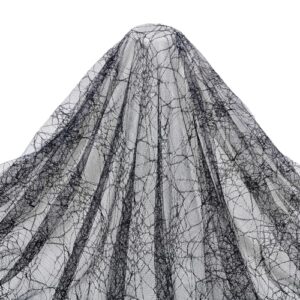
Black spider web lace is the one fabric that does the costume work for you. The openwork cobweb pattern is built right into the weave — no embroidery needed.
At 70.51 x 62 inches, there’s enough material for a full dramatic overlay. Layer it over satin or velvet and the transparency adds depth without bulk. It’s lightweight and wrinkle-resistant, though the stretch can make precise cutting tricky. Go slow, use sharp scissors, and finish cut edges to prevent fraying.
| Best For | Halloween decorators, costume designers, and DIY crafters who want instant gothic or spooky-themed flair without extra embellishment work. |
|---|---|
| Material | Polyester |
| Primary Color | Black |
| Dimensions | 70.51 x 62 inches |
| DIY Craft Use | Bouquet packaging and gift wrapping |
| Costume Suitability | Victorian and spooky themed costumes |
| Durability | Wrinkle-resistant repeated-use design |
| Additional Features |
|
- The built-in cobweb pattern saves time — no extra embroidery or appliqué needed
- At over 70 inches wide, there’s plenty of fabric for full overlays, table runners, or multiple costume pieces
- Lightweight and wrinkle-resistant, making it easy to store, transport, and reuse season after season
- The stretchy material can make straight cuts and precise sewing a real challenge
- Lightweight construction requires careful handling to avoid distortion during assembly
- Cut edges may fray if not properly finished, adding an extra step to any project
Sew The Cape Together
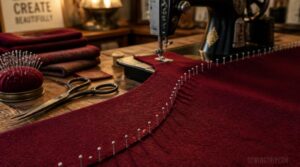
This is where your cape starts looking real. Assembly moves fast once your pieces are cut, but a few steps done in the right order make all the difference. Here’s how to put it all together cleanly.
Cut Fabric Pieces Carefully
Lay your marked fabric flat and taut before making a single cut. Align pattern edges with the grainline to prevent distortion later — off-grain pieces twist and never hang right.
Use sharp fabric scissors or a rotary cutter and cut one layer at a time. Dull blades drag and fray edges. Clean cuts now mean cleaner seams throughout the whole cape.
Align Velvet Nap Direction
Velvet punishes guesswork. Run your hand along the fabric — the hand test tells you instantly which direction the nap lies: smooth means with the nap, resistant means against it.
Tilt each piece under raking light to catch subtle shadows. Mark every panel before cutting. Mirrored pieces must match exactly, or you’ll get patchy shading that no seam can fix.
Stitch Shoulder or Side Seams
Pin raw edges together, aligning notches at equal intervals before you sew a single stitch. Use a 0.5-inch seam allowance, then press the allowances open flat.
Lock stitch works best on woven cape fabrics — backstitch at both ends to lock the seam. Keep stitch density matched to fabric weight; too loose on heavy wool causes gaps, too tight on satin causes puckering.
Sew Lining if Needed
Not every cape needs a lining — but when it does, lining material selection matters more than most people think. Satin or charmeuse glides smoothly; polar fleece adds warmth.
Cut lining pieces identical to your outer fabric. Pin wrong sides together at the neck edge, understitch near the neckline to stop the lining from rolling outward, and press flat.
Clip Curves Before Turning
With your lining pressed flat, it’s time to tackle the neckline curve. Clip shallow notches every quarter to half inch around it — stopping just short of the seam line. This releases tension so the fabric lies smooth instead of bunching into pleats. On tighter curves, go deeper and space clips closer.
Test on a scrap first, especially with wool or satin.
Finish and Customize Your Cape
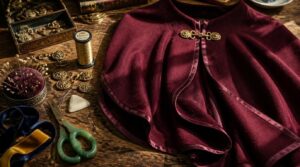
The sewing is done — now comes the part that makes your cape actually yours. Finishing and customizing is where you dial in the details that take it from raw fabric to something worth wearing. Here’s how to wrap it up right:
Hem Raw Fabric Edges
The edge of your cape tells a story before anyone touches it. A raw, unfinished hem can look completely intentional — especially on wool, leather, or denim-inspired fabrics that hold their shape without unraveling.
For anything prone to fraying, run pinking shears along the cut or apply a thin line of fray check. That’s usually enough.
Add Clasp or Toggle
Once your hem is sorted, the neckline needs something to hold it shut. A toggle clasp is the most reliable choice — bar widths range from 12 mm to 25 mm, so match the size to your fabric weight.
- Brass or zinc alloy toggles suit most costume capes
- Antique bronze pairs well with wool or earth tones
- Gold tone adds polish to formal or ceremonial styles
- Velcro squares with fabric glue work for quick no-sew closures
Sew the ring portion into a small fabric loop at the neckline edge. For heavier fabric, back it with a lining patch to spread the stress.
Create Ribbon Neck Casing
A ribbon casing gives your neckline a soft, gathered close — no hardware needed. Fold the top edge down 2 to 3 inches, press it flat, then stitch along the lower edge. Leave a small opening at one side.
Thread ribbon through using a safety pin or bodkin, leaving extra length on both ends for tying.
Attach Hood or Trim
A hood changes everything — suddenly your cape becomes a full garment. Snap fasteners work well here; space them 2 to 3 inches apart along the neckline for even hold.
Match the hood’s neck curve to the cape edge, clip seam allowances to reduce bulk, and finish the hood edge with bias binding before attaching. For trim, keep it narrow so it doesn’t catch.
Embellish for Costumes
Sequins and beads turn a plain cape into a statement. Flat or hex-cut sequins catch stage light from across a room — attach them with a running stitch or fabric glue. For beadwork, use size 10–15 seed beads and backstitch them into motifs that mean something.
Layered appliques add dimension fast. Keep glitter locked down with fabric glue so it doesn’t shed.
Frequently Asked Questions (FAQs)
What other materials can I use to make a cape?
Alpaca wool blends, ripstop nylon, fleece, metallic lamé, and sequin mesh all work well. Each brings different weight, drape, and durability — pick based on your climate, look, and how much sewing you want to tackle.
Is it possible to make a cape without a sewing machine?
Yes — no sewing machine needed. Use felt or fleece, seal edges with fabric glue, and thread a ribbon through a slit at the neck. Done.
What is the best way to store a cape when not in use?
Fold it — don’t hang it. Store your cape flat in a breathable cotton bag, away from sunlight and damp spaces. Tuck in a silica gel packet to keep moisture out long-term.
Is there a way to make a cape reversible?
A reversible cape is built by sewing two fabric faces together at every edge, hiding all seams inside. Match fabric weight and drape on both sides so the cape hangs evenly either way.
Are there any tips for washing a cape?
Treat your cape like a secret — rough handling ruins it fast. Hand wash in lukewarm water with mild detergent. Press out moisture gently. Air dry flat. Spot clean embellishments. Velvet? Brush the nap after drying.
Can a cape be made without a sewing machine?
A cape doesn’t need a machine. Fabric glue, fusible web tape, or basic hand stitching all work. Felt is the easiest starting point — no fraying, no finishing required.
How do you make a cape reversible?
Sew two identical layers wrong sides out, leave a small turning hole, then flip. Match necklines exactly and use a toggle or Velcro that fastens cleanly from either side.
What size cape works best for children?
Picture a tiny superhero bolting across the yard. For ages 1–3, aim for 65–80 cm back length. Ages 4–7 suit 70–110 cm. Always add 1–2 cm neck ease and use Velcro for growth.
How do you keep a cape from stretching out?
Stabilize shoulder seams first — they bear the most stress. Strengthen the neckline with bias facing, and align fabric on-grain. Weight the hem edges to keep everything hanging true.
Can sheer or transparent fabrics be used for capes?
Like a whisper of mist over silk, sheer fabrics — chiffon, organza, tulle, voile — absolutely work for capes. Add a lining for opacity. Expect soft drape and flutter, not structure.
Conclusion
Knowing how to make a cape out of fabric is like learning to read weather—once you understand the signals, every choice becomes intentional. Fabric drives everything. Pick wrong, and even perfect stitching won’t save you. Pick right, and the garment almost builds itself.
Measure carefully. Cut deliberately. Finish with closures and trim that serve your purpose. The cape you make won’t just wear well—it’ll say exactly what you meant it to.