This site is supported by our readers. We may earn a commission, at no cost to you, if you purchase through links.
That tiny strip of fabric sewn into your garment’s seam holds more useful information than most people ever bother to read.
Fiber percentages, care temperatures, country of origin—it’s all there, compressed into a few symbols and lines of text that most of us glance at once before snipping off with scissors.
That’s a mistake, especially if you’ve ever shrunk a sweater or watched a color bleed through an entire wash load.
Knowing how to read fabric labels gives you real control over how your clothes age, how your sewing projects perform, and which materials are worth your money.
Table Of Contents
Key Takeaways
- Fiber content percentages tell you exactly what a fabric is made of and predict how it will behave in the wash, the dryer, and over time.
- Care symbols follow international standards, so once you learn them, you can read any label in any language without guessing.
- Certifications like GOTS and OEKO-TEX are the only reliable way to confirm a fabric is truly sustainable — vague terms like “eco-friendly” without a license number are just marketing.
- A label’s care requirements — whether it’s “dry clean only” or “cool iron” — tell you upfront how much effort and cost a garment will demand before you ever buy it.
Why Fabric Labels Are Essential
That small tag sewn into your garment does a lot more work than most people realize. It’s basically a quick guide to what you’re wearing, how to care for it, and whether it’ll hold up the way you need it to.
If you want to decode what those symbols actually mean, washing instructions for different fabric types break it all down in plain language.
Here’s what fabric labels actually tell you.
What Information Fabric Labels Provide
A fabric label is your garment’s personal ID card. It tells you almost everything you need before washing, wearing, or working with that piece.
Here’s what you’ll usually find:
- Fiber content and percentages
- Care symbols and care instructions
- Country of origin and manufacturing info
- Size and brand details
Understanding each of these keeps your clothes lasting longer. For more details on how to interpret, visit this helpful resource.
Legal Requirements for Fabric Labeling
Those details on your label aren’t just helpful — they’re required by law.
In the U.S., label compliance means every garment must show fiber content, country of origin, and manufacturer rules like a registered ID number.
The EU follows strict fiber disclosure standards under its own textile regulations. Import regulations reinforce this further, so brands can’t skip it even if they wanted to.
For more information about mandatory EU labelling requirements, consult official documentation for compliance guidance.
How Labels Impact Sewing and Fabric Selection
Beyond compliance, a fabric label quietly guides every sewing decision you make. Fiber content tells you whether cotton might shrink in the wash or polyester will hold its shape.
Knowing what fiber content means in fabric helps you make smarter choices before you ever cut into a yard of material.
Care symbols steer you toward the right sewing techniques and pattern choices. That information shapes garment durability, promotes textile sustainability, and helps you match fabric selection to exactly what you’re making.
Decoding Fiber Content on Labels
That little strip of fabric sewn into your garment holds more information than most people realize, and the fiber content section is where it really starts to matter.
Once you know what to look for, it becomes a useful guide for everything from washing decisions to how long a piece will actually last. Here’s what the fiber content on a label is telling you.
Understanding Fiber Percentages
Think of the fiber content on a fabric label as a recipe — it tells you exactly what the fabric is made of and in what amounts. Percentages always run from highest to lowest, so the first fiber listed dominates the fabric composition.
A 3 percent percentage tolerance is built in for most blends, though 100 percent claims allow none. That small detail matters for care instructions and material durability.
Natural Vs. Synthetic Fibers
Material Science draws a clear line between natural fibers and synthetic fibers — and knowing which side your fabric sits on changes how you care for it. Cotton, linen, and wool are breathable, biodegradable, and eco-friendly, though they need gentler handling.
Polyester and nylon resist wear and fading but carry a heavier Eco Impact, shedding microplastics with every wash. Sustainable Fashion starts with understanding that difference.
Blended Fabrics and Their Properties
Blends are where textile science gets genuinely clever. Fabric blending combines fibers to get the best of both worlds — cotton-polyester mixes, for example, balance softness with material durability and wrinkle resistance, while cotton-spandex blends add stretch without sacrificing comfort.
Fabric blending is textile science at its cleverest, combining fibers to balance softness, durability, and stretch
Understanding fiber content in these combinations helps you predict garment performance and choose the right fabric care routine before you even pick up your scissors.
How to Interpret Fabric Care Symbols
Care symbols are those small icons on your label that tell you exactly how to treat a garment without a single word. Once you know what they mean, you won’t have to guess whether something can go in the dryer or needs a cool iron.
Here’s what each key symbol is actually telling you.
Washing Instructions and Symbols
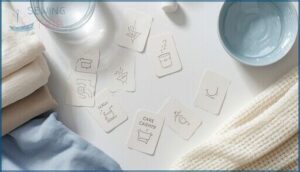
The washtub symbol is your starting point for any care symbol guide. A plain tub means machine wash is fine; a crossed-out tub means hands off — take it to a professional.
Dots inside the tub indicate water temperatures: one dot for cold (30°C), two for warm (40°C). Lines underneath signal wash cycle types, helping you avoid fabric shrinkage and follow safe laundry care instructions every time.
Drying and Ironing Guidelines
Once you’ve decoded the wash tub, drying symbols and ironing symbols become your next checkpoint. A square with a circle inside means tumble dry is safe, while dots inside tell you the heat settings — one for low, two for medium.
Getting this wrong risks fabric shrinkage. For ironing tips, dots inside the iron icon work the same way, guiding your fabric care decisions.
Special Care Codes for Delicate Fabrics
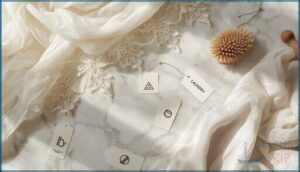
Delicate fabric care is where most laundry mistakes happen. A hand wash only means machine agitation can felt wool or snag lace fast. A crossed-out triangle signals bleach restrictions, so skip the chlorine entirely.
A circle means dry clean codes apply. Two lines under the tub? Gentle cycles only. Follow these care symbols, and your delicate pieces will last.
Identifying Weave, Weight, and Stretch
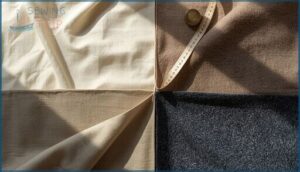
Fiber content tells you a lot, but it doesn’t tell you everything.
How a fabric is constructed, how heavy it’s, and whether it stretches all shape what you can actually do with it.
Here’s what to look for when reading these details on a label.
Weave and Knit Patterns on Labels
The words on clothing labels go beyond fiber content — they tell you exactly how that fabric was built. Knowing the difference between weave or knit structures saves you from choosing the wrong material for your project.
Here’s what to look for:
- Plain or twill signals a woven fabric with limited natural stretch.
- Satin means a smooth, glossy face great for linings.
- Jersey describes a knit with crosswise stretch and soft drape.
- Rib knit offers strong recovery, ideal for cuffs and neckbands.
- Jacquard means the pattern is woven in — it won’t wash off.
Pattern recognition on fabric labels helps you predict texture, drape, and stretch analysis before you cut a single seam.
Fabric Weight and GSM Information
Once you know how a fabric is built, the next question is how heavy it is. That’s where GSM — grams per square meter — becomes your best guide for material selection.
It measures fabric density, not thickness. A 180 GSM jersey suits lightweight tops, while 350 GSM denim carries enough body for jeans. Weight classes help you match fabric weight to your project before you buy.
Recognizing Stretch and Performance Details
Weight tells you how much, but stretch tells you how the fabric moves. Labels on stretch fabrics often list elastane content — usually 2 to 10 percent in everyday knits — plus stretch percentages and two-way or four-way stretch indicators.
Performance fabrics may also flag moisture management or UPF ratings. These details on fabric labels shape your garment care routine and project success.
Using Label Information for Better Sewing Choices
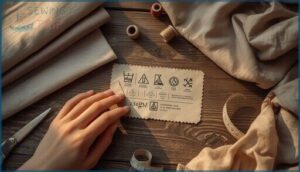
Once you can read a label, the real question is what to do with that information.
Every detail — fiber content, care instructions, certifications — can shape how well your fabric holds up through cutting, stitching, and washing.
Here’s how to put it all together before you buy or begin.
Matching Fabric Care to Project Needs
Matching fabric care to project needs is really just smart project planning. Before you cut a single piece, think about how often the finished item will be washed.
Fabric labels tell you exactly what each material can handle. A quilt needs easy laundry management, so choose cotton with machine-washable care symbols.
Reserve hand-wash-only fabric selection for occasional-wear pieces, not everyday basics.
Choosing Sustainable and Certified Fabrics
Sustainable choices start with knowing which logos actually mean something. GOTS certified fabric confirms organic fibers and safe working conditions. OEKO-TEX Standard 100 means every component — thread, buttons, zippers — is tested for harmful substances.
Look for these fabric certifications on the label rather than vague words like “eco-friendly” or “green.” Organic fabrics and green manufacturing claims without a license number are just marketing.
Assessing Durability and Maintenance Requirements
Longevity is basically written into the label — you just have to know how to read it.
Care symbols like “don’t tumble dry” or “cool iron only” tell you exactly how much effort this garment will demand.
Higher polyester blends signal better clothing durability, while “dry clean only” labels mean ongoing maintenance costs.
Match those performance metrics to your lifestyle before you buy.
Frequently Asked Questions (FAQs)
What does 40 mean on a clothing tag?
The 40 on a clothing tag is a wash temperature indicator inside the care symbols wash tub, meaning your machine’s warm cycle — around 40°C — is the highest safe heat for that fabric.
Can fabric labels help identify counterfeit garments?
Yes, fabric labels can reveal counterfeits. Authentic clothing labels feature consistent fonts, accurate fabric content, and verifiable RN codes.
Misspellings, vague fiber claims, or blurry care instructions symbols are common fake identification red flags worth checking.
How do I read labels in a foreign language?
Start with the care symbols — they follow global label standards like ISO 3758, so clothing label symbols look the same worldwide.
For fiber content terms, use language translation tools or foreign label decoding apps to match fabric content terms instantly.
Do fabric labels affect a garments resale value?
Absolutely — what’s stitched inside a garment speaks volumes at resale.
Fabric labels directly affect buyer perception, authenticity verification, and resale price impact, since intact care and fiber content details signal quality and build instant trust.
Why do some labels cause skin irritation or discomfort?
Some fabric labels irritate skin because of rough label materials, sharp edge construction, or chemical reactions from fabric dyes and finishing resins.
Sensitive skin reacts faster, turning a simple tag into a persistent source of discomfort.
How often are fabric label regulations updated by governments?
Government regulation updates on fabric labels don’t follow a neat schedule.
The EU targets a 2026 label revision proposal, while the US issues amendments as needed — meaning global standards shift every few years.
Conclusion
That small label is a quiet contract between the fabric and everyone who touches it—a promise of what it can withstand and what it can’t.
Once you know how to read fabric labels, you stop guessing and start making deliberate choices: the right wash cycle, the right project, the right purchase. Your clothes last longer, your sewing projects perform better, and nothing gets ruined by information that was always there, waiting to be read.
- https://web.ecreee.org/fresh-field/garment-care-symbols-guide-1771013139
- https://www.ecfr.gov/current/title-28/chapter-I/part-35
- https://www.whirlpool.com/blog/washers-and-dryers/washer-care-symbol-guide.html
- https://www.columbiapikelaundry.com/post/how-to-read-clothing-care-labels
- https://piercings-body.com/