This site is supported by our readers. We may earn a commission, at no cost to you, if you purchase through links.
A scrap of stretchy fabric and twenty minutes can solve the bad hair day you’ve been fighting all week. Headbands sit at that rare intersection of practical and polished—they tame flyaways, pull a look together, and cost next to nothing when you make them yourself.
Most sewists skip them, assuming they’re too small to bother with, but that’s exactly what makes them the perfect project. You get to practice working with knit fabric, nailing seam tension, and finishing edges cleanly—skills that transfer to every garment you’ll ever make.
Whether you’re cutting your first piece of cotton spandex or adding a twisted knot for something more editorial, knowing how to sew a headband opens a surprisingly wide creative door.
Table Of Contents
- Key Takeaways
- Essential Supplies for Sewing a Headband
- Measuring and Cutting Headband Fabric
- Basic Steps to Sew a Simple Headband
- How to Sew a Twisted Headband
- Adding Elastic for a Secure Fit
- Decorating and Customizing Your Headband
- Troubleshooting and Pro Tips for Headbands
- Frequently Asked Questions (FAQs)
- Conclusion
Key Takeaways
- Cotton spandex jersey with 50%+ stretch is your go-to fabric — pair it with a ballpoint needle and zigzag stitch so your seams move without snapping.
- Always measure your head circumference first, then cut your fabric about 1–2 inches shorter to build in the stretch that keeps the band snug and in place.
- The twisted headband style is easier than it looks — overlap the tube ends in a C-shape, mark the midpoint before rotating, and hide the seam at the back for a clean finish.
- Small details separate a polished result from a frustrating one: trim seam allowances to 6mm, press every step with steam, and use polyester thread so it stretches with the fabric instead of breaking.
Essential Supplies for Sewing a Headband
Before you cut a single piece of fabric, getting your supplies in order makes everything easier.
If things don’t go as planned, knowing how to unsew a seam safely can save your fabric from unnecessary damage.
The right materials aren’t just nice to have — they’re what stand between a headband that holds up and one that falls apart by noon. Here’s exactly what you need to get started.
Choosing The Right Fabric
Fabric selection makes or breaks your headband before you even thread a needle.
Stick to knit fabric — cotton spandex jersey is the go-to because its stretch factors hit 50 percent or more with solid recovery. Got fabric scraps? Even better.
Knit types like interlock or bullet offer different texture options, while breathability depends on fiber content. Cotton breathes; polyester performs. For a deeper understanding of fabric types and their unique properties, see this guide on choosing the right knit fabric.
Recommended Sewing Tools and Needles
Once your fabric is sorted, your tools need to match the job.
A sewing machine with stretch or zigzag stitch capability is non-negotiable. Pair it with a ballpoint needle — sizes 70/10 or 80/12 — so it slides between fibers instead of shredding them.
A walking foot or standard presser feet handle knits cleanly.
Round out your setup with a rotary cutting set and flexible measuring tools.
For more information about high-quality essentials, review this list of essential sewing tools.
Selecting Thread and Notions
Thread matters more than most beginners expect. Go with all-purpose polyester — it stretches slightly, so it won’t snap when you pull the headband on.
All-purpose polyester thread stretches just enough to survive every pull without snapping
For color matching, hold a single strand against your fabric rather than judging the whole spool. When elastic is involved, 3/8 inch wide is your sweet spot — comfortable without bulk. A small safety pin makes threading it through the casing easy and trouble-free.
Measuring and Cutting Headband Fabric

Getting the measurements right is what separates a headband that fits from one that ends up in a drawer.
Before you cut a single piece of fabric, you need to know your numbers. Here’s what to nail down first.
How to Measure Head Circumference
Getting the fit right starts with one accurate number: your head circumference. Grab a flexible, non-stretch measuring tape — this is non-negotiable in your measuring tools kit. Wrap it just above your eyebrows, over your ears, and across the occipital bone at the back. That’s your reference point identification locked in.
- Keep your chin level and expression neutral
- Smooth hair flat before tape placement
- Pull snug but never tight enough to compress skin
- Read the tape at eye level to avoid parallax error
- Repeat twice and compare — readings over 0.5cm apart need rechecking
Sizing for Adults, Kids, and Babies
One number changes everything — and knowing how to use it by age makes your sewing pattern bulletproof. Here’s your quick circumference guide for headband making:
Getting the circumference right also protects your seams — here’s how to adjust sewing patterns to prevent stress and stretching.
| Age Range | Head Circumference | Finished Band Length |
|---|---|---|
| Newborn | Up to 14 in | 12–14 in |
| Baby 6–12 mo | 16–18 in | 14–16 in |
| Toddler–Child | 18–20 in | 14–18 in |
| Adult | 21–24 in | 19–23 in |
Fit factors like stretch percentage and negative ease shift these measurements slightly, so always factor in your fabric’s give before finalizing DIY headband size charts.
Cutting Fabric to The Correct Dimensions
Your sewing pattern lives or dies by how well you cut accurately. For a standard adult headband, aim for a rectangle around 20 inches long and 7 inches wide — that accounts for seam allowance and folding.
Always check grainline orientation first: cutting accuracy depends on aligning the longest edge with maximum stretch. Double your desired finished width, add a half-inch total seam allowance, and you’re set.
Basic Steps to Sew a Simple Headband
Now that your fabric is cut and ready, it’s time to actually build something.
Sewing a headband comes down to three straightforward steps, and each one sets you up for a clean, polished result.
Here’s exactly what to do.
Folding and Aligning Fabric
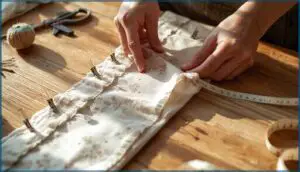
Fold your fabric with right sides together — this is where seam alignment starts. Lay the strip flat and smooth it from center to ends, matching raw edges evenly.
Fabric grain matters here: running the long edge along the lengthwise grain keeps your headband stable and twist-free after washing. Pin or clip every few inches, especially on stretchy knits, to lock those edges in place.
Stitching The Main Seam

This seam makes or breaks your headband. Set your sewing machine to a narrow zigzag — about 1.0mm wide and 2.5mm long — because straight stitches pop on knits.
Sew along the long edge with a 3/8″ seam allowance, backstitching at both ends to lock everything in place. These stretch stitching techniques are core sewing basics every sewist should own.
Turning and Pressing The Headband

Turning your headband right side out is where things get satisfying. Nail it with these steps:
- Trim your seam allowance to 0.25″ — less bulk, cleaner turns
- Clip the corners before reaching for your turning tools
- Use a safety pin to slowly scrunch the fabric through
- Press with steam, lifting the iron up and down — no sliding
Pressing techniques transform a homemade fabric craft into something that looks genuinely store-bought.
How to Sew a Twisted Headband
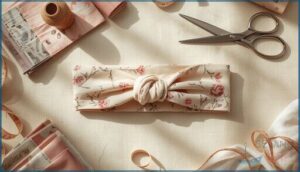
A twisted headband takes everything you just learned and flips it — literally. The twist is what gives this style its signature look, and getting it right comes down to a few key moves.
Here’s what you need to know.
Creating The Twist Effect
The twist is where this DIY twisted headband tutorial goes from basic to bold. Your fabric folding approach makes all the difference — overlap the two tube ends in an interlocking C shape, and the twist depth locks right into place.
These headband construction steps and fabric manipulation moves control everything — shift one layer down halfway before wrapping, and your twisted headband stays centered all day.
| Twist Techniques | Folding Methods | Twist Depth |
|---|---|---|
| Single tube shuffle | C-shape overlap | Subtle, flat knot |
| Two-piece cross | Plus formation | Layered, fuller knot |
| Turban loop | T-shape rotation | Statement, dramatic knot |
| Half-shift wrap | Midpoint offset | Centered, balanced twist |
| Wide band fold | No-elastic stretch | Broad, structured front |
Sewing With Hidden or Visible Seams
Now that your twist is locked in, seam placement decides everything. Hide the join at the center back — right sides together, stitch the raw edge, then turn it clean. Or own the seam visually with contrast topstitching.
- Place hidden seams at the back
- Use zigzag stitch types for stretch
- Match fabric selection to seam style
- Keep seam allowance tight and flat
- Finish with edge binding or ladder stitch
Tips for Even Twists
Even seams mean nothing if your twist is off-center. Mark the tube’s midpoint with a washable pen before you rotate — that single step keeps your DIY twisted headband tutorial repeatable every time. Master these Twist Techniques and you’ll own the whole process.
| Step | Key Action | Why It Matters |
|---|---|---|
| Fabric Tension | Keep steady, light pull on both ends | Prevents lopsided loops |
| Seam Alignment | Seam faces down during rotation | Hides join, looks polished |
| Pinning Methods | Clip four points around the knot | Locks shape before stitching |
| Stitching Accuracy | Narrow zigzag, 0.25″ from edge | Stretch stays, twist holds |
Adding Elastic for a Secure Fit
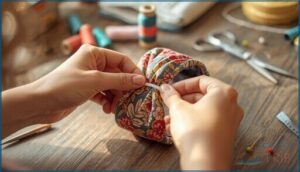
Elastic is what takes a headband from “pretty good” to stays put all day. Without it, even the best-sewn band can slip, roll, or just feel loose by noon.
Here’s exactly how to measure, attach, and finish elastic so your headband fits like it was made for your head — because it was.
Measuring and Cutting Elastic
Getting elastic tension right is everything. Cut it too long and your headband droops; too short and it bites into your scalp all day.
Here’s how to nail it:
- Use a flexible measuring tape as one of your key measuring tools.
- Subtract 1–2 inches from your head circumference.
- Account for stretch factors — knit elastic needs less negative ease than woven.
- Apply clean cutting techniques for straight, even ends.
Attaching Elastic to The Headband
Once you’ve cut your elastic, placement is where the magic happens. Tuck each elastic end about ¾ inch inside the headband tube, aligning it with the seam line so bulk stays hidden. Pin both sides with at least two pins each — no shifting allowed.
| Step | What to Do |
|---|---|
| 1 | Tuck elastic ¾” inside each open end |
| 2 | Align elastic with the headband seam |
| 3 | Pin with two pins per side |
| 4 | Use a wide zigzag stretch stitch |
| 5 | Pull evenly front and back while sewing |
Set your sewing machine to a wide zigzag — your stretch stitch is non-negotiable here for secure seams. Maintain even sewing tension by pulling the elastic gently from both sides as you sew. Backstitch twice over each end for a truly elasticated back that won’t quit.
Finishing The Elastic Seam
The back seam is your headband’s weak spot — so don’t rush it. Stitch over each elastic end two or three times using your sewing machine’s zigzag stretch stitch settings for true elastic end security.
Trim any excess for seam bulk reduction, then close the opening with matching thread. These finishing techniques keep the seam flat, comfortable, and strong through every stretch.
Decorating and Customizing Your Headband

The real fun starts here — this is where your headband goes from basic to completely yours.
A few simple additions can shift the whole look, whether you’re going for subtle or full statement. Here are the best ways to make it your own.
Adding Bows, Flowers, and Buttons
This is where your headband goes from functional to unforgettable. For bow placement, position your bow slightly off-center, about 1 to 1.5 inches from the middle.
Sew fabric flowers using gathered strips rolled into spirals, finishing the center with a button or pearl. For button attachment on stretchy bands, always add a small backing button inside — it protects the fabric and keeps everything secure.
Using Decorative Stitches and Topstitching
Stitching is where your headband becomes a statement piece. Smart stitch placement and thread choices can transform a plain band into something you’d actually want to show off.
Here’s how to do it right:
- Place a topstitch 2–3mm from the seam for clean edge finishing.
- Use contrasting thread for visible decorative patterns.
- Space parallel rows 6–10mm apart to keep stretch intact.
- Test decorative stitches on scrap fabric first.
Personalizing With Fabric Paint or Patches
Your headband is basically a blank canvas — own it. For fabric painting, choose water-based paints that flex with knit fabric so designs don’t crack. Always wash and dry your fabric first so paint bonds properly.
For patch placement, iron-on adhesive methods work on stable knits, but sewing edges down keeps things secure on stretchy bands. Either way, you’re making it yours.
Troubleshooting and Pro Tips for Headbands

Even the best-sewn headband can run into a few issues once it’s actually on your head.
Knowing what to fix — and how — is what separates a good result from a great one. Here’s what to watch for.
Preventing Slippage and Rolling
Nothing kills a good headband faster than watching it slowly creep back and flip into a rope by noon. Your best Grip Materials — cotton jersey, matte spandex, or velvet-lined knits — cut with stretch running around the head are your first line of defense.
For extra Slippage Solutions, sew narrow non-slip elastic inside or dab puffy fabric paint along the inner surface. Nail your Fabric Tension by cutting 1–2 inches shorter than head circumference, and Rolling Prevention becomes almost automatic.
Achieving a Professional Finish
A truly polished headband comes down to the Finishing Techniques most people rush past. These are what separate handmade from handcrafted.
- Trim seam allowances to 6mm for flat Seam Finishing
- Press every step with steam for crisp Edge Stitching
- Use stretch stitch for clean topstitching
- Center seams on the wrong side
- Finish with a final steam press
Common Mistakes and How to Fix Them
Even the cleanest finish won’t save a DIY Headband if the basics go sideways. Most Fit Problems and Elastic Issues come down to simple fixes once you know what to look for.
| Mistake | Fix |
|---|---|
| Headband Slippage | Shorten elastic 2–3 inches |
| Fabric Distortion | Ease grip; let feed dogs lead |
| Uneven Seam Allowance | Use needle plate guide throughout |
Frequently Asked Questions (FAQs)
How to make a handmade headband?
Making a DIY headband starts with the right knit fabric and basic sewing techniques. Grab your fabric, choose a headband pattern, and you’re already halfway there.
How to make a wide headband for beginners?
Wide headbands look complex but they’re actually one of the easiest beginner sewing projects. Cut an 18 by 7 inch knit rectangle, sew the long edge, flip it, and you’re done.
How long should the elastic be for a child’s headband?
Cut your elastic to about one quarter of your child’s head circumference plus one inch for seams. For a toddler with a 19-inch head, that’s roughly 75 inches — snug but comfortable.
Is it possible to make a reversible headband?
Yes, a reversible headband is absolutely possible. With smart Fabric Choices and Smooth Construction, you sew two layers right sides together, turn it out, and get two stylish looks from one DIY headband.
How can I make sure that the headband fits properly?
Nail headband sizing by measuring your head, then subtract 1–2 inches for stretch ease. Test the fit before finishing — snug but not tight is the sweet spot for elastic tension.
Are there any additional tools I need to make a headband?
Beyond the basics, a few sewing notions make all the difference.
Grab fabric cutters, measuring tools, ironing accessories, and stitching aids — your sewing supplies toolkit is what separates a good headband from a great one.
How can I customize my headband with decorative elements?
Your headband becomes truly yours the moment you start adding embellishments.
Try ribbon accents, floral designs, gemstone decor, or fabric painting to personalize your look and turn a simple band into a bold DIY fashion statement.
Can headbands be sewn without a sewing machine?
Absolutely — no machine, no problem. A needle and thread and a little patience are all you need.
Hand stitching makes DIY headbands one of the most portable projects you can tackle anywhere.
How do you wash and care for fabric headbands?
Most fabric headbands handle a gentle machine wash on cold just fine. Skip the fabric softener — it kills stretch.
Air dry to keep elastic intact, and spot-treat makeup or sweat stains before tossing them in.
What headband styles work best for thick hair?
Wide headbands are your best thick hair solutions. These DIY headbands spread pressure evenly, grip dense hair, and stay put — making them the perfect non slip bands for bold, voluminous hair.
Wide headbands, such as knotted styles, and full coverage headbands are ideal for thick hair, as they provide the necessary grip and comfort.
Conclusion
Every great wardrobe starts somewhere small. Now that you know how to sew a headband, you’ve done more than make an accessory—you’ve built confidence with knit fabric, fit, and finishing that carries into every project ahead.
Start simple, then twist it, embellish it, size it for someone you love. That scrap of stretchy fabric you almost threw away? It was always waiting to become something worth wearing.