This site is supported by our readers. We may earn a commission, at no cost to you, if you purchase through links.
You reach for your fabric scissors mid-project, and instead of gliding through the cloth, they chew it. The edges fray. The layers shift. That clean line you needed turns into a ragged mess that threatens your entire seam allowance.
Dull blades don’t just slow you down—they compromise every cut, turning precision work into guesswork and forcing you to wrestle with fabric that should surrender easily.
The good news: you don’t need professional equipment or special skills to bring those blades back to life. With a few household items and ten minutes, you can restore your scissors to the sharp, reliable tools they once were.
Table Of Contents
- Key Takeaways
- Why Sharp Fabric Scissors Matter
- Signs Your Fabric Scissors Need Sharpening
- Essential Tools for Sharpening Scissors at Home
- Preparing Scissors for Sharpening
- How to Sharpen Scissors With a Sharpening Stone
- Sharpening Fabric Scissors Using Sandpaper
- Using Household Items to Sharpen Scissors
- Safety Tips When Sharpening Scissors
- Maintaining and Storing Fabric Scissors
- When to Replace Versus Sharpen Fabric Scissors
- Frequently Asked Questions (FAQs)
- Conclusion
Key Takeaways
- Dull fabric scissors crush fibers instead of cutting cleanly, creating frayed edges and wasting material, while sharp blades slice precisely with deviations under 1mm for professional results.
- You can sharpen scissors at home using sharpening stones at 10-15 degrees, sandpaper between 600-1000 grit, or household items like aluminum foil and glass jars for quick touch-ups.
- Clean blades thoroughly before sharpening, work at consistent angles across both blades, and finish with polishing passes to restore cutting precision without professional equipment.
- Store sharpened scissors in dry conditions with blade protectors, use them only on fabric to prevent dulling, and replace them when chips, cracks, or warping make restoration impossible.
Why Sharp Fabric Scissors Matter
Sharp fabric scissors make the difference between clean, professional cuts and ragged edges that waste material. When your blades are dull, every project becomes harder and your fabric pays the price.
For upholstery work and other heavy-duty projects, choosing fabric scissors designed for thick materials ensures you get through multiple layers without blade strain or uneven edges.
Here’s what happens when you let your scissors go too long without sharpening.
Dull blades crush fabric fibers instead of slicing cleanly, which is why investing in quality sewing scissors makes such a difference.
Impact on Cutting Precision
Precision starts at the blade’s edge. When your fabric scissors boast true blade sharpness, you’ll follow pattern lines with deviations under 1 mm—sharp edges let you trace curves and corners exactly as marked. Dull blades wander and drag, throwing off cutting accuracy by several millimeters.
Pairing sharp blades with the right grip and cutting angle—techniques covered in professional sewing tips for pattern cutting—keeps your cuts smooth through multiple fabric layers.
Master edge sharpening and scissor sharpening techniques, and you’ll maintain cutting precision that keeps every piece true to your vision. To achieve ideal results, understanding proper scissor care techniques is essential for extending the life of your scissors.
Effects on Fabric Quality
Sharp blades protect your fabric’s edge integrity in ways dull scissors never can. When you cut with a properly sharpened edge, you’ll see clean lines with minimal fabric fraying—no bent fibers, no distortion along the cut. Dull blades tug and bend threads, especially on delicate weaves and knits, increasing snag risk and forcing rework. Keep your fabric scissors sharp to preserve:
Sharp blades deliver clean cuts without fraying, while dull scissors tug fibers and distort fabric edges
- Clean cuts with reduced fiber distortion
- Minimal fraying on woven and knit textiles
- Consistent seam allowances for better garment fit
- Lower snag risk on delicate materials
Common Issues From Dull Blades
Dull scissors create frustrating problems that go beyond frayed edges. You’ll notice fabric tears from excessive cutting strain, especially on delicate materials. Blade damage accumulates faster when you’re forcing cuts, and the extra effort accelerates scissor wear on both edges and pivot points.
Without proper blade sharpening and scissor care and maintenance, these issues compound—making DIY scissor sharpening methods essential knowledge for anyone serious about their craft.
Signs Your Fabric Scissors Need Sharpening
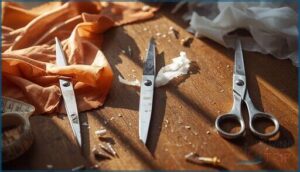
Your scissors will tell you when they need attention. The key is knowing what to look for before your fabric work suffers.
Here are three clear signs that it’s time to sharpen your blades.
Frayed or Jagged Cuts
When your fabric edges look more chewed than cut, it’s time for scissor care and maintenance. Dull blades tug fibers instead of cleanly shearing them, producing frayed, ragged cuts that damage your fabric and ruin cut quality. Loosely woven materials show this worst.
DIY scissor sharpening restores sharp edges that slice cleanly, improving fray prevention and edge finishing for professional results.
Increased Cutting Effort
Struggling through cuts signals blade friction and cutting resistance that shouldn’t be there. When you’re pushing harder to slice through cotton or polyester, dull scissors are forcing extra strain on your hands and boosting user fatigue with every snip.
- Measurably higher hand force needed per cut
- Longer cutting times for identical fabric sections
- Increased tearing at cut edges from friction
- Noticeable muscle tiredness after routine projects
Regular scissor maintenance and sharpening scissors with proper scissor sharpening tools restores smooth fabric scissor maintenance.
Uneven Blade Edges
Misaligned blades destroy cutting accuracy and leave ragged fabric edges that no amount of force can fix. You’ll spot one blade snagging fibers while the other slides freely—a clear sign of unequal sharpness or poor blade alignment.
Check with a magnifying lens for micro-burrs or flat spots that throw off scissor balance and demand edge repair through proper bevel angles and sharpening techniques for scissors.
| Issue | Visual Sign | Impact on Fabric |
|---|---|---|
| Rolled edge | One blade catches repeatedly | Skipped cuts, jagged outlines |
| Damaged tip | Visible chip or bend | Incomplete snips at fabric ends |
| Uneven bevel | Mismatched blade surfaces | Inconsistent pressure, fraying |
| Flat spots | Dull patches along edge | Pulls threads instead of cutting |
Restoring uniform blade care with edge sharpening and honing brings back the precision your projects deserve.
Essential Tools for Sharpening Scissors at Home
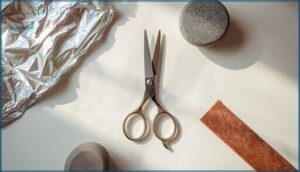
You don’t need fancy equipment to sharpen your fabric scissors at home. Most methods rely on simple tools you probably already have in your craft room or kitchen.
If you’re new to fabric care and cutting techniques, check out these beginner-friendly sewing lessons to build your foundational skills.
Here’s what works best for bringing those blades back to life.
Sharpening Stones and Whetstones
A sharpening stone gives you total control over edge refinement and sharpening techniques. Here’s what you need to know about stone selection and whetstone maintenance:
- Choose your grit progression — start with 1000 grit for routine sharpening, then move to 3000–4000 for polishing
- Hold sharpening angles steady at 15–20 degrees for clean, consistent results
- Pick synthetic over natural for uniform, predictable sharpening and honing every time
Sandpaper and Aluminum Foil
You don’t need expensive gear for effective DIY sharpening. Sandpaper grits between 150-200 work wonders for blade maintenance, creating repetitive abrasive contact that smooths nicks.
Aluminum foil sharpening uses layered sheets as a composite surface—just fold several times and cut through repeatedly.
Both sharpening techniques deliver results with scissor sharpening tools you already own, though foil sharpening works best as a supplementary step after other methods.
Glass Jar or Bottle
A smooth glass jar or bottle works as a budget-friendly sharpening tool when dedicated scissor sharpening tools aren’t available. This DIY sharpening method for household scissor maintenance delivers modest results through friction-based edge refinement.
- Glass sharpening creates consistent contact for uniform burr removal during frugal sharpening sessions
- Jar techniques require multiple passes with controlled blade angles for bottle edge honing
- Homemade tools offer slower sharpening scissors progress compared to whetstones but cost nothing
Safety Equipment
Cut-resistant gloves protect your hands from blade slips while sharpening fabric scissors. Safety glasses keep metal particles away from your eyes. Set up on a non-slip surface to prevent accidents with your sharpening stone, sandpaper, or aluminum foil. Keep a first aid kit nearby.
Protective gear matters when you’re working with sharp steel tools and a screwdriver for disassembly.
Preparing Scissors for Sharpening
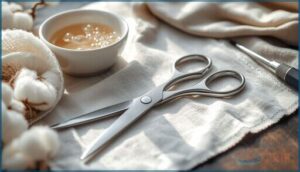
Before you sharpen your fabric scissors, you need to set them up for success. A clean blade works better than a dirty one, and knowing whether to take your scissors apart can make all the difference.
Here’s what to do before you start sharpening.
Cleaning Blades Thoroughly
Before you even think about edge sharpening, your blades need to be spotless. Fabric fibers, dust, and sticky residue dull your cutting edge faster than you’d think. Here’s how to prep your fabric scissor care routine:
- Rinse blades under warm water to flush away fabric fibers and lint.
- Apply mild dish soap to a soft cloth and wipe each blade thoroughly for soap cleaning.
- Use an old toothbrush to scrub the pivot area and remove stubborn debris.
- Dry blades completely with a clean towel to prevent rust and corrosion.
Once you’ve finished water rinsing and dry maintenance, inspect each blade closely. Look for rust spots, nicks, or warping during your blade inspection—these issues need professional attention before you sharpen at home. This rust removal and blade care step saves you time and protects your investment in quality fabric scissors. Clean blades sharpen better and last longer, giving you the precision cuts your projects deserve.
Disassembling Scissors Safely
With your blades clean, scissor disassembly starts now. Grip grips firmly and keep blades pointed away from your body for grip safety. Use a flathead screwdriver for screw management—turn counterclockwise slowly.
Place parts in a labeled container during blade removal so reassembly tips stay simple. This scissor maintenance step ensures even at-home sharpening methods across both edges, making sewing scissor sharpening more effective and your scissor care routine complete.
Inspecting for Damage
Now look closely at your separated blades for edge damage during blade inspection. Run your finger gently along each edge—watch for nicks or chips that sharpening won’t fix.
Visual checks reveal corrosion signs like rust spots or discoloration from metal fatigue. If your sewing scissors show deep gouges or bent areas, sewing tool maintenance through scissor sharpening won’t help dull scissors with structural problems.
How to Sharpen Scissors With a Sharpening Stone
A sharpening stone gives you the most control and precision when restoring your fabric scissors. The process requires some practice, but once you get the hang of it, you’ll achieve professional-level results at home.
Here’s what you need to know to sharpen your scissors like a pro.
Selecting The Right Grit
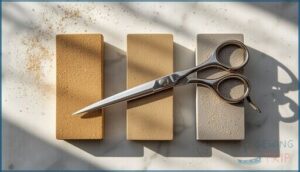
Grit selection determines how effectively you’ll restore your blades. Match the grit value to your blade material and manufacturer’s recommended edge angle.
Start with coarser grits (220–320) for heavily dulled scissors, then move to medium grits (400–600) to rebuild the edge. Finish with finer grits (800–1200) for polishing.
Consistent grit progression across your sharpening sequence creates uniform sharpness and prevents uneven wear.
Setting The Correct Angle
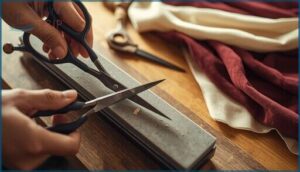
With the right angle calibration, you’ll transform blade care from guesswork into precision. Fabric scissors demand an angle between 10 and 15 degrees per blade for ideal edge sharpening and bevel maintenance.
- Align your sharpener with a consistent low-angle approach to maintain true blade alignment
- For tightly woven fabrics, stay within the 10–12 degree range to preserve edge geometry
- Adjust gradually in small increments rather than making large changes during scissor sharpening
- Apply identical angles to both blades for balanced sharpness testing results
Step-by-Step Sharpening Process
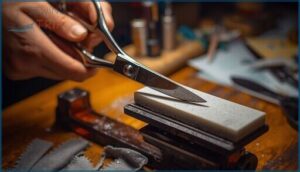
Start with a clean, damp cloth to remove residue from your sewing scissors. Secure them in a vice to prevent movement during at-home sharpening. Hold your sharpening stones at consistent sharpening angles—around 20 degrees for household steel—and glide the blade edge across in smooth, even strokes.
Blade inspection under good lighting reveals nicks. Test cut scrap fabric, repeating light passes with your sharpener until scissor alignment delivers clean cuts through edge refining and proper blade care.
Polishing and Finishing
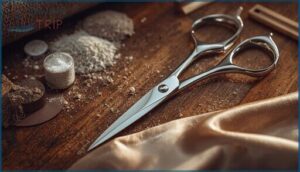
A smooth finish transforms sharp scissors into precision instruments. After blade honing with your whetstone, micro polishing removes roughness that snags delicate fabrics during edge refining.
- Apply fine abrasive film in consistent finishing techniques passes to prevent nicks.
- Use low-grit compounds for sharpness restoration and improved glide.
- Complete at-home sharpening with a final alignment stroke for cutting tool care.
- Test your scissor sharpening work on scrap fabric—clean cuts confirm success.
Sharpening Fabric Scissors Using Sandpaper
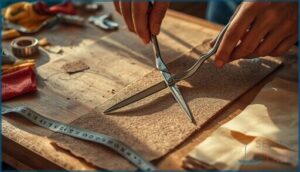
Sandpaper offers a quick way to sharpen fabric scissors when you don’t have a sharpening stone. You’ll need the right grit and a simple folding technique to get clean, sharp edges.
Here’s what you need to know to sharpen your scissors with sandpaper effectively.
Choosing Appropriate Grit
When sharpening fabric scissors with sandpaper, your grit selection makes all the difference. Start with 600 to 1000 grit for edge refinement on steel blade material—finer grits like 800–1000 remove light burrs without stripping too much metal. Avoid anything below 400, which can damage delicate edges.
For best results, follow with a 1000–1200 grit pass using your sharpening stone.
Folding and Using Sandpaper
Think of sandpaper as your precision partner—folding it creates a doubled, stable surface that won’t shift mid-stroke.
Here’s how to use this DIY home repair technique for blade refinement:
- Fold 600–1000 grit sandpaper evenly to double the working surface
- Hold folded edges firmly to prevent blade wobble during passes
- Apply light, consistent pressure along the blade’s bevel
- Use short strokes in one direction for edge smoothing
- Test with a careful finger swipe to confirm a burr-free finish
Using Household Items to Sharpen Scissors
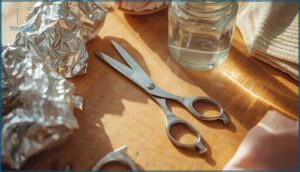
You don’t always need fancy equipment to sharpen your fabric scissors.
A few common household items can restore cutting power when you’re in a pinch.
Here’s how to use aluminum foil and glass jars to bring those blades back to life.
Sharpening With Aluminum Foil
You’ve probably got aluminum foil sitting in your kitchen right now—and it’s surprisingly effective for edge refining. Fold a sheet of aluminum foil into several layers, then make 10-15 full cuts through it with your fabric scissors.
This aluminum method works by micro-edging the blade, removing tiny burrs and realigning the cutting edge. It’s a quick at-home sharpening method that improves sharpness between more thorough sharpening sessions.
Glass Jar Sharpening Technique
Another clever household option is glass jar sharpening—open the blades wide and run each cutting edge along the inner surface of a clean glass jar. Use multiple rotating passes with controlled pressure for blade angle control and edge refining techniques.
This glass surface preparation creates uniform abrasive contact similar to a sharpening stone. Finish with a quick strop on fabric to polish the edge and remove any metal debris.
Pros and Cons of Each Method
Each sharpening technique has trade-offs. Sharpening stones deliver excellent edge geometry and blade materials compatibility, but require practice and higher maintenance costs upfront. Sandpaper offers quick at-home sharpening for fabric scissors with minimal investment, though results fade faster. Household methods like foil and glass provide immediate fixes but create inconsistent edges.
Your sharpening frequency and crafting tool care needs determine which approach works best.
Safety Tips When Sharpening Scissors
Sharpening scissors puts you in direct contact with sharp edges and abrasive materials. A moment of distraction can lead to cuts, nicks, or damaged blades that compromise your tools.
Follow these safety guidelines to protect yourself and your scissors throughout the sharpening process.
Wearing Protective Gloves
Your hands deserve protection when tackling scissor sharpening at home. Cut resistance matters—you’re working with blades sharp enough to slice through fabric in one pass.
- Glove materials: Choose nitrile or latex-free options for enhanced grip on sewing scissors
- Finger dexterity: Wear snug-fitting gloves that allow precise control during tool sharpening
- Hand protection: Replace torn or oil-contaminated gloves immediately
- Safety precautions: Pair gloves with eye protection for complete crafting tool care
Handling Sharp Blades Carefully
Gloves aren’t the only line of defense—how you grip those blades matters just as much. Sharp edges demand respect, and a split-second mistake can turn a simple sharpening session into a trip to urgent care.
| Safe Handling Practice | Why It Works |
|---|---|
| Hold scissors by grips, never blades | Keeps fingers away from sharp edge during movement |
| Close blades immediately after use | Prevents accidental contact when setting down tools |
| Work on stable, non-slip surface | Reduces risk of unexpected tool movement causing injury |
Always pass scissors grip-first to others. Your cutting hand should maintain a neutral wrist position for better control—bent angles increase the chance you’ll slip toward the blade. When you set shears down between passes on your sharpening stone, position them so the sharp edge faces away from your body.
Never try catching dropped scissors. Let them fall. That instinct to grab mid-air? That’s when fingers meet freshly honed edges. Instead, step back and retrieve them safely from the floor.
Focus matters too. Injury prevention starts with attention—finish your stroke on the whetstone before glancing away. Distractions mid-sharpen are how accidents happen, especially when you’re working with fabric scissors sharp enough to slice silk in one pass.
Keep your work area well-lit. You need to see exactly where that blade sits against your stone. Poor lighting leads to incorrect angles and hand positioning, and a better answer is always working where you can clearly track every movement of those scissors.
Preventing Accidental Damage
Beyond personal safety, protecting your workspace and tools keeps scissor sharpening efficient. Blade guards catch metal shavings while sharpening mats provide a stable, non-slip surface for accident prevention. Cut resistance gloves add another layer of safe handling. Keep your area flat and well-lit—proper visibility prevents nicks to both skin and fabric during at-home sharpening methods.
- Secure scissors in a vise to eliminate unexpected movement
- Use protective sheaths immediately after finishing each blade
- Store sharpened tools away from children and pets
Maintaining and Storing Fabric Scissors
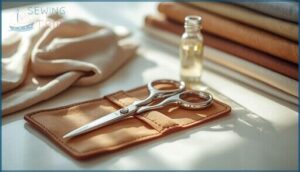
Sharpening your fabric scissors is just the first step in keeping them in top condition. How you clean, store, and use them afterward determines how long that sharp edge lasts.
Let’s cover three essential practices that protect your investment and keep your scissors ready for precise cuts every time.
Cleaning After Sharpening
After sharpening, debris removal is your first priority. Use a clean cloth or soft brush to sweep away metal shavings from the blade surfaces. Then, inspect the blades for burrs or fine wires that could snag fabric. Wipe each blade with a thin film of mineral oil for rust prevention—this simple maintenance step keeps your scissor sharpening efforts working longer.
| Maintenance Task | Method |
|---|---|
| Debris Removal | Clean cloth or soft brush |
| Blade Inspection | Check for burrs and wires |
| Rust Prevention | Apply mineral oil thinly |
| Pivot Area Cleaning | Remove lubricant residue |
| Storage Preparation | Keep in dry environment |
Proper Storage Solutions
Without dry storage methods, your newly sharpened fabric scissors won’t stay sharp. Keep your sewing scissors in a dedicated drawer away from humidity—moisture invites corrosion. Use a blade protector or sheath for edge preservation between projects.
Store your crafting tools closed with blades aligned, and choose storage materials that prevent nicks. Proper sewing tool care means placing them where temperature stays stable, away from heat or chemicals that degrade scissor maintenance efforts.
Avoiding Misuse of Fabric Scissors
Your fabric scissors deserve respect—treat them like precision instruments. Use fabric scissors only for cutting fabric, never for paper, cardboard, or packaging. Cross-contamination dulls blades fast.
Train everyone in your household on proper handling precautions and blade maintenance. Store scissors closed when not in use to prevent accidental nicks.
This simple scissor care protects your investment and maintains cutting techniques for years of fabric protection.
When to Replace Versus Sharpen Fabric Scissors
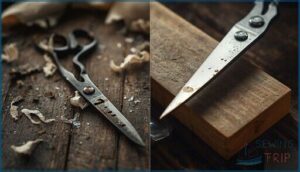
Sharpening breathes new life into dull blades, but every pair of scissors has its limits. Knowing when to sharpen versus replace saves you time, money, and frustration at the cutting table.
Let’s look at how to spot the difference between a blade that needs a tune-up and one that’s reached the end of its road.
Identifying Irreparable Damage
Some damage goes beyond what scissor sharpening can fix. During blade inspection and damage assessment, check for these signs that edge restoration won’t work:
- Chips or cracks that extend into the cutting edge and prevent safe metal fatigue repair
- Severe nicking from drops that makes true restoration impossible
- Warped blades creating uneven surfaces no amount of sharpening corrects
- Corrosion effects with pits breaching the edge line
Expected Lifespan of Fabric Scissors
Your fabric scissors can serve you for decades when you treat them right. Steel quality and proper care are the biggest lifespan factors—premium forged blades like Gingher often cut well for over 20 years with regular sharpening. Midrange brands deliver years of reliable service when you stick to fabric only.
Blade durability depends on scissor material, sharpening frequency, and how you use them daily. Proper scissor care involves following scissor maintenance tips to extend their lifespan.
Signs It’s Time for a New Pair
Even well-made scissors eventually reach a point where sharpening can’t bring back their cutting edge. Watch for these signs that your fabric scissors need replacement:
- Blade wear thins the cutting edges despite regular sharpening frequency and replacement considerations
- Bent or misaligned blades create uneven cuts no tool maintenance can fix
- Deep nicks or chips in the dull edge that persist after sharpening
- Increased cutting struggle even with freshly sharpened sewing scissors
- Visible gaps between blades during scissor maintenance checks
When dull scissors won’t improve, invest in quality fabric scissors.
Frequently Asked Questions (FAQs)
How often should fabric scissors be sharpened?
Your cutting performance tells you when it’s time. Trust your blades—when precision drops, blade maintenance restores scissor longevity instantly.
Most home sewers sharpen once yearly, but daily use demands sharpening every few months.
Can professional sharpening services damage my scissors?
Yes, sharpener errors can damage your fabric scissors. Improper blade angles reduce cutting efficiency by 30%. Over-sharpening weakens blades, while poor service quality introduces nicks. Choose experienced professionals to minimize professional risks.
Whats the cost of professional scissor sharpening?
Most professional sharpening services charge between $8 and $25 per pair, though specialty shears can run higher.
Service fees depend on blade size, condition, and whether you’re using walk-in shops or mail-in options.
Do different fabrics dull scissors at different rates?
Different fabrics affect blade erosion at varying rates. Cotton and linen create less scissor wear than denim, while synthetic blends increase material friction.
Embedded particles accelerate cutting resistance regardless of fabric durability.
Can I sharpen serrated or pinking shears?
Touching up those zigzag pinking scissors or serrated edge fabric scissors isn’t your typical at-home sharpening job.
Blade geometry and tooth maintenance demand specialized sharpening techniques—most manufacturers suggest professional help to preserve cutting performance.
Conclusion
Sharp scissors cut through more than fabric—they cut through frustration. Now that you know how to sharpen fabric scissors at home, you hold the power to maintain your most essential tool without expensive trips or waiting.
Those clean, smooth cuts are yours again. Keep your blades honed, store them properly, and treat them with respect. Your next project deserves precision from the first snip to the final seam.
- https://dalstrong.com/blogs/news/how-to-sharpen-scissors
- https://www.diamondneedle.com/how-to-sharpen-sewing-scissors
- https://threadsmonthly.com/how-to-sharpen-fabric-pinking-scissors/
- https://villagesharpening.co.uk/sharpening-scissors/sharpening/
- https://www.sharpeninghandbook.info/GT-Scissors-Sewing.html