This site is supported by our readers. We may earn a commission, at no cost to you, if you purchase through links.
A single misthreaded tension disc can unravel an entire project—sometimes without you noticing until the seam pulls apart.
The tension discs are the gatekeepers of stitch quality, and most sewists walk right past them when problems start.
Skipped stitches, loops on the underside, thread that snaps mid-seam—these almost always trace back to how the upper thread was seated between those two metal plates.
Threading tension discs correctly takes less than a minute, but the sequence matters.
Get it right, and your machine runs smoothly from the first stitch to the last.
Table Of Contents
Key Takeaways
- Always raise the presser foot before threading — it’s what opens the tension discs and actually lets your thread seat properly between them.
- Most tension problems trace back to one root cause: the thread wasn’t fully seated between the tension discs during setup.
- Match your tension dial to your fabric weight and thread type, making half-step adjustments and always testing on scrap first.
- Clean tension discs regularly using a flossing technique with a fleece strip — lint buildup is a silent stitch-wrecker most sewists overlook.
Step-by-Step Guide to Threading Tension Discs
Threading tension discs correctly makes all the difference between smooth stitches and a tangled mess. The process is straightforward once you know the right sequence to follow.
Once you’ve got the tension right, you’re ready to start practicing actual stitches — this beginner embroidery stitches guide walks you through the foundational ones step by step.
Here’s exactly what you need to do, step by step.
Preparing Your Sewing Machine

Before touching a single thread, shut the machine down completely — power switch off, then unplug it. This protects you from accidental needle movement during inspection.
Snip old thread near the needle and pull it forward to remove it cleanly. Clear lint from the tension discs and bobbin area, then inspect your needle. Replace anything bent or blunt before starting fresh.
Check the bobbin case tension(https://www.stitchclinic.com/how-to-fix-bobbin-tension/) to make sure proper stitch quality.
Raising The Presser Foot for Threading
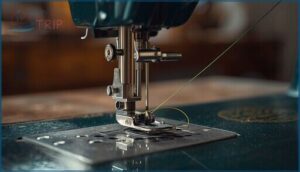
With your machine prepped, it’s time to raise the presser foot before threading anything. Locate the foot lever — it sits behind the needle on the machine head. Lift it fully upward.
The foot lever mechanics matter more than most sewers realize: raising the presser foot separates the tension discs, creating a gap so thread actually seats between them.
Brother, Singer, and Janome models all place this lever slightly differently, so check your manual if needed. Proper balanced tension adjustment is essential for best stitch quality.
Threading Path Through Tension Discs
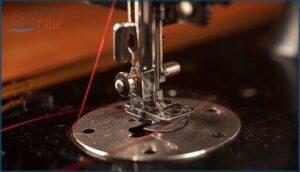
Now that the presser foot is raised, follow the printed arrows down the front slot — that’s your entry slot. Guide the thread through each thread guide in sequence, keeping your thread angle straight.
Disc seating technique matters here: press the thread gently sideways until it snaps fully between the tension discs. Right after, hook it into the check spring for proper guide alignment.
Securing Thread in The Take-up Lever

With the thread seated between the tension discs, bring it up toward the take‑up lever. Hook it through the Lever Eyelet Entry using a Flossing Motion — a quick side‑to‑side wiggle seats it cleanly.
- Raise the lever to its highest point first.
- Hook thread right to left through the eyelet.
- Leave a 6–8 inch Thread Tail Length.
- Do Visual Confirmation — thread should run straight, no slack.
- Lower the foot (Foot Positioning) and tug gently to test engagement.
Adjusting Thread Tension for Perfect Stitches
Getting your tension right is the difference between stitches that hold and stitches that fall apart.
A few simple adjustments can fix most tension problems without a trip to the repair shop.
Here’s what you need to know to dial it in.
Using The Tension Dial Correctly
Your tension dial is the control center of every stitch you make.
Getting familiar with a machine like the Brother HC1850’s tension system can make that trial-and-error on scrap fabric a lot less frustrating.
Most machines default around 4 to 4.5 — start there.
Dial calibration matters, so make incremental adjustments of half a number at a time.
Foot position impact is real: always lower the presser foot before testing thread tension.
That’s when the discs actually grip and troubleshooting tension issues becomes accurate.
Matching Tension to Fabric Type and Weight
Every fabric has its own language, and your tension dial needs to speak it fluently. Silk tension sits around 2 to 3, while denim settings climb to 4 or 6 depending on weight. Stretch knit balance calls for 2 to 3 with a zigzag stitch.
Every fabric has its own language, and your tension dial must learn to speak it
Match thread and fabric compatibility first, then dial in:
- Sheer fabrics (organza fine-tune): tension 2 to 3
- Medium weights (cotton, linen): tension 3 to 5
- Canvas heavy-duty: tension 5 to 7
Balancing Upper and Lower Thread Tension
Balancing upper and lower thread tension is like a tug-of-war — both sides need equal pull.
Tension Dial Calibration on your upper discs should be done before touching the bobbin screw.
Knot Position Indicators tell the story: knots showing on top mean tighten upper tension; knots on the bottom mean loosen it.
Fabric Thickness Impact and Thread Type Effects both shift that balance, so always sew test strips first.
Fine-tuning for Specialty Threads
Specialty threads don’t follow the rules — and that’s exactly why they trip you up.
For Metallic Thread Settings, drop top tension to 1.0–2.0 and slow your machine down.
Monofilament Tension stays loose, around 0.75–2.0, or it will snap.
Elastic Shirring Adjust needs your top tension bumped to 7.
Rayon Embroidery Tuning runs smoothly at 100–120 grams.
Woolly Nylon Fine work? Just relax tension slightly to prevent puckering.
Cleaning and Maintaining Tension Discs

Dirty tension discs are one of the sneakiest causes of bad stitches.
Lint and dust build up quietly, throwing off your thread flow before you even notice.
Here’s what you need to know to keep your discs clean and your machine running right.
Identifying Signs of Dust and Lint Buildup
Dust doesn’t announce itself — it just quietly wrecks your stitches.
Watch for lint shadows inside the disc gap, stitch loopy patterns on the underside, or dial stiffness when you rotate the tension knob.
Fabric shedding indicators like fleece and flannel leave buildup quickly.
You’ll also notice thread drag feel — jerky resistance instead of smooth pull.
These are your early warnings.
Safely Cleaning and Flossing Tension Discs
Think of this like dental flossing — same idea, different machine.
For tension disk cleaning, start with Presser Foot Safety: raise the foot fully to open the discs 1–2 mm. Fleece Preparation means cutting an 8–10 inch strip, stretching it into a tube.
Use the Flossing Motion — 10–20 passes. For sticky buildup, Alcohol Application works. Always mind the Check Spring Guard throughout.
Preventing Future Buildup
Once your tension disk cleaning is done, keep it that way.
A Dust‑Free Workspace cuts airborne fibers in half before they ever reach your machine.
Pair that with Regular Dust‑Cover Use — daily covering drops visible buildup by 80 percent.
Practice Lint‑Free Thread Storage in sealed bins, run Scheduled Air‑Blowing monthly, and keep Humidity Control below 50 percent.
Prevention beats repeat cleaning every time.
When to Seek Professional Servicing
Prevention only goes so far. When persistent tension issues survive every fix you’ve tried — re-threading, bobbin checks, needle swaps — that’s your service interval signal.
Watch for unusual noise symptoms like grinding or clicking near the discs. Visible wear indicators like scoring, rust, or bent discs mean it’s time for professional sewing machine repair.
Don’t wait until it becomes a safety hazard.
Troubleshooting Common Tension Disc Issues
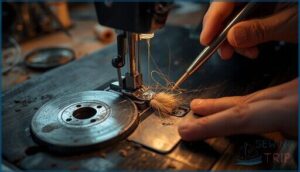
Even the best-maintained machines run into tension disc problems from time to time.
Knowing what to look for makes the fix faster and less frustrating.
Here are the most common issues you’ll likely run into.
Diagnosing Loose or Tight Stitches
Stitch loop detection starts with a simple seam stress test — gently tug your sewn fabric and watch where threads pull apart. Loops on top signal loose upper tension; bobbin thread showing topside means it is too tight.
Fabric pucker signs and uneven seams confirm tension problems fast. A thread lock position check — splitting seam layers apart — reveals exactly where your tension discs need adjustment.
Resolving Thread Slippage and Skipping
Once you’ve spotted the problem, fixing slippage usually starts with presser foot timing — always raise it before threading so the tension discs open fully. Check your guide post alignment and reroute the thread completely.
A thread net usage over slippery spools acts as a spool tension aid, controlling feed. Lint‑free cleaning between the tension discs clears debris that causes skipping.
Fixing Uneven Thread Tension
Uneven stitches often come down to a few overlooked basics. Start by checking spool direction — it should unwind counterclockwise. Thread type choice matters too, since heavier threads need higher dial settings.
Watch for machine vibration loosening your bobbin tension mid-seam. Run a tension disc adjustment, then sew a test seam.
Bobbin thread showing on top? Back off the upper dial one notch at a time.
Checking for Worn or Misaligned Discs
Catching wear early saves you from chasing phantom tension problems for weeks. Run a quick Thread Slip Test — presser foot down, dial at 5, then tug gently. Good discs hold firm. Worn ones let thread slide right through.
Check these four warning signs:
- Grinding marks or Wear Marks along disc surfaces
- Surface Cracks on plastic components after any drops
- Poor Disc Alignment causing uneven Grip Resistance
- Visible gaps between disc pairs during threading
Top Sewing Patterns for Practicing Thread Tension
The best way to sharpen your tension skills is to sew something real.
These three patterns give you varied fabrics, seams, and structure — exactly what you need to test your settings.
Start with the one that matches your current skill level and work your way through.
1. Know Me Men’s Crop Jacket Vest Pattern

The Know Me Men’s Crop Jacket Vest Pattern (ME2064) is a smart choice for tension practice — and here’s why. This pattern combines a snap-front crop jacket with a zipper-close vest, meaning you’ll sew through water-resistant fabrics like dry oilskin and waterproof nylon.
These materials demand precise tension from the start. Loose stitches won’t hold, and tight ones will pucker or tear the fabric. With multiple pocket types and interfaced flaps, you’ll test your tension settings across varying fabric weights in one project.
| Best For | Men who already know their way around a sewing machine and want a stylish, versatile project that challenges their skills. |
|---|---|
| Skill Level | Intermediate to Advanced |
| Language | English |
| Format | Pattern Kit |
| Instructions Included | Yes |
| Origin | Made in USA |
| Fabric Guidance | Yes |
| Additional Features |
|
- The jacket and vest work together or separately, so you get two wearable pieces out of one pattern.
- Pockets, snaps, zippers, and a hood give you plenty of variety to practice different techniques in one project.
- Made in the US with solid sizing info and fabric guidance built right in — less guesswork upfront.
- You’ll need to buy all your own fabric, zippers, snaps, and trims separately, which adds to the cost and planning.
- Sizes only go from 44 to 52, so it’s not an option for everyone.
- This isn’t a beginner project — without solid sewing experience, the technical details can get tricky fast.
2. Butterick Misses Collared Shirt and Shorts Pattern

The Butterick Misses Collared Shirt and Shorts Pattern (B6946D5) is a solid tension workout hiding in plain sight.
You’re dealing with a fitted collared shirt — collar bands, bust darts, pleated sleeves, button cuffs — plus pleated shorts with a fly zipper. That’s a lot of seam types in one project. Each element tests a different tension scenario. Topstitching the collar demands tight control, while softer fabric areas need a looser hand.
Sizes run 4–12, so it fits a range of skill-building goals.
| Best For | Sewists with some experience who want to build their skills making fitted, stylish separates in misses’ sizes 4–12. |
|---|---|
| Skill Level | Beginner to Intermediate |
| Language | English |
| Format | Pattern Packet |
| Instructions Included | Yes |
| Origin | Not Specified |
| Fabric Guidance | Yes |
| Additional Features |
|
- Covers a solid range of techniques — collar bands, bust darts, pleated sleeves, and a fly zipper — so you get a real skills workout in one project.
- Multiple views let you mix up the look, from rolled sleeves to button tabs, so the pattern stays fresh across multiple makes.
- Works for casual days or dressed-up occasions, making it a versatile addition to your pattern collection.
- Only goes up to size 12, so it leaves out a big chunk of sewists who fall outside that range.
- Between the collar, cuffs, and zipper, this isn’t a great pick for total beginners — you’ll want some sewing know-how before diving in.
- The instructions may assume familiarity with sewing terminology, which could slow you down if you’re still learning the lingo.
3. Doll Couture Red Carpet Edition

Think tension practice gets easier at full scale? Try sewing for a 1/8 scale doll.
Kenneth D. King’s Doll Couture Red Carpet Edition turns miniature garments into precision drills.
Metallic threads need the dial at 1–2. Beading passes run at 2–3. Chiffon pleats call for exactly 3.
Every fabric shift demands a tension reset. And those tiny seams forgive nothing.
If you can nail balanced stitches at this scale, full-size garments will feel easy.
| Best For | Doll collectors, fashion lovers, and sewists at any skill level who want to explore miniature haute couture for 1/8 scale dolls. |
|---|---|
| Skill Level | All Levels |
| Language | English |
| Format | Book |
| Instructions Included | Yes |
| Origin | USA Publisher |
| Fabric Guidance | Yes |
| Additional Features |
|
- Stunning photography and behind-the-scenes content make it as beautiful to flip through as it is to learn from
- Patterns and techniques work for all skill levels, so you grow into it as your skills improve
- Builds serious precision — if you can sew at this scale, full-size garments become much easier
- Only works for 1/8 scale dolls, so it won’t help if you sew for other sizes
- Small-scale sewing has a steep learning curve — true beginners may feel overwhelmed early on
- The red carpet and Broadway aesthetic is very specific, so it might not fit everyone’s style
Frequently Asked Questions (FAQs)
How to use a thread tension gauge?
thermometer for your machine, a thread tension gauge measures exactly how much pull your thread carries.
Zero it first, wrap thread around the hook, then pull steadily downward until the reading stabilizes.
Can I use tension discs on a serger machine?
Yes, sergers absolutely use tension discs.
In fact, most standard sergers like Singer and Brother models have separate discs for each needle and looper thread, giving you independent control over every thread path.
How does thread color affect tension disc performance?
Thread color is more than skin deep.
Darker threads carry heavier dyes, creating extra friction against tension discs — meaning you’ll often need to dial tension down slightly compared to lighter threads.
What tension settings work best for quilting projects?
For most quilting projects, set your tension dial between 4 and Test on scrap fabric first. Thick batting may need a slight drop to 5 for smooth, balanced stitches.
How do humidity and temperature impact thread tension?
humidity and temperature quietly mess with your thread tension. Above 60% RH, natural fibers weaken and stiffen, causing puckering.
Heat above 25°C loosens synthetic threads. Aim for 45–55% RH and 18–24°C for stable stitches.
Conclusion
Threading tension discs wrong can throw off a thousand stitches before you catch the culprit.
Now that you know how to thread tension discs, adjust the dial, clean the discs, and troubleshoot the common failures, you’re not guessing anymore. You’re diagnosing.
Every smooth seam from here forward is the result of that knowledge working quietly in the background.
Keep your discs clean, your thread path consistent, and your machine will rarely give you a reason to stop.
- https://www.threadsmagazine.com/2008/11/02/understanding-thread-tension
- https://www.magnetichoop.com/blogs/news/mastering-your-thread-tension-dial-the-ultimate-guide-to-perfect-stitches
- https://www.sewschool.co.uk/sewing-machine-thread-tension/
- https://singersewingoutlet.co.uk/pages/singer-sewing-machine-guides-threading-general-guide
- https://cursa.app/en/page/sewing-machine-mastery-threading-the-upper-path-and-confirming-take-up-lever-control