This site is supported by our readers. We may earn a commission, at no cost to you, if you purchase through links.
A ruler that slips mid-cut doesn’t just ruin fabric—it rattles a student’s confidence right when they’re starting to build it. After years of teaching quilting, that’s the thing I wish someone had told me before I handed a generic ruler to a nervous beginner and watched the whole strip shift sideways.
The right quilting rulers for classroom use do more than measure; they keep students focused on learning the craft instead of wrestling with their tools. From non-slip grip circles to built-in angle guides, the best options make your job easier and their first cuts cleaner.
Table Of Contents
Key Takeaways
- Non-slip grip surfaces and high-contrast dual-side markings are the most important features to prioritize when choosing quilting rulers for a classroom, because they directly prevent slipping mistakes and keep every student cutting accurately regardless of fabric color.
- Creative Grids CGR824 and the Bloc Loc Flying Geese Set stand out as top classroom picks — one for everyday versatility across skill levels, the other for precision trimming of a specific but commonly taught block.
- A starter kit built around a 6½" × 24½" rectangle ruler and a 12½" square ruler covers the majority of beginner projects before any specialty tools are needed, making it the smartest first investment for shared classroom budgets.
- Safety habits like flat hand positioning, re-measuring before every cut, and matching ruler thickness to machine type (⅛" for cutting, ¼" for machine quilting) are just as essential to teach as the cutting techniques themselves.
Top 5 Classroom Quilting Rulers
Not all quilting rulers are created equal, especially when you’re teaching a room full of beginners.
For beginners still finding their footing, starting with simple quilting and sewing patterns takes the pressure off getting every cut perfect.
These five rulers earned their spot because they’re clear, grippy, and genuinely useful across multiple lessons.
Here’s what made the cut.
1. Creative Grids Acrylic Quilt Ruler
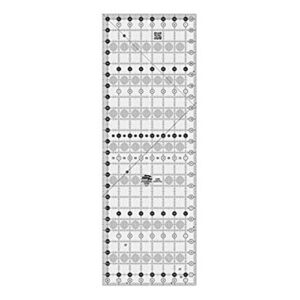
If there’s one ruler I keep reaching for in every class, it’s the Creative Grids CGR824 — the 8.5" × 24.5" acrylic rectangle. Those raised grip circles on the back are a game changer, especially for students with shaky hands.
The dual-side markings give you black-on-white and white-on-black grids, so no matter what fabric you’re working on, you can see your lines clearly. Built-in 45° and 30°/60° angle guides mean fewer tools to juggle during a lesson.
| Best For | Quilters of all skill levels who want a stable, accurate ruler—especially those with limited hand steadiness or anyone who regularly cuts wide borders and long strips. |
|---|---|
| Material | Clear acrylic |
| Origin | United States |
| Seam Allowance | 1/4 in dashed lines |
| Non-Slip Grip | Raised grip circles |
| Unit Count | 1 ruler |
| Quilting Use | Strips and borders |
| Additional Features |
|
- The non-slip grip backing keeps the ruler locked in place, so cuts stay clean and precise without having to white-knuckle it.
- Dual-side markings (black-on-white and white-on-black) mean you can read the lines clearly on almost any fabric color.
- Built-in 45° and 30°/60° angle guides handle half-square triangles, flying geese, and diamonds—all without swapping tools.
- At $44.49, it’s a noticeable step up in price compared to basic quilting rulers.
- Acrylic can scratch or crack if you’re not careful—a sharp knock from an iron’s edge is all it takes.
- The grip circles pick up lint and dust over time, so you’ll need to give them a quick clean every now and then to keep that non-slip performance working.
2. Bloc Loc Flying Geese Quilting Ruler Set
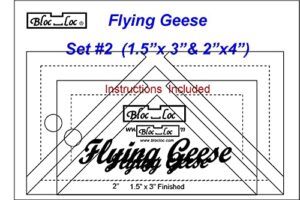
For flying geese blocks, the Bloc Loc FG-SET 2 is worth every penny. That patented groove — the one that locks right onto your seam — keeps the ruler from rocking or sliding while you trim.
Students love how it snaps into place and stays there.
The set covers 1½" × 3" and 2" × 4" finished sizes, which accommodates most classroom projects beautifully. It’s not the cheapest option at $49, but the accuracy it delivers makes re-cutting mistakes practically disappear.
| Best For | Quilters who regularly work with flying geese blocks and want cleaner, faster trimming without the frustration of a slipping ruler. |
|---|---|
| Material | Clear acrylic |
| Origin | United States |
| Seam Allowance | 1/4 in dashed lines |
| Non-Slip Grip | Grip on underside |
| Unit Count | 1 ruler |
| Quilting Use | Blocks and strips |
| Additional Features |
|
- The patented groove locks right onto your seam, so the ruler stays put and your cuts come out accurate every time.
- Trims up to 90% faster than standard flat rulers — a real time-saver when you’re working through a big project.
- Made in the USA from quality acrylic with a bi-color finish that makes markings easy to read.
- At $49, it’s a bigger upfront cost, especially if flying geese aren’t your main pattern.
- Only comes in two sizes, so if you’re working with larger or custom units, you’ll need to look elsewhere.
- The groove is fixed — no adjustable widths — so it’s really built for one specific style of quilting.
3. Creative Grids Six Point Five Quilt Ruler
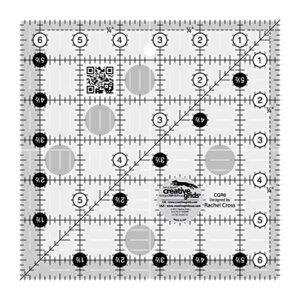
If the Bloc Loc is your precision specialist, think of the Creative Grids CGR6 as your everyday workhorse. This 6½-inch square ruler manages the cuts you reach for constantly — squaring blocks, trimming half-square triangles, checking seam allowances.
The non-slip grip circles lock down when you apply light pressure, so it stays put without a fight. Clear 1/8-inch markings, a built-in 45° diagonal guide, and center lines make it remarkably easy for students to read and use confidently.
| Best For | Quilters and sewists who want a reliable, easy-to-read ruler for everyday cutting, squaring blocks, and trimming seam allowances. |
|---|---|
| Material | Acrylic |
| Origin | United States |
| Seam Allowance | Built into groove |
| Non-Slip Grip | Patented groove |
| Unit Count | 2 rulers |
| Quilting Use | Flying geese |
| Additional Features |
|
- Non-slip grip circles lock fabric in place with light pressure, so your cuts stay accurate without having to hold everything down yourself.
- Clear 1/8-inch markings, a 45° diagonal guide, and center lines make it beginner-friendly and fast to use.
- Lightweight and compact — easy to toss in a bag and take to a class or quilting group.
- Only comes in one size, so you’ll need to buy additional rulers if your projects call for something bigger or smaller.
- Acrylic can crack if dropped, so it needs a little more care than a metal ruler.
- Imperial measurements only — no metric markings, which is a hassle if you prefer centimeters.
4. Creative Grids Acrylic Quilting Ruler
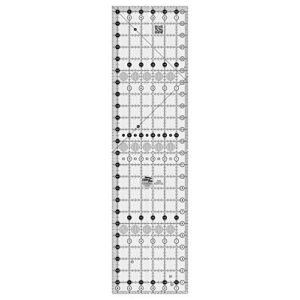
When you need a ruler that does a little of everything, the Creative Grids 6½" × 24½" is hard to beat. It’s built for strip cutting, border trimming, and diagonal work — all in one tool.
The non-slip grip circles hold firm under light pressure, which your students will appreciate the moment they start cutting.
You get 45°, 30°, and 60° angle lines, plus clear 1/8-inch markings.
At $38.99, it earns its spot in every classroom kit.
| Best For | Quilters of all skill levels who want one reliable ruler for strip cutting, borders, and diagonal work — especially helpful for anyone with limited hand strength or dexterity. |
|---|---|
| Material | Acrylic |
| Origin | United States |
| Seam Allowance | 1/4 in dashed lines |
| Non-Slip Grip | Grip circles |
| Unit Count | 1 ruler |
| Quilting Use | Square blocks |
| Additional Features |
|
- Non-slip grip dots keep the ruler steady under light pressure, so your cuts stay accurate without wrestling the tool
- Packed with angle lines (30°, 45°, 60°) and fine 1/8-inch markings, so you rarely need to swap rulers mid-project
- Made in the USA from durable acrylic that holds up to heavy rotary cutter use over time
- At $38.99, it’s a bigger investment than a basic ruler — might be a tough sell for casual hobbyists
- Only comes in one size, so larger quilt projects may still need an additional ruler
- No metric markings, which can be a dealbreaker for quilters who work in centimeters
5. EZ Quilting Angle Acrylic Template
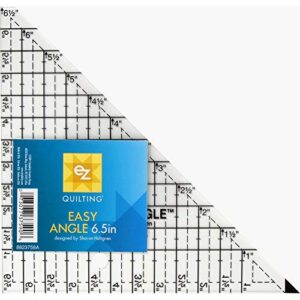
If your students are making half-square triangles, this template earns its place in the kit fast. The EZ Quilting Easy Angle cuts triangles and squares from the same fabric strip — no separate strips, no extra waste.
The built-in ¼-inch seam allowance means beginners don’t have to guess where to sew.
Clear acrylic lets students see the fabric underneath while they cut.
It accommodates sizes from ½ inch up to 6 inches, making it flexible enough for most beginner block projects.
| Best For | Quilters learning to cut accurate triangles — especially beginners working on half-square triangles, flying geese, or other pieced blocks who want a faster, more consistent process. |
|---|---|
| Material | Clear acrylic |
| Origin | United States |
| Seam Allowance | 1/4 in dashed lines |
| Non-Slip Grip | Stabilizing dots |
| Unit Count | 1 ruler |
| Quilting Use | Long strips |
| Additional Features |
|
- Cuts triangles and squares from the same fabric strip, so you’re not wasting extra material
- Built-in ¼-inch seam allowance takes the guesswork out of sewing — great for beginners
- Clear acrylic lets you see exactly where the fabric lines up before you cut
- Acrylic edges can chip if your blade catches a corner, so you have to be a bit careful
- Maxes out at 6.5 inches, so it won’t work if you need larger triangles
- The listed package weight (67.5 lb) is clearly a misprint — don’t let that number throw you off
Classroom Features That Matter
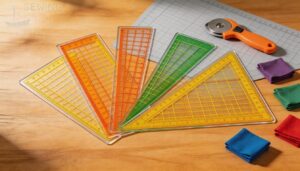
Not every ruler earns a spot in a classroom kit — the ones that do have a few things in common. When you’re teaching a group, small details like grip, markings, and flexibility make a real difference.
Transparent acrylic rulers, for instance, let students see exactly what’s underneath — a small upgrade that makes a big difference when learning basic pattern making techniques.
Here’s what to look for before you buy.
Clear Markings for Faster Student Alignment
Clear markings can make or break a classroom cutting session. When you’re managing twelve enthusiastic quilters at once, a ruler with High Contrast Ink, Dual-Side Numerals, and a Full-Length Scale means everyone aligns faster — no squinting required.
- Shadowed Markings help in mixed lighting conditions
- Tactile Bumps guide visually oriented learners
- Grid lines on clear acrylic support quilt block alignment and precision measurement
Non-slip Surfaces for Safer Cutting
ruler that slides mid-cut is every instructor’s nightmare. That’s why non-slip surfaces matter so much in a shared classroom.
Rubberized vinyl coating and micro-suction microdots grip the fabric without leaving residue, while a silicone underlayer texture adds an extra layer of control.
Look for non-slip grip circles, rubberized grip strips, and a waterproof grip finish — these safety features for rotary cutting keep everyone’s cuts clean.
Angle Guides for Beginner Quilt Blocks
Angle guides are honestly where beginners go from frustrated to confident. When your ruler already shows 45° triangle guidance and 60° lines, you don’t have to draw anything before cutting.
Creative Grids rulers print beginner angle markings on both sides, so angle line clarity stays consistent every pass. The transparent material alignment of Creative Grids rulers also ensures precise fabric alignment for accurate cuts.
EZ Quilting 60-degree triangle ruler keeps angle cut consistency tight, making teaching diagonal angles feel less like guesswork and more like clockwork.
Easy Handling During Group Instruction
Passing a ruler around a group of six students sounds simple — until someone drops it or fumbles the handoff. That’s why ergonomic grips, lightweight frames, and a quick pass design matter more than people think.
Nonslip grip keeps clear acrylic rulers stable mid-cut, while tactile feedback and color-coded zones help every student find the correct hand placement fast, without interrupting your flow.
Multi-use Designs for Repeated Lessons
The best classroom rulers pull double duty — and then some. Look for designs with interchangeable inserts, adjustable measurement wings, and reversible edge markings so one tool covers strip cutting, block squaring, and border work across multiple lessons.
A modular ruler system with customizable corner guides stretches your budget further. Pair that with nonslip grip and clear acrylic, and flexible angle line markers, and you’ve got essential ruler types for beginners handled.
Best Ruler Sizes for Lessons
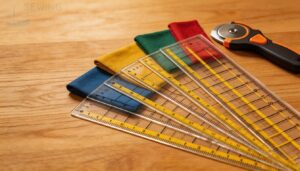
Not every ruler fits every lesson, and size matters more than most beginners expect. The right dimensions can mean the difference between a confident cut and a frustrating one.
Here are the five ruler sizes worth keeping in your classroom toolkit.
Long Rulers for Full-width Strip Cutting
When you’re teaching strip cutting, a long ruler — the classic 6.5 x 24 inch size — becomes your best classroom workhorse. It spans enough fabric for full-width cuts while supporting fabric grain alignment and strip width consistency.
Layered cutting efficiency improves when students don’t reposition mid-cut. Pair it with mat integration techniques and rotary cutter safety habits, and your online quilting classroom lessons run smoother.
Square Rulers for Block Squaring
Once strips are cut, square rulers step in for block squaring.
You’ll want laser-cut squareness and tee grid accuracy to keep edges sharp.
Frosted surfaces reduce glare, while acrylic thickness keeps the ruler steady.
Edge alignment matters, especially with nonslip quilting ruler designs.
Square up rulers for halfsquare triangles are precision measuring tools—perfect for double-checking your students’ work before sewing.
Small Rulers for Desk-side Measuring
Small rulers shine at the desk. The Creative Grids 1½ Inch x 6½ Inch Square Ruler slips right into a pen pot — ready whenever a student needs a quick check.
- Compact Grip Dots and frosted grip circles keep it still during fast measurements
- Student-friendly Markings and Desk-friendly Layouts simplify seam checks without confusion
- Portable Measurement Guides double as Miniature Angle Templates for on-the-spot triangle work
Acrylic rulers for quilting this size are genuinely easy for every hand to control.
Rectangle Rulers for Trimming Practice
Rectangle rulers are where trimming really clicks for students.
A long rectangular ruler — made with acrylic transparency and laser-engraved markings — keeps lines readable, cut after cut. Rubberized backing and solid edge reinforcement mean the ruler stays put while students trim.
UV stabilization keeps those markings sharp over years of classroom use, and the non-slip ruler technology genuinely improves fabric cutting accuracy.
Thick Rulers for Machine Quilting Demos
When you move from cutting demos to machine quilting, ruler thickness really matters.
Machine quilting rulers are generally 1/4-inch thick so the ruler foot clears the edge safely — that’s your Thickness Standards and Foot Clearance check before students ever touch the machine.
Thick ruler builds with Grip Enhancement, keep Ruler Stability consistent, while adaptable angle line markers and non‑slip ruler technology support Angle Precision throughout every demo.
Rulers for Beginner Projects
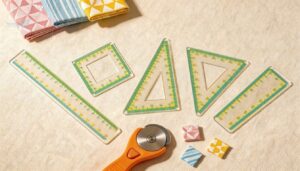
Starting out doesn’t mean starting with complicated projects — the right ruler makes beginner work feel genuinely doable. A few classic techniques show up again and again in first-time quilting classes, and they’re where solid ruler skills really take root.
Here’s a look at the projects your students will tackle most and the ruler moves that make each one work.
Straight Strips and Border Cuts
Nothing trips up beginners faster than wobbly strips and uneven borders.
A long ruler paired with a non‑slip surface gives you Strip Width Consistency and Border Margin Accuracy in one pass. Use Parallel Cutting Guides for Edge‑to‑Edge Alignment, and always check Fabric Grain Alignment before cutting.
That precision turns chaotic first cuts into clean, confident strips that your students will actually be proud of.
Half-square Triangle Trimming
Half-square triangles humble every beginner — and that’s okay. The secret is solid Seam Alignment before you ever make a cut. Your center seam needs to run corner‑to‑corner, and your square‑up ruler’s 45‑degree line is how you confirm that every time.
Every beginner struggles with half-square triangles — your 45-degree ruler line is what makes the seam run true
For reliable Trim Accuracy and Block Consistency, focus on:
- Ruler Positioning: Line up the diagonal guide to the seam first, then square the outer edges
- Two Cut Trimming: Trim two sides, rotate once, trim again — no repeated repositioning needed
- Specialty rulers: Bloc-Loc style rulers lock right onto the seam, so the block can’t shift mid-cut
- Guidelines for selecting quilting rulers: Choose unfinished-size markings that match your pattern’s target block size
Flying Geese Classroom Exercises
Flying Geese blocks are an excellent jumping-off point for Geese Block Sequencing in any quilt workshop.
Start with Batch Cutting Workflow — precut all wing triangles together before sewing begins.
Your 60° angle ruler keeps Angle Ruler Demonstrations clean and consistent.
Build in Student Verbalization Practice so learners call out each seam direction. Use Color Value Planning to show how light goose points pop against darker backgrounds.
Stitch-and-flip Corner Practice
Stitch-and-flip is one of those techniques that looks simple — until a student’s corner comes out crooked. Corner Square Sizing matters here: cut your square a half-inch larger than the finished triangle size.
Stitch Line Accuracy keeps corners landing right, so use the Creative Grids Folded Corner Clipper ruler to skip drawn lines entirely.
Trim Flip Technique, Orientation Consistency, and neon green markings on Omnigrid’s nonslip line all support confident Student Practice.
Bias Binding and Angle Cutting
Bias binding trips up beginners fast — but the right ruler makes it click. The Creative Grids Bias Binding Simplified Ruler covers Bias Binding Basics and Folded Edge Finishing in one tool, while the EZ Quilting 60° Triangle Ruler facilitates 45° Angle Cutting with less guesswork.
- Use Fabric Grain Considerations to cut true bias at 45°
- Apply Template Alignment Tricks for clean strip starts
- Rely on a Non Slip Ruler to hold fabric steady
- Use Adaptable Angle Line Markers 30/45/60 for consistent cuts
- An Angle Line Marker guides repeated diamond and binding angles
Safety Tips for Student Cutting
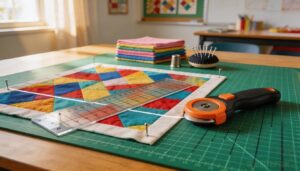
Cutting with a rotary cutter is fast and satisfying, but it only takes one slip to ruin a piece of fabric — or worse, nick a finger.
A few simple habits can make your cutting station a much safer place, whether you’re working solo or managing a whole room of students. Here are five safety tips worth building into every cutting session.
Pair Rulers With Rotary Mats
Every ruler works better when it has the right partner beneath it.
A self‑healing rotary mat gives you Surface Protection for your table while supporting Blade Tracking and Mat‑Ruler Alignment in one setup.
Built‑in angle guides sync with your ruler’s markings — that’s your Angle Guide Sync working.
With Grip Compatibility between a non‑slip ruler and a stable mat, rotary cutting methods for quilting become safer and more consistent for everyone.
Keep Fingers Off Cutting Edges
A mat keeps your cutting area grounded — but your hands need just as much attention.
Hand positioning is everything. Keep your ruler hand flat, pinky along the edge, fingers well back from the blade path. Wrist alignment matters too — a straight wrist gives you better control and less fatigue over long cutting sessions.
- Use Blade Path Awareness before every cut — look where the cutter will travel.
- Finger Guard Usage adds a raised barrier between your fingers and the rotary blade.
- ClipOn Finger Guard options attach directly to your ruler through pre‑drilled holes.
- Safety Shield Integration keeps grid lines visible while blocking the blade from reaching fingertips.
Prevent Slipping With Grip Aids
Once your fingers are positioned safely, keeping the ruler from sliding is the next piece of the puzzle.
Rubberized Edge Strips and Silicone Tactile Coating both grip fabric surprisingly well — some nonslip coating options reduce slipping by up to 40 percent.
Selfadhesive Grip Strips retrofit older rulers instantly.
Micro-Embossed Patterns and Magnetic Alignment Aids add extra stability, and Adjustable Grip Modules let you customize placement for different hand sizes.
Check Ruler Thickness Before Machine Use
Grip aids keep rulers steady on the table — but machine quilting adds another layer to think about: ruler thickness.
standard cutting ruler is 1/8 inch thick. Machine quilting rulers run 1/4 inch. Using the wrong one is a real Thickness Mismatch Risk — thin rulers can slip right under the hopping foot into the needle path.
Before any student starts a machine demo, run a quick Ruler Fit Test:
- Check the shank height first — low shank machines need 3mm rulers
- Do a Foot Gap Measurement: adjust the ruler foot roughly one credit card’s thickness above the fabric
- Confirm Needle Path Safety by sliding the ruler edge against the foot side
- Use Crystal Clear Grip Strips for better visibility during Shank Clearance Checks
- Adjustable angle line markers (30°/45°/60°) should still be readable once the foot is lowered
Re-measure Before Every Cut
Always re-measure before your blade moves. A misread line can shrink a 2½‑inch strip into a 2¼‑inch one — and that small shift causes big headaches at the seam. Build a simple Pre‑Cut Recheck habit into every lesson.
| Step | Action | Why It Matters |
|---|---|---|
| Alignment Confirmation | Match ruler edge to fabric edge | Prevents skewed cuts |
| Precision Verification | Check the exact marking line | Ensures measurement accuracy |
| Consistent Marking | Verify angle or seam guide | Ensures cutting safety |
Comparing Grip and Readability
Not all rulers feel the same in your hands — and in a classroom, that difference really shows up fast. Grip style and marking clarity can make or break a student’s first cutting experience.
Here’s how the top options stack up across both.
Frosted Grips Versus Tacky Coatings
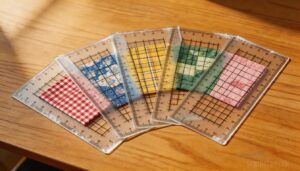
Both options have real strengths worth knowing.
Frosted grips give you consistent tactile feedback and chalk smudge control — they stay cleaner longer and are a breeze for cleaning, simply with just a damp cloth.
Tacky coatings, part of solid non slip ruler technology, grab fabric instantly and reduce fatigue.
For longevity and wear, frosted surfaces resist scratching better, while tacky coatings may need to be renewed over time.
High-contrast Lines for Mixed Fabrics
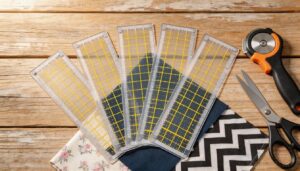
When your class includes a mix of pale prints, rich darks, and busy patterns, ruler visibility becomes everything. Dual-color markings and bright accent lines mean students aren’t squinting or guessing.
Here’s what actually helps:
- Frosted acrylic visibility softens glare without hiding the grid lines beneath.
- Laser-etched inks outlast painted markings under heavy classroom use.
- Color-coded increments let beginners instantly separate ¼-inch from ⅛-inch spacing.
Crystal clear grip strips and nonslip surfaces make every cut more confident.
Dual-side Numbers for Left-handed Use
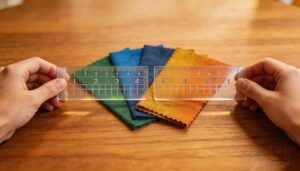
About a third of your students are probably left-handed — and a standard ruler just fights them. That’s where dual-side visibility changes everything.
Mirror numbering lets lefties read measurements without flipping or rotating the ruler.
Bidirectional markings and left-hand alignment built into ergonomic edge designs mean every student cuts with confidence.
Grip strips and nonslip surfaces keep things steady, no matter which hand is leading.
1/8-inch and 1/4-inch Marking Visibility
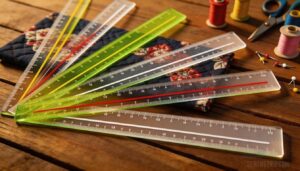
Tiny hash marks can make or break a cutting session. High Contrast Lines help students separate 1/8-inch from 1/4-inch marks at a glance — no squinting required.
Look for Laser Etched Marks that won’t rub off after heavy classroom use, White Dot Numerals that pop on busy prints, and a Frosted Acrylic Edge that cuts glare on dark fabric.
Fluorescent Acrylic rulers add another visibility boost when ruler markings need to stand out fast.
Simple Layouts for New Quilters
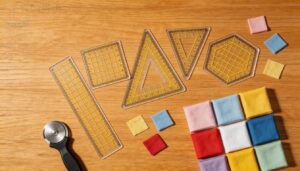
Simple layouts are your best friend when you’re just starting out. Basic Block Grids with Uniform Spacing let students focus on technique, not confusion.
Single Row Layout using a nine-patch or rail fence keeps cutting decisions minimal.
Color Coding to your fabrics, and block placement becomes almost easy to grasp.
Minimalist Design isn’t cutting corners — it’s how beginner quilters build real confidence fast.
Buying for Shared Classrooms
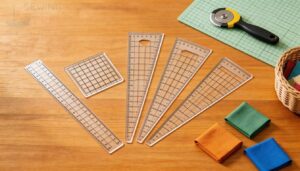
Buying rulers for a shared classroom is a little different from shopping for yourself. You’re thinking about durability, consistency, and keeping costs reasonable without sacrificing quality.
what to look for before you stock up.
Choose Durable Acrylic for Heavy Use
Shared classroom rulers take a beating — and durable acrylic manages it well.
Look for rulers meeting solid Thickness Standards (around 3/16 to 1/4 inch) because thinner ones warp under pressure. Good acrylic also offers:
- Scratch Resistance and Impact Resistance to survive daily drops
- UV Protection against yellowing in sunny rooms
- Longevity Maintenance — just mild soap keeps them clear
Durable acrylic rulers for quilting are worth every penny.
Standardize Sizes Across The Class
Once rulers are built to last, it’s time to think about consistency. A uniform measurement units approach across your shared ruler inventory just makes teaching smoother.
When every student holds the same standard cutting ruler — say, a 6.5" x 24.5" — your classroom size protocol practically runs itself. Consistent ruler sets mean no one’s guessing while you demonstrate.
Essential quilting rulers in matching standard block dimensions keeps everyone cutting confidently together.
Balance Budget With Versatility
Budget and versatility go hand in hand when you’re outfitting a shared space.
Multipurpose Toolkits — rulers with diagonal markings, multipurpose angle line markers for 30°, 45°, and 60° cuts, and Dual-Scale Measurements — replace several single-use tools at once.
Bulk Purchase Savings can reach 22 percent, and Reusable Grip Enhancements extend ruler life noticeably.
Modular Ruler Sets stretch every dollar further without sacrificing lesson flexibility.
Buy Starter Sets Before Specialty Rulers
Adaptable foundations matter more than novelty when you’re starting out. A starter set — usually a 6½" × 24½" rectangle and a 12½" square ruler — covers strip cutting, block squaring, and seam checks before you ever need a specialty tool.
That’s budget prioritization and real learning curve reduction. Choosing essential quilting rulers first means every student builds confidence on the same reliable tools.
Add Grip Strips for Older Rulers
Older rulers don’t have to retire. Grip strip installation takes minutes and gives worn acrylic rulers a second life — no new purchase needed.
- Adhesive types vary; low-residue acrylic bonds well to most ruler material compatibilities
- Clear strips preserve marking visibility while using non-slip grips to prevent ruler slippage
- simple maintenance schedule — inspect every class rotation — keeps built-in grip strips performing
- Cost-benefit analysis favors grip strips over full ruler replacement every time
Choosing The Right Classroom Ruler
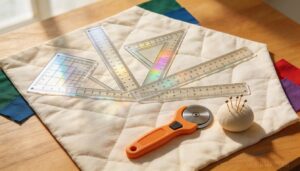
Picking the right ruler for your classroom doesn’t have to be complicated, but a few key factors make all the difference. Think about fabric width, block size, angle lines, ease of handling, and how many tasks one ruler can cover.
Here’s what to look for.
Match Ruler Length to Fabric Width
Getting ruler size right is half the battle. A long rectangular ruler — usually 6" × 24" — is your classroom workhorse for fabric width matching because it spans most fabric in a single pass.
Ruler length selection matters: shorter rulers force mid-cut repositioning, which throws off accuracy quickly.
| Ruler Size | Best Use |
|---|---|
| 6" × 24" | Width-of-fabric strips |
| 6.5" × 24.5" | Fat-quarter cuts |
Choose Square Size by Block Size
Matching your square ruler to your block size makes all the difference. Ruler Size Matching isn’t complicated — you just need a ruler slightly larger than your unfinished block for clean Small Block Control and Large Block Clearance.
- 6.5" square ruler accommodates blocks up to 5.5" finished
- 12.5" square ruler suits 12" Finished Block Margins
- Square-in-Square Sizing starts with a 7" center for a 6.5" finished block
That extra half-inch is your best friend for Ruler selection for quilt block precision.
Prioritize Rulers With Angle Lines
Angle Line Visibility is what separates a helpful classroom ruler from a frustrating one. When your students can spot 45-degree angle and 60-degree angle lines instantly, they spend less time second-guessing and more time cutting.
Flexible angle line markers 30 45 60 support everything from flying geese to angle line marking for diamond shapes.
Good Angle Line Durability means those lines stay crisp through hundreds of classes.
Pick Tools Students Can Control Easily
Control matters more than you’d think. A lightweight construction and balanced weight distribution help students guide an acrylic ruler smoothly without fighting it.
Look for ergonomic shape, finger-safe edges, and a portable carry hole for easy station-to-station transport.
Non-slip grips and adjustable angle line markers 30/45/60 round out the ease of use. Good tool ergonomics quietly build student confidence.
Focus on Rulers With Multiple Uses
One ruler doing three jobs is worth ten single-use tools in a shared classroom.
Creative Grids 6.5" × 24.5" is a great example — it performs strip cutting, flying geese squaring, and half-square triangles with its cross-functional layouts and integrated measurement scales.
Add multi-purpose angle line markers for 30/45/60 cuts, and your students get ease of use, ruler grip, and safety practices when cutting with rotary cutters all in one.
Frequently Asked Questions (FAQs)
How often should classroom quilting rulers be replaced?
There’s no strict timeline — but don’t wait for a ruler to fail mid-lesson. Replace it when edges chip, markings fade, or slippage becomes a safety concern.
Can quilting rulers be shared between different grade levels?
Yes, quilting rulers can absolutely be shared between grade levels.
With a solid ruler rotation schedule, grade-level labeling, and shared inventory tracking, cross-grade durability stays strong and rulers remain accurate for every class.
What storage solutions work best for classroom rulers?
A clear acrylic bin keeps your ruler collection upright and visible.
Pegboard wall systems, rolling carts, drawer dividers, and color-coded bins all support ruler storage, maintenance, and easy access for every student.
Are quilting rulers suitable for left-handed students?
Absolutely — quilting rulers work well for left-handed students.
Creative Grids makes left-handed versions with mirror markings and dominant hand comfort in mind, so angle line visibility stays clear and cutting feels natural without awkward flipping.
How do you clean acrylic rulers after classroom use?
Like a good cutting mat, acrylic rulers last longer with simple care.
Wipe with mild soap, warm water, and a microfiber cloth. Use isopropyl alcohol for stubborn spots. Dry thoroughly before storing.
Conclusion
Equipped with the right tools, your students’ quilting journey unfolds like a perfectly pieced block—each cut precise, each seam purposeful.
When searching for quilting rulers for classroom use, remember that the best ones aren’t just about measurement, but about confidence.
The top 5 rulers I’ve shared offer a blend of safety, clarity, and versatility.
By choosing wisely, you’ll set your students up for success, making every cut a lesson in precision and every stitch a proof of their growing skill.
- https://tidd.ly/4awVm5L
- https://guidelines4quilting.com/pages/make-9-patch-and-16-patch-quilt-blocks-any-size-no-math-finished-size-quilting
- https://www.creativegrids.com/acatalog/info_CGRSAV1.html
- https://www.patch-yard.de/Flying-Geese-Ruler-Set-1
- https://www.redpepperquilts.com/2013/06/flying-geese-and-bloc-loc-rulers.html