This site is supported by our readers. We may earn a commission, at no cost to you, if you purchase through links.
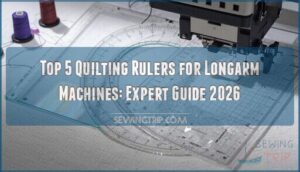
Most longarm quilters discover ruler work the hard way—after their first freehand border waves like a flag in the wind. You deserve better than that.
The right quilting rulers for longarm machines transform shaky attempts into crisp, professional lines, but only if you choose tools that match your machine’s specifications and your skill level. Quarter-inch acrylic thickness matters. Laser-cut edges matter. Non-slip grips that actually grip matter more than you’d think when you’re guiding a ruler through a tight curve at speed.
The five rulers below deliver on all three counts, plus the high-contrast markings and balanced geometry that separate workspace tools from drawer clutter.
Table Of Contents
- Key Takeaways
- Essential Features of Longarm Quilting Rulers
- Types of Quilting Rulers for Longarm Machines
- Setting Up for Longarm Ruler Work
- Top 5 Quilting Rulers for Longarm Machines
- Techniques for Using Quilting Rulers
- Maintenance and Safety Tips for Ruler Quilting
- Frequently Asked Questions (FAQs)
- Conclusion
Key Takeaways
- Quarter-inch acrylic thickness, laser-cut edges, and non-slip grips are non-negotiable features that separate professional-grade longarm rulers from tools that’ll frustrate you mid-project.
- Your longarm setup requires a ruler base, compatible ruler foot, and proper calibration before any ruler work begins—skipping these steps guarantees wandering stitches and damaged rulers.
- Straight edge rulers handle borders and ditch work, curved rulers manage arcs and motifs, and multipurpose templates expand your design range without cluttering your workspace with redundant tools.
- Consistent stitch density comes from matching thread weight to fabric, maintaining stable backing tension, and practicing steady rhythm until hand motion syncs with machine speed.
Essential Features of Longarm Quilting Rulers
Not all longarm quilting rulers are built the same. The right features make the difference between shaky lines and professional results you’re proud to show off.
Investing in quality rulers is one of those gift ideas for quilters that pays off with cleaner edges and faster, more confident stitching.
Here’s what separates beginner frustration from confident quilting.
Importance of ¼-Inch Thickness
Quarter-inch thickness is the benchmark for longarm quilting rulers. This dimension gives you edge stability without excessive weight, so you can reposition rulers quickly during intricate ruler work.
It prevents bending under typical machine speeds, which improves fabric control and quilting accuracy.
Most longarm quilting tools and ruler bases are built around this size, ensuring smooth machine compatibility across brands.
High-Contrast Markings and Laser-Cut Edges
Laser-cut edges deliver burr-free smoothness with tolerances of 0.1 to 0.2 millimeters, so your straight edge rulers glide without snagging fabric or catching on batting layers during ruler work.
High-contrast markings—think matte black on white or tungsten white on dark acrylic rulers—improve marking visibility under varied studio lighting.
Together, laser cutting and contrast optimization give you edge precision and ruler durability that last through thousands of quilting passes.
Non-Slip Grip and Stability
Grip materials matter more than you think. A textured coating or silicone strip along the underside provides traction control that halves slippage when you’re guiding longarm quilting rulers across batting.
Ruler balance and edge geometry work together to prevent tipping on tight curves, while stability features like uniform weight distribution keep your nonslip grip steady through every pass.
Your ruler foot won’t fight wandering rulers.
Built-in Reference Lines and Increments
Reference line clarity starts where grip ends. Longarm quilting rulers etched with half-inch increments nail seam allowances every time, while high-contrast marks stay visible against any fabric.
Increment standards you’ll use most:
- Quarter-inch subdivisions for precision piecing
- One-inch steps for quick border checks
- Decimal marks at 0.125-inch for ditch rulers
Label customization and line style options let you adapt acrylic rulers to your ruler work without guesswork.
Types of Quilting Rulers for Longarm Machines
Your longarm ruler collection needs more than one shape to handle different quilting challenges. Each ruler type fulfills a specific purpose, from mastering straight lines to maneuvering tight curves.
Let’s break down the four essential categories every serious longarm quilter should know.
Straight Edge Rulers
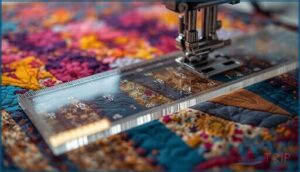
Your longarm quilting success starts with a tool that never bends under pressure. Straight rulers run six to twelve inches long, built from quarter-inch acrylic with laser-cut edges for snag-free edge alignment.
Etched grid markings guide straight stitching and corner squaring with quarter-inch precision. Pair them with your ruler base for rock-solid ditch work and border ruler work that delivers every time.
For more details about ruler compatibility and safety, choosing the correct thickness and pairing it with your machine is essential.
Curved and Arc Rulers

Sweeping arcs and graceful borders demand rulers with multiple radii built in. Curved rulers let you trace complex swoops with arc precision, while circle and oval rulers handle rounded motifs. French curve ruler designs and lotus lines ruler shapes reveal border designs beyond straight lines. Arc templates maintain curve mastery when you need smooth transitions around blocks without measuring every pass.
Ditch Rulers and Stitch-in-the-Ditch Channels
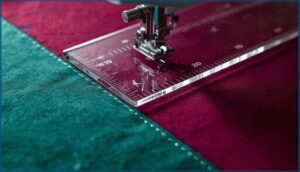
Precision along seam lines starts with ditch rulers built for stitch-in-the-ditch ruler work. These wider tools feature channel guides that keep your needle aligned with seams, eliminating drift and boosting stitch accuracy.
Look for models with registration lines for seam alignment—they simplify ruler calibration and deliver clean ditch quilting without pre-marking. Proper ruler work transforms longarm quilting rulers into essential allies for impeccable SID patterns.
Multipurpose and Shape Rulers
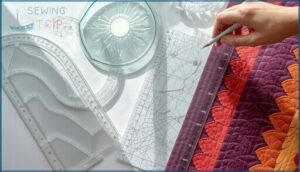
Your creative vision expands when multipurpose rulers bring ruler versatility to every project. These multitasking rulers combine straight edges, shape templates, and curved rulers in one tool, letting you trace feathers, hexagons, and meander motifs without swapping accessories.
Curve mastery and block precision improve instantly. Add a circle and scallop quilting ruler for motif variety, and your longarm quilting rulers deliver professional ruler work across any design challenge.
Setting Up for Longarm Ruler Work
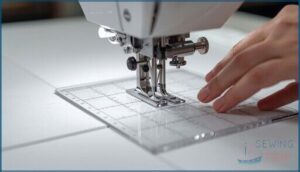
Your longarm machine won’t handle rulers without the right hardware in place. Before you can trace clean lines and sharp angles, you need to prepare your machine for ruler work.
Here’s what you need to set up and why each piece matters.
Installing a Ruler Base
Before you can master ruler work, your machine needs the right foundation. Power off before installing.
Ruler base installation starts by aligning the mounting holes on the base with your machine’s frame, then securing with the supplied screws. Tighten in a crisscross pattern to prevent warping.
Check compatibility with your ruler foot and quilting rulers. Proper base alignment ensures your longarm quilting techniques deliver professional results.
For more information on machine compatibility, see the Little Rebel Ruler Base details.
Calibrating The Longarm Machine
After Ruler Installation, your machine won’t deliver true lines until you complete calibration. Start with Bed Leveling—check that the head and quilting bed sit parallel within 0.010 inches.
Next, run Encoder Calibration by recording a 12-inch travel span and comparing it to spec. Confirm Machine Alignment by zeroing your home position.
Finish with a System Reboot and test your Longarm Quilting Techniques on scrap fabric.
Choosing Compatible Ruler Feet
Once calibration finishes, match your Ruler Foot to your machine’s shank type—low or high. Foot Height must clear your ¼-inch ruler without tilting it.
Check Edge Design for smooth contact and Material Durability; stainless steel outlasts aluminum under heavy Ruler Work.
Verify Shank Compatibility with your manufacturer specs. A secure fit prevents slippage and keeps your Longarm Quilting lines razor sharp.
Must-Have Accessories for Ruler Work
Beyond a compatible Ruler Foot, you need Grip Accessories to lock your Quilting Rulers in place during Longarm Quilting. Stock these essentials:
- Grips or knobs that attach to acrylic for single-hand control
- Edge Guides that align Ditch Rulers with seam lines
- Template Sets for repeatable motifs across blocks
These extras transform shaky Ruler Work into clean, repeatable excellence.
Top 5 Quilting Rulers for Longarm Machines
You’ve got your ruler base installed and your machine calibrated. Now it’s time to stock your workspace with the right tools.
Here are five rulers that’ll give you the control and precision you need to tackle borders, curves, and everything in between.
1. Keepsake Quilting Ditch Ruler
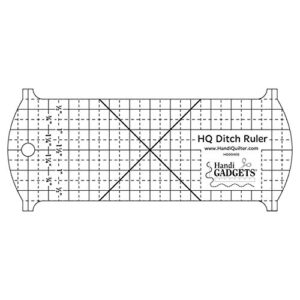
Precision matters when you’re chasing perfect ditch lines. The Keepsake Quilting Ditch Ruler (model HG00405) gives you ¼-inch projections on each end that lock right into seam channels.
At 7 x 3 inches, it’s compact but mighty—black acrylic construction with laser-etched quarter-inch increments keeps your spacing dead-on accurate. Stops at both ends prevent overrun, while the clear material lets you see exactly where your needle’s heading.
Weighs just 4.8 ounces, so your hand won’t fatigue during long sessions.
| Best For | Quilters who need a compact, accurate ruler for ditch stitching and straight-line work on longarm machines. |
|---|---|
| Material | Black Acrylic |
| Weight | 4.8 ounces |
| Thickness | 0.04 inches |
| Brand | Keepsake Quilting |
| Primary Use | Ditch quilting |
| Machine Compatibility | Longarm machines |
| Additional Features |
|
- Quarter-inch projections slide perfectly into seam channels for precise ditch quilting
- Clear acrylic with easy-to-read markings lets you see your fabric and track needle placement
- Built-in stops at both ends prevent stitching past your intended line
- 7-inch length feels too short for some quilters who prefer working with longer rulers
- Compact size may require repositioning more frequently on larger quilt sections
- Thickness can take some getting used to if you’re switching from thinner rulers
2. Missouri Star Quilting Ruler Tool
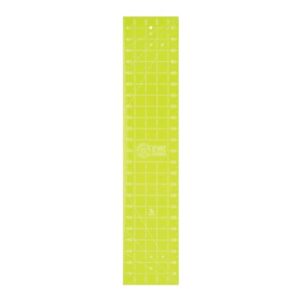
For versatility across yardage and precuts, Missouri Star’s 5 x 24-inch acrylic ruler delivers. Clear green construction with grid lines and measurement markings keeps your cuts visible on any fabric. The 0.118-inch thickness sits right at heavy-duty territory—stable enough for accurate guiding without the bulk.
Laser-cut edges prevent snagging during glide, while beveled non-slip surfaces maintain contact through every pass. At 10.4 ounces, it balances weight with control. Built-in reference lines align perfectly with block borders and stitch patterns.
| Best For | Quilters who work with both yardage and precut fabrics and want a versatile ruler that’s easy to see on any fabric. |
|---|---|
| Material | Acrylic |
| Weight | 10.4 ounces |
| Thickness | 0.118 inches |
| Brand | Missouri Star Quilt Co. |
| Primary Use | Cutting & measuring |
| Machine Compatibility | Quilting & sewing |
| Additional Features |
|
- Clear green acrylic with grid lines gives excellent visibility on light and dark fabrics
- Heavy-duty 0.118-inch thickness provides stability for accurate cutting without feeling bulky
- Laser-cut edges and beveled non-slip surfaces keep the ruler in place during cuts
- Can reflect light in certain angles, which may cause eye strain during long cutting sessions
- Some users report it’s not as good as other rulers from the same brand
- At 24 inches long, it might be too large for smaller cutting mats or tight workspaces
3. Creative Grids Quilting Ruler Tool
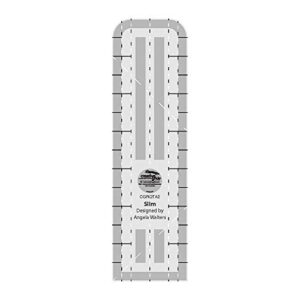
Creative Grids brings you USA-made clarity with their 7 x 2-inch acrylic ruler, purpose-built for longarm work. The ¼-inch thickness matches the standard you need for stability without needle strikes. Black and white dashed guide lines cut through any fabric color—no squinting at markings mid-stitch.
That patented non-slip grip locks when you press down but slides smoothly when you don’t. Curved edges expand your design range beyond straight lines. At 3.2 ounces, it won’t tire your hand during extended sessions.
Perfect for ditch work, echoing, and parallel lines.
| Best For | Quilters who need a reliable ruler for longarm or domestic machines to handle ditch stitching, echo quilting, and creating clean parallel lines without fighting slippery tools. |
|---|---|
| Material | Acrylic |
| Weight | 3.2 ounces |
| Thickness | 0.25 inches |
| Brand | Creative Grids |
| Primary Use | Ruler work quilting |
| Machine Compatibility | Domestic & longarm |
| Additional Features |
|
- Non-slip grip actually works—stays put when you need it, glides when you don’t
- Guide lines show up on light and dark fabrics so you’re not guessing
- Curved edges let you do more than just straight lines
- Sticky backing can peel off with heavy use
- Design options are pretty limited compared to fancier rulers
- Costs more than basic alternatives that do similar work
4. Creative Grids Quilting Template Ruler
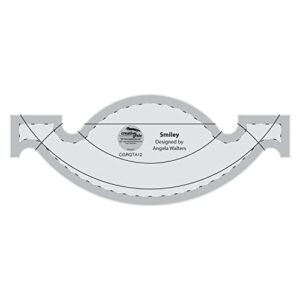
Arc mastery begins with this compact 3 x 7.5-inch template. You get two differently sized arcs on one tool—perfect for cables, curved echoes, and continuous curves without switching gear mid-quilt. The ¼-inch acrylic thickness holds steady against your ruler foot while needle stops mark exact start and finish points.
Black and white dashed lines work on any fabric shade. That signature non-slip grip keeps your arcs smooth without mid-curve shifts. Compatible with high shank domestic machines and most longarms. Simple, focused, reliable.
| Best For | Quilters working with ruler feet on domestic or longarm machines who want to add clean arcs and curves to their designs without constantly switching templates. |
|---|---|
| Material | Acrylic |
| Weight | 2.82 ounces |
| Thickness | 0.25 inches |
| Brand | Creative Grids |
| Primary Use | Arc quilting |
| Machine Compatibility | Domestic & longarm |
| Additional Features |
|
- Two arc sizes on one compact tool give you design flexibility without cluttering your workspace
- Non-slip grip and needle stops help you nail precise curves, especially helpful when you’re stitching continuous patterns
- Dashed guide lines in black and white stay visible whether you’re working on light or dark fabric
- Actual thickness falls short of the advertised ¼ inch according to some users
- Takes practice to get smooth results—not necessarily grab-and-go for beginners
- Only works with high shank machines and most longarms, so check compatibility before buying
5. Handi Quilter Ruler Tool
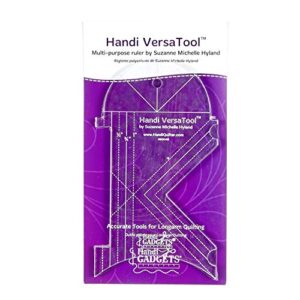
Control meets stability with this multi-purpose HQ ruler. The 1⁄4-inch clear acrylic gives you just enough heft to resist shifting while keeping sightlines open. High-contrast markings show up on any fabric color, and laser-cut edges glide smooth against your ruler base without snagging thread.
Built-in reference lines nail seam allowances every time. Pair it with Handi Grip for rock-solid contact during stationary work—no mid-stitch drift. Compatible with HQ ruler bases and hopping feet. Straight and curved edge options let you switch between grids and arcs seamlessly.
| Best For | Quilters who need precise measurements and stable rulers that won’t shift during intricate piecing or free-motion work. |
|---|---|
| Material | Acrylic |
| Weight | 3.7 ounces |
| Thickness | 0.5 inches |
| Brand | HandiQuilter |
| Primary Use | General measuring |
| Machine Compatibility | Longarm machines |
| Additional Features |
|
- High-contrast markings stay visible on both light and dark fabrics
- 1⁄4-inch acrylic thickness prevents ruler drift without blocking your view
- Laser-cut edges glide smoothly without catching thread or snagging
- Acrylic bubbles can sometimes interfere with reading measurements
- White lines on the underside can be hard to see on certain fabrics
- Quality control inconsistencies may require exchanges or returns
Techniques for Using Quilting Rulers
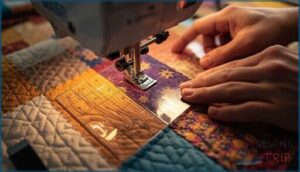
You’ve got the right rulers and your machine is dialed in. Now it’s time to put those tools to work with techniques that actually deliver clean lines and professional results.
Here’s what you need to master for precise, confident ruler quilting.
Achieving Precise Borders and Blocks
Straight rulers turn wonky borders into clean frames. Align your ruler edge with seam lines for edge control that locks in seam accuracy.
Square each corner before you stitch—offset angles show up fast on longarm quilting. Use ditch rulers with built-in channels to follow piecing without wandering.
Consistent pressure and steady speed deliver block precision every pass.
Mastering Curves and Arcs
Smooth curves demand more than steady hands—they require the right setup and rhythm. Arc templates with defined radii give you repeatable geometry, while ruler calibration ensures your needle hits every point precisely.
Master curve work with these essentials:
- Start shallow before attempting sweeping arcs to build stitch control
- Maintain even fabric tension and slow feed rate for wobble-free lines
- Use curved rulers flush against the quilt surface for cleaner arcs
- Practice compound curves by combining arc segments for flowing free motion quilting motifs
Building Confidence With Basic Motifs
Repetition builds mastery faster than complexity ever will. Start with simple shapes—squares, triangles, circles—that align naturally with your quilting rulers and teach your hands controlled motion. Consistent stitch tempo during ruler work reduces size variation by up to 18 percent in twenty-minute sessions, while fabric control prevents shifts and keeps motifs uniform.
| Practice Element | What to Focus On | Why It Matters |
|---|---|---|
| Simple shapes | Squares, triangles, arcs | Predictable alignment with ruler edges |
| Stitch tempo | Even needle speed | Reduces motif variation by 18% |
| Error recovery | Stop, realign, continue | Prevents compounding mistakes |
Draw motifs on scrap fabric before stitching your quilt top—this clarifies motion paths and speeds learning.
When placement errors occur during free-motion quilting or longarm quilting techniques, stop immediately and realign with ruler marks to restore consistency for your next repeat.
Tips for Consistent Stitch Density
Once you nail basic motifs, your next challenge is keeping every stitch the same size across the quilt. Rhythm practice makes the difference—hand motion synced with machine speed eliminates gaps and bunching during ruler work.
Three pillars of stitch control:
- Thread weight and needle selection—match diameter to fabric density for smooth penetration
- Fabric tension—stable backing prevents shifting that creates uneven longarm quilting
- Consistent rhythm—steady pedal pressure keeps spacing uniform along quilting rulers
Maintenance and Safety Tips for Ruler Quilting
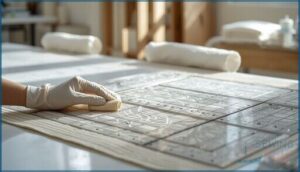
Your rulers work hard, so they deserve proper care and handling. A few smart maintenance habits keep them accurate and your quilting sessions safe from costly mistakes.
Let’s walk through the essentials that protect both your equipment and your finished quilts.
Preventing Ruler Slippage
During ruler work for beginners, slippage kills ruler precision faster than anything else. Apply even downward pressure along the entire ruler length to maintain fabric control, and pair that with friction enhancement accessories like True Grips for Templates and Rulers for instant stability.
Keep your wrist aligned with the ruler and use smooth strokes rather than abrupt taps.
| Grip Solution | How It Works | Best For |
|---|---|---|
| Cork or rubber backing | Creates immediate traction against batting | Straight edge guidance |
| Non slip adhesive tape | Adds tacky surface without residue | Curved quilting rulers |
| Magnetic ruler bases | Pulls ruler down to metal frames | Longarm quilting precision |
| Textured grips | Distributes pressure for steadier control | Extended stitching runs |
Cleaning and Storage Best Practices
A stable grip matters, but proper care locks in your investment for the long haul. Store rulers flat in a dry cabinet between 65 and 75 degrees to prevent warping that kills precision. After each session, wipe acrylic surfaces with a lint-free cloth and mild soap solution to banish fiber buildup and oils.
Five storage moves that protect your quilting rulers:
- Keep humidity between 40 and 50 percent using desiccant packs
- Use drawer dividers to separate straight edge and curved rulers
- Vacuum your storage area weekly for dust control
- Wipe rulers with isopropyl alcohol on microfiber for ruler sanitizing
- Label bins by type and date for quick access
Troubleshooting Common Issues
Even with careful cleaning, your longarm quilting setup will throw curveballs. Slippage prevention starts with checking your ruler base for worn grip pads. If stitches wander off curved rulers, examine foot clearance—you need 1/8 to 3/16 inch gap. Material warping from heat shifts accuracy by 0.5 millimeters over 12 inches.
| Issue | Cause | Fix |
|---|---|---|
| Ruler slippage | Worn grip pads | Replace anti-slip backing |
| Offset stitches | Poor ruler calibration | Test swatch, adjust needle path |
| Edge damage | Chips or nicks | Replace compromised rulers |
Safe Handling During Quilting Sessions
Always stop your needle before repositioning Control Rulers to avoid impact damage. Workspace Safety and Injury Prevention depend on consistent Ruler Safety habits.
Maintain proper Quilting Posture—sit with knees at 90 to 105 degrees and keep shoulders relaxed during Ruler Work and Free Motion Quilting sessions. These Ergonomic Tips protect your back and wrists while improving Quilting Accuracy.
Take five-minute breaks every 45 minutes.
Frequently Asked Questions (FAQs)
What ruler thickness works best for beginners?
You’d think thicker means better, but ¼-inch rulers give beginners the best fabric control and edge guidance.
They balance quilting stability with easy movement—perfect for building free motion quilting confidence.
Can I use regular quilting rulers instead?
You can’t use regular quilting rulers on longarm machines. Regular rulers lack the ¼-inch thickness, anti-slip grip, and compatibility with ruler bases that longarm quilting demands for safe, accurate work.
How do I choose my first ruler set?
Start with one straight edge ruler in 12 or 18 inches, plus a curved template. Many starter kits bundle these essentials around $60, giving you core tools to master ruler work basics.
Whats the difference between acrylic and template materials?
Acrylic offers 92 percent transparency for tracing underneath, laser-cut edges for edge quality, and resists UV damage.
Template materials cost less but wear faster, obscure fabric, and lack the precision longarm quilting demands.
Do all longarm machines accept standard rulers?
Not every longarm machine accepts standard rulers without modifications. Ruler compatibility hinges on dedicated base requirements, foot designs, and calibration tips specific to your model—so verify your machine’s ruler work specifications before investing.
Conclusion
The right tool makes all the difference—and that’s never truer than with quilting rulers for longarm machines. You’ve seen the specs that matter: quarter-inch thickness, laser-cut precision, grips that hold.
Now you choose the ruler that fits your machine and skill level. Install your base, calibrate your foot, and start with straight lines before tackling curves.
Your borders won’t wave anymore. They’ll anchor every quilt you finish.