This site is supported by our readers. We may earn a commission, at no cost to you, if you purchase through links.
Your workspace doesn’t need to swallow half your house just to finish king-sized quilts. A full long arm setup runs $15,000 and demands a dedicated room. That’s a tough pill to swallow when you’re juggling a mortgage and a growing fabric stash.
The good news? You’ve got options that deliver professional results without the financial hangover. Sit-down long arms squeeze into 10 square feet. Mid-arm machines handle ambitious projects along a single wall. Even your trusty domestic machine can tackle bed quilts with the right accessories and a dash of determination.
Each path opens different creative doors while keeping your budget and floor plan intact.
Table Of Contents
Key Takeaways
- You don’t need a $15,000 full longarm machine to finish professional quilts—sit-down longarms, mid-arms, domestic machines with quilting features, DIY frames, and portable frames all deliver quality results at a fraction of the cost and space.
- Sit-down longarms offer 16-22 inches of throat space for $4,500-$8,000 and fit in about 10 square feet, while mid-arms provide 12-18 inches for $3,500-$5,200, giving you professional quilting power without claiming half your house.
- Your regular domestic sewing machine can tackle bed-sized quilts with the right accessories like walking feet, guide bars, and extension tables—stitch quality depends more on tension balance, thread choice, and practice than machine type.
- The machine you’ll actually use beats the “perfect” setup you can’t afford or don’t have room for, so pick an alternative that fits your budget and space, then start building your quilting skills instead of waiting for ideal equipment.
Best Alternatives to Long Arm Quilting Machines
You don’t need to spend thousands on a full longarm machine to finish beautiful quilts. Several smart alternatives give you professional results without the hefty price tag or massive footprint.
Let’s explore five practical options that fit different budgets and spaces.
Sit-Down Long Arm Quilting Machines
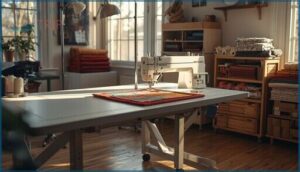
A sit-down longarm quilting machine gives you that professional throat space—around 16 to 22 inches—without claiming half your studio. These machines generally run between $4,500 and $8,000 for complete table-mounted systems. You’ll get speeds up to 2,200 stitches per minute and adjustable-height tables that adapt to your body.
Market analysis indicates a strong 6.2% CAGR from 2026-2033. Market growth reflects increasing demand as quilters discover this sweet spot between domestic machines and full frames.
Mid-Arm Quilting Machines
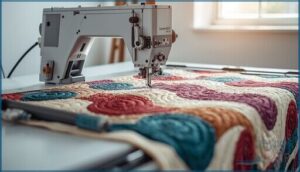
Mid-arm machines offer 12 to 18 inches of throat space, enough room for ambitious projects without swallowing your workspace. You’ll hit 1,800 to 2,000 stitches per minute with built-in stitch regulation that smooths out your free motion quilting. These systems cost around $3,500 to $5,200 with compact frames. The larger bobbin size means fewer interruptions.
For those wanting more control, the Q’nique 15M offers manual speed control. It’s a smart step up from domestic machine quilting when you’re ready to expand your quilting skills and techniques.
Domestic Sewing Machines With Quilting Features
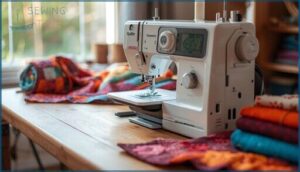
Your regular sewing machine can tackle quilt projects with the right accessories. Look for these features to support domestic machine quilting:
- Built-in stitches offering 100-300 options including straight stitches at 2.5mm for piecing
- Walking feet that synchronize top and bottom fabric layers through multiple thicknesses
- Guide bars that maintain consistent spacing between quilting lines without marking
Machine stability matters—heavier models around 30 pounds reduce vibration during free motion quilting while handling fabric layers smoothly.
DIY Quilting Table and Frame Setups
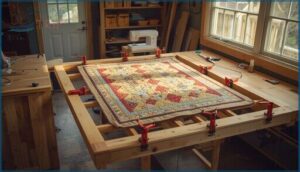
Building your own quilting table can mimic a sit-down longarm experience for under 250 USD in materials. A 120-inch DIY frame using dimensional lumber spans two desks and holds bed-sized quilts.
Position the front rail at belly-button height—around 90 degrees at your elbows—to reduce shoulder strain during free motion quilting. These homemade setups work with most domestic machines once you drop the feed dogs.
Portable Quilting Frames
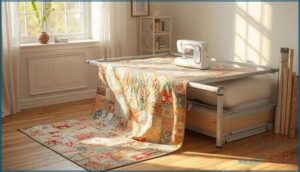
Portable quilting frames fold flat when you’re done and cost around 1,000 USD. The Grace Cutie spans 42 inches and stores under your bed. You’ll quilt in sections—advance the quilt as you finish each pass. These frames work with domestic machines that have 9- to 19-inch throats. Assembly takes under an hour with basic tools.
Comparing Quilting Results and Techniques
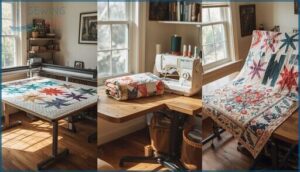
Each quilting setup delivers different results depending on your project and skill level. The machine you choose affects stitch quality, how easily you can handle large quilts, and what techniques you can master.
Let’s compare how these alternatives stack up in real-world quilting scenarios.
Stitch Quality and Consistency
When you aim for 10 to 12 stitches per inch, tension balance and thread quality matter more than machine type. Needle choice paired with proper fabric support reduces skipped stitches.
Machine maintenance keeps timing accurate. Practice quilting techniques on scraps to improve your quilting skills and techniques. Clean your hook area often.
These quilting tips improve machine quilting results on any setup.
Free Motion Quilting Capabilities
Free motion quilting opens creative doors whether you use a domestic machine or portable frame. About 70% of modern machines let you drop feed dogs for true freehand motifs. Quilting videos and training methods build your confidence through practice sandwiches.
Key techniques include:
- Speed control to match hand movement and prevent long stitches
- Stitch regulation for consistent lengths on DIY frames
- Design variety from loops to stipples for machine quilting mastery
Ease of Handling Large Quilts
Wrestling a king-size quilt through a narrow throat feels like threading an elephant. Throat depth of 18–26 inches cuts fabric drag by half compared to standard 8-inch harps.
Wrestling a king-size quilt through a narrow throat feels like threading an elephant
Frame tension bears quilt weight on rollers so your arms stay free. Extension tables and ergonomic aids reduce shoulder strain when making quilts on domestic setups.
Smart quilting techniques and tips transform handling from workout to workflow.
Versatility for Various Quilting Patterns
Pattern complexity isn’t limited by machine type. Computerized domestic machines pack 100–800 built-in stitches. Mid-arm setups handle pantographs and dense stippling with stitch regulation that keeps every motif crisp.
Template usage and quilting ruler work enable feathers and geometric designs on any throat size.
Free-motion options shine when you pair the right accessories with solid quilting techniques and tips from proven quilting patterns and tutorials.
Cost and Space Considerations
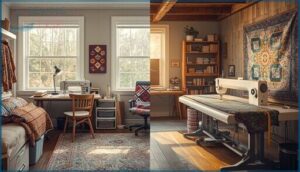
Your budget and workspace will shape which alternative fits your quilting life. A domestic machine might cost a few hundred dollars and tuck into a corner, while a sit-down longarm can run several thousand and needs dedicated real estate.
Let’s break down what each option demands from your wallet and your sewing room so you can make a choice that works for you.
Price Comparison of Alternatives
Your wallet will thank you when you skip the stand-up longarm. New domestic machines with quilting features start under $1,000, while mid-arm systems generally run $4,000 to $10,000. Used machine costs drop considerably—expect $2,200 to $4,800 for pre-owned sit-downs. DIY frame pricing stays below $1,000.
Compare longarm ownership costs of $10,000-plus against these budget-friendly quilting tools and equipment that still deliver professional machine quilting results.
Space Requirements for Each Option
Once you’ve settled your budget, think about where each option will live in your home. A domestic machine on a 2 by 4 foot table fits into most 10 by 10 foot spaces with room to spare for storage. Mid-arm frames need 12 to 14 feet along one wall. Sit-down longarms occupy roughly 10 square feet before you add chair clearance.
Consider these footprint comparisons:
- Domestic machines claim under 8 square feet
- Tabletop frames like the Cutie Breeze need about 10 square feet
- Sit-down longarms require 16 square feet with chair space
- Mid-arm frames demand 12-foot wall lengths minimum
- DIY tables work along standard 8 to 10 foot walls
Room layout affects your quilting projects and workflow more than price alone.
Portability and Storage Solutions
Beyond square footage, think about how you’ll tuck your setup away between quilting projects. Folding sewing tables and hoop frame storage let you reclaim multipurpose rooms fast. Extension table removal turns your domestic machine back into a compact unit. Sit-down portability means rolling your setup into a corner. Modular frame lengths give you options for sewing projects and quilting workshops without permanent commitment.
Long-Term Investment Value
Your quilting setup holds value years later. Professional long-arm systems keep strong resale potential—trade-in value often hits four to seven thousand dollars.
Domestic machines depreciate slower through lighter use, stretching their lifespan comparison across decades. A modest maintenance budget of around $175 yearly preserves performance.
Investing in quality quilting tools and equipment plus ongoing quilting education through workshops sharpens your quilting techniques while protecting your initial spend.
Ergonomics and User Experience
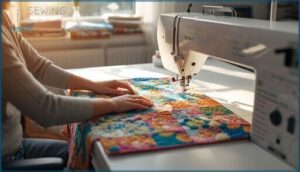
Your body will tell you when a quilting setup isn’t working. Some machines ask you to wrestle heavy quilts through tight spaces while others let you glide along with ease.
Let’s look at how each alternative feels to use and what you can do to keep your back and shoulders happy.
Physical Demands of Each Setup
Each quilting setup creates different physical demands. Your posture impacts back and neck strain, while workstation height affects shoulder elevation. Muscle fatigue builds with repetitive strain during machine quilting sessions.
Key physical demands across setups:
- Domestic machines require pushing heavy quilts through limited throat space, increasing upper body fatigue during free motion quilting.
- Sit-down long arms reduce bulk handling but maintain seated stances that strain your lower back.
- Frame systems transfer weight to stands, lowering continuous grip forces during quilting techniques.
Ergonomic Aids for Comfortable Quilting
Comfort starts with seating adjustments. Set your table at 29 to 30 inches so your elbows bend at 90 degrees during sewing techniques. Add posture assistance with a chair that holds your lower back.
Use anti-fatigue mats when standing at your cutting station. Adjust lighting solutions to 500 lux over your needle area.
Wrist braces help during free motion quilting techniques when kept neutral and straight.
Accessibility for Beginners and Hobbyists
When you’re just starting out, a domestic machine removes every barrier. You don’t need a dedicated studio or thousands of dollars to build quilting skills and techniques.
Here’s what makes alternatives beginner-friendly:
- Skill development happens faster with simplified controls and 15 to 30 built-in stitches
- Learning curve flattens with free quilting tutorial videos and online classes
- Physical limitations vanish when you can sit comfortably instead of standing for hours
- Community support thrives around domestic setups through local shops and forums
Maintenance and Ease of Use
You’ll find domestic machines ask the least of you. Remove lint every 8 to 10 hours and add oil every full day of use. That simple cleaning frequency and oiling schedule keep repair costs down and extend time between pro visits by 6 to 12 months.
Most quilters master setup time and basic maintenance tasks within their first 10 to 20 projects—a gentle learning curve that lets you focus on building quilting skills instead of wrestling with equipment.
Top Quilting Tools for Alternative Setups
The right tools can transform your alternative quilting setup from frustrating to fun. You don’t need to spend thousands on a longarm to create professional results.
Here are three game-changing tools that make free motion quilting easier on any machine you already own.
1. Supreme Slider Free Motion Quilting Mat

Your domestic machine can become a free motion quilting powerhouse with the right tools. The Premium Slider features a Teflon surface that lets fabric glide effortlessly during machine quilting. Its tacky backing grips your sewing surface without residue.
You get trimming options to fit any setup. This mat works with most quilting tools and equipment. Maintenance tips are simple: wipe clean and store flat.
At under $30, it transforms how you approach quilting techniques and sewing techniques and tips. Machine compatibility is excellent across brands.
Best For: Quilters using domestic sewing machines who want smoother fabric movement during free-motion quilting without dealing with drag or jerky stitches.
- The Teflon surface creates a low-friction glide that makes free-motion quilting noticeably easier, especially for complex patterns like stippling or feathers.
- Reusable tacky backing sticks to your machine bed without tape or mess, and you can lift it off and reattach it across multiple projects.
- You can trim it to fit your specific machine setup, and at around $30, it’s an affordable upgrade compared to specialized quilting equipment.
- Some users report the size runs smaller than expected, particularly the standard version at about 8 by 11.75 inches.
- Mixed feedback on value—a few quilters feel it’s overpriced for what amounts to a Teflon sheet with sticky backing.
- The tacky backing needs occasional cleaning to maintain grip, and the mat can arrive damaged or used according to some customer reports.
2. Stipples Made Easy Quilting Pattern
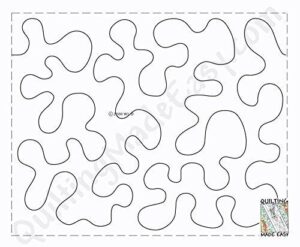
Printed quilting patterns take the guesswork out of free motion work. Stipples Made Easy delivers 26 feet of continuous stipple design on a 9.5-inch wide roll. You apply the pattern with repositionable adhesive strips and stitch through the paper.
Coverage calculations help you plan yardage before buying. Paper removal difficulty and pattern adhesion issues can slow your workflow. Dark fabric usage shows leftover paper lint.
Cost-effectiveness depends on project frequency. These quilting patterns build your machine quilting skills while tackling quilting projects without expensive equipment.
Best For: Beginner to intermediate quilters who want to practice free-motion stippling on their domestic or longarm machine without the stress of planning their own path.
- Gives you 26 feet of continuous pattern per roll, enough to cover lap quilts or sections of larger projects without piecing together multiple sheets
- Takes the guesswork out of spacing and direction since you just follow the preprinted line, making it easier to get consistent results
- Works as either a one-time tear-away or a reusable pantograph, so you can adapt it to different quilting setups and skill levels
- Removing the paper after stitching takes time and can pull up threads if you’re not careful, adding extra work to your finishing process
- Leaves behind paper lint that shows up on dark fabrics, limiting your fabric choices or requiring extra cleanup
- Gets expensive if you quilt frequently, since larger quilts need multiple rolls and the cost adds up quickly
3. BLACK DECKER BullsEye Auto Leveling Laser
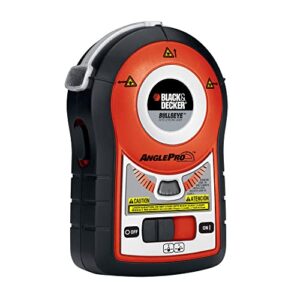
Straight lines transform chaos into order on your design wall. The BLACK+DECKER BullsEye Auto Leveling Laser projects laser alignment accuracy across 100 feet of workspace.
You mount it hands-free on walls or metal surfaces while positioning quilt blocks. This visual reference tool squares borders and aligns sashing strips without manual adjustment.
Consumer-grade precision suits fabric alignment guide tasks in quilting layout applications. It won’t replace your ruler for cutting but helps verify block placement before stitching.
Cost runs under $50. Your quilting tools and equipment collection gains a layout helper for sewing techniques and tips.
Best For: Quilters who need a quick visual guide for aligning blocks and borders on design walls or long work surfaces without fussing with bubble levels.
- Projects laser lines up to 100 feet so you can align multiple quilt blocks or long borders across your entire workspace in one go.
- Auto-levels itself within seconds and mounts hands-free on walls or metal surfaces, leaving both hands free to adjust fabric.
- Costs under $50, making it an affordable layout helper that saves time squaring up quilt tops before you stitch.
- Accuracy varies between 0-1% off level in real-world use, so it’s fine for fabric placement but not precise enough for cutting measurements.
- The angle feature lacks degree markings, which some users find frustrating when trying to set specific sloped lines.
- Doesn’t work well outdoors or in very bright rooms where the laser line becomes hard to see.
Frequently Asked Questions (FAQs)
How do professional quilters finish edges on alternatives?
Professional quilters rely on binding techniques like double-fold binding with walking feet for edge durability. Faced edges create gallery-style finishes.
Decorative trims add flair.
Machine stitching with zigzag utility stitches distributes thread effectively across layers.
What thread weight works best for domestic machines?
Think of thread weight as your fabric’s dance partner—50 wt cotton is your reliable lead for machine quilting. This needle size pairing creates balanced tension.
Fiber type choice matters, and decorative thread weights showcase free motion sewing techniques.
How often should I service my alternative quilting setup?
Your machine needs professional servicing once a year with light use. Heavy daily sewing shortens intervals to 3-6 months.
Clean lint after every project and oil every 8-10 hours of quilting.
Conclusion
Here’s the truth most quilters discover too late: the perfect machine matters far less than the one you’ll actually use.
A quilting sewing machine long arm alternative that fits your space and budget beats a dormant $15,000 monster every single time.
Your next heirloom quilt is waiting. It doesn’t care whether you stitch it on a sit-down long arm or your grandmother’s domestic machine. Pick your path and start quilting.
- https://marketintelo.com/report/quilting-machine-market
- https://www.linkedin.com/pulse/exploring-long-arm-quilting-machine-lcuie
- https://graceframe.com/en/resources/blog/choosing-the-sewing-machine-with-the-correct-throat-length
- https://www.youtube.com/watch?v=AoNdSWJeyYE
- https://www.craftsy.com/post/mid-arm-quilting-machines