This site is supported by our readers. We may earn a commission, at no cost to you, if you purchase through links.
Long-arm quilting machines are the preferred choice for finishing bed-sized quilts, but at $5,000 to $15,000 and requiring a dedicated room, most quilters never get one. That gap between wanting professional results and owning a long-arm has quietly driven an entire ecosystem of alternatives—each solving the problem differently.
Mid-arm machines shrink the footprint without sacrificing much throat space. Domestic machines paired with the right frame punch well above their weight class. And for some projects, a professional quilting-by-check service costs less than a single machine payment.
Eight machines and five setup styles are worth a closer look before you decide.
Table Of Contents
- Key Takeaways
- Best Long-Arm Alternatives
- Top 8 Quilting Machines
- 1. Juki Computerized Sewing Machine
- 2. Brother PQ1600S Sewing and Quilting Machine
- 3. Singer Quantum Stylist 9960 Sewing Machine
- 4. Brother XR3774 Sewing Quilting Machine
- 5. Brother HC1850 Sewing and Quilting Machine
- 6. Juki TL2000Qi Sewing Quilting Machine
- 7. Janome MC6650 Sewing Quilting Machine
- 8. Bernette B77 Sewing Quilting Machine
- Compare Size, Space, and Cost
- Stitch Quality and Speed
- Choose The Right Quilting Setup
- Frequently Asked Questions (FAQs)
- Conclusion
Key Takeaways
- mid-arm machines with 18–24 inches of throat space are the sweet spot for finishing large quilts at home without the $10,000+ price tag or a dedicated studio that a true long‑arm demands.
- Your floor space decides your setup before your budget does — a sit‑down frame needs 6×8 ft, while a domestic machine fits comfortably in 5×8 ft, so measure first and shop second.
- Speed and stitches aren’t the whole story: tension control, feed dog precision, and the right presser foot determine whether your finished quilt looks polished or puckered.
- When equipment, space, or time falls short, quilting‑by‑check services fill the gap cleanly — expect to pay $0.02–$0.08 per square inch for professional edge‑to‑edge results without owning a single frame.
Best Long-Arm Alternatives
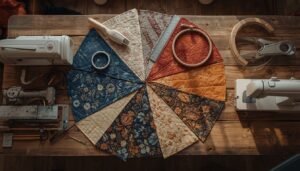
You don’t need a $10,000 long-arm setup to finish a beautiful quilt. Plenty of practical alternatives can handle large projects without dedicated studio space or a steep price tag.
With the right approach, quilting a full-size project on a regular sewing machine is more doable than most beginners expect.
You don’t need a $10,000 long-arm setup to finish a beautiful quilt
Here are six worth knowing about.
Mid-arm Quilting Machines
Mid-arm quilting machines hit a sweet spot most quilters don’t expect.
With throat spaces reaching 18–24 inches, you’re handling full-size quilts without constant repositioning.
The larger M-size bobbin capacity means fewer interruptions mid-project, and ergonomic controls with digital displays keep fatigue low during long sessions.
Noise reduction from belt-drive systems makes them pleasant to use.
The machine also offers an extended work area for larger quilt blocks.
- Extended throat space for wide quilt coverage
- Adjustable stitch regulation for consistent, even stitching
- Solid upgrade options as your skills grow
Domestic Sewing Machines for Quilting
Domestic sewing machines punch above their weight for home quilting. Most offer 9–12 inches of throat space, solid stitch quality, and built-in thread cutters that save time mid-project.
They’re budget-friendly, lightweight, and easy to store — portable power without a dedicated room. Good fabric feeding systems and ergonomic seating setups reduce fatigue, and noise reduction makes long sessions surprisingly manageable.
Sit-down Quilting Frame Setups
Sit-down quilting frame setups take things a step further than your standard domestic machine arrangement.
Picture a large frame with ball bearing guides, fabric tension clamps, and adjustable rail systems — your machine stays put while the quilt glides smoothly underneath.
Customizable frame width and portable storage solution options keep workspace requirements manageable, and entry-level kits start around $150, making these genuinely budget-friendly.
Hand Quilting for Large Projects
Hand quilting skips throat space concerns entirely — your hoop or frame becomes the large workspace, and quilt size selection is limited only by your patience.
- Large Needle Choice: Size 8 Perle cotton creates bold, fast stitches
- Hoop Frame Stability: Tension clamps keep layers flat as you work outward
- Thread Organization plus Rest Break Strategies and Ergonomic Seating prevent fatigue during long sessions
Budget-friendly and surprisingly effective.
Quilting-by-check Services
Quilting-by-check Services let you skip the equipment entirely — you send your quilt top to professional quilters who handle the stitching for you. Pricing Models usually run $0.02–$0.08 per square inch, with flat-rate packages for standard sizes.
A solid Design Library, clear Turnaround Times, and built-in Quality Assurance make this a smart fix for cost and space considerations for quilting equipment.
DIY Quilting Table and Frame Setups
If you’d rather build than buy, a DIY quilting table gives you surprising control over size and frame without the long-arm price tag. Plywood tops run 4–6 feet, with adjustable height set between 28–30 inches.
wood vs PVC rails based on your budget — both support solid tension clamp design. Add portable casters and surface finishing options to suit your home studio space.
Top 8 Quilting Machines
Not every quilter needs a long-arm machine to get great results. The right domestic or mid-arm machine can handle more than you’d expect, especially when you know what to look for.
Here are eight quilting machines worth your attention.
1. Juki Computerized Sewing Machine
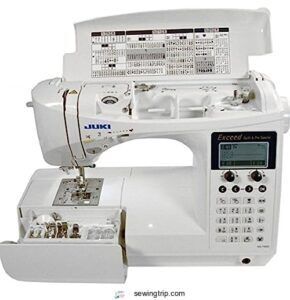
The Juki Computerized Sewing Machine punches well above its $1,499 price tag. It gives you 255 built-in stitches, dual LED lighting, and an automatic thread cutter — features you’d expect on machines costing twice as much.
The independent bobbin winder keeps you stitching without stopping, and the free-motion quilting foot manages large projects surprisingly well.
At 30 lb with a metal frame, it’s sturdy but not portable.
Beginners appreciate the LCD guidance; experienced quilters will love the precision.
| Best For | Home sewists and quilters — from curious beginners to seasoned pros — who want a reliable, feature-rich machine for garments, quilts, and everything in between. |
|---|---|
| Price | $1,499.00 |
| Weight | 30 lb |
| Auto Needle Threader | Yes |
| Auto Thread Cutter | Yes |
| LED Work Light | 2 LED lights |
| Extension Table | Yes |
| Additional Features |
|
- 255 stitches, dual LEDs, and an auto-threader make everyday sewing faster and easier
- The independent bobbin winder keeps you going without interrupting your work
- Solid metal frame and quiet motor hold up well in a home workshop setting
- At 30 lb, it’s not going anywhere — you’ll need a permanent spot for it
- Struggles with heavy fabrics like thick denim, and some users report durability hiccups after months of use
- No touchscreen or embroidery functions, and the presser-foot lift doesn’t lock on thick layers
2. Brother PQ1600S Sewing and Quilting Machine
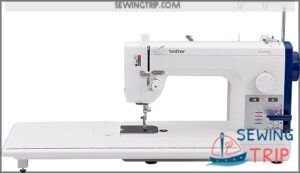
The Brother PQ1600S is built like a workhorse — and priced like one too, at $999.99. It tops out at 1,500 stitches per minute, which is serious speed for a domestic machine.
The extra-large extension table (11.1 × 23.3 inches) gives you real breathing room for big quilts, and the knee lifter keeps both hands free where they belong — on the fabric.
The pin-feed manages multiple layers cleanly, though the side-loading bobbin offers no visual run-out indicator, so listen for the cues.
| Best For | Serious quilters and experienced sewists who need near-industrial speed and a large workspace without stepping up to a full commercial machine. |
|---|---|
| Price | $999.99 |
| Weight | 24 lb |
| Auto Needle Threader | Yes |
| Auto Thread Cutter | Yes |
| LED Work Light | Yes |
| Extension Table | 11.1×23.3 in |
| Additional Features |
|
- Blazing 1,500 spm speed with a massive extension table — great for big quilts and long runs of fabric
- Knee lifter, push-button thread cutter, and dual-cone thread stand all work together to keep your hands free and your workflow moving
- Adjustable pin-feed and four feed-dog settings handle everything from sheer delicates to thick multi-layer projects
- No visual bobbin run-out indicator on the side-loading case — you’re listening for the sign, not seeing it
- The automatic needle threader can be finicky, especially with cheaper or bulk thread
- Loud at high speeds, and the pin-feed mechanism has a history of wearing out under heavy use
3. Singer Quantum Stylist 9960 Sewing Machine
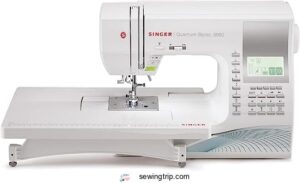
The Singer Quantum Stylist 9960 punches well above its weight class. You get 600 built-in stitches, 13 automatic buttonhole styles, and a bright LED work area — all on a metal frame that holds steady through heavy layers.
The extension table adds real workspace for maneuvering quilt sandwiches, and the needle-up/down function makes free-motion work far less frustrating.
Just know the throat space is modest, so very large quilts will need some repositioning.
Solid value for a serious hobbyist.
| Best For | Serious hobbyists and intermediate sewers who want a feature-packed machine for garment construction, quilting, and home décor without jumping to an industrial setup. |
|---|---|
| Price | Not listed |
| Weight | 14.6 lb |
| Auto Needle Threader | Yes |
| Auto Thread Cutter | Yes |
| LED Work Light | Yes |
| Extension Table | Yes |
| Additional Features |
|
- 600 built-in stitches and 13 automatic buttonhole styles give you serious creative range without swapping machines.
- Handles heavy, multi-layer fabrics (think 8 layer rag quilts) without skipping a beat.
- The auto needle threader, thread trimmer, and extension table make long sewing sessions a lot less tedious.
- The throat space is on the smaller side, so large quilt projects will have you repositioning fabric more than you’d like.
- Beginners may feel overwhelmed — 600 stitches and a tension screw on the bottom isn’t the most welcoming setup.
- At nearly 15 pounds, it’s not something you’ll want to haul to a sewing class regularly.
4. Brother XR3774 Sewing Quilting Machine
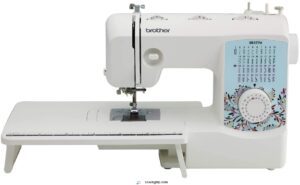
If you’re just starting out, the XR3774 gives you a real quilting machine without the real-machine price tag.
It runs 37 built-in stitches, drops a jam-resistant bobbin in from the top, and threads itself automatically — so you spend less time fussing and more time stitching.
The wide extension table helps manage quilt layers, and the free arm manages cuffs and curves easily.
At 15 lb, it’s portable enough to pack up when your sewing room doubles as a guest room.
| Best For | Beginners and hobbyists who want a capable quilting machine with smart features like auto-threading and a drop-in bobbin — without spending big. |
|---|---|
| Price | Not listed |
| Weight | 15 lb |
| Auto Needle Threader | Yes |
| Auto Thread Cutter | No |
| LED Work Light | Not specified |
| Extension Table | Yes |
| Additional Features |
|
- 37 built-in stitches plus a 1-step buttonhole cover a wide range of projects, from garments to simple quilts.
- The automatic needle threader and jam-resistant bobbin system make setup quick and frustration-free.
- The free arm and wide extension table make it easy to handle cuffs, sleeves, and larger quilt layers.
- Gets noisy and vibrates noticeably at higher speeds or with heavier fabrics.
- Struggles with very thick materials like plush fleece, minky, or heavy upholstery.
- The extension table can loosen under big, heavy projects — a non-slip mat is a smart add-on.
5. Brother HC1850 Sewing and Quilting Machine
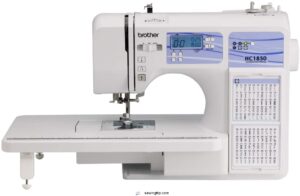
Step up in stitch count, and the HC1850 starts making sense. Where the XR3774 gives you 37 stitches, this machine hands you 185 — including 55 alphanumeric options for basic monogramming.
At $299.99, it punches well above its price. The detachable wide table and spring-action quilting foot handle free‑motion work without complaint, and 850 stitches per minute keeps projects moving.
Automatic needle threading, a drop‑in bobbin, and a 25‑year warranty round out a solid package for dedicated hobby quilters.
| Best For | Hobby quilters and home sewists who want a versatile, feature-packed machine without jumping to an industrial price tag. |
|---|---|
| Price | $299.99 |
| Weight | 10.1 lb |
| Auto Needle Threader | Yes |
| Auto Thread Cutter | No |
| LED Work Light | Yes |
| Extension Table | Yes |
| Additional Features |
|
- 185 stitches (including alphanumeric options) gives you serious creative range for quilting, garments, and basic monogramming
- Automatic needle threader and drop-in bobbin make setup quick and frustration-free
- Detachable wide table and free-motion quilting capability are included — no extra purchases needed for most hobby projects
- US-only (120V), so using it abroad voids the warranty
- Not built for heavy-duty work — thick or multi-layer fabrics can push it to its limits
- The edge-hemming foot isn’t included and has to be bought separately
6. Juki TL2000Qi Sewing Quilting Machine
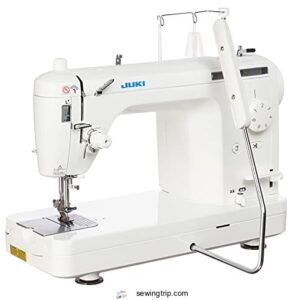
Speed jumps to a whole new level with the Juki TL2000Qi.
This machine hits 1,500 stitches per minute — nearly double the HC1850 — and limits itself to straight stitch only.
No decorative options, just raw quilting power.
The aluminum die-cast frame keeps vibration low across king-size projects, and the included extension table gives you real room to work.
Built-in LED lighting, an automatic needle threader, and a walking foot make it a genuine workhorse for serious quilters who value consistency over versatility.
| Best For | Serious quilters and heavy-duty sewers who want pure speed and stability for large projects like king-size quilts, bags, or thick materials — and don’t need decorative stitches. |
|---|---|
| Price | Not listed |
| Weight | 25.4 lb |
| Auto Needle Threader | Yes |
| Auto Thread Cutter | Yes |
| LED Work Light | Yes |
| Extension Table | Yes |
| Additional Features |
|
- Blazing 1,500 SPM straight-stitch speed with low vibration thanks to the aluminum die-cast frame
- Comes ready to work with an extension table, walking foot, and built-in LED lighting
- Handles tough fabrics like canvas, leather, and thick batting without breaking a sweat
- Straight stitch only — no decorative stitches, buttonholes, or zigzag
- No built-in speed control, so beginners may find it hard to manage at full throttle
- Needs a voltage converter for 220V regions, and key accessories like the free-motion foot cost extra
7. Janome MC6650 Sewing Quilting Machine
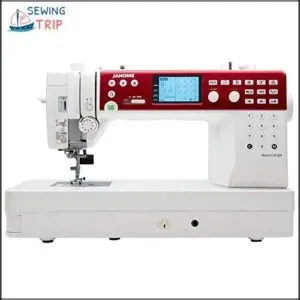
Where the TL2000Qi goes full throttle, the Janome MC6650 takes a more balanced approach.
You get a 10-inch throat space — solid for quilting blocks and mid-size projects — paired with 172 built-in stitches and a 3.6-inch LCD screen that makes navigation straightforward.
The all-metal flatbed manages heavy layers without flexing, and six LED lights keep your work area bright.
At $2,099, it sits firmly in the mid-range, offering real versatility for quilters who won’t compromise on build quality.
| Best For | Quilters and home sewists who want a heavy-duty, feature-rich machine that can handle everything from thick fabrics to decorative stitching without sacrificing ease of use. |
|---|---|
| Price | $2,099.00 |
| Weight | 24.25 lb |
| Auto Needle Threader | Yes |
| Auto Thread Cutter | Yes |
| LED Work Light | 6 LEDs |
| Extension Table | Yes |
| Additional Features |
|
- That 10-inch throat gives you real room to maneuver big quilt blocks and layered projects.
- 172 stitches plus memory banks mean you can get creative and save your favorite settings for later.
- Built solid — the all-metal flatbed handles heavy fabric without wobbling or flexing under pressure.
- At $2,099, it’s a serious investment that’ll give budget shoppers pause.
- Coming in at 24 lbs, it’s not something you’ll be hauling to a sewing class easily.
- Some users have reported thread cutter hiccups and stitch skipping, and the manual doesn’t make troubleshooting any easier.
8. Bernette B77 Sewing Quilting Machine
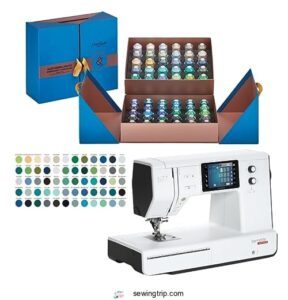
The Bernette B77 is a step up in features without jumping to a full long-arm price tag.
You get 500 built-in stitches, a 5-inch color touchscreen, and a dual-feed system that keeps multiple layers moving smoothly — no puckering, no shifting.
It sews up to 1,000 stitches per minute and ships with 8 presser feet plus a large extension table.
Just know the automatic threader can be finicky, and tension adjustments are manual.
At around $1,000–$1,500, it’s solid for serious hobbyists.
| Best For | Serious hobbyists and experienced sewists who want quilting-capable features like dual-feed and a large throat area without paying long-arm prices. |
|---|---|
| Price | Not listed |
| Weight | Not listed |
| Auto Needle Threader | Yes |
| Auto Thread Cutter | Yes |
| LED Work Light | Not specified |
| Extension Table | Not specified |
| Additional Features |
|
- The dual-feed system handles thick layers and multiple fabrics smoothly — great for quilting, appliqué, and upholstery work
- Tons of built-in stitches with an LCD display make it easy to dial in the right setting for any project
- Automatic needle threader and thread cutter save real time on big, repetitive sewing jobs
- No automatic thread-tension adjustment, so you’ll be tweaking it manually every time you switch fabrics
- The automatic needle threader is known to be unreliable and can fail early
- Warranty support is hit or miss — some owners report frustrating customer service experiences despite the 10-year claim
Compare Size, Space, and Cost
Picking the right quilting setup isn’t just about stitches — it’s about what actually fits your space, your budget, and how you work. A long-arm sounds dreamy until you measure your spare room.
Here’s how the main options stack up across the factors that matter most.
Throat Space and Quilt Capacity
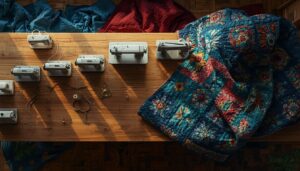
Throat space is the real gatekeeper of quilt size limitations. With 9–12 inches of Throat Clearance, you’re comfortable on small to medium tops, but Center Access becomes a struggle on anything larger.
A large frame setup with 24–30 inches opens up king-size quilts, reducing Layer Compression and extending your Pass Length dramatically. More space simply means less repositioning — and smoother results.
Floor Space for Each Setup
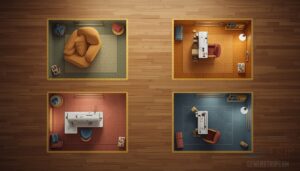
Floor space shapes your entire quilting experience before you even thread a needle.
Here’s how each setup stacks up on Footprint Dimensions:
- Sit-down frame – 6×8 ft dedicated area, plus a Chair Buffer Zone of 1.5 ft behind you
- Mid-arm with frame – 7×10 ft large workspace, with 2 ft Aisle Space on all sides
- Domestic machine – compact size fits in 5×8 ft, including chair clearance
- Portable frame – Folded Frame Storage shrinks to just 2×3 ft, with 7 ft Ceiling Clearance needed when open
Your home studio space determines which setup actually works for you.
Price Ranges by Machine Type
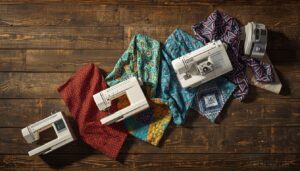
Every quilting journey starts with a budget reality check. Here’s a quick cost analysis of quilting machine types to guide your decision:
| Machine Type | Price Range |
|---|---|
| Entry-level Pricing | $150–$400 |
| Mid-range Pricing | $400–$800 |
| Industrial Frame Costs | $2,000–$8,000 |
| DIY Upgrade Expenses | $1,000–$5,000 |
| Professional Tier Pricing | $8,000–$20,000+ |
Budget-friendly options exist at every level — your machine cost simply depends on how seriously you quilt.
Portability and Storage Needs
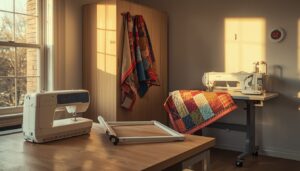
Weight Considerations vary a lot between setups. Domestic sewing machines usually weigh 15 to 25 pounds, making them a true lightweight portable sewing machine you can lift solo.
Mid-arm units run 20 to 40 pounds and often ship with transport carts. Collapsible Frames fold down to closet-friendly depths.
If you have a limited workspace, Storage Climate Control and a Compact Footprint matter — keep machines between 60 and 80°F.
Workspace Stability and Table Requirements
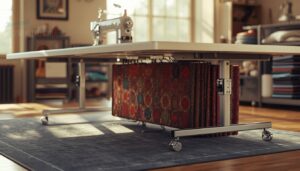
A wobbly table ruins even your best stitching. Your workspace setup and stability requirements matter as much as the machine itself.
Here’s what a solid station needs:
- Adjustable Height legs (28–34 in) to match your posture
- Caster Locking wheels to prevent drift mid-stitch
- Anti-Vibration Mats underneath to absorb machine feedback
- Reinforced Brackets and corner joinery for large extension table support
- Cable Management channels to clear trip hazards
A rail system and stable surface complete the picture.
Long-term Value for Hobbyists
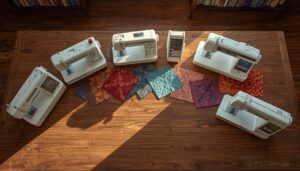
Mid-arm machines hold their resale value well, thanks to steady hobbyist demand — so your investment doesn’t just sit there.
Domestic models stay budget-friendly upfront, with low maintenance costs and broad community support online.
Most offer clear upgrade pathways as your skills grow, and software compatibility keeps expanding.
For beginners, machine durability and usability matter most, making domestic quilters a smart long-term choice.
Stitch Quality and Speed
Stitch quality can make or break a finished quilt, no matter which machine you’re using.
Speed matters too, but only if your stitches stay even and your tension holds up under pressure.
what to look at when comparing your options.
Stitch Regulation and Consistency
Stitch regulation is what separates a polished quilt from a puckered mess. Feed Dog Precision controls how fabric advances, while Regulated Needle Pressure keeps layers from shifting. Together, they deliver Stitch Length Uniformity across every pass.
SPI Consistency Management and Tension Balance Optimization work in tandem — aim for 6–12 SPI depending on your pattern — so thread tension stays balanced and stitch quality assessment becomes straightforward.
Free-motion Quilting Performance
Free-motion quilting lives or dies on Needle Drop Precision and Fabric Glide Efficiency. Drop your feed dogs, attach a free motion quilting foot, and you’re in control of every curve.
Thread Feed Consistency keeps your loops even across the sandwich. Watch for Stitch Length Variability by regulating Motion Smoothness through three habits:
- Keep your speed steady
- Move fabric at an even pace
- Maintain consistent hand pressure
Speed for Large Quilt Projects
Once your motion is smooth, speed becomes your next lever. Mid-arm quilting machines hit 600–1,200 stitches per minute, while high-throughput stitching on professional setups can reach 2,000 stitches per minute — serious fuel for high-volume projects.
Accelerated needle transfer and an optimized feed mechanism help rapid fabric advancement across a large workspace, keeping your rhythm locked in without sacrificing accuracy.
Tension Control and Thread Handling
Speed gets you far, but tension is what keeps every stitch honest. Here’s what to check:
- Upper Thread Tension — balanced discs prevent surface loops
- Bobbin Tension — a calibrated spring locks the lower thread
- Thread Guide Lubrication — smooth guides cut friction and breakage
- Fabric Tension Matching — heavier fabrics need higher settings
- Automatic Tension Sensors — real-time adjustments catch skipped stitches instantly
Lighting and Visibility Features
Good lighting isn’t optional — it’s what separates a clean stitch from a costly mistake. LED Ring Lighting delivers 360-degree coverage, while Adjustable Arm Lamps let you angle light exactly where the needle meets fabric. High CRI Illumination (CRI ≥ 90) keeps your thread colors true, and Shadow-Free Lighting eliminates those sneaky dark spots near seam lines.
| Lighting Feature | Why It Matters |
|---|---|
| Glare-Reducing Fixtures | Protects eyes on shiny fabrics |
| LED lighting (3000–6500K) | Matches thread to fabric accurately |
| Color touchscreen / LCD touch screen display | Controls brightness without stopping work |
| Quilting machine lighting and visibility | Reduces eye strain during long sessions |
Accessory Compatibility and Quilting Feet
The right foot changes everything. A walking foot manages bulk seams across multiple fabric layers, while a free‑motion quilting foot — sometimes called a hopping foot — lets you follow pantographs or freehand designs by lowering the feed dogs.
Piecing foot guides nail that precise quarter‑inch seam, and specialty applique feet handle detailed edge work. Most mid-range machines accept built‑in guide feet, making quilting machine accessories and add-ons easy to swap.
Choose The Right Quilting Setup
The right setup depends on where you’re in your quilting journey — your space, your budget, and how often you sew also plays a role. There’s single answer that works for everyone, but a few clear patterns make the choice easier.
Here’s how each option stacks up across the situations quilters run into most.
Best Option for Beginners
Starting out, a domestic sewing machine with simple free-motion capability keeps your learning curve manageable.
Look for adjustable stitch length, easy threading, and bright lighting — these aren’t extras, they’re what real confidence early on builds.
Clear presser foot visibility helps you stay accurate, and reliable tension control manages the rest.
Budget-friendly and beginner-friendly, it’s genuinely the best for beginners.
Best Choice for Large Quilts
Large quilts need room — and a mid-arm machine delivers exactly that, with 12 to 18 inches of throat space that accommodates king-size projects without constant repositioning. Quilting machine size and workspace considerations matter here.
- Thread Tension Control stays consistent across wide passes
- Fabric Handling improves with stable carriage movement
- Ergonomic Design reduces fatigue during long sessions
- Automation Options speed up edge-to-edge patterns
midarm quilting for large quilt projects are hard to beat.
Best Setup for Tight Budgets
Tight budgets don’t mean tight limits. A secondhand mid-arm machine often runs $800–$2,000, and pairing it with low-cost frame materials keeps your total investment manageable.
Budget rulers and affordable lighting solutions round out a minimalist workspace design without sacrificing function.
| Budget Option | Estimated Cost |
|---|---|
| Used domestic machine | $200–$400 |
| Secondhand mid-arm | $800–$2,000 |
| DIY sit-down frame | Under $300 |
| Basic ruler/lighting kit | $50–$100 |
Best Pick for Frequent Quilting
If you’re quilting every week, midarm quilting machines are your best ally for high-volume projects. Their 12–18 inch throat accommodates dense layers without constant repositioning, while speed and efficiency keep your output consistent.
Professional quilters love models with built‑in software integration, reliable thread compatibility across weights, and energy efficiency for long sessions.
A strong user community support network seals the deal on durability and maintenance confidence.
Manual Versus Computerized Controls
Manual controls give you tactile feedback and a simpler maintenance simplicity story — fewer electronics mean fewer surprises.
Computerized machines flatten the learning curve with preset patterns and a intuitive interface, plus software reliability keeps stitches consistent across big quilts.
A hybrid workflow splits the difference nicely: use manual speed control and your manual needle threading system for borders, then let automation handle fills.
How to Quilt on a Regular Sewing Machine
Your domestic sewing machine can handle quilts surprisingly well with a few smart adjustments. Swap in a darning foot for free motion quilting, and dial down presser foot pressure for smoother fabric stabilization across layers.
Needle selection matters — a 90/14 quilting needle cuts cleanly through batting. Set needle-down mode for precise pivots, and you’ve got solid stitch regulation and precision in quilting without spending thousands.
Frequently Asked Questions (FAQs)
How to machine a quilt without a longarm?
You don’t need a longarm to machine quilt.
A domestic sewing machine with a walking foot or darning foot manages most quilts well, especially when paired with a quilting table for fabric tension and support.
How do professional quilters finish edges on alternatives?
Professional quilters lean on binding techniques like slip stitch and ladder stitch to keep edges clean.
With midarm quilting or domestic sewing machines, a walking foot and careful thread tension adjustments make all the difference.
What thread weight works best for domestic machines?
For domestic sewing machines, 50-weight thread is your best starting point.
It manages thread-fabric matching well, accommodates needle size compatibility, and keeps tension adjustment simple across most fabric weight pairing needs.
How often should I service my alternative quilting setup?
Service timing depends on your setup. Mid-arm quilting machines need professional cleaning every 12–18 months, while domestic sewing machines run on a 12–24 month maintenance interval based on how often you quilt.
How do servo motors improve automated stitch paths?
Servo motors bring quiet intelligence to every stitch path.
Real-time feedback and adaptive path correction keep needle placement accurate within micrometers, while torque modulation and microstepping precision handle fabric shifts without missing a beat.
What warranty coverage matters most for long-arm machines?
Focus on structural component coverage and electrical warranty terms first. Extended service plans matter too.
Keep your claim documentation ready, and check whether downtime compensation is included before you sign anything.
How does fabric tension affect large quilt outcomes?
Ever wonder why large quilt puckers unevenly?
Fabric tension control drives everything — from edge distortion to thread balance. Consistent tension means better stitch quality and cleaner large format quilting results.
Are quilting-by-check services worth the added cost?
Quilting-by-check services are worth it when your time and equipment can’t deliver the finish you need. For a throw quilt, expect to pay $48–$144 for edge-to-edge work.
Conclusion
Nearly 80% of quilters finish large projects on domestic machines—never touching a long-arm.
That single stat reframes the whole conversation around a quilting sewing machine long arm alternative: you don’t need the most expensive tool, just the right one for your space, budget, and goals.
Whether you go mid-arm, sit-down frame, or hand quilting, the best setup is the one you’ll actually use consistently.
Pick your match, set it up well, and the quilts will follow.
- https://marketintelo.com/report/quilting-machine-market
- https://www.linkedin.com/pulse/exploring-long-arm-quilting-machine-lcuie
- https://graceframe.com/en/resources/blog/choosing-the-sewing-machine-with-the-correct-throat-length
- https://www.youtube.com/watch?v=AoNdSWJeyYE
- https://www.craftsy.com/post/mid-arm-quilting-machines