This site is supported by our readers. We may earn a commission, at no cost to you, if you purchase through links.

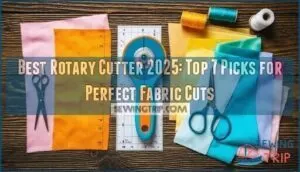
Your first time handling a rotary cutter can feel like picking up a tiny pizza cutter designed by engineers—circular blade, ergonomic handle, and enough cutting power to slice through eight layers of fabric in one smooth glide. That precision is exactly why quilters and sewers swear by them, but it’s also why beginners need proper guidance before rolling that blade across their first piece of fabric.
Rotary cutters for beginners aren’t just about choosing the right tool size or brand. They’re about understanding how a sharp, exposed blade behaves, how to pair it with the right mat and ruler, and how to develop the muscle memory that turns cautious cuts into confident, accurate lines.
Once you master the basics—blade safety, proper grip, and straight-edge technique—you’ll wonder how you ever managed with scissors alone.
Table Of Contents
- Key Takeaways
- What is a Rotary Cutter Used For?
- Choosing The Right Rotary Cutter Size
- Essential Rotary Cutter Safety Tips
- Setting Up Your Rotary Cutting Workspace
- Step-by-Step Guide: Using a Rotary Cutter
- How to Use Rotary Cutters With Rulers and Mats
- Top 10 Rotary Cutter Tools for Beginners
- 1. Omnigrid Quilting Sewing Ruler
- 2. Omnigrid Self Healing Cutting Mat
- 3. June Tailor Shape Cut Ruler Tool
- 4. Wonder Grip Quilting Gloves
- 5. Kai Rotary Cutter Tool
- 6. Fiskars Rotary Fabric Cutter
- 7. TightGrips Quilt Template Non Slip Pads
- 8. Omnigrid Ruler Grip Handle
- 9. NoCry Cut Resistant Gloves
- 10. Olfa Deluxe Rotary Cutter
- Maintaining and Replacing Rotary Cutter Blades
- Frequently Asked Questions (FAQs)
- Conclusion
Key Takeaways
- Start with a 28mm rotary cutter if you’re new to fabric cutting—it balances control and versatility across medium-weight materials before you graduate to the 45mm workhorse size for quilting projects.
- Always close your blade guard immediately after every cut and pair your rotary cutter with a self-healing mat (at least 0.25-inch thick) plus a clear acrylic ruler to prevent accidents and maintain cutting accuracy.
- Replace your blade every 3-6 months or as soon as you notice increased pressure, frayed edges, or skipped sections—dull blades compromise both safety and precision while forcing you to work harder.
- Press your ruler down firmly with your palm (not splayed fingers), keep your wrist aligned with your forearm, and cut in one smooth stroke away from your body to avoid the common beginner mistakes that cause uneven cuts and potential injuries.
What is a Rotary Cutter Used For?
A rotary cutter isn’t just a blade on a handle—it’s a revolution for anyone working with fabric. You’ll find it in every quilter’s toolkit because it manages jobs that scissors simply can’t match.
Let’s look at where this tool really shines and why you’ll reach for it again and again.
Rotary Cutters in Sewing and Quilting
A rotary cutter slices fabric with a circular blade that rolls smoothly across your material. You’ll find it essential for quilting patterns and improving sewing accuracy through precise cutting techniques.
- Speed up fabric preparation by cutting multiple layers at once
- Create straighter lines for rotary cutting than scissors deliver
- Master quilting for beginners with cleaner, more controlled cuts
- Improve material selection decisions with this adaptable tool
Benefits Over Traditional Scissors
You’ll notice faster cutting speed the moment your blade starts rolling—no more snipping motions that slow you down. That circular action delivers continuous straight edges when you pair your rotary cutter with grid rulers, giving you fabric precision scissors can’t match.
| Feature | Rotary Cutter | Scissors |
|---|---|---|
| Cutting Efficiency | Slices multiple layers simultaneously | Cuts one layer at a time |
| Fabric Precision | Maintains consistent edge width across long cuts | Creates tapering or jagged ends |
| Wrist Movement | Minimal hand fatigue during repetitive cuts | Requires constant opening and closing |
Your cutting mat protects surfaces while the rotary accuracy keeps lines straight without the tapering you’d get from manual scissor comparison methods.
Types of Projects Suited for Rotary Cutters
Your speed advantage pays off most in quilting tasks, where you’ll trim seam allowances and square up blocks with consistent accuracy.
Garment making becomes simpler when cutting multiple pattern pieces through layered fabric.
You’ll handle paper crafting projects, vinyl cutting for decals, and light leather working with the same tool—just match your blade size to material thickness for clean edges every time.
Choosing The Right Rotary Cutter Size
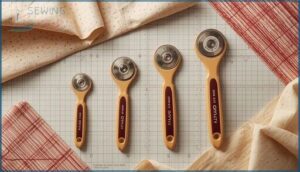
Rotary cutters come in four main blade sizes, and picking the right one makes all the difference in how your cuts turn out. The size you need depends on what you’re cutting and how much control you want over the blade.
Let’s break down each size so you can choose the best fit for your projects.
Overview of Blade Sizes (18mm, 28mm, 45mm, 60mm)
You’ll find rotary cutter blades in four standard sizes, each designed for specific tasks. The 18mm manages delicate trimming and tight curves. The 28mm balances precision with speed for medium-weight fabrics. OLFA’s popular 45mm blade manages general quilting and straight cuts. The 60mm powers through thick materials and wide strips.
Sharp blade quality and cutting efficiency improve with proper fabric selection and regular blade replacement.
Recommended Sizes for Beginners
Start with a 28mm rotary cutter for adaptable beginner tips and solid cutting efficiency across medium-weight fabrics. This blade selection balances control with speed, making fabric cutting tips easier to apply.
Once you’ve practiced rotary cutter techniques and understand fabric thickness, shift to the 45mm—the workhorse size for quilting. Keep your sharp blade ready and track blade replacement timing as your skills develop.
Matching Blade Size to Materials
Match your rotary blade to fabric weight for better fabric compatibility and cutting efficiency. Use 18mm excel blades for delicate trims, 28mm for medium fabrics, and 45mm for standard quilting tasks. When you’re tackling leather or multiple layers, grab a 60mm rotary cutter.
Smart blade selection prevents fraying and uneven edges while boosting precision cutting and rotary cutting safety through proper material guidance.
Essential Rotary Cutter Safety Tips
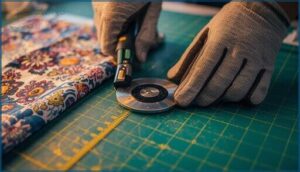
A rotary cutter can slice through fabric like butter, but that sharp blade demands your respect. One careless moment can lead to a nasty cut or a ruined work surface.
A rotary cutter slices fabric effortlessly, but one careless moment with that sharp blade can lead to serious injury
Here’s what you need to know to keep yourself safe and your tools in top shape.
Proper Blade Handling and Storage
Think of your rotary blade like a kitchen knife—respect keeps you safe. Always close the blade guard immediately after cutting, and store your rotary cutter in a locked container away from children.
When changing blades, wear cut-resistant gloves and hold edges carefully. Dispose of dull blades in a puncture-resistant sharps container, and apply mineral oil occasionally to prevent rust.
These blade safety habits protect your hands.
Cutting Mat Usage for Safety
Your cutting mat isn’t just for protection—it’s your first line of defense against accidents. Choose a self-healing mat with at least 0.25-inch mat thickness to absorb blade impact and prevent surface damage.
Look for these safety features:
- Grid alignment with 1-inch increments for precise fabric positioning
- Non-slip backing that anchors your workspace during cutting techniques
- Blade protection that extends rotary cutter lifespan
- Heat-resistant surface for safe storage away from warmth
Quality mats like the Fiskars SelfHealing Cutting Mat transform sewing safety and precautions from concern into confidence.
Avoiding Common Beginner Mistakes
Poor grip is where most beginner quilters stumble. Keep your wrist aligned with your forearm—drifting angles cause uneven cuts.
Don’t strangle the rotary cutter with excessive pressure; it dulls the blade and frays fabric edges. Practice blade control on scrap material before tackling your project.
These safety measures and cutting techniques transform common errors into confident, accurate results.
Setting Up Your Rotary Cutting Workspace

Your workspace setup can make or break your cutting experience. A well-organized area keeps you safe, improves accuracy, and makes every project more enjoyable.
Let’s walk through the essential tools and simple strategies that’ll get your workspace ready for success.
Must-have Tools (cutting Mat, Ruler)
You’ll need three core tools before you make your first cut. Start with a self-healing cutting mat in 0.25-inch thickness—it protects your table and keeps your rotary cutter blade sharp.
Add a clear acrylic quilters ruler, ideally 6×24 inches, with 1/8-inch grid markings. Choose a nonslip ruler or add grip pads underneath for stability during cuts.
Organizing Your Cutting Area
Set up a dedicated cutting station within arm’s reach of your rotary cutter, acrylic ruler, and nonslip ruler. Store replacement blades in clear bins to reduce search time by 20%.
Position your cutting mat flat on a sturdy table at elbow height—proper workspace ergonomics prevents strain during long sessions.
Keep safety rules visible and label tool storage compartments for quick access.
Maintaining a Clutter-free Surface
A tidy workspace isn’t just about looks—clearing away scraps and fabric pieces after each cut improves your accuracy by up to 40%. Dedicate labeled zones for your cutting mat, rotary cutter, and sewing tools to cut tool-hunting time in half.
Quick surface cleaning between sessions keeps dust off blades and prevents lint buildup, extending tool life while reinforcing safety protocols.
Step-by-Step Guide: Using a Rotary Cutter
You’ve got your mat, ruler, and rotary cutter ready—now it’s time to put them to work. The first few cuts can feel awkward, but once you understand the basic technique, everything clicks into place.
Let’s walk through the process step by step, from prepping your fabric to making clean, straight cuts every time.
Preparing Fabric and Aligning Materials
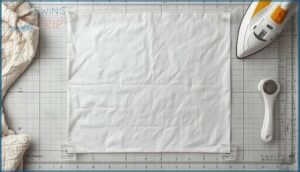
Fabric preparation sets you up for clean, confident cuts every time. Start by pre-washing or stabilizing your material to prevent unwanted fabric stretching after cutting. Press it flat with a warm iron, then lay it on your cutting mat with grain alignment parallel to the gridlines. Secure with pins or weights to keep everything steady while you work with your rotary cutter and acrylic ruler.
- Pre-wash fabric to minimize shrinkage and guarantee material stabilization
- Press wrinkles flat for improved cutting accuracy
- Align fabric grain with mat gridlines for precise fabric cutting techniques
- Secure layers with pins or weights to prevent shifting
Holding and Guiding The Rotary Cutter
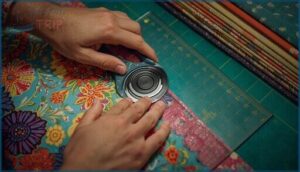
Once your fabric’s flat and aligned, proper grip techniques make all the difference. Hold the rotary cutter with a relaxed but firm grasp, placing your index finger along the blade housing for steady blade control. Keep your wrist alignment straight and press the acrylic ruler down with your other hand for a secure ruler grip.
Apply light, even pressure while cutting away from your body—these hand placements and cutting angles follow essential safety rules that prevent accidents on your cutting mat.
Making Straight and Precise Cuts
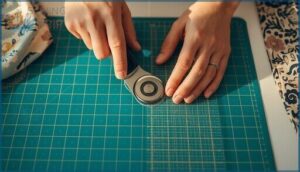
Precision control starts with your fabric alignment along the ruler’s gridline—verify that 90-degree angle before you cut. Press the acrylic ruler firmly to prevent drift, then guide your rotary cutter in one smooth stroke away from your body.
These cutting techniques rely on a sharp blade and stable cutting mat to deliver clean edge finishing:
- Keep the blade flush against the ruler’s edge throughout the entire pass
- Apply steady, even pressure without forcing the Excel Blades through thick layers
- Check your cut against a reference line to confirm accuracy
- Follow safety rules by never lifting the blade mid-stroke
Blade sharpening matters—dull edges fray fabric and compromise control.
How to Use Rotary Cutters With Rulers and Mats
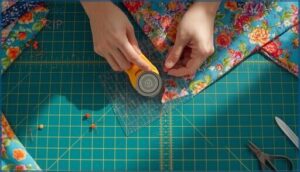
A rotary cutter works best when you pair it with the right ruler and mat. These tools work together like a team—your mat protects the surface and keeps the blade sharp, while your ruler guides each cut with precision.
Let’s walk through how to set up and use these essential tools so your cuts come out straight every time.
Selecting The Right Ruler for Straight Cuts
A flat, unwarped acrylic ruler is your first priority—modern versions stay true under normal temperatures. Look for gridlines every 1/8 or 1/16 inch to align with fabric grain and your cutting mat.
Choose 6–12 inches for small trims, 18–24 inches for full-length edges. Transparent rulers let you see exactly where you’re cutting, and non-slip grips keep everything steady under your rotary cutter blade.
Preventing Ruler Slippage
When your ruler shifts mid-cut, accuracy vanishes. Grip solutions stop that drift before it starts.
- Apply adhesive ruler grip dots at corners and center points—silicone or sandpaper texture reduces slippage by up to 90% on your cutting mat.
- Press down with 3–5 pounds of steady palm pressure across the acrylic ruler width, keeping fingers flat.
- Position your non-cutting hand at least 2 inches from the blade path for safer, firmer control.
- Choose frosted-finish rulers that generate 25–35% more friction against self-healing surfaces than polished acrylic.
Aligning Fabric With Gridlines
Your mat’s 1-inch gridlines do more than measure—they prevent fabric distortion and guarantee cutting precision across every seam allowance.
Lay your fabric edge along the vertical or horizontal lines, then position your acrylic ruler directly over the intersection points. This grid alignment creates a foolproof reference system for fabric cutting and preparation, turning guesswork into confident quilting techniques with your rotary cutter.
Top 10 Rotary Cutter Tools for Beginners
You’ve learned the techniques—now let’s talk about the gear that’ll make your cutting easier and safer. The right tools don’t just improve accuracy; they protect your hands and give you confidence as you work.
Here are ten beginner-friendly essentials that quilters and sewers rely on every day.
1. Omnigrid Quilting Sewing Ruler
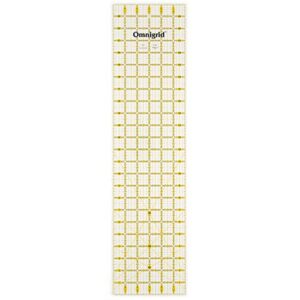
You’ll rely on clear gridlines when learning proper cutting techniques, and the Omnigrid 6×24 inch ruler delivers exactly that. Made from durable acrylic with laser-cut edges, this quilting tool features a patented double-line system that works on both light and dark fabrics—essential for fabric alignment.
The grid systems include markings at 30, 45, and 60-degree angles, making it compatible with any cutting mat. At 11.56 ounces, it provides stability without excessive weight.
Note that you’ll need to apply firm pressure or add non-slip pads, since it doesn’t include built-in grip features for rotary cutter work.
| Best For | Quilters and sewers who need a versatile ruler for cutting strips and shapes with clear angle markings, and don’t mind adding their own non-slip accessories. |
|---|---|
| Primary Use | Quilting ruler |
| Material | Acrylic |
| Brand | Omnigrid |
| Skill Level | All levels |
| Hand Compatibility | Left and right |
| Washable | No |
| Additional Features |
|
- Patented double-line gridlines stay visible on both light and dark fabrics, making alignment easier across different projects
- Laser-cut edges and durable acrylic construction provide smooth, accurate cuts that hold up over time
- Multiple angle markings (30, 45, and 60 degrees) work for both left and right-handed users without needing separate tools
- No built-in non-slip surface means you’ll need to press down hard or buy separate grip pads to keep it from sliding
- Lacks rubber feet or backing that many quilters expect, which can slow down your workflow
- You may need to purchase additional accessories like suction cups to get the stability other rulers offer right out of the box
2. Omnigrid Self Healing Cutting Mat
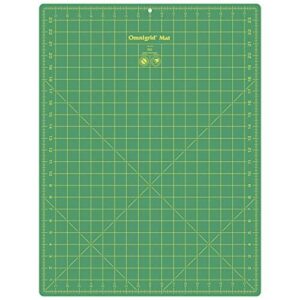
Your rotary cutter deserves a surface that won’t fight back—and the Omnigrid Self Healing Cutting Mat gives you exactly that. This 24.8″L x 18.8″W mat features grid lines marked to the 1/8 inch, essential for accurate cutting techniques when working on quilting tools and supplies. The self-healing base withstands repeated blade passes without permanent grooves, extending blade care intervals. Two-sided design offers green gridlines or solid grey backgrounds.
Remember proper mat maintenance: store flat away from heat to prevent warping, affecting your safety features and cutting precision.
| Best For | Quilters, crafters, and sewers who need a durable, accurate cutting surface for larger fabric pieces and precision work with rotary cutters. |
|---|---|
| Primary Use | Cutting mat |
| Material | Fabric |
| Brand | Omnigrid |
| Skill Level | All levels |
| Hand Compatibility | Universal |
| Washable | No |
| Additional Features |
|
- Self-healing surface resists grooves from repeated cutting, extending the mat’s lifespan and keeping your cutting area smooth
- Double-sided design with grid lines on one side and plain grey on the other gives you two surfaces in one mat
- Clear measurement markings down to 1/8 inch and 45-degree angle guides make alignment and precision cuts easier
- Contains California Prop 65 warning chemicals that may pose health risks
- Some users report an unpleasant chemical smell, especially when new
- Can warp if exposed to heat or extreme temperatures, so storage conditions matter
3. June Tailor Shape Cut Ruler Tool
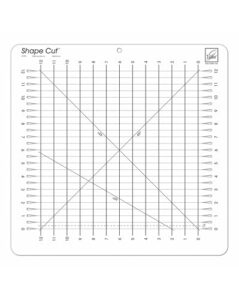
Cutting strips and squares gets faster when you pair your rotary cutter with the June Tailor Shape Cut Ruler Tool. This 13.5″L x 13.5″W acrylic ruler cuts strips from 1/2 inch up to 12 inches in half-inch increments, then flips to handle triangles, diamonds, or chevrons—expanding your precision edges beyond basic straight lines.
The transparent plastic helps with fabric alignment against your mat’s gridlines. Yes, it’s slightly bendy when lifting, requiring careful ruler maintenance and a gentle touch, but it streamlines repetitive cuts for strip quilting and saves you from constantly repositioning bulkier quilting tools and supplies.
| Best For | Quilters who cut a lot of strips and want to speed up repetitive tasks without constantly repositioning a standard ruler. |
|---|---|
| Primary Use | Strip cutting tool |
| Material | Plastic |
| Brand | June Tailor |
| Skill Level | Beginner to intermediate |
| Hand Compatibility | Universal |
| Washable | No |
| Additional Features |
|
- Cuts strips in half-inch increments from 1/2 inch to 12 inches and flips to handle shapes like triangles, diamonds, and chevrons
- Transparent design makes it easy to align fabric against your cutting mat’s gridlines
- Saves time on strip quilting projects by reducing the need to move and realign bulkier rulers
- Has a slight learning curve when you’re first getting used to it
- The plastic can be a bit bendy, so you need to lift it carefully to avoid shifting your fabric
- Limited to 12×12 measurements, which means you’ll need to fold larger fabric pieces before cutting
4. Wonder Grip Quilting Gloves
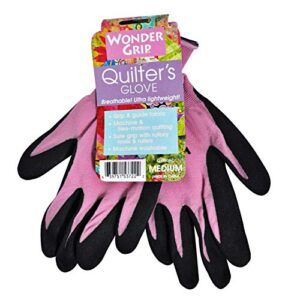
Your hands need protection while you learn sewing safety and tips, especially when guiding rulers against sharp blades. Wonder Grip Quilting Gloves deliver grip enhancement through their textured nitrile palm coating on an 18-gauge nylon knit—light enough to preserve tactile sensitivity for aligning fabric edges with quilting accuracy.
The breathable glove materials reduce sweating during extended sessions, and they’re machine washable for easy care. You’ll gain confidence in hand protection without sacrificing the fingertip feel needed to control your rotary cutter and other quilting tools safely.
| Best For | Quilters who need a secure grip on rulers and rotary cutters while maintaining the fingertip sensitivity required for precise fabric alignment and cutting. |
|---|---|
| Primary Use | Quilting gloves |
| Material | Nitrile/Nylon |
| Brand | Wonder Grip |
| Skill Level | All levels |
| Hand Compatibility | Universal |
| Washable | Yes |
| Additional Features |
|
- Textured nitrile coating provides excellent grip on slippery rulers and tools without adding bulk
- Breathable 18-gauge nylon knit keeps hands comfortable during long quilting sessions and reduces sweating
- Machine washable for easy maintenance and repeated use
- Only available in medium size, which won’t fit everyone’s hands
- Random color selection means you can’t choose your preferred shade
- Cut resistance is protective padding rather than certified industrial-grade protection
5. Kai Rotary Cutter Tool
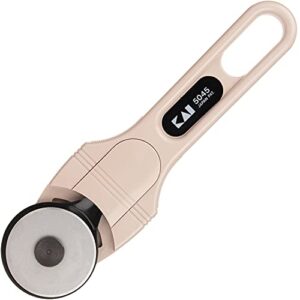
A lightweight tool like the Kai Rotary Cutter gives you controlled precision in your sewing for beginners toolkit. Its 45mm stainless-steel blade—paired with a compact cutter handle design—feels natural in your hand during long cutting sessions, making this rotary cutter tutorial favorite comfortable for single-handed operation.
The automatic blade retraction safety lock mechanism retracts immediately after each pass, reducing accidental injuries.
When you need blade replacement tips, know that Kai’s tool-free system lets you swap blades quickly without extra equipment, reinforcing crafting tools and supplies essentials alongside rotary blade care and sewing safety and tips.
| Best For | Sewers and quilters who want a lightweight, ergonomic rotary cutter with safety features for extended fabric cutting sessions. |
|---|---|
| Primary Use | Rotary cutter |
| Material | Alloy Steel/Plastic |
| Brand | KAI |
| Skill Level | All levels |
| Hand Compatibility | Left and right |
| Washable | No |
| Additional Features |
|
- Automatic blade retraction provides immediate safety protection after each cut, reducing injury risk during repetitive use.
- Universal grip design works comfortably for both right and left-handed users without needing separate models.
- Tool-free blade replacement system makes swapping dull blades quick and straightforward without extra equipment.
- Some users report blade durability issues, with blades becoming dull faster than expected during regular use.
- The retaining screw may back off over time and requires occasional checking to keep the blade secure.
- Mixed feedback on long-term performance suggests quality control inconsistencies across different production batches.
6. Fiskars Rotary Fabric Cutter
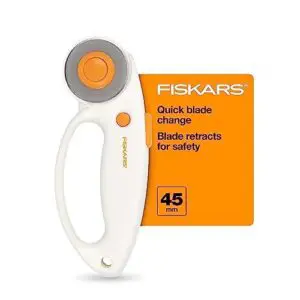
With its ergonomic loop handle and 45mm premium steel blade, the Fiskars Rotary Fabric Cutter balances blade sharpness with easy-to-use Fiskars design. You’ll appreciate how its sliding button extends and locks the blade, giving you control during fabric cuts while maintaining sewing safety through automatic retraction.
The cutter’s ergonomics suit both right- and left-handed beginners, and its fabric compatibility spans felt, vinyl, and quilting materials.
When you’re building your crafting tools and supplies arsenal for sewing for beginners projects, this rotary cutter delivers reliable performance backed by Fiskars’ lifetime warranty.
| Best For | Sewers and crafters who need clean, precise cuts through multiple fabric layers and want a comfortable tool that works for both right- and left-handed users. |
|---|---|
| Primary Use | Rotary cutter |
| Material | Steel/Stainless Steel |
| Brand | Fiskars |
| Skill Level | All levels |
| Hand Compatibility | Left and right |
| Washable | No |
| Additional Features |
|
- The 45mm steel blade stays sharp through multiple projects and cuts several fabric layers at once, saving you tons of time compared to regular scissors.
- The ergonomic loop handle feels comfortable during long cutting sessions, and the sliding button makes it easy to lock and retract the blade safely.
- Lifetime warranty on everything except the blade gives you peace of mind, and replacement blades are easy to find and swap out when needed.
- The blade can dull faster than expected if you’re cutting a lot, especially through tougher materials like vinyl.
- The handle can feel a bit slippery during use, which might affect your control on detailed cuts.
- Not the best choice if you have limited hand strength since it requires a firm grip to guide the cutter smoothly.
7. TightGrips Quilt Template Non Slip Pads
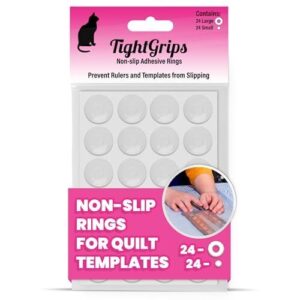
Template slippage steals accuracy from your cuts, but this 48-piece silicone pad set solves the problem. You’ll place TightGrips pads under your rulers and templates to create non-slip technology that keeps everything stable on your cutting mat.
The kit includes 24 large and 24 small pads for cutting mat compatibility with various quilting tools. Clean your pads with mild soap to maintain their grip enhancement properties.
When you pair these with your rotary cutter and ruler during quilting projects, you’ll reduce hand pressure and boost quilt template safety through better stability.
| Best For | Quilters who struggle with rulers and templates shifting during cutting and want an affordable solution to improve accuracy without applying excessive hand pressure. |
|---|---|
| Primary Use | Non-slip pads |
| Material | Silicone |
| Brand | TightGrips |
| Skill Level | All levels |
| Hand Compatibility | Universal |
| Washable | No |
| Additional Features |
|
- Complete 48-piece set with two sizes gives you plenty of pads to use across multiple rulers and templates at once
- Creates stable grip on cutting mats that helps maintain alignment with measurement marks and reduces the risk of mis-cuts
- Thin profile doesn’t block gridlines on rulers, and the pads are reusable after cleaning with soap and water
- Some users report the pads don’t stick well or fall off during use, especially on certain surfaces
- Adhesion weakens over time and may require frequent replacement depending on how often you quilt
- Performance can vary on glossy surfaces compared to standard matte cutting mats
8. Omnigrid Ruler Grip Handle
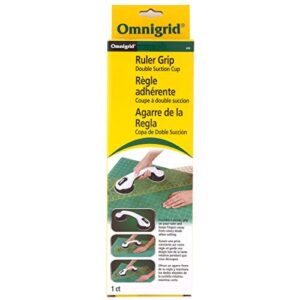
The Omnigrid Ruler Grip Handle attaches to your acrylic ruler with two suction cups, lifting your hand above the cutting line for better rotary cutter accuracy. Lock the levers to secure it in place before each cut.
This grip handle’s durability helps prevent ruler slippage while keeping fingers away from the blade path—a real boost for ruler grip safety. Clean the suction cups regularly for proper suction cup maintenance.
The handle ergonomics let you press down with your palm instead of splaying fingers across quilting tools and supplies during cutting.
| Best For | Quilters and sewers who want to keep their fingers safely away from rotary cutter blades while maintaining steady pressure on acrylic rulers during fabric cutting. |
|---|---|
| Primary Use | Ruler grip handle |
| Material | Plastic |
| Brand | Omnigrid |
| Skill Level | All levels |
| Hand Compatibility | Universal |
| Washable | No |
| Additional Features |
|
- Elevates your hand above the ruler so you can press down with your palm instead of spreading fingers near the blade path
- Two suction cups with lock levers distribute pressure across the ruler surface and stay put when properly cleaned
- Works with most standard acrylic quilting rulers and can be moved between different templates as needed
- Suction strength can vary—some users find it holds great while others report weak adhesion depending on ruler surface and cleanliness
- Size may be too bulky for smaller rulers or users with limited workspace
- Requires regular cleaning of both suction cups and ruler surfaces to maintain reliable grip over time
9. NoCry Cut Resistant Gloves
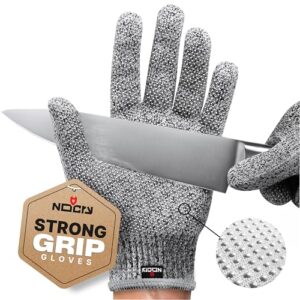
NoCry Cut Resistant Gloves shield your non-cutting hand from accidental blade interaction while you guide fabric along the ruler. These glove materials include high-performance polyethylene layers that offer Level 5 cut resistance—four times stronger than leather for hand protection.
Grip dots on the palms prevent fabric slippage during cuts, and the breathable design keeps your fingers comfortable through long sewing sessions. Machine wash them to maintain safety features. They’re essential sewing tools and supplies that pair with any rotary cutter for safer quilting and crafting supplies work.
| Best For | Home sewers, quilters, and crafters who use rotary cutters frequently and want to protect their guiding hand from accidental slips without sacrificing dexterity. |
|---|---|
| Primary Use | Cut-resistant gloves |
| Material | HMWPE/Rubber/Silicone |
| Brand | NoCry |
| Skill Level | All levels |
| Hand Compatibility | Ambidextrous |
| Washable | Yes |
| Additional Features |
|
- Level 5 cut resistance offers serious protection—four times stronger than leather—so you can focus on precision cuts instead of worrying about nicks
- Grip dots keep fabric from sliding around on your cutting mat, which means cleaner lines and less frustration during long projects
- Machine washable and breathable design makes them practical for regular use, not just something that sits in a drawer
- Some users find the fingers run tight or uncomfortable, especially during extended cutting sessions
- Won’t protect against forceful stabs or punctures, so you still need to use proper cutting technique
- Grip dots aren’t ideal for every material—they work great on fabric but might not grip as well on other surfaces
10. Olfa Deluxe Rotary Cutter
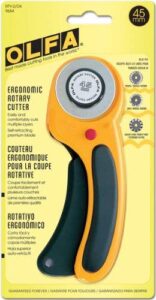
The Olfa Deluxe Rotary Cutter balances precision with beginner-friendly design through its 45mm blade—ideal for quilting and sewing projects involving multiple fabric layers. This model features a dual-action safety lock that works for both right- and left-handed users, plus an ergonomic rubber grip that reduces hand fatigue during extended cutting sessions.
Deluxe models from OLFA include blade guards and easy replacement mechanisms for cutter maintenance. Follow safety tips by retracting the blade after each cut, and pair it with sewing tools and supplies like self-healing mats for peak rotary blades performance.
| Best For | Quilters, sewers, and crafters who need a reliable rotary cutter that handles multiple fabric layers and works well for both right- and left-handed users. |
|---|---|
| Primary Use | Rotary cutter |
| Material | Rubber |
| Brand | OLFA |
| Skill Level | All levels |
| Hand Compatibility | Left and right |
| Washable | No |
| Additional Features |
|
- The 45mm blade cuts through several layers of fabric at once, speeding up quilting and sewing projects.
- Dual-action safety lock and ergonomic rubber grip make it comfortable and safe for extended use.
- Replacement blades are easy to find and swap out when the original blade dulls.
- The extremely sharp blade requires constant caution and isn’t ideal around kids or pets.
- Left-handed users may find the blade shield awkward or obstructive during cuts.
- You’ll need to buy a cutting mat separately to protect your work surface from damage.
Maintaining and Replacing Rotary Cutter Blades
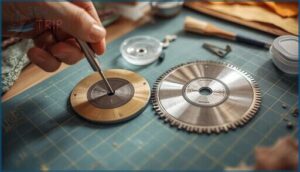
A sharp blade makes all the difference in clean, safe cuts, but knowing when to replace it isn’t always obvious. You’ll also need to handle disposal the right way and keep your cutter in good working order between projects.
Let’s cover the essentials of blade care so your rotary cutter stays reliable and safe to use.
When to Replace or Sharpen Blades
Your rotary cutter blade won’t tell you it’s dull—your fabric will. Watch for these blade wear signs: increased pressure needed, frayed edges instead of clean cuts, skipped sections along your cutting line, or visible nicks in the blade. Test sharpness on scrap fabric first. Replace blades every 3-6 months with regular use, or immediately when cuts feel rough.
Remember these blade maintenance tips:
- Sharp blades cut effortlessly; dull blade effects include snagging and uneven edges
- Test replacement timing by checking if your OLFA rotary cutter drags through cotton
- Serrated blades show different wear patterns than straight-edge quilt tools
- Clean debris buildup before deciding on sharpening versus replacement
- Safety tips: always lock the blade before changing to prevent accidents
Safe Blade Disposal Methods
Used blades aren’t regular trash—they’re sharps that need careful handling. Store dull blades in a puncture-resistant container like a thick plastic bottle with a secure lid before disposal. Tape edges first to protect handlers. Check your local hazardous waste programs, as many areas ban curbside sharp waste disposal.
Label your hazard control container clearly to protect sanitation workers.
Here’s your safe blade disposal guide:
| Container Type | Disposal Method | Safety Feature |
|---|---|---|
| Metal tin with safety lock | Household hazardous waste facility | Prevents needlestick injuries |
| Heavy plastic bottle with guard | Municipal sharps program | Leak-proof eco-friendly option |
| OLFA blade case | Mail-back sharpening services | Reusable rotary cutter storage |
Cleaning and Storing Your Rotary Cutter
Beyond disposal, your cutter needs routine care to stay sharp and safe. Wipe fabric fibers from the blade after each cutting session using a dry cloth, then lock the safety lock before storage.
Mat cleaning prevents grit buildup that dulls edges. Apply light oil for rust prevention, keeping your Olfa 45mm Ergonomic Rotary Cutter smooth.
Blade sanitizing and proper cutter storage extend tool life dramatically.
Frequently Asked Questions (FAQs)
Can rotary cutters be used on paper?
Yes, you can slice through paper with your rotary blade—it’s perfect for scrapbooking and craft cutting. Just keep your blade sharp and use a self-healing mat to protect your work surface.
How do I cut curved shapes accurately?
Trace your arc with a washable marker, then guide a sharp 28mm or 45mm blade along the curve using steady pressure.
Rotate the fabric—not your hand—for tighter radii and smoother precision.
What causes wavy edges when cutting fabric?
A sharp rotary cutter and stable mat prevent wavy fabric edges.
Dull blade sharpness, inconsistent cutting technique, or uneven fabric tension create waves.
Keep your ruler firmly pressed and maintain steady edge control throughout each quilting cut.
Are left-handed rotary cutters really necessary?
Left-handed cutters aren’t mandatory, but they do improve comfort and blade orientation for many users. Ambidextrous models or reversible blades offer flexibility. Test ergonomic designs to find what feels natural for your hand dominance.
Understanding research methodology is essential for evaluating tools and techniques.
How do I prevent fabric from shifting?
Like ancient weavers securing looms, you need a grippy cutting mat and non-slip ruler to anchor fabric.
Press firmly, keep your blade sharp, and cut smoothly—these gripping surfaces stop quilting disasters before they start.
Conclusion
Think of mastering rotary cutters for beginners like learning to ride a bike—wobbly at first, then suddenly second nature. You’ve got the blade size down, the safety habits locked in, and the mat-ruler-cutter trio ready to go.
Now it’s about repetition. Each cut builds confidence, each project sharpens your accuracy. Keep that blade guard closed between passes, your ruler hand firm, and your workspace clear. Before long, you’ll slice through fabric layers like you’ve been doing it for years.