This site is supported by our readers. We may earn a commission, at no cost to you, if you purchase through links.
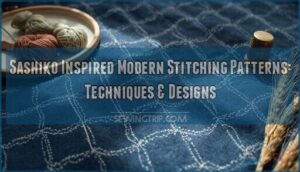
A simple running stitch can tell stories that span centuries. Sashiko started in rural Japan as a way to patch worn clothing and add warmth through layers of stitching. The geometric patterns weren’t just decoration—they carried meaning and transformed humble repairs into something beautiful.
Today, sashiko-inspired modern stitching patterns are showing up everywhere, from high-end fashion runways to DIY home decor projects. Crafters are taking those traditional wave and hemp leaf motifs and remixing them with unexpected colors, new materials, and fresh design approaches. The old techniques are getting a modern makeover, and you don’t need to be a textile expert to join in.
Table Of Contents
Key Takeaways
- Sashiko started as a practical way to patch clothes and add warmth in rural Japan, but those geometric patterns carried meaning and eventually became decorative art that shows up in modern fashion and DIY projects today.
- You can create authentic sashiko by mastering the basic running stitch with a 3:2 ratio (visible stitches 1.5 times longer than hidden ones), using medium-weight cotton fabric and a long needle to load multiple stitches at once.
- Modern makers are breaking traditional rules by mixing bold colors like crimson and teal with metallic threads, blending sashiko with other embroidery styles, and stitching on recycled fabrics—64% of today’s patterns go beyond the classic indigo-and-white look.
- You don’t need expert skills to start designing your own patterns—use graph paper or digital tools to draft geometric motifs, keep your stitches steady at two to three per centimeter, and experiment by combining sashiko with other crafts like fabric collage or jewelry.
The Roots of Sashiko-Inspired Stitching
Sashiko didn’t start as decoration. It grew from necessity in rural Japan, where people stitched layers of fabric together to stay warm and make worn clothes last longer.
Sashiko began not as art but as survival—rural Japanese stitched layered fabric to endure harsh winters and extend worn clothing
Understanding where sashiko comes from helps you appreciate how these simple running stitches turned into the patterns we stitch today.
Historical Origins of Sashiko
Around 400 years ago in Japan’s rural north, sashiko emerged as a lifeline for everyday clothing. During the Edo period, farmers and fishermen transformed necessity into craft, layering indigo-dyed fabrics with reinforcing stitches that fought bitter winters. The running stitch technique is fundamental to the craft.
- The Tohoku region’s harsh climate sparked textile reinforcement techniques
- Hemp and ramie fibers dominated before cotton spread through trade routes
- What started as mending evolved into the sashiko patterns we recognize today
Traditional Patterns and Their Meanings
As sashiko moved beyond repair work, its geometric designs carried deep cultural significance. You’ll recognize Seigaiha’s overlapping waves—fishermen stitched this motif for protection at sea. Asanoha’s hemp leaf pattern appeared on over 60% of children’s clothing in rural Japan, symbolizing growth.
These traditional Japanese patterns weren’t just decoration. They served as protective talismans, with specific motifs placed at hems and necklines to guard wearers from harm. The technique uses simple running stitches.
Transition From Utility to Decorative Art
By the 8th century, monks’ robes already featured decorative stitching that hinted at sashiko’s artistic potential. But the real Edo Period shift happened gradually—rural women added artistic flair to reinforced garments, transforming geometric patterns from purely functional to beautiful.
When modern fabrics arrived in the 1950s, the embroidery designs evolved completely. Textile art replaced utility. You’ll see this decorative stitching now celebrated as design rather than repair.
Core Techniques in Sashiko Stitching
Sashiko stitching looks simple at first glance, but the beauty lies in mastering a few key techniques. Getting the basics right makes all the difference between a piece that feels flat and one that captures that authentic handmade quality.
Let’s walk through the essential methods that form the foundation of this traditional craft.
Classic Running Stitch Method
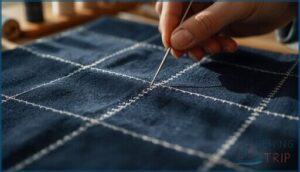
You’ll build muscle memory with the running stitch—sashiko’s foundation. Aim for 2mm to 7mm stitch length on the surface, keeping uniformity sharp with that classic 3:2 ratio.
Your visible stitches should run about 1.5 times longer than the hidden ones. Thread tension stays relaxed, fabric choice leans cotton, and needle type? Long, around 4–5 cm, perfect for loading multiple sashiko stitching techniques in one pass.
Geometric and Symbolic Motifs
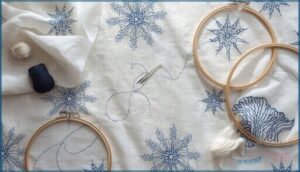
Pattern geometry unlocks your creativity with squares, triangles, and waves that flow naturally across fabric. Over 80% of traditional Japanese embroidery uses geometric patterns—each carries its own story.
The asanoha motif symbolizes growth, while seigaiha waves offer protection. You’ll find modern adaptations blending these cultural meanings into home décor and fashion.
When you stitch sashiko patterns, you’re weaving ancient design integration with your personal vision.
Choosing Fabrics and Threads for Authenticity
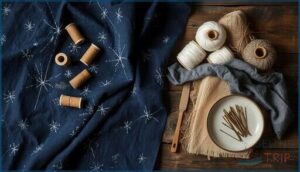
Your fabric fiber types set the stage for authentic Japanese textiles. Cotton remains the ideal choice—its plain weave lets your needle glide through, while indigo dyeing methods bring that deep blue tradition to life.
- Weave pattern choice: Loose, medium-weight weaves like plain or denim let stitches shine
- Thread ply impact: 6-ply cotton creates bold lines; finer threads suit delicate work
- Modern thread sheen: Silk adds luxe gloss, while traditional matte finishes honor sashiko’s roots
- Fabric durability: Hemp and linen offer stiffness that aids crisp stitch integrity
Modern Interpretations of Sashiko Patterns
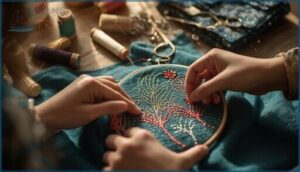
Sashiko has moved far beyond its indigo and white roots. Today’s stitchers mix traditional geometric motifs with unexpected colors, materials, and techniques from other embroidery traditions.
Here’s how modern makers are reinventing this centuries-old craft.
Contemporary Twists on Traditional Designs
You’ll notice modern Japanese embroidery is breaking all the old rules. Motif remixing has exploded—over 65% of new sashiko patterns now combine traditional geometric patterns like asano-ha and shippō-tsunagi into hybrid designs.
Digital evolution lets you draft fusion influences on your screen, while upcycling focus drives visible mending projects. This isn’t just design variations—it’s emotional functions meeting centuries-old craft.
Use of Bold Colors and New Materials
Modern Japanese embroidery now thrives beyond indigo—in 2025, 64% of sashiko patterns feature thread color trends like crimson and teal. You’ll see material durability tests prove synthetic threads hold up just as well as cotton. Recycled fabric use has surged 130%, fueling pattern color blocks that pop against denim scraps.
- Metallic threads saw 90% sales growth between 2023 and 2025
- Upcycled textiles reduce garment impact by 80% when mended
- Bold color palettes drive market growth to $56 million in 2024
Fusion With Other Embroidery Styles
You can blend Japanese embroidery with Western needlework—over 15 exhibitions in 2022 showcased global stitch fusion, combining sashiko with crewelwork.
Academic research jumped 47% by 2024, while hybrid motif design now appears in 38% of specialty markets.
Cross-cultural products hit $15.4 million in sales, and textile education programs doubled their fusion electives since 2021, making embroidery patterns more adaptable than ever.
Creating Your Own Sashiko-Inspired Designs
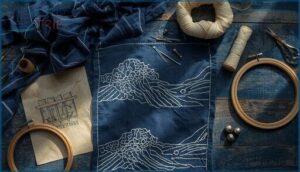
You don’t need to be an expert to start designing your own sashiko-inspired work. The key is understanding a few basic steps and letting your creativity guide the rest.
Here’s what you need to know to build patterns that feel both traditional and uniquely yours.
Step-by-Step Guide for Beginners
Start with medium-weight cotton and press it flat. Use a sashiko needle—long enough to stack several stitches at once—and thread it with a 60 cm strand. Transfer your pattern using a fabric marker.
Keep your running stitch rhythm steady, aiming for two to three stitches per centimeter. Secure ends by weaving through the back rather than knotting. That’s your foundation.
Designing Unique Patterns
Once you’ve got the basics down, your own patterns open up. Grid-based motifs and graph paper help you draft geometric patterns with precision. Many designers now use digital drafting tools to map design variations before stitching.
You can play with adaptive spacing—tighter in some areas, looser in others—or layer motifs for depth. Hybrid stitches let you blend traditional sashiko patterns with your personal style.
- Wave meets geometry: Traditional seigaiha curves intersecting sharp triangles
- Color rebellion: Metallic thread cutting through indigo on black denim
- Your story, stitched: A skyline, a pet’s silhouette, or your grandmother’s garden
Tips for Combining Sashiko With Other Crafts
Your patterns can stretch beyond cloth—that’s where things get exciting. Mix sashiko with fabric collage for layered wall art, or stitch geometric patterns onto handmade paper crafts for textured cards.
Some makers even combine embroidery techniques with wood engraving, etching sashiko motifs into furniture. Jewelry integration is growing too—tiny stitched panels set in pendants or cuffs.
Textile crafts blend beautifully when you’re willing to experiment across mixed media.
Sashiko in Today’s Textile and Craft Culture
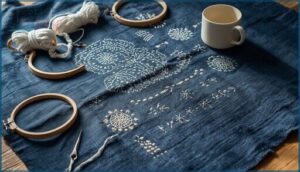
Sashiko has moved beyond its humble roots to become a real force in modern textile culture. You’ll see its influence everywhere, from high-end fashion runways to neighborhood craft circles.
Let’s look at how this traditional technique is shaping today’s creative communities and design trends.
Sashiko’s Influence on Modern Fashion
You’ll see sashiko patterns showing up everywhere, from luxury runways to everyday denim. KENZO stitched geometric patterns into bomber jackets, while the Sashiko Gals collective partnered with brands like Veja on limited-edition pieces.
This Japanese embroidery technique fits perfectly into sustainable fashion, extending garment life while adding visual punch. Denim innovation especially loves sashiko—those traditional patterns bring cultural resonance to global markets while reducing waste.
Community Groups and Workshops for Enthusiasts
Beyond high-fashion collaborations, you can join thriving sashiko communities worldwide. The Sashiko Stitch Club spans over 20 countries, while Facebook groups connect 18,000+ enthusiasts sharing techniques and patterns.
Workshops cap at 6-15 participants for hands-on learning, with instructor ratios staying at 1:6. Group skill levels range from newcomers to skilled stitchers, all preserving cultural traditions while exploring handmade innovations through online engagement and community outreach.
Frequently Asked Questions (FAQs)
How do I transfer a Sashiko pattern onto fabric?
You can hand-draw patterns on graph paper, use marking tools like water-soluble pens or tailor’s chalk, or choose preprinted Sashiko samplers.
Transfer paper options and Sashiko templates simplify the process while preventing pattern distortion.
What is the difference between Sashiko and Boro stitching?
Sashiko is the running-stitch technique you use to reinforce and decorate fabric. Boro is the layered, patched result that emerges from years of mending worn textiles with Sashiko and other repair stitches.
What are common mistakes made when stitching Sashiko?
Like a ship straying from its navigation points, new stitchers drift into trouble with uneven stitch length, wrong thread selection, excessive fabric tension, missed pattern errors, and rushed finishing touches in their sashiko embroidery technique journey.
How do I choose the right thread and needle for Sashiko?
Match thread thickness to your project type. Medium-weight thread suits large panels, while thin thread works best for intricate patterns.
Choose needle size based on thread diameter and fabric weave for smooth stitching.
How do I finish my Sashiko stitching without knots?
You can secure your thread by overlapping stitches through previous work for 1–2 cm. Backstitch finish techniques and thread weaving between fabric layers also work well without visible knots.
What needle length works best for sashiko?
Most practitioners use 2-inch (50mm) needles for 78% of their projects.
You’ll want longer needles for straight-line geometric patterns and shorter ones—around 36mm to 45mm—for curves, considering your hand size and thread thickness.
How do you wash sashiko-stitched garments safely?
Hand wash your sashiko textiles in cold water with mild detergent. Test colorfastness first, especially with indigo fabrics.
Air dry flat in shade to prevent thread damage and fabric shrinkage. Avoid harsh bleach or high-heat drying methods.
Can sashiko be done on denim?
Denim durability makes it perfect for sashiko mending and repair.
You’ll find creative mending techniques that blend modern colorways with traditional patterns.
Thread choice and stitching time vary, but the mending impact transforms worn jeans into art.
Whats the difference between sashiko and boro?
Sashiko describes the stitching technique itself—precise running stitches creating geometric patterns. Boro refers to the patched, layered textiles that result from years of mending.
One’s the process; the other’s the worn, beautiful outcome.
How long does a typical project take?
Like a tapestry woven from patience itself, your Sashiko embroidery projects unfold based on project size, pattern complexity, and stitching experience.
Small pieces need 3-6 hours, while intricate work spans 40-80 hours or more.
Conclusion
Picture your needle pulling thread through fabric in steady rows—each stitch building on the last. That’s how sashiko inspired modern stitching patterns work their way into your creative practice.
You’ve learned the foundations and explored new directions. Now the thread is in your hands. Start with one simple pattern and let your stitches speak.
The beauty you create doesn’t need permission to blend tradition with your own vision.
- https://www.craftpassion.com/sashiko-patterns/
- https://textileranger.com/2025/11/01/the-endeavourers-reveal-day-november-2025-sashiko/
- https://2025-japan-pavilion.go.jp/magazine/en/backissues/issue11/feature02/
- https://www.embroidery.rocksea.org/sashiko-sustainable-mindful-embroidery/
- http://sylvia-pippen.com/module/class/618290/sashiko--stitched-in-color-nov-15th--2025