
This site is supported by our readers. We may earn a commission, at no cost to you, if you purchase through links.
The fastest way to ruin a clean sewing job isn’t crooked stitching, it’s bad marking. One fuzzy line on silk, one chalk mark that won’t brush off, and suddenly a simple seam turns into a rescue mission.
Good fabric marking methods for sewing give you control before the needle ever moves. They help you place darts, match notches, follow curves, and keep slippery or thick fabrics from leading you astray.
Some tools vanish with water, some hold through pressing, and some work best on delicate cloth.
Once you know which mark to make, the whole project starts behaving better too.
Table Of Contents
- Key Takeaways
- Most Common Fabric Marking Methods
- Choosing The Right Marking Tool
- Top 10 Fabric Marking Tools for Sewing
- 1. Ogrmar Tailor Fabric Chalk Set
- 2. YEQIN White Fabric Chalk Wheel
- 3. Dritz Fabric Chalk Cartridge
- 4. Dritz Dual Ink Fabric Marking Pen
- 5. Leonis Water Erasable Fabric Pens
- 6. Clover Water Soluble Marking Pencils
- 7. Pilot FriXion Erasable Gel Pen
- 8. Ibotti Washable Fabric Marker Pen
- 9. Clover Hera Fabric Marker
- 10. OZXTYO Triangle Tailor Fabric Markers
- Tips for Accurate Fabric Marking
- Fabric Marking for Different Fabric Types
- Frequently Asked Questions (FAQs)
- Conclusion
Key Takeaways
- Matching your marking tool to your fabric type—like using water-soluble pens on silk or broad chalk on thick textures—prevents ghosting, stains, and rescue missions before they start.
- The three core marking methods (direct tools like chalk and pens, transfer methods with tracing wheels, and thread-based tailor’s tacks) each suit different fabrics and precision needs, so knowing all three gives you a reliable toolkit for any project.
- Always test your marking tool on a scrap first, remove marks before applying heat, and store tools in dry, airtight containers—because even the best marker becomes a liability when mishandled.
- Color-coding your marks (blue for seams, pink for darts, yellow for notches) cuts confusion fast and keeps complex projects organized without second-guessing yourself mid-stitch.
Most Common Fabric Marking Methods
Regarding sewing, marking your fabric accurately makes all the difference. There are several tried-and-true methods you’ll see used in every sewing room.
From tailor’s chalk to water-soluble pens, the right sewing fabric marking tools can take the guesswork out of every cut and seam.
Let’s look at the most common ways to mark fabric and how each one fits into your process.
Direct Marking With Pens, Pencils, and Chalk
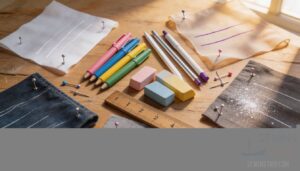
If you want quick, clear marks, direct tools are your best friends.
Whether you’re after Ink Permanence or Pencil Line Precision, these options have you covered:
- Fabric marking pens with ergonomic grip and heat‑set markers
- Fabric pencils for fine, removable lines
- Tailors chalk—great for Chalk Dust Control
- Soluble markers
- Air erasable pens
Using Tracing Paper and Tracing Wheels
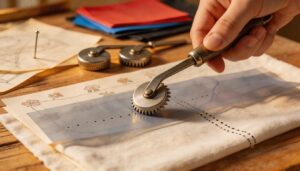
If you crave precision beyond pens and chalk, tracing paper and tracing wheels are your ticket. Using carbon paper with a tracing wheel, you can transfer crisp pattern lines with careful pressure control techniques.
Wheel tooth selection matters—serrated wheels for guidance, smooth for slippery fabrics.
Reusable tracing systems let you reposition marks, while carbon paper variants adapt to fabric types, minimizing unwanted fabric perforation effects.
Tailor’s Tacks and Thread Tracing
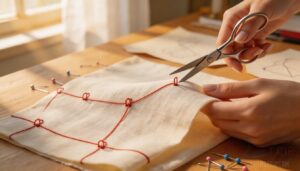
If tracing wheels feel too harsh for your fabric, try tailor’s tacks and thread tracing. Using contrast thread selection, you stitch gentle, visible marks right through the layers. This method excels at curved line tracing and fabric grain alignment. For best results, mind thread tension control and use tack removal techniques that protect delicate weaves from snags or marks.
- Choose a bright, contrasting thread
- Stitch along pattern lines with gentle tension
- Snip and remove tacks after fitting
Marking With Pins and Pin Wheels
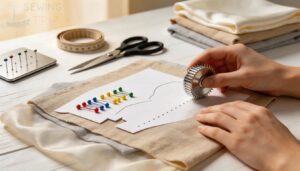
After mastering tailor’s tacks, you’ll find pins and pin wheels are a handy shortcut for marking pattern symbols without fuss.
Color-coded pins help you track notches and seam lines, while pin wheel pressure creates neat dots along weaving.
Use a magnetic pin board for easy access, select tip size for fabric safety, and follow pin removal tips to avoid visible holes.
Transfer Marking Techniques
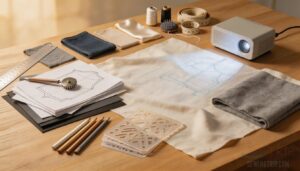
Although you might reach for a pen first, transfer marking techniques open up a world of precision.
Carbon Paper Transfer uses a tracing wheel and carbon paper for pattern transfer, while Heat Transfer Stencils and Wax Pencil Transfer make marks with an iron or stylus.
Water Soluble Transfer keeps things tidy, and Digital Projection Transfer lets you trace designs directly, perfect for basting and weaving.
Choosing The Right Marking Tool
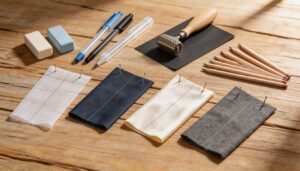
Choosing the right marking tool can make all the difference in your sewing results. Each fabric calls for its own approach, and not every tool works the same way.
Let’s look at how to pick the best option for your project.
Matching Tools to Fabric Types
Ever tried marking silk with a chalk pencil, only to watch the line vanish before you blink? The impact of fabric type on marking choice is huge. Choosing the right fabric marking tool means testing marking tools on scrap fabric first.
Marking silk teaches fast that every fabric demands its own tool—and a scrap test first
Here’s how:
- Silk Tool Selection
- Knit Marking Strategies
- Leather Safe Markers
- Delicate Fiber Options
- Heavy Fabric Solutions
Pros and Cons of Chalk, Pens, and Pencils
If you want crisp lines, fabric marking pens and pencils offer exceptional precision, but some bleed on loose weaves. Tailors’ chalks and chalk pencils shine for visibility on dark fabrics, though dust generation can be messy.
Chalk marks brush off easily—great for removal ease.
Each tool’s advantages and disadvantages depend on fabric compatibility and how much clarity you need for your project.
Safe Marking for Delicate and Thick Fabrics
Think silk is tricky? With fabric marking safety and stain prevention, you’ll breeze through.
For delicate fabrics, removable fabric pens and water‑soluble markers vanish with a damp cloth. On thick weaves, tailor tacks and chalk sticks won’t stain.
Color‑coded markers keep instructions clear, while pressure‑controlled wheels and non‑staining tapes guarantee fiber‑safe removal.
Basting as a marking method? Always reliable.
Top 10 Fabric Marking Tools for Sewing
Finding the right marking tool can make all the difference in your sewing projects. Each option has its own strengths, so it’s worth knowing what’s out there.
Here are ten trusted tools that can help you mark fabric with confidence and precision.
1. Ogrmar Tailor Fabric Chalk Set
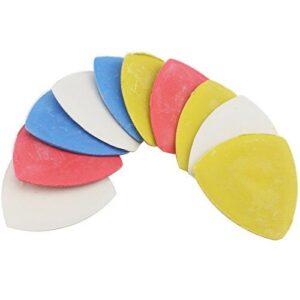
If you’re searching for a marking tool that’s as adaptable as a Swiss Army knife, the Ogrmar Tailor Fabric Chalk Set is your answer. Its triangular blocks—red, blue, white, and yellow—let you mark patterns on nearly any fabric, from cotton to linen.
Marks brush or wash away, so you’re free to adjust without worry. Each chalk is easy to grip and gives thin, clear lines.
The handy storage box keeps everything tidy, making this set a favorite for both beginners and pros.
| Best For | Professional tailors, quilters, and hobbyists who need easy-to-remove fabric markings in multiple colors. |
|---|---|
| Marking Method | Chalk Block |
| Removable Marks | Water/Brush |
| Color Options | 4 Colors |
| Intended User | Adult |
| Unit Count | 10 pieces |
| Price | $6.99 |
| Additional Features |
|
- Marks are temporary and wipe or wash away easily.
- Triangular shape is comfortable to hold and offers precise lines.
- Comes with four colors for great visibility on different fabrics.
- Chalk edges can feel sharp and may need smoothing before first use.
- May require extra pressure on dense or fuzzy fabrics.
- Chalk pieces can crack if dropped, and the cardboard box isn’t very durable.
2. YEQIN White Fabric Chalk Wheel
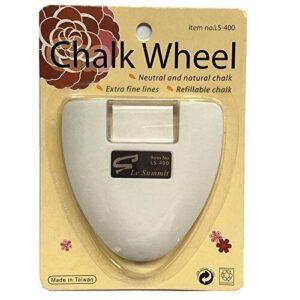
Need crisp, fine lines for tricky fabrics? The YEQIN White Fabric Chalk Wheel rolls out extra-thin marks—perfect for tailoring, quilting, and detail work.
Its metal roller dispenses white chalk powder that brushes or washes away, so you won’t worry about stains. This tool shines on silk and thick fabrics, where regular chalk slips or fades.
Refills snap in easily, and you can switch colors for clarity. Just remember to test on delicate textiles and avoid pressing too hard with the metal wheel.
| Best For | Tailors, quilters, and DIY sewists who need precise, removable lines on tricky fabrics like silk or thick material. |
|---|---|
| Marking Method | Chalk Wheel |
| Removable Marks | Water/Brush |
| Color Options | 4 Colors |
| Intended User | Adult |
| Unit Count | 1 wheel |
| Price | $8.59 |
| Additional Features |
|
- Makes extra-fine, clear marks that wash or brush away easily
- Works well on fabrics where regular chalk slips or fades
- Multiple chalk colors available for color-coded marking
- May require several passes for visible lines, especially on dark or smooth fabrics
- Delicate fabrics can be damaged if too much pressure is used
- No instructions included, and packaging may vary randomly
3. Dritz Fabric Chalk Cartridge
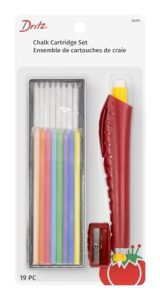
If you’re after precision and flexibility, the Dritz Fabric Chalk Cartridge is a smart pick.
Its slim chalk sticks (just 4 mm thick) let you mark sharp, accurate lines—ideal for darts, notches, and seam allowances. The cartridge’s built-in sharpener keeps your point crisp, while the reusable storage box keeps everything tidy.
You can swap between white and assorted colors for contrast on any fabric, and marks erase easily with a fabric eraser or iron.
It’s practical, tidy, and ready for complex projects.
| Best For | Anyone who needs precise, erasable fabric markings for sewing, quilting, or crafting projects. |
|---|---|
| Marking Method | Chalk Stick |
| Removable Marks | Eraser/Iron |
| Color Options | Assorted Colors |
| Intended User | Teen & up |
| Unit Count | 16 refills + cartridge |
| Price | $13.19 |
| Additional Features |
|
- Thin chalk sticks make sharp, accurate lines for detailed work
- Includes multiple colors and white for marking on both light and dark fabrics
- Built-in sharpener and storage box keep tools organized and ready to use
- Chalk sticks can break easily if pressed too hard
- Some colors may not show well on very dark fabrics
- Contains a chemical listed under California Prop 65, which may concern some users
4. Dritz Dual Ink Fabric Marking Pen
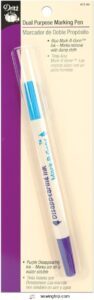
If you prefer a pen over chalk, the Dritz Dual Ink Fabric Marking Pen is a handy choice.
With its blue water-soluble side and purple disappearing ink, you get flexibility for marking everything from seam lines to embroidery motifs.
The purple ink fades on its own—perfect for slippery silks or quick projects—while the blue side wipes away with a damp cloth.
Just remember to test on a scrap, keep the cap on, and avoid ironing before marks are gone.
It’s practical and fuss‑free.
| Best For | Sewists, quilters, and embroiderers who need temporary, precise fabric markings that disappear without fuss. |
|---|---|
| Marking Method | Marking Pen |
| Removable Marks | Water/Air |
| Color Options | Dual Color |
| Intended User | 12+ years |
| Unit Count | 1 pen |
| Price | $4.77 |
| Additional Features |
|
- Dual-ended pen offers both water-soluble and air-soluble ink for different marking needs.
- Marks are easy to remove—either fade away or wipe off with a damp cloth.
- Fine tip makes it simple to draw detailed lines and patterns.
- Ink can dry out quickly, so cartridges may need replacing sooner than other markers.
- Purple ink requires gentle pressure; pressing hard can make marks harder to remove.
- Possible bleed-through on thin fabrics, so always test before using on your project.
5. Leonis Water Erasable Fabric Pens
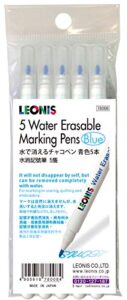
If you’re after crisp, removable lines, Leonis Water Erasable Fabric Pens are a solid pick. These Japanese-made pens use blue ink that washes out easily—no ghost marks or residue.
The fine tip is perfect for tracing patterns or marking embroidery guides, especially on cotton or muslin.
You’ll get five pens in a pack, so you won’t run short mid-project. Just remember, marks need water to disappear, so don’t iron before washing. For accuracy and ease, Leonis pens rarely disappoint.
| Best For | Crafters and sewists who need precise, washable marks on fabric for pattern tracing, embroidery, or sewing projects. |
|---|---|
| Marking Method | Marking Pen |
| Removable Marks | Water |
| Color Options | Blue |
| Intended User | Adult |
| Unit Count | 5 pens |
| Price | $9.99 |
| Additional Features |
|
- Fine tip creates crisp, detailed lines that don’t bleed on fabric.
- Ink washes out completely with water, leaving no residue or shadow.
- Short barrel makes the pen easy to handle and reduces hand fatigue.
- Fully round caps cause pens to roll off work surfaces easily.
- Small barrel size may feel awkward for users with larger hands.
- Ink can become permanent if you iron over marks before washing them out.
6. Clover Water Soluble Marking Pencils

Now, if you want a marking tool that’s as straightforward as a trusty pencil but washes out cleanly, Clover Water Soluble Marking Pencils are worth a look.
They come in blue, pink, and white—handy for separating seam lines from dart points.
Marks disappear with a damp cloth, so you won’t be left scrubbing.
The fine tip lets you draw sharp lines on cotton or linen, and each pencil’s cap keeps things tidy in your kit.
Always test on a scrap first for best results.
| Best For | Sewers and quilters who need precise, temporary markings that wash out easily from fabric. |
|---|---|
| Marking Method | Charcoal Pencil |
| Removable Marks | Water |
| Color Options | 3 Colors |
| Intended User | Adult/Child |
| Unit Count | 3 pencils |
| Price | $9.01 |
| Additional Features |
|
- Marks wipe away with a damp cloth, leaving no residue.
- Fine tip makes drawing detailed lines simple.
- Caps keep the pencils from drying out or breaking in your kit.
- Chalk core can break during sharpening or heavy use.
- Some colors may need several passes to show up on certain fabrics.
- Quality varies between batches, with occasional reports of easy breakage.
7. Pilot FriXion Erasable Gel Pen
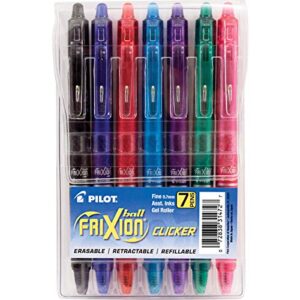
Even though FriXion pens are marketed for paper, many sewists reach for them when marking fabric because the thermo-sensitive ink disappears with a quick swipe of an iron.
The click-retract design keeps your hands clean, and the fine 0.7 mm tip is spot-on for detailed lines.
You’ll love the smooth gel flow and the range of colors for color-coding darts or notches.
Just remember, heat erases everything—so don’t use them for permanent marks or anything official!
| Best For | Mistake-prone note-takers, planners, and creative folks who want clean, erasable lines in multiple colors. |
|---|---|
| Marking Method | Gel Pen |
| Removable Marks | Friction/Heat |
| Color Options | 6 Colors |
| Intended User | Adult/Older Child |
| Unit Count | 7 pens |
| Price | $13.34 |
| Additional Features |
|
- Smooth gel ink erases cleanly with no residue.
- Click-retract tip means no lost caps or messy hands.
- Color variety helps organize notes, projects, or sketches.
- Heat can erase marks unintentionally—avoid for permanent records.
- Limited refill color options; full pen replacements needed for most colors.
- Ink reservoir is small and may run out quickly.
8. Ibotti Washable Fabric Marker Pen
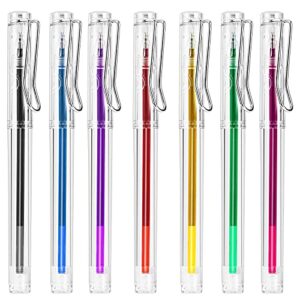
If you’re after vibrant, removable marks, the Ibotti Washable Fabric Marker Pen stands out. With seven water-soluble colors and fine gel-like tips, you can mark seam lines, darts, or embroidery details with precision.
The translucent barrel keeps you aware of ink levels, and the refill cartridges mean you won’t run dry mid‑project.
Just remember—soak your fabric for several hours to fully remove marks, and steer clear of ironing before washing, since heat can set the ink permanently.
| Best For | Crafters and sewists who want vibrant, precise fabric marks that can be washed out after finishing their projects. |
|---|---|
| Marking Method | Fabric Pen |
| Removable Marks | Water/Soak |
| Color Options | 7 Colors |
| Intended User | 12+ years |
| Unit Count | 7 pens + 14 refills |
| Price | $13.19 |
| Additional Features |
|
- Fine tips make detailed marking easy and clean.
- Seven bright colors show up well on different fabrics.
- Refillable design saves money for frequent users.
- Marks need several hours of soaking to fully wash out.
- Some colors may leave faint residue or not wash out completely.
- Ink can set permanently if exposed to heat before washing.
9. Clover Hera Fabric Marker
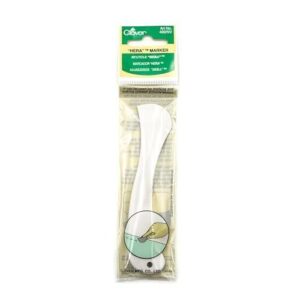
Here’s a tool that’s all about simplicity and precision—the Clover Hera Fabric Marker.
Instead of ink or chalk, you press a crease right into the fabric, making a visible guide for sewing or quilting.
It’s especially handy for hemming, marking fold lines, or prepping slippery materials.
No risk of stains, no messy residue, and marks vanish after a quick steam or wash.
If you’re tired of chasing disappearing lines, this pressure-based marker gives you control without fuss.
| Best For | Quilters, sewists, and garment makers who want clean, temporary fabric lines without the mess or risk of stains. |
|---|---|
| Marking Method | Hera Marker |
| Removable Marks | Steam |
| Color Options | White |
| Intended User | Adult |
| Unit Count | 1 piece |
| Price | $7.05 |
| Additional Features |
|
- No ink or chalk, so marks disappear easily and leave no residue.
- Works on many fabric types, including polyester batting.
- Simple to use, especially for beginners and precise hemming.
- May not work as well on very thick or dense fabrics.
- Only available in one size, limiting versatility for bigger or smaller projects.
- Can be hard to find in some regions due to distribution issues.
10. OZXTYO Triangle Tailor Fabric Markers
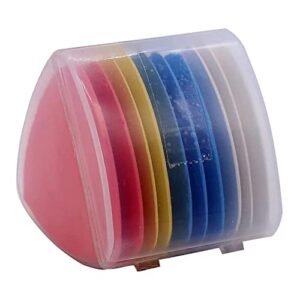
Looking for clear, color-coded marks that won’t leave you guessing?
The OZXTYO Triangle Tailor Fabric Markers offer four colors—blue, red, white, and yellow—so you can organize seam lines, darts, and pattern notes with confidence. Each triangle gives a crisp, fine line that stands out on light or dark fabrics and rubs away cleanly after sewing.
The shock-proof case keeps chalk safe, though it’s wise to add a band for extra security.
With ten pieces, you’re set for big projects and fine details.
| Best For | Hobbyists and professional sewists who need clear, removable marks for tailoring or quilting. |
|---|---|
| Marking Method | Tailor’s Chalk |
| Removable Marks | Water/Alcohol |
| Color Options | 4 Colors |
| Intended User | General |
| Unit Count | 10 pieces |
| Price | $5.95 |
| Additional Features |
|
- Four bright colors make it easy to organize and differentiate your fabric markings.
- Marks erase cleanly without damaging material, perfect for trial layouts.
- Compact, shock-proof case protects chalk during transport.
- Chalk pieces can break easily, especially with rough handling.
- Case doesn’t snap closed securely and may need extra reinforcement.
- Some packages may arrive with broken pieces due to fragile chalk.
Tips for Accurate Fabric Marking
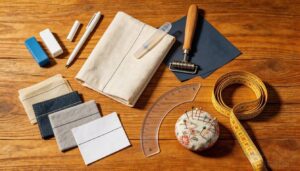
Getting your fabric marks crisp and reliable makes sewing so much easier.
There are few tricks and habits that can help you avoid headaches later on.
Here’s what you need to know to mark your fabric accurately every time.
Marking Inside Seam Allowances
You know, marking inside seam allowances is like drawing a roadmap for your stitches—miss it, and you risk wandering off course.
Keep your seam edge alignment crisp by sharpening your marking tool, testing pre‑marking fabric tension, and choosing contrast color selection.
Try fabric marking pens, tailor’s tacks, or basting for precise seam allowance marking, especially on tricky fabrics.
Removing Marks Safely After Sewing
Ever worry those marks will haunt your finished project? Removing fabric marking residues is simple if you follow these steps:
- Use Gentle Detergent Wash for water soluble ink and washout markings.
- Try chalk removal techniques with a soft brush or damp cloth.
- Always perform a Stain Remover Test on hidden seams.
- Stick to Heat‑Safe Ironing or iron‑activated erasers for stubborn marks.
Using Different Colors for Clarity
Once your marks are gone, clarity is your next ally.
A Color Coding System makes pattern layouts faster—blue for seams, pink for darts, yellow for notches.
Contrast Pairings and Dual Tone Markings keep lines legible, even under bright workshop lights.
Neon Visibility works wonders on dark fabrics, while color-coded markings help avoid mix-ups.
Choose color contrast for each fabric type, and plan your Color Removal Strategies.
Avoiding Common Marking Mistakes
If you’ve just sorted your color system, don’t let common marking mistakes trip you up. Pressure control matters—press too hard and you risk stains or stretched seams.
Scrap testing isn’t optional; always check removability on a spare inch. Timing removal keeps residues from setting.
Keep your tools sharp and clean, and match color contrast to fabric for safe, precise results.
Storing Marking Tools Properly
When you’re aiming for fabric marking safety and stain prevention, storing tools in dry airtight containers is your best bet. Humidity control and temperature regulation keep chalk crisp and pens fresh.
Clear labeling system speeds up tool selection.
For travel, portable carry cases protect your marking storage. Don’t forget sharpeners and refills—keeping everything together makes handling waxed tracing paper a breeze.
Fabric Marking for Different Fabric Types
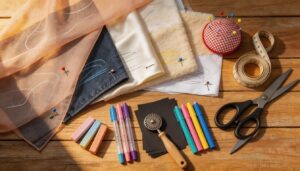
Every fabric has its quirks regarding marking. Knowing which method works best can make your sewing projects easier and cleaner.
Let’s walk through the most effective marking techniques for each fabric type.
Techniques for Light, Slippery Fabrics
Light, slippery fabrics like silk can feel as tricky as catching a fish bare-handed.
Tissue Underlay Stabilization keeps your fabric steady, while Low Residue Tape holds patterns in place without staining.
Pair a Microtex Needle Size 70/10 with Walking Foot Feeding for smooth sewing.
Use Light Spray Starch for body, water soluble markers or air erasable pens, tracing wheel, and fine basting thread.
Methods for Heavy, Textured Fabrics
When you face thick, nubby fabrics, you’ll need marking techniques that stand out and stay put. Try these textured fabric marking solutions:
- Broad Chalk Lines or High-Contrast Markers for visibility.
- Heavy Fabric Tacks or thread tracing for textured and knit fabrics—perfect for basting thread marking.
- Dotted Wheel Transfer with tracing paper for accurate transfer, focusing on Edge-Only Marking to avoid shifting.
Marking Medium-weight Woven Fabrics
Almost every sewing project calls for woven fabric marking best practices.
For medium-weight wovens, chalk pencils, tracing wheel with carbon paper, and heat‑set markers offer crisp lines. Scrap testing prevents ghosting, and using color contrast tips—like blue on light, white on dark—keeps marks visible.
Gentle pressure control avoids stretching.
Always mark inside seam allowances and remove marks promptly for a perfect finish.
Safe Marking for Water-sensitive Fibers
If you’re working with water‑sensitive fibers, fabric marking safety and stain prevention are key.
Try Low Alkalinity Chalk, air‑erasable pens, or soap slivers, and always use non‑contact transfer methods. Test marking tools on scrap fabric first.
For removal, distilled water works best—skip soapy washes.
Heat‑safe markers offer options, but water‑soluble markers need gentle handling.
Marking Fine and Sheer Materials
Ever tried marking silk fabric and felt like you’re threading a needle in a storm? You’ll want tools that barely touch the surface. For fine and sheer materials, try:
- Pressure Sensitive Pencils or Gel Chalk Application for light, removable lines
- Air‑Erasable Pens and water soluble markers for temporary marks
- Magnetic Template Guides and Low‑Residue Paper to protect delicate weaves with minimal contact
Frequently Asked Questions (FAQs)
What is the best thing to use to write on fabric?
The best fabric marker depends on your project. For most fabrics, water soluble markers offer great color visibility and removal ease.
Air erasable pens work beautifully too, balancing ink permanence with fabric compatibility.
What are the three methods of marking patterns on fabric?
Measure twice, cut once." The three core methods are direct marking (chalk, fabric marker), transfer marking (tracing wheel with carbon paper), and thread marking (basting or tailor’s tacks).
What to use instead of chalk to mark fabric?
Heat‑erasable pens, water‑soluble markers, removable fabric pens, carbon transfer sheets with a tracing wheel, FriXion fabric marking pens, spray stencils, carbon paper, and painter’s tape all work beautifully as chalk alternatives.
Can you mark fabric without traditional tools?
Yes, you can. Soap slivers, disappearing ink, and watersoluble markers work surprisingly well.
Even DIY fabric marking alternatives like heat erasable pens or digital projection can guide your stitching without a single traditional tool in sight.
How do you mark stretchy or knit fabrics?
Knit fabrics need gentle handling. Use solvent-free markers, water soluble markers, or air erasable pens to avoid fiber damage.
Contrast thread tracing works beautifully on textured knits, and magnetic template guides keep everything stable without stretching the fabric.
What marking methods work best for quilting?
For quilting, chalk wheels and water-soluble pens handle quilt block alignment cleanly across layered fabric marking.
Basting thread guides and heat-resistant marks keep multi-layer marking stable, while quilt marking spray speeds up quilt design transfer effortlessly.
Do marking tools expire or lose effectiveness?
Yes, marking tools absolutely expire. Liquid markers dry out within 6 months to 2 years, chalk loses its dusting power, and heat-erasable pens can permanently set if stored poorly.
Always test on scrap first.
How do you mark dark or black fabrics?
Use white or light-colored chalk, air erasable pens, or tailor’s tacks with contrast thread.
Always test first — dark fabrics can hide ghost lines or hold stubborn residue from heat soluble markers.
Can fabric markings cause permanent damage over time?
Think of a marking tool like a houseguest — most leave no trace, but a careless one can stain the carpet forever.
Yes, fabric markings can cause permanent damage if you’re not careful.
How do temperature changes affect fabric marking tools?
Temperature quietly sabotages your marking tools. Heat thins ink viscosity, causing faint lines, while cold brittleness cracks pen bodies.
Heat erasable pens vanish prematurely under warm irons, and chalk adhesion variance worsens in humidity.
Conclusion
secret to sewing success lies not in perfect stitches, but in imperfect beginnings—specifically, precise fabric marking.
Mastering various fabric marking methods for sewing gives you control and confidence. With the right tools and techniques, you’ll transform chaotic fabric into a harmonious garment.
Choose your marks wisely, and your seams will thank you. Accurate marking is the unsung hero of sewing; now, go forth and mark your fabric with precision and ease, always.