This site is supported by our readers. We may earn a commission, at no cost to you, if you purchase through links.
A misaligned seam allowance of even 1/8 inch compounds across every pattern piece until your finished garment fits no one.
Professional tailors know this—it’s why a good set of sewing rulers for garment making sits at the center of every serious cutting table, not buried in a drawer.
The ruler you reach for determines whether your French curves flow cleanly into a neckline or fight it, whether your hem lies flat or ripples.
With dozens of options spanning clear metric sets, flexible curves, and L‑squares, finding the right tools for your specific work cuts straight to the difference between a garment you’re proud of and one you’re ripping apart.
Table Of Contents
- Key Takeaways
- Essential Sewing Rulers for Garment Making
- Key Features to Look for in Sewing Rulers
- Top 9 Sewing Rulers for Garment Making
- 1. LJLJ Clear Metric Sewing Ruler Set
- 2. LINXIAO Metric Sewing Ruler Set
- 3. Sunenlyst Plastic French Curve Rulers
- 4. HLZC Clear Metric Sewing Ruler Set
- 5. Bequilter Fashion Design Sewing Ruler Set
- 6. Copkim Fashion Designer Tools Kit
- 7. EXTCCT Clear French Curve Ruler Set
- 8. Labriciyon 1:5 Fashion Design Ruler Set
- 9. Luqeeg French Curve Sewing Ruler Set
- Choosing The Right Sewing Ruler for Your Needs
- Tips for Using and Caring for Sewing Rulers
- Frequently Asked Questions (FAQs)
- Conclusion
Key Takeaways
- Even a tiny misalignment in your seam allowance compounds across every pattern piece, so the ruler you pick isn’t a minor detail — it’s what makes or breaks the fit.
- Different rulers do different jobs: French curves shape armholes and necklines, hip curves handle side seams, and L-squares lock in right angles, so you can’t get by with just one tool.
- Look for clear acrylic rulers with dual metric/imperial markings — transparency lets you see your fabric underneath, and dual scales mean you’re never stuck converting mid-draft.
- Beginner? Start simple with a straight ruler and one French curve; experienced drafters will get more out of a full set with specialized tools for grading and seam precision.
Essential Sewing Rulers for Garment Making
The right ruler can make or break your pattern work — and not every ruler does the same job.
If you’re not sure where to start, this guide on how to true a sewing pattern walks you through exactly why ruler choice matters at every step.
Garment making calls for a specific set of tools, each built to handle a different part of the process.
Here are the essential sewing rulers you’ll want in your toolkit.
Straight Rulers for Accurate Measurements
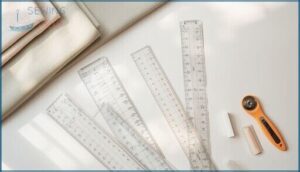
straight ruler is your most-used tool on the cutting table.
clear acrylic rulers with acrylic edge durability handle rotary cutters without nicking.
grid line alignment keeps hems and seams square, while midpoint centering scales and angle reference marks speed up pattern work.
Choose rulers with metric-imperial conversion markings — precision cutting across 1⁄16-inch or 1mm increments keeps every measurement exact.
clear grid rulers provide precise alignment for seam allowances.
French Curves for Shaping Armholes and Necklines
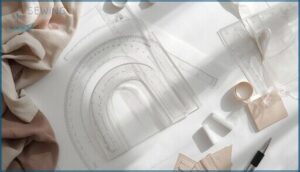
French curves are where pattern drafting gets precise. Mark armhole guide points — shoulder, mid-curve, and underarm — then rotate your French curve until it flows cleanly through all three.
For neckline depth adjustment, anchor one end at center front and walk the curve to the shoulder point.
Metric marking precision down to 1 mm keeps every contour exact.
Multi-curve set integration means one tool manages armholes and necklines both.
Choosing high-quality drafting rulers ensures durability and accuracy.
Hip Curves and Flexible Rulers for Pattern Drafting
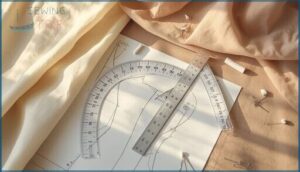
Where French curves leave off, hip curves and flexible rulers take over. A 24-inch hip curve mimics your body’s waist-to-hip arc, making seam change techniques on fitted pants and skirts feel smooth. Pair it with a 12-inch flexible ruler for armholes and necklines.
- Curve measurement accuracy down to 1mm on dual metric/imperial scales
- Material flexibility impact: pliable plastic holds custom shapes repeatedly
- Multi-scale drafting facilitates ergonomic curve handling across varied garment sizes
L-square and Tailor’s Rulers for Precise Right Angles
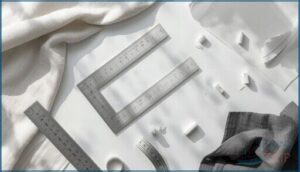
When curves aren’t enough, you need hard angles.
An Lsquare locks two arms at exactly 90 degrees—no angle calibration techniques required on your end.
Tailor rulers with dual-scale conversion let you work in inches or centimeters instantly.
Grading scale integration and material edge sharpness keep every square, rectangular corner clean.
Ergonomic grip design means less fatigue during long drafting sessions.
Specialized Rulers for Seam Allowances and Hems
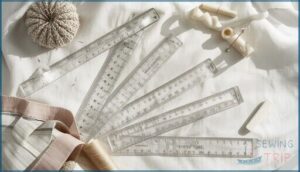
Precision lives in the details — and that’s exactly where specialized rulers earn their place.
- Seam guide rulers set allowances from ⅛ inch to 2 inches consistently
- Add‑a‑Quarter rulers hook over seam lines for exact ¼-inch trimming
- Sliding gauges lock hem depths without re-measuring
- Hot hem rulers let you fold and press in one motion
These sewing and patternmaking tools make every seam count.
Key Features to Look for in Sewing Rulers
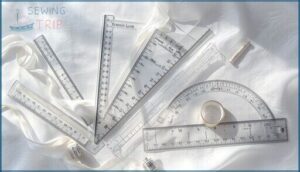
Not all sewing rulers are built the same, and the right one can make or break your pattern work.
Before you grab just any ruler off the shelf, it helps to know what actually matters.
Here are the key features worth checking before you buy.
Measurement Markings (metric Vs. Imperial)
Your ruler’s measurement system can make or break a project.
Dual Scale Conversion rulers handle both metric measurements and imperial measurements on a single tool — metric in black, imperial in yellow — so Color‑Coded Markings let you switch systems instantly.
Look for Grid Line Density with 1mm precision, Fractional Increment Accuracy down to ⅛ inch, and built‑in Seam Allowance Standards for consistent, professional results.
Material Durability (plastic, Metal, Wood)
Material choice matters more than most sewists realize.
Acrylic brittleness is a real concern — drop it edge‑first and it can crack.
Metal rulers win on stainless corrosion resistance and longevity, but they’re heavier.
Wooden rulers look classic, though wood warping near steam irons is a genuine risk.
Plastic offers UV stability and flexibility under stress, making it the everyday workhorse for most home studios.
Transparency and Grid Lines for Precision
A transparent ruler is like working with a window instead of a wall — you see everything underneath, which changes how you work entirely. Clear grid rulers give you fabric visibility that opaque tools simply can’t match, letting you lock grid alignment to stripes, checks, or grainlines instantly.
A transparent ruler turns your cutting table into a window, revealing every grainline beneath
- Contrast markings (black or black-and-yellow) stay readable across light and dark fabrics
- Bias cutting becomes reliable when 45-degree diagonal grid lines are built directly into the ruler
- Rotary cutter integration works best with transparent rulers — you watch the blade path while keeping pattern pieces perfectly positioned
- Scale markings in 5mm or 0.25-inch increments support precision in sewing and fashion design, letting you add seam allowances directly over drawn stitching lines
Ergonomic Shapes for Ease of Use
Your hands do a lot of talking when you’re cutting garment pieces — so why fight your tools? Ergonomic rulers with soft grip edges and curved handle design let you guide cuts without clenching.
Non-slip foot profiles keep things steady, while lightweight contour shapes reduce fatigue. Adjustable angle guides lock in right angles fast, so smooth accurate curves and clean lines stay within reach.
Compatibility With Pattern Drafting Tools
Your sewing ruler needs to speak the same language as your software.
For DXF Integration, transparent rulers trace armhole curves from AccuMark imports with 0.1 mm precision.
SVG Overlay lets you align paths from Seamly2D exports without scaling errors.
CAD Sync, Cutting Machine Alignment, and Scale Matching guarantee your pattern drafting ruler, tailor rulers, and other measuring and cutting tools stay accurate across every pattern making tool you use.
Top 9 Sewing Rulers for Garment Making
Now that you know what to look for, it’s time to match that knowledge to real options. These nine rulers cover a solid range of styles, from metric sets to French curve collections, so there’s something here for every stage of garment making.
Here’s a closer look at each one.
1. LJLJ Clear Metric Sewing Ruler Set
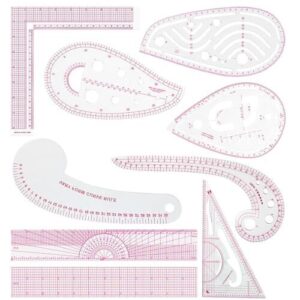
The LJLJ Clear Metric Sewing Ruler Set gives you four purpose-built tools in one compact kit — comma-shaped curve, triangular straight-edge, multi-angle ruler, and half-round for circular pattern work.
Each piece is made from lightweight, flexible plastic that won’t crack under pressure. The clear body lets you see your fabric lines as you trace, and the etched metric markings stay crisp over time. At just over half a pound, it’s a solid starter set for any pattern drafter.
| Best For | Sewers, pattern makers, and fashion design students who want an affordable, lightweight metric ruler set that covers everything from curves to straight edges. |
|---|---|
| Material | Plastic |
| Piece Count | Multiple styles |
| Skill Level | Beginner and experienced |
| Measurement System | Metric only |
| Primary Use | Sewing and quilting |
| Includes Curves | Yes |
| Additional Features |
|
- Four different ruler shapes in one kit — you’ve got curves, angles, and straight edges covered without buying separate tools
- Clear plastic body lets you see your fabric or paper underneath while you work, so lining things up is actually easy
- Lightweight and flexible — won’t crack if you bend it a little, and easy to carry around
- Runs smaller than some people expect, so if you’re used to working with larger rulers, it might feel a bit fiddly
- Metric only — if you think in inches, you’ll need to adjust or keep a conversion handy
- Lightweight plastic means it might shift around on slippery fabric if you’re not holding it steady
2. LINXIAO Metric Sewing Ruler Set
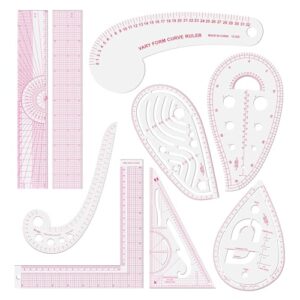
The LINXIAO set takes things up a notch with nine pieces — more tools, more coverage. You get straight rulers, a French curve, and grips for better control, all cut from shatterproof transparent acrylic. Both inch and metric scales are printed clearly, so you’re not squinting mid‑draft.
The whole kit packs into a protective case, which makes it easy to carry between studio and fitting room. If you’re working across multiple project types, this set pulls real weight.
| Best For | Beginners, hobbyists, and crafters working across multiple projects like quilting, embroidery, or sewing who want a versatile, portable set without breaking the bank. |
|---|---|
| Material | Acrylic |
| Piece Count | 9-piece set |
| Skill Level | Beginner and experienced |
| Measurement System | Inch and metric |
| Primary Use | Sewing and quilting |
| Includes Curves | Yes |
| Additional Features |
|
- Nine-piece set covers a wide range of needs, from straight lines to smooth curves
- Shatterproof acrylic with both inch and metric scales makes measuring quick and easy
- Comes in a protective case, so it’s easy to pack up and take anywhere
- Rulers run small, which can be frustrating for adult garment or pattern work
- Not built for heavy, large-scale projects where sturdier tools would hold up better
- Quality reflects the price point — fine for casual use, but may not satisfy pros
3. Sunenlyst Plastic French Curve Rulers
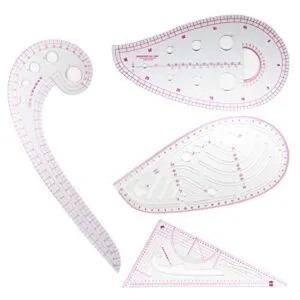
Where the LINXIAO covers volume, the Sunenlyst set covers versatility.
Four distinct shapes — comma, triangular, multi-function, and half round — handle everything from tight armhole curves to smooth neckline sweeps.
Each ruler is made from clear, flexible plastic that bends without breaking, so you can follow a curve without fighting your tool.
They’re lightweight enough for long drafting sessions and transparent enough to trace directly over your pattern pieces.
At under four ounces total, this set punches above its weight.
| Best For | Students, designers, tailors, and pattern makers who need a versatile set of curves for sewing, drafting, and craft projects. |
|---|---|
| Material | Plastic |
| Piece Count | 4-piece set |
| Skill Level | Beginner and experienced |
| Measurement System | Metric only |
| Primary Use | Sewing and drafting |
| Includes Curves | Yes |
| Additional Features |
|
- Four distinct shapes cover a wide range of curves, from tight armholes to smooth necklines
- Clear, flexible plastic makes it easy to trace directly over pattern pieces
- Lightweight and durable enough for long drafting sessions without hand fatigue
- Thin construction means they can bend more than expected under pressure
- Markings are small, which can be tricky to read quickly
- Not ideal for large-scale pattern pieces like skirts or trousers
4. HLZC Clear Metric Sewing Ruler Set
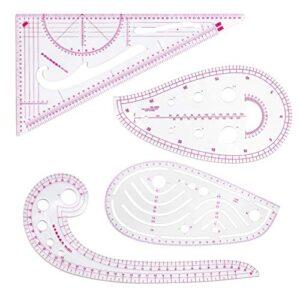
The HLZC set takes a different angle — four pieces, flexible pink plastic, and a focus on metric measurements that suit pattern drafters working in centimeters.
You get French curves, a triangle ruler, and individual storage bags, which means less time hunting for the right tool mid‑draft.
At under four ounces, it travels well.
Beginners especially appreciate how easy the markings are to read.
The trade‑off? No inch measurements, so if you work in imperial, this one isn’t your match.
| Best For | Beginner to intermediate sewers and pattern makers who work in centimeters and want a lightweight, portable ruler set for drafting, sewing, and fashion design projects. |
|---|---|
| Material | Flexible plastic |
| Piece Count | 4-piece set |
| Skill Level | Beginner and experienced |
| Measurement System | Metric only |
| Primary Use | Pattern making |
| Includes Curves | Yes |
| Additional Features |
|
- Four-piece set with French curves and triangle ruler covers most drafting needs in one kit
- Flexible pink plastic and clear markings make tracing curves and reading measurements simple
- Lightweight at under four ounces and comes with individual bags, so it’s easy to store and take on the go
- Metric only — no inch measurements, so imperial sewers will need to look elsewhere
- Thin and lightweight construction may not hold up well under heavy or professional use
- Some users have noted a noticeable smell from the plastic material
5. Bequilter Fashion Design Sewing Ruler Set
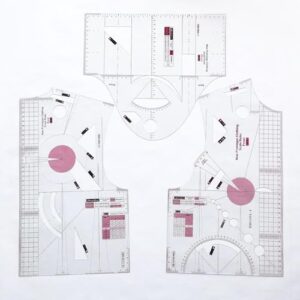
Bequilter Fashion Design Sewing Ruler Set pulls together everything you need for serious pattern work — straight rulers, French curves, hip curves, and an L-square — all in one kit. Made from clear acrylic with dual metric and imperial markings, you can follow any pattern instruction without converting units.
It covers bodices, sleeves, necklines, and waistbands. Whether you’re a student or a working dressmaker, it’s a budget-friendly starter bundle that doesn’t cut corners on the shapes that matter most.
| Best For | Fashion design students, hobbyists, and dressmakers who want an all-in-one ruler kit for drafting women’s blouse patterns with precision. |
|---|---|
| Material | Acrylic |
| Piece Count | Multiple templates |
| Skill Level | Beginner and experienced |
| Measurement System | Inch and metric |
| Primary Use | Fashion design |
| Includes Curves | Yes |
| Additional Features |
|
- Covers all the key pattern pieces — bodices, sleeves, necklines, and more — so you’re not hunting for extra tools
- Clear acrylic with both inch and centimeter markings means you can work from any pattern without unit headaches
- Lightweight and thin, so storage isn’t a nightmare despite the set size
- Focused specifically on women’s blouses, so it won’t help much if you’re branching into menswear or other garment types
- Some experience with pattern-making helps — total beginners might feel a little lost at first
- The 15-inch length could be awkward to store if your workspace or drawer space is tight
6. Copkim Fashion Designer Tools Kit
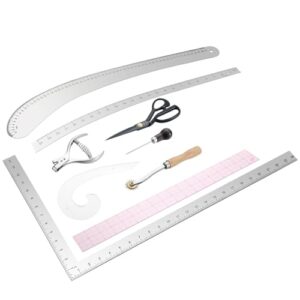
The Copkim Fashion Designer Tools Kit gives you nine dedicated tools in one package — aluminum curve rulers, an L-square, a hip curve ruler, a French curve, grading ruler, tracing wheel, notcher, awl, and tailor’s scissors.
The aluminum construction resists warping, so your measurements stay true over time.
The 24-inch hip curve manages side seams and crotch shaping, while the 12-inch curve ruler tightens armholes and necklines with control.
Whether you’re drafting from scratch or grading existing patterns, this kit covers the full workflow.
| Best For | Fashion students, pattern makers, and DIY sewers who want a solid all-in-one kit without hunting down tools separately. |
|---|---|
| Material | Metal and acrylic |
| Piece Count | 9-piece set |
| Skill Level | Beginner and experienced |
| Measurement System | Metric and inch |
| Primary Use | Fashion design |
| Includes Curves | Yes |
| Additional Features |
|
- Nine tools in one package covers the full pattern-making workflow, from drafting to cutting
- Aluminum rulers resist warping, so your measurements hold up over repeated use
- Works for beginners and experienced designers alike
- Some tools like the straight ruler can feel flimsy compared to the rest of the kit
- Scissors sharpness and overall quality can be hit or miss
- Manual measurements may have slight sizing errors, so double-check critical cuts
7. EXTCCT Clear French Curve Ruler Set
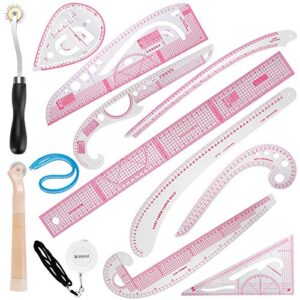
The EXTCCT Clear French Curve Ruler Set puts 13 transparent plastic rulers in your hands — curves sized for armholes, necklines, hips, and crotch seams, plus straight and multi-purpose combination rulers.
The see-through design lets underlying pattern lines show through, so alignment stays honest. Metric gradations run along both straight and curved edges for precise seam allowances and blending. It’s a solid starter kit for beginners, though experienced sewers may find the thin plastic less rigid than they’d prefer.
| Best For | Beginners and hobbyist sewers who need an affordable all-in-one set for drafting basic clothing patterns. |
|---|---|
| Material | Acrylic |
| Piece Count | 9-piece set |
| Skill Level | Beginner and experienced |
| Measurement System | Metric and inch |
| Primary Use | Pattern making |
| Includes Curves | Yes |
| Additional Features |
|
- 13-piece set covers the most common curves — armholes, necklines, hips, and more
- Clear plastic lets you see pattern lines underneath for easier alignment
- Metric markings on both straight and curved edges make seam allowances quick to measure
- Thin plastic feels flimsy and may flex when you need a firm edge
- No instructions included, so beginners may not know which ruler to reach for
- Fine measurement lines on the flat ruler can be hard to read at a glance
8. Labriciyon 1:5 Fashion Design Ruler Set
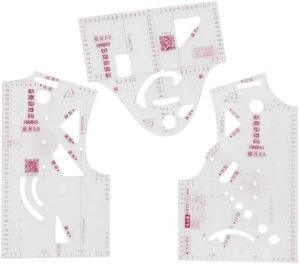
Think small to design big — that’s the idea behind the Labriciyon 1:5 Fashion Design Ruler Set. This three‑piece plastic set lets you draft scaled garment patterns at one‑fifth actual size, so you can sketch necklines, armholes, and side seams without burning through full sheets of pattern paper.
It’s lightweight, easy to store, and genuinely useful for students learning pattern relationships. Just know upfront: scaled for miniature drafting, not full‑size construction work.
| Best For | Fashion design students and hobbyists who want to practice pattern drafting at a smaller scale without wasting materials. |
|---|---|
| Material | Plastic |
| Piece Count | 13-piece set |
| Skill Level | Beginner and experienced |
| Measurement System | Metric only |
| Primary Use | Fashion design |
| Includes Curves | Yes |
| Additional Features |
|
- Great for learning pattern relationships — necklines, armholes, seams — without committing to full-size paper
- Lightweight and compact, so it’s easy to toss in a bag or store in a small space
- Works surprisingly well for making doll clothes like Barbie outfits
- The small size catches some buyers off guard — it’s not meant for full-size garment construction
- The 1:5 scale limits its usefulness for professional, production-level design work
- Product descriptions can be a bit misleading, so it’s easy to order with the wrong expectations
9. Luqeeg French Curve Sewing Ruler Set
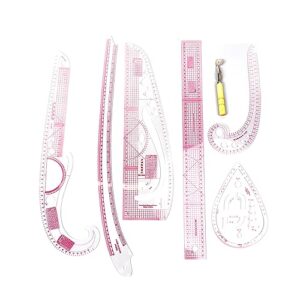
The Luqeeg French Curve Sewing Ruler Set gives you a full toolkit in one flat package. Clear plastic construction lets you see your pattern lines right through the ruler — no guessing, no shifting.
Each piece targets a specific task: necklines, armholes, hip curves, side seams.
The millimeter-scale markings in contrasting ink stay readable session after session.
Lightweight enough for class, sturdy enough for daily drafting.
If you’re building a pattern toolkit from scratch, this set covers the essentials without the clutter.
| Best For | Beginners, tailors, and home sewers who want an all-in-one ruler set for drafting and shaping garment patterns with accuracy. |
|---|---|
| Material | Plastic |
| Piece Count | 3-piece set |
| Skill Level | Beginner and experienced |
| Measurement System | Metric scale |
| Primary Use | Pattern making |
| Includes Curves | Yes |
| Additional Features |
|
- Covers the essential curves — necklines, armholes, hips — so you’re not hunting for separate tools
- Clear millimeter markings make it easy to measure and transfer pattern lines quickly
- Lightweight and compact enough to toss in a bag for class or a sewing group
- Plastic and wood construction may wear down faster under heavy, daily use
- Really only useful for sewing and pattern work — not much crossover into other crafts
- Complex projects might still need extra specialized tools beyond what’s in the set
Choosing The Right Sewing Ruler for Your Needs
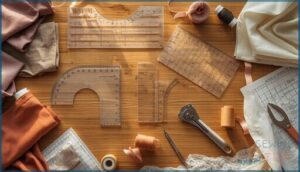
Not every ruler works for every project — and that’s actually a good thing.
Once you know what you’re making and how you like to work, the right tool becomes obvious.
Here’s what to think about before you pick yours.
Matching Rulers to Garment Types and Techniques
Your garment type calls the shots on which ruler you reach for first.
- Bodices & tops — French curves nail armholes, necklines, and sleeve caps with tailor rulers built for custom sizing
- Skirts & pants — hip curves handle garment construction along side seams from waist to hip
- Custom jackets — designer combination rulers manage lapels and collar lines
- Knits & casuals — straight sewing ruler measurements plus gentle curves keep things fluid
Ruler Sets Vs. Single Rulers
Sets win on cost efficiency and workflow speed — you get French curves, hip curves, and L-squares in one purchase, usually between 15 and 40 euros.
But if storage space is tight or portability matters, one solid pattern drafting ruler covers the basics beautifully.
Your skill development stage matters too: committed drafters get more mileage from a full set.
Considerations for Beginners Vs. Advanced Users
Your skill level shapes everything here.
If you’re just starting out, one clear straight ruler and a basic French curve cover most measuring tools you’ll need — there’s no reason to overcomplicate your learning curve early on.
Experienced sewers doing serious pattern drafting need accuracy down to a millimeter, which means more specialized sewing tools and a smarter expansion strategy as your work demands it.
Budget, Brand, and Availability Factors
Once you know your level, budget becomes your next filter. Basic sewing rulers start around $7–$10, while mid-range sets with better clarity run $12–$20 — solid value for the price tier comparison. Brand reputation scores matter too; look for 4.3+ star ratings and high monthly sales. Watch for discount bundle options and stock level alerts, since shipping time variability can delay your next project.
- Choose trusted tailoring tools with verified buyer reviews
- Bundle sewing and quilting supplies to lower per-piece cost
- Check availability early — sewing tools and accessories sell out fast
Tips for Using and Caring for Sewing Rulers
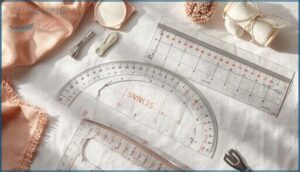
Getting the most out of your sewing rulers isn’t just about how you use them — it’s also about how you treat them.
A little care goes a long way toward keeping your measurements accurate and your tools lasting for years.
Here’s what you need to know.
Proper Storage to Prevent Damage
Your rulers deserve better than a cluttered drawer. Flat storage on a shelf or in a tray keeps acrylic from warping over time — a simple sewing ruler tip that pays off every time you draft.
Use rack systems on pegboards for easy access, and portable cases for travel. Climate control and impact protection round out smart sewing ruler storage habits.
Cleaning and Maintaining Clear Rulers
Clear rulers need simple, consistent care. Gentle Soap Wash with lukewarm water removes oils and starch buildup that blur your grid lines.
Follow with Microfiber Lint Removal to avoid scratching the surface. Scratch Polishing Techniques, a dab of non‑gel toothpaste works surprisingly well.
Always practice Avoiding Harsh Solvents — acetone clouds acrylic fast. UV Protection Storage in a drawer preserves those markings long‑term.
Safety Tips When Using Sharp Tools With Rulers
Sharp tools demand respect. Your hand position matters more than most sewers realize — keep fingers tented and at least 2–3 cm from the ruler edge.
For blade handling, open your rotary cutter only when your cutting setup is ready, then lock it immediately after.
Non-slip pads boost ruler stability, and a cut-resistant glove is the smartest safety gear investment you’ll make.
Maximizing Accuracy in Pattern Drafting
Drafting with precision isn’t guesswork — it’s a system. Build yours around these five habits:
- Use Zero‑Start Edge rulers to eliminate parallax error reduction issues at the ruler’s tip.
- Apply Dual‑Scale Calibration for switching seamlessly between metric and imperial mid‑pattern.
- Check Grid Alignment against your grainline before every seam.
- Walk seams to confirm Consistent Seam Allowance on both edges.
- Trace, don’t cut — preserve your master for pattern drafting techniques that last.
Frequently Asked Questions (FAQs)
Can sewing rulers double as cutting guides?
Yes, and they pull double duty beautifully.
Acrylic and metal sewing rulers offer Rotary Cutter Compatibility with strong Guide Edge Maintenance, delivering solid Cutting Accuracy Metrics while Material Grip Benefits and Safety Blade Positioning keep every cut clean and controlled.
How do I scale patterns using rulers?
To scale patterns, use a grading ruler with the slash-spread method or grid scaling technique.
Match your body measurement ratio, apply fractional increment markings, and adjust seam allowances after grading for clean, accurate pattern alterations.
Are sewing rulers suitable for leather garments?
Sewing rulers work well for leather garments.
Use metal-edged rulers for cutting, flexible curve rulers for seams, and avoid cork backed rulers.
Acrylic transparency issues arise near heat, so store them carefully.
Can rulers help with grading between sizes?
Absolutely — rulers are your secret weapon for grading.
They keep cardinal point alignment sharp, support incremental size shifts, and make curve blending ease feels smooth across multi‑size drafting without guesswork.
Do digital pattern tools replace physical rulers?
Digital tools speed up workflow and improve fit accuracy, but they don’t fully replace your sewing ruler.
A hybrid workflow — drafting by hand, then digitizing — remains the go-to for most garment construction pros.
Conclusion
The difference between a garment that fits perfectly and one that doesn’t often comes down to a single tool decision made before you cut your first piece. Every curve you trace, every seam allowance you mark—it all traces back to what’s in your hand at that moment.
Choosing the right sewing rulers for garment making isn’t just preparation; it’s the decision that determines everything that follows. Pick deliberately, and your fabric will prove it.
- https://inthefolds.com/blog/2024/guide-to-sewing-patternmaking-rulers
- https://www.thecreativecurator.com/french-curve-ruler-for-sewing/
- https://www.craftsy.com/post/curved-rulers/
- https://www.kearing.com/3-curved-rulers-you-need-for-sewing/
- https://snugglesquilts.com/cutting-mat-rotary-cutter-and-sewing-machine-tips-maintenance-to-keep-you-sewing/