This site is supported by our readers. We may earn a commission, at no cost to you, if you purchase through links.
A wobbly seam allowance or a pattern piece that’s off by half an inch can unravel an entire project before you’ve cut a single stitch.
Most home sewists blame their skills when the real culprit is often the ruler in their hand—or the wrong one for the job.
The right sewing rulers for home sewists make the difference between a garment that fits and one that sits unfinished in a drawer.
From quilting grids to French curves, each ruler solves a specific problem, and knowing which to reach for sharpens every cut you make.
Table Of Contents
- Key Takeaways
- Essential Sewing Ruler Types for Home Sewists
- Key Features to Look for in Sewing Rulers
- Top 9 Sewing Rulers for Home Sewists
- 1. LINXIAO Metric Sewing Ruler Set
- 2. Fiskars Sewing Ruler 6×24 Clear Black
- 3. Fiskars Acrylic Sewing Ruler 3 by 18
- 4. HLZC Clear Metric Sewing Ruler Set
- 5. Mr Pen Acrylic Sewing Ruler 3×17
- 6. VPVPV Quilting Acrylic Ruler Set
- 7. Linxiao Acrylic Quilting Ruler Set Green
- 8. OZXTYO Tailor Chalk Fabric Markers
- 9. LJLJ Clear Metric Sewing Ruler Set
- Choosing The Right Sewing Ruler for Your Needs
- Maximizing Precision and Safety With Sewing Rulers
- Frequently Asked Questions (FAQs)
- Conclusion
Key Takeaways
- Matching the right ruler to your project type — French curves for garment seams, quilting rulers for patchwork, L-squares for drafting — is what separates clean, confident cuts from frustrating guesswork.
- Clear acrylic with non-slip backing and dual metric/imperial markings aren’t just nice extras; they’re the features that keep your measurements accurate and your fabric from shifting mid-cut.
- Buying a ruler set gives you more coverage for less money, but seasoned sewists often get better results by investing in single specialty tools built for the precise work they do most.
- Taking care of your rulers — storing them flat or hanging, keeping them away from heat, and replacing them when markings fade — protects the accuracy you rely on every single time you cut.
Essential Sewing Ruler Types for Home Sewists
Choosing the right sewing ruler can make your projects smoother and more accurate.
Once you’ve picked your tool, trying out sewing rulers designed for beginners and kids on a simple project is the fastest way to build real confidence.
There are several types, each designed for a specific task or technique.
Here’s a look at the most useful options for home sewists.
Straight Rulers for Basic Measuring
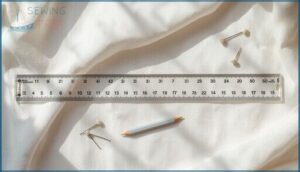
Even if your project starts small, a straight ruler is invaluable for basic measuring. Choose clear acrylic rulers with metric markings for easy Metric‑Imperial Conversion and sharp Edge Visibility Tips.
Durable acrylic and nonslip design help prevent fabric shifts. A Length Selection Guide suggests 12‑inch rulers for most tasks, while Budget‑Friendly Options offer slim widths for precise marking and reliable Material Grip Comparison.
Quilting Rulers for Patchwork Precision
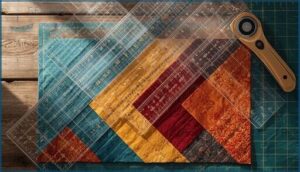
If you want patchwork precision, quilting rulers are the backbone of your toolkit. Their clear acrylic thickness benefit, paired with non‑slip backings, keep every cut true. Grid line angles help you tackle triangles and diamonds, while square up techniques and fussy cut centering make block trimming easy. Look for these features:
- 30/45/60° grid lines
- Fussy cut frames
- Non‑slip coating
- 3mm acrylic
Consider adding a specialty block ruler to improve accuracy for triangular cuts.
French Curve and Hip Curve Rulers
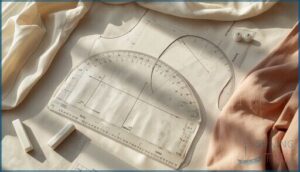
Straight rulers nail the basics, but when your patterns need curves, that’s where French curve pattern rulers and hip curves take over.
French curves handle armholes and necklines, while hip curves shape side seams and waist-to-hip transitions naturally.
Material transparency benefits let you trace directly over existing lines, and adjustable pivot points help you blend sizes without guesswork—solid sewing ruler accuracy for garment work.
The acrylic French curve ruler offers precise alterations for upcycling projects.
L-Square and Pattern Drafting Rulers
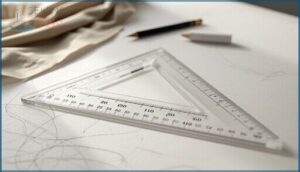
Once your French curves shape those necklines, the L-square locks everything else into place. This ruler’s two arms meet at a precise 90-degree angle, making pattern drafting feel almost foolproof. Here’s what makes it indispensable:
- Fractional scales simplify halving or quartering body measurements instantly
- Angle transfer techniques square trouser legs and hems cleanly
- Clear acrylic rulers offer material transparency benefits for tracing
- Gridline accuracy keeps measurement markings consistent throughout your drafting workflow integration
Specialty Rulers for Unique Projects
Specialty rulers are where your toolkit gets truly interesting. Curved Pocket Templates keep pocket openings consistent, while Buttonhole Guide Rulers eliminate guesswork on spacing.
For garment work, Couture Draping Rulers and Shoe Pattern Rulers handle shapes that standard tools simply can’t. Embroidery Stencil Rulers make fabric marking simple, and quilting templates paired with pattern drafting tools bring precision cutting to even the most complex designs.
Key Features to Look for in Sewing Rulers
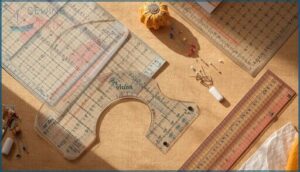
Not all sewing rulers are created equal, and the right features can make a real difference in your work.
Before you buy, it’s worth knowing what to look for so you don’t end up with something that slips, fades, or just doesn’t fit your projects.
Here are the key features that matter most.
Measurement Markings: Metric Vs. Imperial
Choosing between metric and imperial isn’t just a preference—it’s about matching your ruler to your patterns.
Many dual‑system design rulers print both scales on the same edge, giving you incremental precision without swapping tools.
Metric markings show millimeter steps clearly, while imperial measurements divide into ⅛-inch increments.
For fabric compatibility across international patterns, scale visibility matters.
A sewing ruler buying guide always recommends dual‑marked options for flexible conversion tips.
Material Durability: Acrylic, Metal, and Wood
Material durability shapes how long your tools stay accurate. Each option has real trade-offs:
- Durable acrylic – lightweight and affordable, but prone to edge chipping over time.
- Metal ruler – resists corrosion and bending, though blades dull faster against it.
- Wood – warps from moisture swelling in humid rooms.
- Polycarbonate – excellent crack resistance, outlasting standard acrylic considerably.
Match your material to your workflow.
Transparency and Grid Lines for Accuracy
Clear acrylic rulers change how you cut. With Crystal Clear Acrylic and a Non-Reflective Surface, you can see fabric grain lines and pattern prints directly beneath your ruler — no guessing.
Fine Grid Increments (as small as ⅛ inch) keep your cuts tight, while Contrast Line Colors stay readable on any fabric.
Angle Alignment Marks handle bias cuts and triangles without re-measuring each piece.
Non-Slip and Ergonomic Designs
A ruler that slides mid-cut can ruin an entire panel. That’s why nonslip rulers and ergonomic design matter more than most sewists expect.
- Grip Textures like etched backing and adhesive dots keep fabric locked in place
- Handle Shapes reduce hand fatigue during long cutting sessions
- Edge Comfort comes from polished, beveled durable acrylic edges
- Pressure Distribution stays even, preventing rotary cutter wobble
- Visual Contrast markings stay sharp against any fabric color
Compatibility With Pattern Drafting Tools
Your rulers need to speak the same language as your other drafting tools.
Dual‑Scale Integration keeps metric and imperial markings in sync across your full setup, while Transparent Grid Alignment lets you see pattern lines beneath the tool.
Seam Allowance Sync, Curve‑Straight Compatibility, and L‑Square Coordination all guarantee every measurement transfers cleanly between tools.
| Feature | Benefit |
|---|---|
| Dual‑Scale Integration | Matches patterns in either unit system |
| Transparent Grid Alignment | Sees through to notches and guidelines |
| Seam Allowance Sync | Transfers consistent allowances across tools |
| L‑Square Coordination | Locks right angles with straight rulers |
Top 9 Sewing Rulers for Home Sewists
Finding the right ruler can make or break your sewing projects, so it helps to know what’s actually worth your money.
The nine options below cover a range of needs, from quilting and pattern drafting to everyday measuring. Let’s take a closer look at each one.
1. LINXIAO Metric Sewing Ruler Set
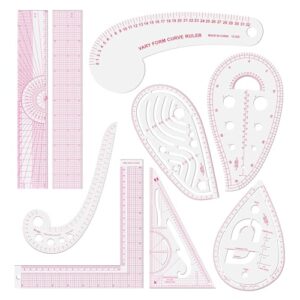
The LINXIAO Metric Sewing Ruler Set gives you nine pieces covering everything from French curves to L‑squares, so you’re not hunting for the right tool mid‑project. Each ruler is transparent acrylic with red‑printed markings in both metric and imperial, making them easy to read against any fabric.
At just 8.4 ounces total, the whole kit fits in your sewing bag without a second thought. It’s budget‑friendly and beginner‑approved, though serious pattern drafters working at scale may want something heavier.
| Best For | Beginners, hobbyists, and crafters who need a versatile, affordable ruler set for sewing, quilting, embroidery, and other small-to-medium projects. |
|---|---|
| Material | Acrylic |
| Piece Count | 9-piece set |
| Primary Use | Sewing/Quilting |
| Skill Level | Beginner/Advanced |
| Measurement Units | Inch and Metric |
| Weight | 8.4 oz |
| Additional Features |
|
- Nine rulers in one kit means you’ve got the right shape for almost any cut or curve.
- Transparent acrylic with clear red markings makes it easy to see exactly what you’re measuring.
- Lightweight and compact — the whole set fits in your bag without adding bulk.
- The rulers run small, so if you’re drafting full-size adult patterns, you may find them limiting.
- Not built for heavy, daily professional use — more of a hobbyist-grade set.
- You can find more durable options out there, but you’ll pay more for them.
2. Fiskars Sewing Ruler 6×24 Clear Black
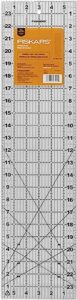
When you need something with a bit more reach, the Fiskars 6×24 Clear Black steps up.
At 24 inches long and 6 inches wide, it spans most folded quilting cotton in a single pass—no repositioning needed.
The clear acrylic body keeps your fabric’s grainline visible, while bold black grid lines and 30-, 45-, and 60-degree angle markers make bias cuts and border strips straightforward.
Pair it with a rotary cutter, and long, clean cuts become almost easy.
| Best For | Quilters and sewers who work with large fabric pieces and need precise, long cuts for borders, bias strips, and quilting cotton. |
|---|---|
| Material | Acrylic |
| Piece Count | Single ruler |
| Primary Use | Quilting/Sewing |
| Skill Level | Beginner/Advanced |
| Measurement Units | Inch |
| Weight | 12 oz |
| Additional Features |
|
- At 24 inches, it covers most folded fabric in one pass—no awkward repositioning mid-cut
- Clear acrylic with two-toned gridlines means you can actually see your fabric underneath, whether it’s light or dark
- Built-in 30-, 45-, and 60-degree angle guides make bias cuts and mitered corners way less guesswork
- Too bulky for small cuts under 1½ inches—you’ll want a shorter ruler for detail work
- Some rulers arrive with a slight warp, so you might need to flatten it with heat before it’s truly usable
- The acrylic can crack or scratch if you’re not careful, and it’s not built for anything beyond fabric and paper work
3. Fiskars Acrylic Sewing Ruler 3 by 18
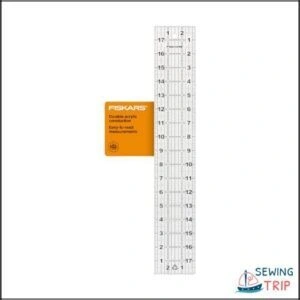
Sometimes smaller is smarter. The Fiskars 3×18 acrylic ruler is the one you’ll reach for when waistbands, facings, or narrow strips are on the cutting table.
At 3 inches wide, it fits between pattern pieces without crowding your layout, and the 18-inch length manages most garment edges in a single pass.
Bold grid lines, broken‑edge markings, and angle guides for 30, 45, and 60 degrees keep your cuts clean.
Non‑slip feet and a hanging hole make it both functional and easy to store.
| Best For | Sewers and quilters who need a reliable, easy-to-read ruler for cutting fabric strips, squares, and garment edges with precision. |
|---|---|
| Material | Acrylic |
| Piece Count | Single ruler |
| Primary Use | Quilting/Sewing |
| Skill Level | Beginner/Advanced |
| Measurement Units | Inch |
| Weight | 4.6 oz |
| Additional Features |
|
- Bold grid lines and broken-edge markings make measurements quick and easy to read at a glance
- Non-slip vinyl feet keep the ruler from sliding around while you cut
- Lightweight and easy to store, with a built-in carrying handle
- Not great for cutting pieces smaller than 1.5 inches
- May develop a slight bend over time with heavy use
- Replacement blades add to the long-term cost
4. HLZC Clear Metric Sewing Ruler Set
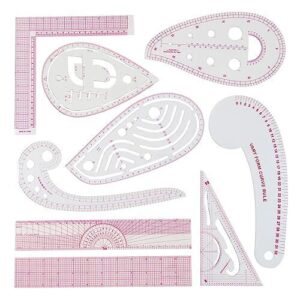
When one ruler isn’t enough, the HLZC Clear Metric Sewing Ruler Set steps in with a full 9-piece kit covering straight edges, L-squares, and multiple curve profiles. Each piece manages a different drafting task — armholes, necklines, seam lines — so you’re not improvising mid-project.
The clear acrylic and easy-to-read markings make layout work faster, especially for beginners still building confidence. At just 3.53 ounces, the whole set travels light and stores flat without taking over your workspace.
| Best For | Sewers, tailors, and fashion design students who need a versatile drafting toolkit without spending a lot. |
|---|---|
| Material | Acrylic |
| Piece Count | 9-piece set |
| Primary Use | Pattern Making |
| Skill Level | Beginner/Advanced |
| Measurement Units | Inch and Metric |
| Weight | 3.53 oz |
| Additional Features |
|
- Nine pieces cover nearly every drafting need — straight edges, L-squares, and curves all in one set
- Clear acrylic with easy-to-read markings speeds up layout work and reduces measuring errors
- Lightweight and compact, so it stores flat and travels easily to classes or workshops
- Thin acrylic means they can crack or warp if you’re not careful with them
- Not a great match for rotary cutters — you’ll want something sturdier for that
- Some users feel the build quality doesn’t hold up as well as pricier alternatives
5. Mr Pen Acrylic Sewing Ruler 3×17
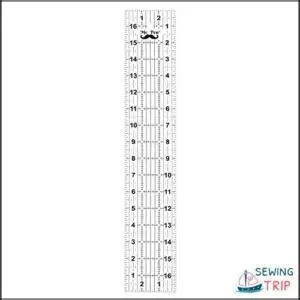
The Mr. Pen Acrylic Sewing Ruler measures 3 by 17 inches — a compact size that manages strip cutting, borders, and sashing without crowding your cutting mat. Made from clear, lightweight acrylic, it works smoothly with rotary cutters and lets you see your fabric lines underneath.
At around $6 to $7, it’s a budget-friendly pick for beginners and seasoned sewists alike. Worth noting: the 1/8-inch markings aren’t the clearest, so it’s best suited for straightforward cuts rather than highly detailed work.
| Best For | Beginners, hobbyist sewists, and crafters who need a reliable, no-fuss ruler for quilting, sewing, and basic cutting projects. |
|---|---|
| Material | Acrylic/Plastic |
| Piece Count | Single ruler |
| Primary Use | Quilting/Sewing |
| Skill Level | Beginner/Advanced |
| Measurement Units | Inch |
| Weight | 3.59 oz |
| Additional Features |
|
- Lightweight and clear acrylic makes it easy to see your fabric lines while you work
- Compact 3×17 size is great for strip cutting, borders, and sashing without taking up too much mat space
- Works smoothly with rotary cutters and is simple enough for total beginners to pick up fast
- The 1/8-inch markings can be hard to read, so detailed precision work gets tricky
- Not fully gridded, which makes measuring smaller vertical sections a bit of a hassle
- The rubber grip pieces can peel off over time with regular use
6. VPVPV Quilting Acrylic Ruler Set
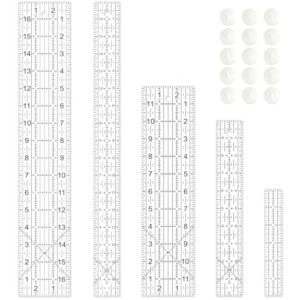
The VPVPV Quilting Acrylic Ruler Set is a 14‑piece kit that covers nearly every cut you’ll make at your sewing table. You get seven rulers ranging from 1 × 6 inches up to 8.5 × 24.5 inches, plus 50 non‑slip rings and a rotary cutter with five extra blades.
The clear acrylic construction keeps your fabric’s grainlines visible, so fussy cutting feels less like guesswork. It’s a solid all‑in‑one starter kit for quilters who want matched tools without hunting separately.
| Best For | Quilters, sewers, and crafters who need a reliable set of rulers in multiple sizes to handle everything from small patchwork to larger projects. |
|---|---|
| Material | Acrylic |
| Piece Count | 5-piece set |
| Primary Use | Quilting/Sewing |
| Skill Level | Beginner/Advanced |
| Measurement Units | Inch |
| Weight | 10.2 oz |
| Additional Features |
|
- Comes with five different ruler sizes, so you’ve got the right tool for almost any cut
- Laser-cut acrylic means the measurements are accurate and the edges stay clean over time
- The 15 non-slip grip rings are a nice touch — your ruler won’t slide around mid-cut
- A few buyers have reported receiving broken rulers, so quality control can be hit or miss
- The longest ruler tops out at 17 inches, not 18 — a small but real issue if your projects need that extra inch
- The non-slip rings only work as well as they’re applied, so results may vary depending on your cutting surface
7. Linxiao Acrylic Quilting Ruler Set Green
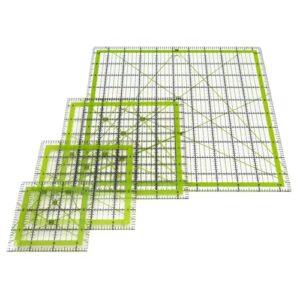
The Linxiao Acrylic Quilting Ruler Set Green gives you four square rulers — 3.5″, 5″, 6.5″, and 10.5″ — each laser‑cut from tinted green acrylic that’s easy to spot on a busy cutting mat.
The green tint cuts glare under bright lighting, and the high‑contrast grid lines make quick work of trimming blocks to size.
Whether you’re squaring half‑square triangles or trimming full sampler blocks, this set covers the most common patchwork sizes without cluttering your cutting station.
| Best For | Quilters of all skill levels who want a reliable, easy-to-read set of square rulers for trimming blocks and piecing accurate patchwork. |
|---|---|
| Material | Acrylic |
| Piece Count | 4-piece set |
| Primary Use | Quilting/Sewing |
| Skill Level | Beginner/Advanced |
| Measurement Units | Inch |
| Weight | 14.4 oz |
| Additional Features |
|
- Four common sizes in one set — covers most everyday quilting and patchwork needs without buying rulers separately
- Laser-cut green acrylic is easy to spot on a busy cutting mat and reduces glare under bright lights
- Clear 1/4″ grid lines make measuring and trimming fast and accurate
- Only square shapes, so you’ll still need other rulers for triangles, hexagons, or long strips
- The largest size tops out at 10.5″, which may feel limiting for bigger quilt blocks or borders
- Four rulers packed together weigh nearly a pound, so storage and portability could be a minor hassle
8. OZXTYO Tailor Chalk Fabric Markers
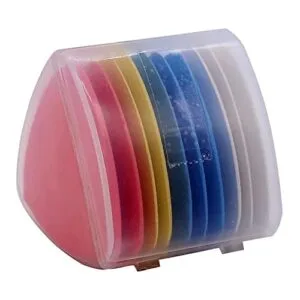
Marking fabric accurately doesn’t require expensive tools — the OZXTYO Tailor Chalk Set proves that.
You get 10 triangle-shaped chalk pieces in four colors: blue, red, white, and yellow, so you can always find a shade that shows up on your fabric.
The HB hardness draws crisp, clean lines with light pressure, and cleanup is simple — brush, wash, or a bit of alcohol removes marks easily.
Just handle these thin wedges gently, since they can crack if dropped.
| Best For | Sewers, tailors, and quilters who need a reliable, affordable way to mark fabric without fuss. |
|---|---|
| Material | Chalk |
| Piece Count | 10-piece set |
| Primary Use | Tailoring/Sewing |
| Skill Level | Beginner/Advanced |
| Measurement Units | N/A |
| Weight | 2.46 oz |
| Additional Features |
|
- Comes in four colors so you can pick what shows up best on any fabric
- HB hardness gives you clean, precise lines without pressing hard
- Marks wash right off, so no worrying about ruining your project
- The chalk pieces are thin and can snap if you drop them or apply too much pressure
- Some buyers have received pieces already broken in the box
- Can crumble and leave dust as you use it down
9. LJLJ Clear Metric Sewing Ruler Set
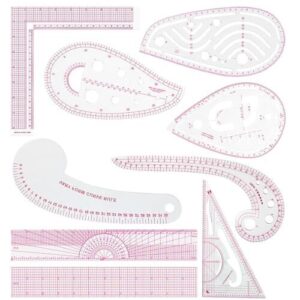
The LJLJ Clear Metric Sewing Ruler Set is basically a full pattern drafting studio packed into one lightweight kit.
You get 7 to 9 transparent acrylic rulers — straight edges, French curves, hip curves, and an L-square — covering everything from armholes to hemlines.
The pink-tinted metric markings stay readable against most fabrics, and the smooth edges work cleanly with rotary cutters.
At under 9 ounces, it won’t crowd your workspace.
Just note the pieces run smaller than you might expect.
| Best For | Fashion students, pattern makers, and tailors who work with metric measurements and need a versatile, lightweight drafting kit. |
|---|---|
| Material | Plastic |
| Piece Count | Multi-piece set |
| Primary Use | Sewing/Quilting |
| Skill Level | Beginner/Advanced |
| Measurement Units | Metric |
| Weight | 8.1 oz |
| Additional Features |
|
- Comes with multiple ruler styles (French curves, hip curves, L-square) so you’re covered for nearly any pattern drafting task
- Pink-tinted markings are easy to read against fabric without straining your eyes
- Lightweight at under 9 ounces — easy to store and won’t clutter your workspace
- Pieces run smaller than most people expect, so double-check the dimensions before buying
- Metric only — not a great fit if you’re used to working in inches
- May feel flimsy to users who prefer heavier, more substantial rulers
Choosing The Right Sewing Ruler for Your Needs
Picking the right sewing ruler isn’t complicated, but the wrong choice can slow you down fast.
Your project type, skill level, and budget all play a role in what actually works for you. Here’s what to keep in mind before you buy.
Matching Rulers to Project Types
Not every ruler belongs in every project—and using the wrong one wastes time quickly. For garment sewing, project-specific rulers like French curves and hip curves handle fabric type matching along body lines.
Quilting supplies like 6×24 acrylic rulers suit strip cutting, while tailoring equipment covers darts and seams. Matching scale and pattern needs the right tool is how precision actually happens.
Ruler Sets Vs. Single Rulers
Once you’ve matched rulers to your projects, the next question is whether to buy a set or go solo. Sets like a 5-piece acrylic bundle offer serious Cost Efficiency—around $15 for multiple tools—while a single sewing ruler runs $10–12 alone.
- Versatility Range – Sets cover hems, armholes, and curves in one purchase.
- Storage Space – Singles stack flat; sets need pegboards or grooved stands.
- Brand Consistency – Same-brand sets keep grip coatings and grid lines uniform.
- Learning Curve – Beginners benefit from sewing ruler sets for beginners since guided variety builds skills faster.
- Professional Tools – Experienced sewists choosing the right sewing ruler often prefer single specialty pieces for precision tasks.
Sets win on value. Singles win on focus.
Ruler sets offer more for less, while single rulers deliver focused precision
Considerations for Beginners and Advanced Users
Your skill level shapes which ruler features actually matter. Beginners do well starting with a 6×12‑inch clear acrylic ruler—Transparency Benefits make fabric lines easy to read, and grippy non‑slip bases reduce crooked cuts.
As you grow, Thickness Choices and Marking Clarity become priorities for complex work.
| Feature | Beginners | Professionals |
|---|---|---|
| Grip Comfort | Non-slip base essential | Rubberized edge preferred |
| Transparency Benefits | High priority | Situational use |
| Marking Clarity | Bold 1/8-inch markings | Laser-etched dual scales |
Budget, Brand, and Availability Factors
Beyond skill level, your budget shapes the decision.
Basic rulers start around $5, while premium picks like Madam Sew run nearly $29.
Brand Reputation matters too—Fiskars holds a 4.7-star average across thousands of buyers.
- Compare Price Comparison across Walmart, Amazon, and Etsy
- Check Stock Levels before peak sewing seasons
- Watch Discount Timing at Joann’s frequent sales
- Review Shipping Options for sets over $99 at WAWAK
Maximizing Precision and Safety With Sewing Rulers
Getting the most out of your sewing rulers comes down to how you use and care for them.
A few smart habits can mean the difference between clean, accurate cuts and costly fabric mistakes.
Here’s what you need to know to work with precision and stay safe while doing it.
Fabric Cutting Techniques Using Rulers
Your ruler becomes a true partner when you treat fabric cutting as a system, not just a step.
Start with edge trimming to square your fabric, then move into strip cutting by sliding your ruler along in measured increments.
Multi-layer cutting speeds up quilting templates, while squaring blocks keep patchwork tight.
Bias cutting at 45 degrees unlocks stretch for binding and curves.
Safe Use With Rotary Cutters and Scissors
Keep your fingers at least 2 inches from the blade, and use a ruler grip to stay elevated above the rotary cutter’s path.
Always push the cutter forward, away from your body, with the blade flush against your sewing ruler.
Engage the blade guard the moment you stop cutting.
A self-healing cutting mat protects both your scissors and your surface.
Protective accessories like Klutz gloves add real peace of mind.
Proper Storage and Maintenance Tips
Storing your sewing rulers the right way pays off every time you reach for one. Use vertical hanging on a pegboard or Command hooks to protect edges and save drawer space.
Protective bins prevent scratches, while routine cleaning with mild soap keeps clear gridlines readable. For sewing ruler durability and design, temperature control matters—keep acrylic away from sunlight and heat to prevent warping.
Optimizing Workspace for Accurate Measuring
A well-organized workspace quietly does half the measuring work for you. Set your cutting table between 34–38 inches high for an Ergonomic Stance that keeps ruler pressure steady. Then layer in these essentials:
- Table Height aligned to bent elbows
- Lighting Quality at 5000–6500K
- Mat Positioning flush to the table edge
- Tool Organization with pegboard storage
- Ergonomic Stance facing cuts directly
Frequently Asked Questions (FAQs)
How do I choose the right sewing ruler?
Start with project type, then factor in Fabric Compatibility, Measurement System Preference, and Ergonomic Grip.
Material Longevity and Budget Constraints narrow it down further—matching the right sewing ruler features and benefits to your specific needs.
What rulers do tailors use?
Tailors rely on straight edge rulers, French curves, hip curves, L-squares, and Patternmaster rulers — each handling seam allowances, bias binding rulers, and pattern scaling techniques with precision across every fabric measurement task.
How do I calibrate rulers for pattern scaling?
Compare your ruler to a trusted metal straightedge using the Edge Alignment Method, starting at the 1-inch mark.
A quick Grid Consistency Test confirms accuracy — any drift over 30 cm means retiring it for precision cuts.
Which rulers work best for curved garment alterations?
Like a sculptor shaping clay, French Curve Pattern Rulers and hip curve rulers master curved garment alterations.
Their adjustable pivot points, seam allowance guides, and curve tracing tips make tailoring necklines and side seams effortlessly precise.
Can children safely learn sewing with rulers?
Yes, children can safely learn sewing with rulers using age-appropriate rulers, non-slip materials, and supervised cutting practices. Ages 6 and up handle child-friendly marking tools well with proper adult guidance.
How often should worn sewing rulers be replaced?
Replace worn sewing rulers when you notice faded markings, edge warping, or visible nicks—usually every 5 to 3 years with regular use, depending on care and cutting frequency.
Conclusion
The right tool is never just a tool—it’s the difference between guessing and knowing. Every accurate seam, every pattern piece that lands exactly where it should, traces back to the ruler you trusted enough to follow.
When you invest in the best sewing rulers for home sewists, you’re not just buying measured lines on acrylic—you’re buying confidence in every cut. Choose deliberately, use consistently, and let precision do what talent alone can’t.
- https://woolery.com/omnigrid-quilters-ruler-6-5-x-24.html
- https://www.qualitysewing.com/products/quilters-select-sewing-and-quilting-rulers
- https://www.missouriquiltco.com/blogs/missouri-star-blog/quilting-rulers-guide
- https://scissortailquilting.com/tutorials-instruction/basic-quilting-rulers-beginners/
- https://inthefolds.com/blog/2024/guide-to-sewing-patternmaking-rulers