
This site is supported by our readers. We may earn a commission, at no cost to you, if you purchase through links.

Walk into any fabric store and the glossy bolts stop you cold—charmeuse, duchesse satin, lamé—each catching light differently, each engineered for a specific purpose most sewers never fully understand.
Shiny fabric isn’t a single category. It’s a spectrum of fiber compositions, weave architectures, and surface treatments, where satin-weave floats reflect up to 70% of incident light while metallic threads manipulate wavelengths through foil layers measured in micrometers.
The difference between a bridal gown that photographs beautifully and one that reads flat under flash often comes down to which shiny fabric names and types you chose—and why. Knowing the physics, the fiber behavior, and the project-specific rules changes everything about how you cut, sew, and care for these materials.
Table Of Contents
Key Takeaways
- Shine is a physics problem, not an aesthetic one—weave structure, fiber geometry, and surface coatings each control how much light bounces back, with satin floats hitting 70% specular reflectivity and lamé reaching 95%.
- Your fiber choice determines everything downstream: silk breathes, drapes, and biodegrades while polyester wins on cost and durability, but neither outperforms cire’s calendered coating, which tops 80–85 Gloss Units.
- Matching fabric to project isn’t optional—duchesse satin suits bridal and evening silhouettes, stretch lamé survives stage lighting and quick-changes, and high-traffic upholstery demands 40,000+ double rubs before anything else matters.
- Slippery, glossy fabrics punish shortcuts at every stage: cut single-layer with a fresh rotary blade, use a microtex needle, press with a muslin barrier, hand-wash cold, and store at 18–22°C with acid-free tissue between layers.
Shiny Fabric Names by Fiber Type
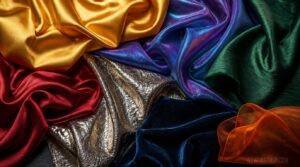
The fiber a fabric is made from determines everything — how it catches light, how it drapes, and how it behaves under your needle. Whether you’re working with nature’s own lustrous offerings or engineered synthetics built for maximum shine, each fiber type brings a distinct set of trade-offs worth knowing.
Silk, in particular, rewards those who understand its quirks — explore how different thread materials shape your results before diving into delicate or decorative projects.
Here’s how the most common shiny fabrics break down by fiber.
Natural Shiny Fabrics
Nature engineered some of the most compelling luminescence long before synthetic mills existed. Mulberry silk charmeuse delivers a glossy front face with a matte reverse, while duchesse satin achieves pearlescent weight through dense silk thread counts.
Three natural fabrics worth knowing:
- Silk offers fluid, lustrous drape that shifts with movement
- Mohair’s long, smooth fibers produce a soft but distinct highlight
- Bamboo viscose reflects light cleanly due to its uniform microfiber cross-section
Understanding these various shiny fabrics helps sewists choose the perfect material for their projects.
Synthetic Shiny Fabrics
Where natural fibers rely on biology for their luster, synthetics engineer it deliberately. Polyester satin reflects light with a smooth, glassy surface — durable enough for evening gowns yet affordable for everyday linings.
Cire finishing uses heat and pressure to produce a crisp, wet-look mirror effect on nylon or polyester. PVC-coated polyamides and vacuum-metallized aluminum polyesters push synthetic shimmer even further.
Blended Shiny Fabrics
Mixes split the difference between biology and engineering. A polycotton mix or silk-nylon combination layers gloss over comfort, with mix ratio impact determining how much reflective brightness dominates.
- Higher synthetic fiber content sharpens specular gloss
- Natural components soften stiffness and improve drape
- Dye uptake coordination keeps luster uniform across the cloth
- Elastomeric mixes add stretch recovery without bagging
Moisture management benefits come standard with synthetic components.
Shiny Cotton Options
Cotton surprises most sewists — it can achieve genuine gloss without a single synthetic thread. Cotton sateen, woven with long-staple Pima or Egyptian fibers, floats face threads across the surface to catch light evenly, hitting thread counts between 200 and 600.
Mercerized cotton takes that sheen further, chemically treating fibers for deeper luster and stronger dye uptake. Calendering presses an additional mirror-like finish into the cloth.
Silk Versus Polyester
When silk meets polyester, the gap in performance runs deeper than price. Silk breathes naturally, wicking moisture and regulating temperature, while polyester traps heat against skin in warm conditions. Silk’s protein fibers produce a subtle, depth-rich sheen polyester can only approximate.
That structural elegance comes down to the weave itself — explore fabric weave structures and how they shape texture, light, and feel to understand what separates truly luxurious textiles from convincing imitations.
Polyester wins on durability and low-maintenance care, but sheds microplastics. Silk biodegrades and rewards careful handling with lasting luminosity.
Popular Types of Shiny Fabric
Shiny fabrics span a surprisingly wide range — from the fluid drape of charmeuse to the bold mirror-finish of patent leather.
Each type brings its own weave structure, fiber composition, and light-reflecting behavior to the table, which means the right choice depends entirely on what you’re making. Here are the most popular shiny fabrics worth knowing before you cut a single seam.
Satin and Charmeuse
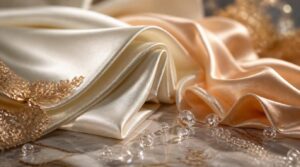
Satin’s secret lies in its warp-faced weave — long filament floats gliding across the surface, reflecting light with up to 70% specular efficiency. The backside stays quite dull, a useful distinction when lining garments.
Duchesse satin adds heavyweight body, while charmeuse trades weight for fluid drape, its matte reverse and slippery hand making it the go-to for gowns that genuinely move.
Organza and Taffeta
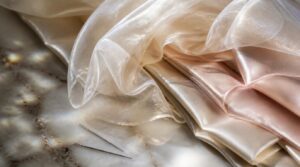
Organza and taffeta both build volume — but differently. Sheer organza lets light pass through, creating a soft glow; taffeta’s opaque weave reflects a uniform sheen.
- Layer organza over taffeta for depth
- Use taffeta’s stiffness for structured pleats
- Avoid rough handling on both delicate weaves
- Press with low heat to preserve fabric sheen
When sewing either fabric, use a fine needle.
Brocade and Damask
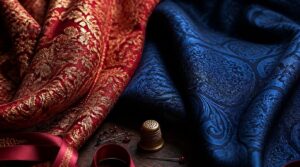
Brocade and damask occupy opposite ends of the texture spectrum, yet both command attention through weave alone.
Brocade’s raised, Jacquard-loomed motifs — often threaded with metallic highlights — create dimensional, embossed surfaces that catch light directionally. Brocade suits structured silhouettes.
Damask works differently: its satin-and-twill reversal produces a tonal, flat pattern that shifts under changing light. Damask drapes more forgivingly.
Lamé and Sequins
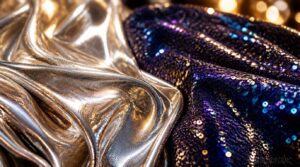
Lamé delivers all-over metallic luminosity, woven or knitted with thin metallic ribbons that achieve up to 95% light reflectivity — closer to liquid metal than fabric. Its smooth drape suits evening silhouettes, though metallic threads make it prone to seam slippage and snagging.
Sequins work differently, offering discrete reflective points through individually sewn or machine-applied disks that pulse with movement under stage lighting.
Vinyl and Patent Leather

Vinyl’s wetlook surface mimics patent leather at a fraction of the cost, achieving a uniform, mirror-bright reflective surface through PVC calendering and coating.
- Patent leather: deep, mirror-like shine that intensifies with conditioning
- Vinyl: bright, consistent gloss; waterproof and wipe-clean
- Both suit fashion applications from statement bags to upholstery
Patent leather breathes slightly; vinyl won’t.
What Makes Fabric Look Shiny
Shine isn’t magic — it’s physics, and once you understand what’s actually happening at the fiber level, your fabric choices get a lot more intentional. Everything from weave structure to surface coatings plays a role in how much light bounces back at you. Here’s what’s really driving that glossy effect:
Fabric shine is pure physics: weave structure and surface coatings determine exactly how much light bounces back at you
Satin Weave Structure
The secret behind satin’s signature gleam isn’t the fiber — it’s the architecture. Warp yarns float over four or more weft threads before interlacing, keeping the surface nearly unbroken and smooth enough to reflect over 70% of incident light.
That move value controls how interlacing points shift, distributing floats evenly. Get it wrong, and you create twill instead — a completely different fabric.
Smooth Fiber Surfaces
Weave structure sets the stage, but fiber surface geometry closes the deal. Flat synthetic filaments reflect up to 40% more light than irregular natural fibers — nanometer-scale polishing during manufacturing is what separates true duchesse satin’s pearlescent luster from a fabric that merely approximates it.
Surface planarity keeps specular reflection uniform, eliminating hotspots across charmeuse and satin weave constructions alike.
Metallic Thread Effects
Where fiber geometry ends, metallic thread construction begins. A polyester or nylon center wrapped in foil layers 0.5–2 micrometers thick determines whether you get chrome-bright silver or warm gold — that variance in foil thickness directly controls brightness.
Iridescent variants shift hue as light angles change. A matte overlayer can reduce glare without sacrificing sparkle, while laminated foil layers improve abrasion resistance across lamé and sequin metallic fabric alike.
Glossy Fabric Coatings
Metallic threads create shine through construction, but coatings engineer it through chemistry.
Calendering presses synthetic fibers between heated rollers, producing a uniform, mirror-flat surface — while polymer coating applies a thin polyurethane or PVC layer that you can dial from matte to liquid-metal sheen. Cire finishing takes this further, using heat and pressure to deliver that signature wet-look reflectivity.
Iridescent Light Reflection
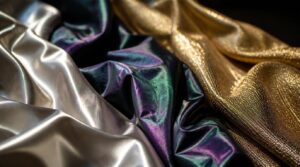
Shift your angle, and the color shifts with you. That’s iridescent light reflection at work — thin-film interference within layered microstructures manipulates wavelengths between 200–700 nm, producing hues that move from red to violet as your viewpoint changes.
Constructive interference at each geometry determines which wavelength dominates. Smooth filament fibers improve this through specular reflection, while holographic foil laminates stretch without cracking the effect.
Best Shiny Fabrics by Sewing Project

Not every shiny fabric belongs in every project, and choosing the wrong one can make even a well-sewn garment fall flat.
The right match depends on your end use — whether you’re constructing something structured, draped, theatrical, or decorative. Here’s how the best options stack up across five key project types.
Evening Dresses
Evening dresses demand fabric that performs under lighting — and duchesse satin delivers, reflecting up to 70% of incident light across mermaid and ball gown silhouettes alike.
Three fabrics worth prioritizing:
- Charmeuse — glossy front, matte reverse, ideal for sweetheart necklines
- Lamé — metallic thread, stunning with beading at the waist
- Sequin fabric — maximum sparkle for off-the-shoulder evening wear
Pair strappy heels and a clutch; let the fabric lead.
Bridalwear and Formalwear
Duchesse satin remains the definitive bridal fabric — its pearlescent luster and heavyweight drape complement ballgown and A-line silhouettes equally well.
For ivory or champagne palettes, silk charmeuse offers a softer glow. Pair either with crystal appliqués and satin pumps for a polished look.
After alterations, professional gown preservation protects beadwork and fabric integrity — because the dress deserves to last as long as the memory.
Costumes and Dancewear
Stage lighting exposes every fabric choice — which is why stretch lamé and sequin metallic fabric dominate dancewear. Satin panels reflect spotlights with precision, while glitter fabric adds movement-responsive shimmer.
Sequins require reinforced backing to survive jumps and quick-changes. Holographic laminates shift color as lighting angles change, giving costumes visual range a single shiny fabric can’t achieve alone.
Lingerie and Accessories
Charmeuse and satin weave fabrics define lingerie’s signature sheen — smooth, liquid-feeling, and flattering against skin texture.
Silk delivers natural moisture-wicking for chemises; polyester satin resists fraying at lower cost. Lace texture variety ranges from delicate Chantilly to bold embroidered appliqués. Fine mesh panel design creates sheer coverage without bulk. For shapewear, compression levels rise with multi-panel construction.
Three fabric choices that transform lingerie projects:
- Charmeuse for breathable, body-skimming silhouettes
- Iridescent mesh for layered, modern bralettes
- Satin with decorative strap styles for elevated sets
Silk robe pairings complete any intimate lingerie wardrobe.
Upholstery and Decor
Duchesse satin and brocade shift the moment you stretch them across a sofa frame — the Jacquard-raised patterns catch light differently at every angle. Velvet reads matte yet plush; iridescent fabrics add shimmer to accent cushions.
For durability, target 40,000+ double rubs on high-traffic pieces. Reupholstery using sustainable deadstock textiles lets you refresh a frame without landfill waste.
Sewing and Caring for Shiny Fabrics

Shiny fabrics reward the extra care you put into them — but they won’t forgive shortcuts. The good news is that once you know the right techniques, working with them becomes second nature. Here’s what you need to handle, sew, and store your glossy materials with confidence.
Cutting Slippery Fabrics
Slippery fabrics punish impatience. Always cut in a single layer layout, placing tissue paper beneath to grip the surface and prevent drift. Pattern weights hold pieces more reliably than pins on charmeuse or lamé.
A rotary cutter with a fresh blade slices cleanly without dragging. Check grain line accuracy often — one degree off ruins the drape entirely.
Needles and Thread
Once the fabric is cut, the needle does the real talking. For lightweight satins and charmeuse, a size 70/10 or 80/12 microtex needle pierces cleanly without visible punctures — ballpoint needles leave marks on smooth surfaces.
Metallic threads need an elongated-groove needle eye to prevent shredding. Apply a thread conditioner on slippery threads to stabilize feed. Change needles every three to four sewing hours.
Pressing Without Shine Marks
The right needle protects the fabric during sewing — the right pressing technique protects it afterward.
Always place silk organza or cotton muslin between the iron and the surface, keeping the cloth smooth and residue-free. Set heat to low-medium, hover with steam rather than pressing down hard, and lift frequently. Satin and polyester blends show glossy patches fast when heat lingers.
Washing Delicate Fabrics
Heat is the enemy of textile finishes — and so is rough handling. Hand wash shiny fabrics in cold water, swirling gently for 3–5 minutes without rubbing. Use a mild, protein-safe detergent for silk and satin; skip fabric softeners entirely.
Machine washing works only with a mesh bag, delicate cycle, and low spin. Air dry flat, away from sunlight.
Storing Glossy Materials
Good storage protects your textile finishes as much as careful washing does. Keep glossy materials at 18–22°C with 40–50% relative humidity — silica gel packs help stabilize moisture levels inside containers.
- Wrap in acid-free tissue paper between layers
- Store flat inside breathable, archival boxes away from UV light
- Wear clean cotton gloves when handling
Never stack items without archival interleaving sheets.
Frequently Asked Questions (FAQs)
What type of fabric is shiny?
Shine comes down to fiber structure and weave. Satin, charmeuse, lamé, organza, and silk all reflect light through smooth filaments or metallic threads — each delivering a distinct luster, sheen, or surface gloss intensity.
What is a shiny, metallic fabric called?
Lamé is the go-to name for shiny metallic fabric, woven with metallic threads or foil-coated fibers that reflect up to 95% of incident light, delivering that signature mirror-bright fabric luster and sheen.
What are the different types of shiny fabrics?
Shiny fabrics span a wide spectrum — from satin weave and charmeuse to lamé, brocade, and duchesse satin. Each delivers a distinct reflectivity level, determined by fiber composition, weave structure, or metallic thread use.
What are the different types of shiny silk fabric?
Silk is captured moonlight — each weave bends light differently. Charmeuse’s liquid drape delivers the smoothest luster at 400–600 threads per inch, while Duchesse satin offers heavier, pearlescent weight. Dupioni, taffeta, and organza each refract silk’s lustrous quality distinctly.
What is a shiny fabric?
Fabric lustre emerges when smooth fiber surfaces or satin weaves redirect light uniformly rather than scattering it. Weave structure, fiber composition, and surface treatments each control how much specular reflection a textile produces.
What are common fabric names?
The global textile industry catalogs over 5,000 distinct fabric names. Satin, sateen, charmeuse, and brocade rank among the most recognized — each differentiated by weave float direction, fiber composition, and the resulting surface luster.
What are the different types of Shiny cotton?
Cotton earns its gloss through mercerization, sateen weaving, and calendering pressure. Polished cotton, cotton sateen, mercerized cotton, brilliantine, and resin-glazed chintz each deliver distinct luster levels without surrendering the breathability cotton is known for.
What is the shiniest fabric?
Cire’s crisp, calendered coating clinches the title. When measured at 60° angles, cire fabric consistently records Gloss Units above 80–85 — outperforming duchesse satin and metallic lamé — with surface reflectance pushing past 70%, approaching near-mirror-like intensity.
What is that shiny fabric called?
That gleaming fabric is most likely satin, charmeuse, or duchesse satin — each achieving its luster through a specific satin weave structure, fiber composition, and surface smoothness that directs light into a controlled, specular reflection.
What fabric has a shine?
Satin, charmeuse, and lamé each produce shine through reflective filament profiles and satin weave structure. Silk achieves luster via lustrous protein structures, while synthetic options like cire rely on surface smoothness factors and metallic treatments.
Conclusion
Ironic, isn’t it—the most deceptively simple bolt on the shelf demands the most technical understanding to use well.
Shiny fabric names and types reveal exactly where textile physics meets creative ambition. Satin-weave floats, metallic threads, calendered coatings—each behaves according to its own logic, rewarding the sewers who study that logic rather than fight it.
Learn the material first. The garment follows.