This site is supported by our readers. We may earn a commission, at no cost to you, if you purchase through links.
Your first embroidery stitch doesn’t need to be perfect—it just needs to exist. That single thread pulled through fabric marks the beginning of a skill that’s both ancient and endlessly personal.
Simple hand embroidery stitches form the foundation of this tactile art, and once you learn five or six basic techniques, you can create everything from delicate flowers to bold geometric patterns. The beauty lies in how forgiving the craft is: you can pull out mistakes, adjust tension as you go, and watch your confidence grow with each completed line.
With the right needle, some cotton floss, and a bit of fabric stretched tight, you’re ready to turn plain cloth into something uniquely yours.
Table Of Contents
Key Takeaways
- You only need five or six basic stitches—running stitch, backstitch, stem stitch, satin stitch, chain stitch, and French knots—to create nearly any embroidery design, from flowers to bold geometric patterns.
- The right setup matters more than perfection: a 6-inch hoop with adjustable tension, size 7-9 needles, and quilting cotton with a tight weave will prevent most beginner frustrations, like puckering and slipping fabric.
- Tension control separates clean work from messy attempts—keeping your hoop drum-tight, pulling thread smoothly without tugging, and maintaining consistent stitch length (3-6mm) transforms wobbly experiments into polished pieces.
- Start with small, quick-win projects like hearts or single words that fit in a 4-inch hoop and finish in two to three hours, then gradually combine stitches to build confidence without overwhelm.
Essential Tools for Hand Embroidery
You don’t need much to start embroidering, but the right tools make a real difference in how your stitches turn out. Getting your hands on a few basics will set you up for success and help you avoid frustration as you learn.
If you’re ready to tackle more detailed projects, mastering intricate embroidery techniques starts with choosing needles sharp enough for clean, precise stitches.
Here’s what you’ll want to have on hand before you thread your first needle.
Start with the basics like fabric, thread, and scissors, or explore electronic sewing machine tutorials to see how modern tools can simplify your setup.
Choosing The Right Embroidery Hoop
Before you tackle embroidery stitches, grab a hoop that actually works with you. Hoop size selection matters—small 5-inch rounds suit compact motifs, while 6 to 8-inch hoops balance comfort and workspace for hand embroidery.
Beginners often find that understanding key embroidery machine features helps them choose hoops that match their project scale and stitching style.
Hoop material choices like wood or plastic affect grip, and the tension mechanism keeps fabric taut. For beginners, a sturdy 6-inch hoop with adjustable tension lets you focus on mastering embroidery tools instead of wrestling slippery fabric.
Once you’ve practiced the basics, upgrading to a Brother embroidery machine gives you programmable stitch patterns and automatic tension adjustments that make advanced projects way less finicky.
For a deeper understanding of factors like sizing, material, and tension, check out this guide to choosing the right embroidery hoop.
Selecting Needles and Threads
Once your hoop’s ready, pair it with the right needle and thread. Cotton floss remains the go-to fiber for hand embroidery—six-strand skeins let you separate threads for fine or bold needlework.
Size 7 to 9 needles suit single-strand weaving, while size 3 to 5 accommodates heavier cotton. Check colorfastness and prepare thread with light waxing to prevent fraying and keep your stitches smooth.
Fabric Choices for Beginners
Plain quilting cotton is your best friend for fabric selection—its tight weave keeps stitches clean and won’t slip in an embroidery hoop.
Medium-weight cotton blends hold tension without puckering, and thread counts around 150 give you enough structure to place patterns confidently.
Prewash your fabric to remove sizing and prevent later shrinkage, then iron it flat so your first weaving feels smooth and forgiving. For more insight into the advantages of natural fiber embroidery fabrics, consider exploring the qualities that different materials offer.
Additional Helpful Accessories
Beyond your embroidery hoop and cotton floss, a few extras make weaving smoother. Needle threaders save you squinting at tiny eyelets, while fabric stabilizers prevent puckering on delicate projects.
Ergonomic grips reduce hand fatigue during long sessions, and portable lighting paired with magnifying glasses lets you see every stitch clearly. These small investments turn frustration into flow.
Getting Started: Preparation Tips
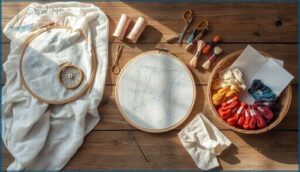
Before you bring needle to fabric, a little groundwork makes everything easier. Think of this stage as setting the scene—choosing how to get your design onto the cloth, prepping your floss so it doesn’t tangle, and making sure your fabric stays put.
If you’re working with a machine instead, getting familiar with your embroidery machine setup will save you hours of trial and error down the road.
These simple steps turn chaos into control, so you can focus on the stitching itself.
A little groundwork transforms chaos into control, letting you focus on the stitching itself
Transferring Patterns to Fabric
Getting your embroidery pattern onto fabric doesn’t have to feel like wizardry—you’ve got options. Tracing methods work beautifully with a bright window or light box under light cotton fabric.
Heat transfer pens give you crisp, permanent lines that won’t fade mid-stitch. Carbon paper presses designs onto thicker material, while stabilizer sheets dissolve away after you’ve finished.
For bold rebels, fabric printing with freezer paper and an inkjet printer puts patterns exactly where you want them, no fuss.
Threading and Organizing Floss
Before you start weaving your first embroidery stitches, you’ll need to wrangle that cotton floss into submission. Standard six-strand thread can be split and recombined—cutting about 45 centimeters keeps tangles at bay while giving you control.
- Needle threading: Snip floss at an angle and match your embroidery needle size to strand count
- Floss organization: Use bobbins or clear bags labeled with color numbers for quick access
- Thread conditioning: Swipe floss through beeswax or silicone conditioner to tame fraying during hand embroidery
Keeping Fabric Taut and Smooth
When fabric in your embroidery hoop feels drum-tight, giving a firm bounce under your fingertip, your stitches will sit flat and even. Tighten the screw in stages, pulling opposite edges in sequence to keep the weave square and prevent distortion.
Proper hoop tension, combined with careful fabric handling and balanced stitch tension, transforms embroidery techniques from frustrating to satisfying. Re-tighten after fifteen minutes to correct any slack.
Basic Outline and Straight Stitches
Outline stitches are the backbone of nearly every embroidery design you’ll make. These straightforward techniques give you clean edges, smooth curves, and the confidence to tackle more complex patterns down the road.
Let’s walk through four essential stitches that’ll become your go-to toolkit for defining shapes and creating beautiful lines.
Running Stitch Step-by-Step
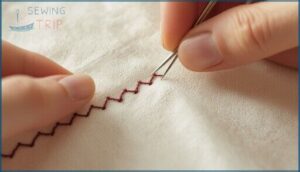
The running stitch is hand embroidery at its most elemental—just a simple up-and-down rhythm that weaves thread through fabric. Bring your needle up at the starting point, push it down about 1/8 to 1/4 inch ahead, then come back up the same distance forward.
Keep stitch length and spacing consistent for that classic dashed-line effect. Shorter stitches help curves bend smoothly without puckering.
Backstitch for Clean Lines
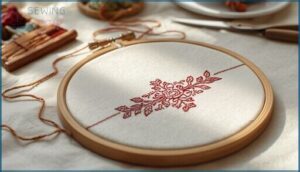
Backstitch is your go-to move when you need a solid, unbroken line in hand embroidery for beginners. Each new stitch overlaps the end of the previous one, erasing gaps and giving you crisp outlines for lettering or shapes.
Three quick wins with backstitch:
- Line quality stays flatter than stem stitch, so borders look sharp.
- Stitch tension matters—even pressure prevents puckering on curved lines.
- Thread selection controls weight; drop to three strands for finer basic embroidery stitches, or use all six for bold impact and easy backstitch variations.
Split Stitch Techniques
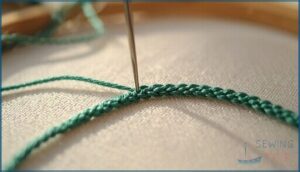
Split stitch pierces the middle of each thread with every new pass, forming a slightly rope-like line that navigates tight curves better than plain backstitch.
Keep your stitch length short—about rice-grain size—and split as close to center as possible for hand embroidery techniques that look professional. Thread tension tips matter here: loose floss twists awkwardly, while even pull shows off split stitch variations in basic embroidery stitches.
Stem Stitch for Curves
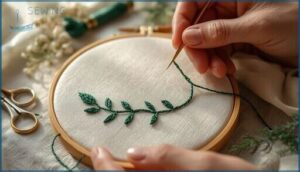
Stem stitch creates a rope-like twist that follows gentle curves beautifully—perfect for vines and scrolls in hand embroidery techniques.
Keep your working thread below the needle for consistent thread twist management, and shorten stitch length adjustment on tight bends so your curved line control stays smooth.
Tension techniques matter: pull too hard and fabric puckers, too loose and the twist looks messy.
Fabric stability tips start with a taut hoop.
Simple Decorative and Filling Stitches
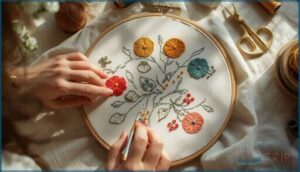
Once you’ve practiced your basic outline stitches, it’s time to add depth and personality to your work.
Decorative and filling stitches transform simple shapes into rich, textured designs that feel truly handmade. Here are four essential stitches that’ll help you fill spaces, create borders, and build up eye-catching details in your embroidery.
Satin Stitch for Solid Fills
When you want to fill a shape completely with glossy, packed-tight stitches, Satin Stitch is your go-to Hand Embroidery technique. These Embroidery Stitches for beginners rely on steady Thread Tension and careful Stitch Direction—bring your needle up on one edge, down on the opposite, and repeat until fabric disappears under thread.
Mastering Satin Stitch Basics, Padded Satin variations, and Color Blending opens up beautiful Hand Embroidery Techniques for any project.
Chain Stitch for Bold Lines
For bold lines that stand out on any Embroidery Fabric Choices, Chain Stitch is unbeatable among Hand Embroidery techniques.
This Embroidery for Beginners favorite forms linked loops—bring your needle up, reinsert in the same spot, then emerge ahead with thread looped under the tip.
Chain Stitch Variations like heavy chain create thicker outlines, while proper Thread Selection and Stitch Tension keep each loop even and raised.
Blanket Stitch for Borders
The Blanket Stitch locks L-shaped loops along any edge, perfect for felt appliqué or fabric borders. This Hand Embroidery classic delivers Edge Reinforcement and charm—bring your needle out on the fabric edge, insert above, emerge beside the first stitch catching the thread loop.
Corner Turning Techniques require tighter spacing around pivots, while steady Stitch Tension Control prevents puckering. Even beginners master this Embroidery for Beginners staple with practice.
French Knot for Texture
Those tiny raised dots you see on vintage linens? French Knots build texture like nothing else.
Wrap your floss around the needle twice, hold it snug, then slip the needle back into the fabric close to your starting point—not through the same hole.
Two wraps give stability; one strand makes delicate dots, while three strands create bold dimension for flower centers or clustered berries.
Practice Ideas and Beginner Projects
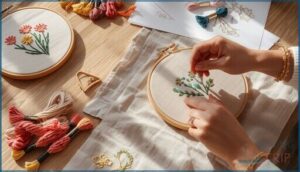
Now that you’ve got these stitches in your hands, it’s time to put them to work. The best way to build confidence is by choosing simple projects where you can practice one stitch at a time, then gradually combine them into real designs.
In this section, you’ll find starter patterns, tips for mixing techniques, and solutions to the small frustrations that trip up most beginners.
Easy Patterns to Try First
Your first hand embroidery patterns should feel like quick wins, not marathons. Start with small motifs—hearts, stars, or leaves—that fit comfortably in a 4-inch hoop and introduce running stitch, backstitch, and French knot basics.
Here are four beginner-friendly embroidery patterns for beginners to try:
- Simple floral designs with lazy daisy petals
- Word quotes like “joy” or “home”
- Themed beginner kits with pre-cut floss
- Small hoop projects sized for 3–6 inch frames
Most patterns finish in two to three hours of relaxed stitching.
Mixing Stitches in Simple Designs
Once you’ve practiced basic hand embroidery stitches, combine them for richer motif planning. Pair backstitch stems with satin stitch petals to play with stitch textures, or outline shapes in stem stitch and fill them using French knots for contrast.
Experiment with color combinations by threading herringbone in one shade and weaving a second through it. These stitching techniques turn simple embroidery patterns for beginners into vibrant border designs and decorative stitches that feel uniquely yours.
Common Mistakes and Troubleshooting
Even seasoned embroiderers fight puckers and tangles. Tension control matters—pulling thread too tight causes fabric to bunch, while loose hoops let stitches sag.
Watch for these common pitfalls:
- Threading needles with strands cut too long leads to fraying and knots mid-stitch
- Skipping fabric preparation means crooked patterns that hang off-center
- Forcing dull needles through tight weaves snags fibers and leaves visible holes
- Ignoring backstitch direction creates uneven lines that look rushed
Correct errors early for cleaner hand embroidery.
Tips for Neat and Even Stitches
Stitch length control separates polished work from wobbly experiments. Mark 3–6 mm guidelines with a water-soluble pen to anchor your backstitch and running stitch evenly along curves.
Thread tension improves when you pull smoothly instead of tugging—watch for puckers that signal you’ve yanked too hard. Accurate placement means bringing your needle up exactly on drawn lines, building stitch consistency that transforms basic hand embroidery into something you’ll proudly display.
Frequently Asked Questions (FAQs)
What are the easiest stitches for embroidery?
Picture yourself threading your first needle—running stitch, backstitch, and straight stitch are the easiest embroidery for beginners.
These basic embroidery techniques build confidence quickly with simple stitches guide anyone can master.
What are the basic hand embroidery stitches?
Most beginner guides list running stitch, backstitch, split stitch, stem stitch, satin stitch, chain stitch, blanket stitch, and French knot as core hand embroidery basics you’ll use constantly.
How do I fix tangled or twisted embroidery floss?
Think of tangled embroidery floss as a minor hiccup, not a disaster. Pause, let your needle dangle to untwist, separate strands for smoother Floss Management, and use gentle Thread Conditioning.
For stubborn knots, try Knot Removal with a fine embroidery needle.
Can I wash finished embroidery without damage?
You can safely hand wash finished embroidery in cold water with gentle detergent if you’ve tested thread color fastness first.
Always press moisture out carefully, lay flat to dry, and iron from the back.
What causes puckering and how to prevent it?
Puckering happens when fabric tension in your hoop is too tight or loose, thread weight overpowers delicate cloth, or stitch density compresses the weave.
Choose stabilizer types that support your embroidery stitches properly.
How do I secure thread ends invisibly?
You don’t need knots to keep hand embroidery secure. Weaving under stitches, knotless starts, tiny anchoring, and burying tails hide ends inside your work, so backstitch lines and running stitch details stay invisibly finished.
Should I use a frame for small projects?
A small embroidery hoop keeps fabric tension steady, which helps your stitches sit flat and evenly spaced.
But you can try hoopless work once your hand tension feels confident and consistent.
Conclusion
Every stitch you make is a small rebellion against the idea that handmade things don’t matter anymore. These simple hand embroidery stitches aren’t just techniques—they’re your voice translated into thread, proof that your hands can create beauty without permission or flawlessness.
Start with one stitch today, then another tomorrow. Before long, you’ll realize the fabric transformed isn’t just cloth—it’s your confidence, pulled tight and stitched into place.
- https://stitchfloral.blogspot.com/2018/09/10-basic-stitches-for-hand-embroidery.html
- https://rsnstitchbank.org/stitch/back-stitch
- https://diaryofanorthernbelle.com/5-easy-embroidery-stitches-for-beginners-tutorial/
- https://www.embroidery.rocksea.org/reference/picture-dictionary/
- https://www.shinyhappyworld.com/2011/02/embroidery-tools.html