This site is supported by our readers. We may earn a commission, at no cost to you, if you purchase through links.
Most beginners grab whatever thread is in the drawer and hope for the best. Sometimes it works. Often, it doesn’t—and seam puckers, the fabric pulls, or the thread snaps mid‑stitch with no obvious explanation.
The culprit, more times than not, is mismatch between thread weight and fabric. Thread weight for beginners sounds technical, but the concept is straightforward once you see how the numbering system works.
Get this one variable right, and your stitches lie flat, your seams stay clean, and your machine stops fighting you.
Table Of Contents
Key Takeaways
- Thread weight numbers run backward — the higher the number, the finer the thread, so 80wt is delicate and 12wt is bold.
- Match your thread weight to your fabric first: 50wt handles most everyday projects, 60–80wt suits delicates, and 30wt or heavier belongs on denim and canvas.
- Your needle size has to keep up with your thread — a mismatched eye causes shredding, skipped stitches, and breakage before you even finish a seam.
- Most beginner problems like puckering, snapping, and tension drama trace back to one fix: choosing the right thread weight for the fabric you’re actually sewing.
What Thread Weight Means
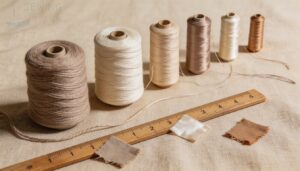
Thread weight sounds technical, but it’s actually a pretty simple idea once you see how the numbering works. It controls everything from how visible your stitches look to how much bulk builds up at your seams.
Once you nail the weight, pairing it with the right color is the next step — these sewing thread color selection tips make that choice a lot easier.
Here’s what you need to know.
Why Higher Wt Means Thinner Thread
Here’s the counterintuitive part: a higher weight number actually means a thinner thread. The system measures how many kilometers of thread fit in one gram — so more thread per gram means finer filaments.
Core spun design keeps diameter consistent, supporting needle eye compatibility and tension balance effects without sacrificing fabric weave preservation. Think of it as thread math working backwards.
Fine, Medium, and Heavy Thread Weights
Once you understand that backward numbering system, the rest clicks fast. Thread weight falls into three zones: fine (60–80 wt), medium (40–50 wt), and heavy (12–30 wt).
Fine threads blend invisibly; medium weights handle everyday thread strength and color fastness needs beautifully; heavy threads make bold statements.
Your project decides which zone you need. Using fine bobbin threads improves seam flatness and reduces tension issues.
How Thread Weight Affects Seam Bulk
Thread weight directly shapes seam bulk. Heavier thread adds physical thickness per stitch — especially noticeable on fine fabrics where thread thickness impact compounds quickly.
Stitch type choice matters too: shorter stitches with thick thread pile bulk quickly. Pressing technique can compress it back down.
fabric nap direction, since napped surfaces show seam puckering more than smooth weaves. Seam tension adjustment helps, but picking the right weight upfront does more.
How Thread Weight Changes Stitch Visibility
Weight shapes what your eye catches first. Fine thread — think 80 wt — nearly disappears into woven fabric, while 30 wt sits bold on the surface.
Sheen impact matters too: shiny finishes catch light and read heavier than they are.
Fabric texture role is real — busy patterns forgive weight differences that smooth solids expose.
Color contrast influence often matters more than weight alone.
Common Thread Weight Numbers
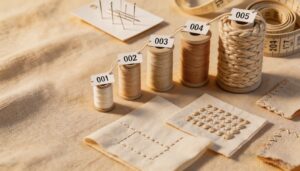
Thread weight numbers can feel like a secret code at first — but they follow a simple logic once you see them in action. A handful of key weights cover almost everything you’ll sew, from whisper-thin appliqué to chunky decorative stitching.
Here’s what each one does and when you’d reach for it.
80 Wt and 60 Wt for Fine Work
Both 80wt and 60wt sit at the fine end of the scale — and that’s exactly what makes them so useful for detailed work. With fine weight threads, seam flatness improves dramatically in layered fabric interaction, keeping bulk low where it matters most.
The 80wt delivers near-invisible construction with maximum stitch precision; the 60wt gives slightly more presence while still offering edge cleanliness and thread feed smoothness.
50 Wt as a Beginner-friendly Standard
If you’re just starting out, 50wt is your best friend — genuinely one of the most reliable Affordable Thread Options for everyday projects. This beginner guide to sewing thread selection staples covers cotton blends, light denim, and quilting cottons without fuss.
It feeds smoothly through your machine, ensures Color Fastness Assurance through washing, stores well for Storage and Longevity, and requires almost no tension tweaking — perfect for Beginner Skill Development.
40 Wt for General Sewing and Quilting
Most sewists eventually land on 40wt as their workhorse — and for good reason. In any beginner guide to sewing thread selection, 40wt sits right in the sweet spot for general sewing and quilting.
It manages woven cottons and quilting projects cleanly, pairs with an 80–90 universal needle, and rarely demands tension drama.
Mind your Thread Storage Conditions, make smart Color Contrast Choices, and you’re set.
30 Wt and 12 Wt for Bold Stitching
Want your stitches to actually say something? That’s where 30wt and 12wt step in.
Both are heavy weight threads built for graphic stitch emphasis — but they hit differently.
30wt is your go-to for bold machine quilting and decorative stitching with contrast thread color and stitch density control.
12wt goes bolder, ideal for design layering and project style selection where the thread is the statement.
Wt Vs Tex Vs Denier Basics
Three systems measure thread thickness — and they don’t all agree. Wt (weight) is an inverse scale: higher numbers mean finer thread. Tex measures grams per 1,000 meters — higher means thicker. Denier measures grams per 9,000 meters, same logic.
Thread weight conversion between these isn’t guesswork: 50wt ≈ Tex 30 ≈ 270 denier.
Fiber type impacts these numbers too, so industry standards vary across cotton, polyester, and silk.
Best Weights for Common Projects
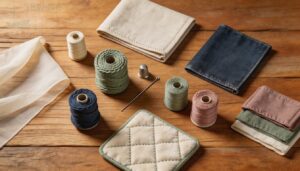
Knowing thread weight is one thing — knowing which weight to reach for is where it actually clicks. Different projects pull in different directions, and the right thread makes the whole thing easier.
Here’s what works best for the most common ones you’ll run into.
Everyday Garment Sewing
For everyday garments, 50 wt thread is your dependable go-to — strong enough for clean seams, fine enough not to pucker cotton poplin or linen.
Understanding thread weight and size helps you match thread fiber to fabric type without overthinking it.
Choosing the right sewing thread also means checking needle and thread compatibility, managing thread tension and machine settings, and keeping tidy Thread Storage Tips so nothing tangles mid-project.
Quilt Piecing and Machine Quilting
Quilting is where thread weight really earns its keep. Your Seam Allowance Tips mean nothing if bulky thread is fighting your pressed seams flat.
Use this quick thread weight chart for quilt piecing techniques and machine quilting:
- 60 wt – fine piecing, invisible seams
- 50 wt – everyday piecing standard
- 40 wt – visible machine quilting lines
- 28–12 wt – bold decorative quilt stitching
Match your Stitch Length Settings and thread weight together — finer thread needs shorter stitches. Good Thread Storage Practices and Quilting Design Planning keep your Color Coordination Strategies consistent start to finish. Check a thread weight conversion guide when switching brands.
Embroidery and Appliqué
Embroidery and appliqué demand more precision than general sewing. Your embroidery thread weight sets the tone — literally.
| Project Type | Thread Weight | Best Choice |
|---|---|---|
| Machine embroidery | 40 wt | Polyester or rayon |
| Appliqué stitching | 60 wt | Cotton or polyester |
| Satin stitch fills | 40 wt | Rayon for sheen |
| Metallic thread accents | 40 wt | Slow speed required |
Stabilizer choice matters as much as thread gauge here. Fusible web bonds your layered fabric shapes — then satin stitch locks the edges clean. Troubleshooting common thread issues? Start with your weight.
Topstitching on Denim and Canvas
Denim and canvas don’t forgive weak thread. For topstitching, reach for 30 wt — heavy weight threads built for dense fabric type.
Pair with a 90/14 or 100/16 needle. Stitch length: 3–3.5 mm.
Double stitching at seams and bar tacks at stress points add real durability. Contrast yarns make edge finishing pop.
Understanding thread weight and size here means bolder, longer-lasting results.
Delicate Fabrics and Lightweight Seams
Flip to the other end of the spectrum — silk, chiffon, and voile demand fine weight threads like 60 wt or 80 wt. Fiber compatibility matters here: lighter thread preserves fabric drape and seam flexibility.
Stitch density stays low, thread finish subtle.
Pair with a 70/10 needle, ease your thread tension, and understanding thread weight and size for each fabric type keeps stitches nearly invisible.
Match Thread Weight to Fabric
Thread weight only works when it matches your fabric — get that wrong, and even the best stitch falls apart. Think of it like pairing shoes to an outfit: the weight has to suit what it’s carrying.
Thread weight only works when it matches your fabric — like pairing shoes to an outfit, the weight must suit what it carries
Here’s how to match your thread to whatever you’re sewing.
Lightweight Fabrics and Finer Threads
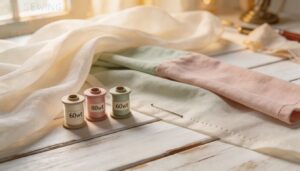
Lightweight fabrics — think chiffon, voile, or cotton lawn — need fine weight threads in the 60 to 80 wt range. Go heavier and you’ll drag the drape right out of the fabric.
Fine weight threads keep seams nearly invisible, support delicate seam finishing techniques, and won’t distort the texture. Reduce your presser foot adjustments, match thread compatibility to fiber, and you’re set.
Medium Fabrics and All-purpose Weights
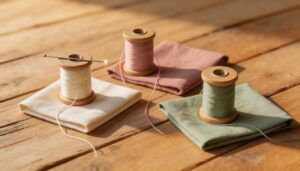
Most medium fabrics — quilting cotton, linen, poplin — hit their stride with 50 wt thread. It’s the sweet spot for seam strength without bulk. Match your fabric type to medium weight threads, and your stitch length, needle size, and thread compatibility fall into place naturally.
- Thread color blends cleanly along the fabric grain
- Seam strength stays balanced without distorting the weave
- Smart thread storage keeps your 50 wt ready for any project
Heavy Fabrics and Thicker Threads
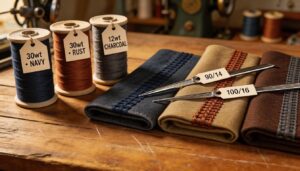
Heavy canvas, denim, and upholstery don’t forgive weak thread choices. Use 30 wt or 12 wt heavy weight threads — they handle fabric compression issues and machine torque impact without snapping under pressure.
Bump your needle size to a 90/14 or 100/16 for thread friction management and stitch density control.
Wider seam allowances protect seam durability where fabric type adds bulk quickly.
Cotton, Polyester, and Specialty Thread Choices
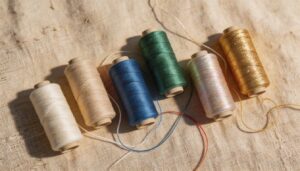
Fiber matching starts with knowing what each thread brings to the table.
Cotton threads breathe, blend naturally, and hold a soft hand on linen or muslin — but colorfastness issues can appear after heavy washing.
Polyester thread wins on UV durability, elasticity differences, and strength.
For sheen options and decorative and specialty threads, rayon adds gloss; metallic adds drama.
Your thread selection should follow your fabric’s lead.
When Thread is Too Heavy or Too Fine
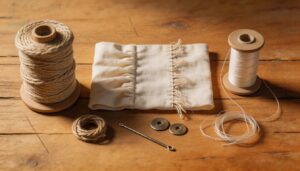
Both extremes cost you a good seam.
Too heavy, and you’ll deal with:
- Fabric pull that bunches the seam instead of letting it lie flat
- Thread breakage from needle heat friction in a too-small eye
- Poor thread feed consistency as thick thread drags through tension discs
Too fine? You lose seam flexibility and stitch coverage fast. Match the weight, or the fabric decides for you.
Needles and Tension by Weight
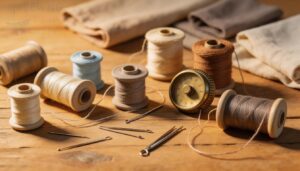
Getting your thread weight right is only half the battle — your needle and tension settings have to keep up.
The wrong needle size or mismatched tension can unravel even the best thread choices fast.
Here’s what to adjust for each weight.
Matching Needle Size to Thread Thickness
Think of your needle eye as a highway lane — your thread needs enough room to travel without friction. too-small eye matters because a too-small eye shreds fibers quickly.
Match your needle size to thread weight: 80 wt needs a 60/8 or 70/10, while 30 wt wants a 90/14 or 100/16.
This ensures thread path smoothness, seam bulk management, fabric pull reduction, and real stitch consistency.
Best Needle Types for Common Weights
Size matters, but so does point shape.
Microtex needles handle fine 60–80 wt threads on woven fabrics cleanly, while Jeans needles power through denim with 30 wt.
Ballpoint needles protect knit fabrics by sliding between fibers instead of piercing them.
For metallic or heavy threads, nickel plated needles resist corrosion, and titanium coated needles reduce drag — both extending needle life noticeably.
When to Lower or Raise Tension
Once your needle is right, tension is the next dial to get friendly with.
- Bobbin thread visibility on top = top tension is too tight — lower it by one number.
- Top thread loops underneath = tension is too loose — raise it slightly.
- Fabric distortion signs like puckering = thread too heavy for the setting — loosen gradually.
Test every change on a scrap first.
Using Finer Bobbin Thread for Balance
Here’s a simple trick that works every time: load your bobbin with thread one weight lighter than your top thread.
A finer bobbin thread improves bobbin thread balance by reducing top-thread pull, which cuts loop formation and facilitates stitch density control on thin fabrics.
It also helps with thread breakage mitigation across long seams — keeping your lightweight fabric compatibility intact without adding seam bulk or affecting seam visibility reduction.
Fix Beginner Thread Weight Mistakes
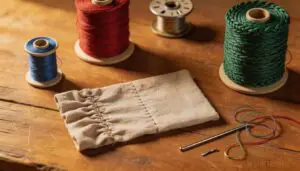
Even experienced sewists hit these snags, so don’t sweat it if your thread keeps shredding or your seams look puckered. Most thread problems come down to a few fixable mismatches between your thread, needle, and tension settings.
Here’s what’s likely going wrong — and exactly how to sort it out.
Thread Shredding From Needle Mismatch
Thread shredding is almost always a needle eye mismatch in disguise. The wrong needle creates Thread Slip Friction that quietly destroys your thread before the stitch even forms.
Watch for these four warning signs:
- Fine thread loops and snaps — needle eye is too large
- Heavy thread frays at entry — Sharp Point Damage from an undersized eye
- Skipped stitches with metallic thread — classic Mismatched Needle Eyes problem
- Consistent Thread Breakage mid-seam — Needle Wear Impact from the wrong needle type
Match your thread weight to needle size compatibility, and shredding stops.
Puckered Seams From Bulky Thread
When you use heavy weight threads on tightly woven fabrics, puckered seams show up fast—especially if you ignore Seam Density Control or forget about Stitch Length Adjustment. Fabric Stretch Mismatch makes things worse, crowding the seam.
For fabric puckering prevention, pick finer thread, try Bias Stitching Benefits, and check Thread Lubrication Effects. Lower thread tension and proper needle size keep seams smooth.
Skipped Stitches With Wrong Setup
Skipped stitches usually trace back to one of a few fixable problems—Improper tension, Needle size mismatch, or Bobbin path obstruction.
- Too loose thread tension lets the upper thread slip past fabric without forming a loop
- A needle size that doesn’t match your thread weight leaves gaps in stitch pickup
- Stabilizer absence on slippery fabrics causes inconsistent feed, and machine timing issues can compound every problem above
Breakage Caused by Poor Thread Choice
Most thread breakage comes down to four culprits: Eye Friction Breaks, Heat Snap, Mismatched Tension, and Fabric Pull Stress.
When your needle size is too small, the thread frays and snaps from constant rubbing. Tight tension weakens thread at every bend. Metallic Thread Snaps are especially common here — metallic threads need a larger eye and lower tension.
Match needle size to thread weight, and breakage drops fast.
Simple Thread Weight Rules to Remember
Keep these four rules close — they’ll save you from most beginner headaches:
- Higher wt numbers = finer thread; lower numbers = bolder, heavier stitches
- Match needle size to thread weight — mismatches cause breakage quickly
- Test on scrap fabric first; Thread Testing Methods catch tension problems early
- Proper Thread Storage Tips (cool, dry, dark) prevent degradation and snapping
Simple rules. Big results.
Frequently Asked Questions (FAQs)
How much does a thread weigh?
A single spool of thread weighs practically nothing — yet that tiny mass per meter shapes every seam you sew. Thread weight isn’t about heaviness; it’s a classification system describing thickness.
What is a good thread weights chart?
A solid thread weight chart maps wt numbers against Tex and Denier side by side.
Color coding system entries by project type make scanning fast.
Many sewers prefer digital interactive tools for quick metric conversions on the go.
Should thread weights be considered before starting a sewing project?
Yes — project planning starts with thread weight.
The right pick shapes seam quality, fabric stretch, and design aesthetic. Wrong weight means puckering, breakage, or bulk before you’ve sewn a single stitch.
How do I choose the right thread for my sewing machine?
Match thread weight to your fabric first — 50 wt works well for most projects.
Test tension on scraps, pair your needle size with the thread, and store spools somewhere cool and dry.
What weight of thread should I use?
Start with 50 wt thread — it works with most fabrics cleanly. For delicate work, go finer (60–80 wt). For denim or bold topstitching, go heavier (30–40 wt).
Is 60 wt thread thinner than 40 wt?
Yes — 60 wt is thinner than 40 wt. The higher the number, the finer the thread. Think of it as a thread weight chart in reverse: bigger number, smaller diameter.
Can I mix thread weights in one project?
Absolutely — weight layering is a real technique.
Use lighter thread for seams to reduce seam stress, then switch to contrast stitching with heavier thread for design accent. Just test your thread pairing on a scrap first.
Does thread color affect how weight looks?
Thread color absolutely changes how weight reads. Light value expansion makes pale threads look thicker; dark value compression slims them visually.
Contrast visibility, saturation impact, and fabric background interaction all shift how your stitches appear — sometimes dramatically.
How does thread age impact its performance?
Old thread breaks trust fast. Fiber oxidation makes it stiff, reducing flexibility. Increased friction strains the bobbin path, color fading dulls seams, and reduced tensile strength means unexpected snaps mid-stitch.
Should bobbin thread always match the top thread?
Not always.
For most woven fabrics, matching bobbin and top thread weight keeps stitches balanced. But bold topstitching often benefits from a lighter bobbin — less bulk underneath, cleaner results on top.
Conclusion
Measure twice, stitch once" is especially true regarding thread weight for beginners. Mastering thread weight ensures your stitches lie flat and seams stay smooth.
When you match thread weight to fabric, your sewing machine becomes a willing partner, not a frustrating foe.
With practice, you’ll develop an instinct for choosing the right thread weight.
Thread weight for beginners may seem challenging, but with patience, you’ll sew with confidence and precision every time.