This site is supported by our readers. We may earn a commission, at no cost to you, if you purchase through links.
Nothing derails a sewing session faster than watching your machine churn through fabric without forming a single stitch. The needle punches down, the fabric moves, but the thread just trails behind—no loops, no locks, no connection. That disconnect usually traces back to one culprit: upper thread not catching the bobbin thread beneath the needle plate.
Fix sounds simple, but the causes stack up fast. A slightly bent needle, a lint-clogged hook race, or threading done with the presser foot down can each break the entire stitch cycle. Knowing which one you’re dealing with changes everything.
Table Of Contents
Key Takeaways
- Threading with the presser foot down is one of the most overlooked causes of missed bobbin catches, because the tension discs stay closed and never grip the upper thread properly.
- A needle that looks perfectly fine can still be bent, dull, or installed backward—roll it on a flat surface to check, and replace it before chasing any other fix.
- Bobbin problems often come down to two things: wrong orientation (the thread should form a "P" in drop-in machines) and using the wrong bobbin size, which quietly kills thread tension.
- If skipped stitches persist across every fabric and setting after a full rethread, that’s a timing issue—not a DIY fix—and the machine needs a professional technician.
Why The Upper Thread Won’t Catch The Bobbin
When your upper thread refuses to catch the bobbin, something in the chain has broken down — and it’s usually one of a handful of familiar culprits.
Check common bobbin problems and how to fix them to quickly pinpoint whether threading, tension, or a misaligned case is the real issue.
Most of the time, the fix is simpler than you’d expect once you know where to look.
Here’s what’s most likely going wrong.
Common Causes of Thread Not Catching
Several culprits can stop your upper thread from catching the bobbin thread.
Spool pin twist causes uneven feeding, while lint accumulation blocks the hook race entirely.
Tension disk issues keep the thread from relaxing into a catchable loop.
Hook timing drift means the hook simply arrives too late or too early.
Needle bar height and thread tension adjustment problems quietly wreck everything else.
Ensuring proper bobbin case placement is essential for smooth catching.
How Stitch Formation Works in Your Machine
stitch formation is a quick handoff. Your needle carries the upper thread down, and just as it starts to rise, a tiny loop forms behind it — that’s when hook path timing matters most.
The hook grabs that loop, wraps it around the bobbin thread, and the take-up lever mechanics snap everything tight.
Feed dog synchronization then moves the fabric forward, ready for the next stitch.
Ensuring proper threading of take-up lever helps prevent the upper thread from missing the bobbin.
When to Suspect Timing Issues
Sometimes the problem goes deeper than threading or bobbin insertion. If you’ve reset everything correctly and still see a hook miss pattern on every stitch, timing is likely the culprit.
Watch for these signs:
- Consistent skipped stitches in a repeating pattern
- Sudden needle breakage at low speed
- Needle strike sounds — clicks or grinding
- Irregular zigzag gaps on one side only
Checking and Rethreading The Upper Thread
Most threading problems trace back to a few specific spots in the upper thread path.
Knowing which needle and thread combinations work best can help you rule out compatibility issues before you start chasing tension problems.
Before you touch the bobbin or swap the needle, it’s worth going back to basics and checking how the top thread is actually sitting in the machine.
Here’s what to look at.
Correct Thread Path and Take-Up Lever
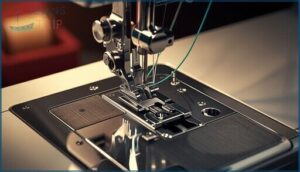
Your machine prints the thread path for a reason — follow those arrow markings without skipping a single guide. Every guide in the sequence shapes your upper thread loop size, and a small loop means the hook misses the bobbin thread entirely.
Follow every thread guide without skipping one, or your hook will miss the bobbin entirely
Check lever eye alignment by tugging the thread lightly; you should feel resistance. Keep tension discs clean, or the grip disappears quickly.
Importance of Threading With Presser Foot Up
Always raise the presser foot before threading — no exceptions. Here’s exactly why it matters:
- Disc Opening Mechanics — lifting the foot opens the tension discs so your upper thread actually seats inside them.
- Zero Tension Loops — foot down means the discs stay closed, creating zero tension and messy underside bird’s nests.
- Thread Path Feel — with the foot up, the thread path feels smooth; any snag signals a misroute instantly.
- Automatic Threader Compatibility — most built-in threaders only work correctly with the foot raised.
Run a quick scrap stitch test after rethreading to confirm your bobbin thread pulls up cleanly.
Presser Foot Position and Thread Tension
Once you lower the presser foot, something small but critical happens — the tension discs close and grip the upper thread. That’s Tension Disc Mechanics at work.
Without that Thread Grip Dynamics in place, the needle can’t form a proper loop for the hook to catch. Check that your Tension Dial sits at a normal setting, then let Foot Lever Synchronization do the rest.
Inspecting The Needle for Problems

The needle is one of the first things I check when the upper thread won’t catch — and it’s surprising how often tiny flaw is the whole problem.
A needle that looks fine to the eye can still be bent, dull, or sitting in the wrong position.
Here’s what to look at.
Bent, Dull, or Damaged Needles
A needle that looks fine can still be the problem. Needle Tip Wear and Needle Eye Burr are invisible culprits — your upper thread snags mid‑loop, thread tension collapses, and the hook misses.
Needle Impact Damage from hitting a pin causes the same chaos.
Needle Bend Detection, roll it on glass — wobble means replace.
Don’t wait. Needle Replacement Timing matters more than most sewists realize.
Proper Needle Installation and Orientation
Even a brand-new needle causes trouble if it’s installed wrong. Get these three things right every time:
- Flat Side Direction – flat side faces the back on most home machines
- Full‑Height Insertion – push it up until it stops, then tighten the Clamp Screw firmly
- Scarf Position and Needle Groove Alignment – the groove guides your upper thread down; the scarf presents the loop to the hook
Wrong orientation collapses thread tension instantly.
Choosing The Right Needle Size and Type
Think of needle selection like picking the right wrench — the wrong size just slips. A size 80/12 with 50‑weight thread manages everyday cotton well, while heavy denim needs a 100/16 needle. Fabric weight matching and thread weight pairing keep thread tension balanced through every guide.
| Fabric Type | Needle Size & Type |
|---|---|
| Delicate silk, lace | 60/8 – Microtex for delicate fabrics |
| Cotton, muslin | 80/12 – Universal |
| Denim, canvas | 100/16 – Denim needle choice |
| Knits, jersey | 80/12 – Ballpoint vs universal |
Bobbin and Bobbin Case Troubleshooting
The bobbin area is where a lot of sneaky problems hide.
Even if your upper thread looks fine, something as simple as a slightly wrong bobbin drop can throw off your whole stitch. Here’s what to check on that side of the machine.
Correct Bobbin Insertion and Orientation
Getting bobbin insertion right is half the battle. For drop‑in machines, your bobbin thread should form a P shape — that’s your thread exit direction check.
Front‑load systems need the opposite rotation, so don’t mix up habits.
Always confirm case seating check by feeling it click, thread through the spring slot alignment, and verify bobbin rotation verification by tugging the thread gently.
Bobbin Type and Size Compatibility
Orientation sorted? Now make sure you’re using the right bobbin altogether.
Class L vs 15 looks nearly identical — we’re talking a 2mm height difference — but drop the wrong one in and your bobbin thread tension goes sideways fast.
Metal vs plastic matters too; swapping materials changes friction and weight.
Check your manual, measure diameter if unsure, and match thread weight to bobbin class.
Cleaning Lint and Debris From The Bobbin Area
Now that you’ve got the right bobbin, keep that area clean — lint is sneaky. After every 10–12 hours of sewing, brush out the bobbin area using lint brush techniques: sweep toward the opening, never deeper in.
Use tweezers for packed fuzz, then focus on hook race cleaning with a pin. Finish with post-clean lubrication. Skip compressed air — it makes things worse.
Fabric and Thread Factors Affecting Stitching
Sometimes the problem isn’t the machine at all—it’s what you’re feeding through it. The fabric you’re sewing and the thread you’re using can throw off your stitch formation just as much as a bad needle or a tangled bobbin.
Here are the key factors worth checking.
Sewing Thick or Layered Fabrics
Sewing through thick or layered fabric is where most machines quietly start struggling. Fabric thickness forces the needle to deflect slightly, pushing the upper thread loop just far enough off‑path that the hook misses it entirely.
- Raise presser foot lift fully before feeding bulky layers
- Use a walking foot to keep layers aligned
- Loosen layered fabric tension slightly for a bigger catchable loop
- Sew slowly to reduce needle deflection
- Take shorter stitches through heavy seams
Matching Needle and Thread to Fabric
Thick fabric already bends your needle — but the wrong needle-and-thread combo makes it worse. Thread Weight Matching starts here: pair the needle eye size to your thread thickness, not just your fabric.
| Fabric Weight Guide | Needle Type Selection | Thread Weight Matching |
|---|---|---|
| Lightweight (chiffon, silk) | Microtex 60/8–70/10 | Fine Tex 18–30 |
| Medium (cotton, twill) | Universal 80/12–90/14 | Standard Tex 30–40 |
| Heavy (denim, canvas) | Denim 100/16–110/18 | Heavy Tex 60–90 |
An undersized needle pinches your upper thread, killing the loop the hook needs to catch. Fix the match, fix the skip.
Adjusting Presser Foot Pressure for Different Materials
Getting presser foot pressure wrong is one of the quietest causes of upper thread skipping. Here’s a quick Quilting Pressure Guide for your machine settings:
- Denim Pressure Settings: Set 4–6 for heavy fabric and thread tension control
- Silk Pressure Tips: Drop to 1–3 to protect delicate upper thread flow
- Leather Foot Force: Turn dial clockwise; firm compression prevents skipped stitches
- Stretch Fabric Adjustment: Mid-range pressure keeps fabric and thread management smooth
- Quilting layers: Slightly higher settings maintain stitch consistency through batting
Step-by-Step Fixes for Thread Not Catching
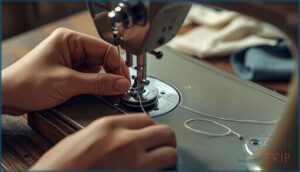
At this point, you’ve diagnosed the problem—now it’s time to fix it. Most thread-catching issues come down to a handful of simple, hands-on steps you can work through in minutes.
Here’s what to do.
Manual Bobbin Thread Pickup Method
Think of this as a nudge and catch move.
Hold your upper thread tail with your left hand — that thread tension grip keeps everything in place.
Turn the handwheel toward you, lowering the needle fully, then raise it back up.
Watch for a loop of bobbin thread to emerge through the needle plate.
Use a seam ripper or your finger for clean loop extraction.
Re-threading Both Upper Thread and Bobbin
Start fresh — turn the machine off, raise the presser foot lever fully, and re-thread from scratch. Check spool direction first, then walk the upper thread through every guide, through the tension discs, and through the take-up lever.
Reinsert the bobbin, confirm the bobbin spring adjustment feels snug, and pull out a generous tail. Thread quality selection matters too — cheap thread frays and snags constantly.
When to Seek Professional Machine Service
Some problems are beyond a simple re-thread.
If you’re seeing Persistent Timing Issues — skipped stitches across every fabric, no matter what you try — or hearing Persistent Noise Alerts like clunking or grinding, stop sewing.
Hook Damage, Gear Failure, and Internal Wear need a trained technician.
Bobbin Thread Issues and Thread Tension problems caused by worn internal parts aren’t DIY fixes.
Book professional Sewing Machine Repair and Service.
Frequently Asked Questions (FAQs)
Why is my bobbin not catching the thread?
Your bobbin thread isn’t catching because something’s breaking the stitch loop—usually a thread tension disc problem, hook timing adjustment issue, poor needle eye alignment, or a worn bobbin case throwing off the whole pickup sequence.
Why does my sewing machine not catch the bobbin?
Your sewing machine can’t catch the bobbin when thread tension balance is off, hook timing adjustment is needed, or bobbin case alignment is wrong.
Needle eye height and presser foot pressure matter too.
Why is my machine not picking up the bobbin thread?
Your machine skips the bobbin thread when thread tension is off, needle height is wrong, or hook timing is out of sync — three small things that quietly break every stitch.
How do I know if my bobbin thread is too tight?
Run the Drop Test: hold the bobbin case by its thread.
A slight jerk should let it slide an inch.
Zero movement means your Thread Tension is too tight—classic Bobbin Thread Problems confirmed.
Why isn’t my top thread catching the bobbin?
hook misses the upper thread loop because of a threading mistake, a bent needle, or a bobbin seated incorrectly.
Fix those three things first, and most cases solve themselves.
Why is my singer not picking up the bobbin thread?
Your Singer skips bobbin pickup when bobbin case orientation is wrong, needle height adjustment is off, or tension disc cleaning is overdue.
Fix presser foot timing first — it’s the fastest win.
Can thread quality affect bobbin catching issues?
Yes, thread quality matters more than most people realize.
Fuzzy thread impacts clogs tension discs fast. Stiff thread loop formation fails the hook. Uneven diameter tension causes skipped stitches.
Use smooth, quality thread every time.
Does sewing speed impact thread loop formation?
Sewing speed absolutely affects loop timing.
Faster stitching creates tension peaks that tighten the upper thread before hook synchronization can occur, disrupting stitch formation and making reliable bobbin thread pickup harder.
How does needle plate damage affect thread catching?
rough needle plate is the hidden culprit.
Burr-induced snagging and scratched thread path surfaces throw off thread tension, cause feed-dog interference, and trigger a hook timing shift — stopping your bobbin thread cold.
Does thread color or dye affect tension consistency?
Yes, thread color can affect tension.
Dark threads carry more dye, creating extra friction through the guides. That dye-induced friction raises effective upper thread tension even when your tension dial hasn’t moved.
Conclusion
When addressing upper thread not catching bobbin issues, the devil’s in the details—a slightly off needle, skipped threading step, or lint-packed hook race can quietly shut down your entire stitch cycle.
But now you know exactly where to look.
Work through each fix methodically, and your machine will reward you.
Most problems like this are solved in minutes, not hours.
Trust the process, and get back to sewing.