This site is supported by our readers. We may earn a commission, at no cost to you, if you purchase through links.
Most sewers think of needles as a commodity—grab a pack, thread it, get to work. But a standard sewing needle survives thousands of fabric penetrations per minute under a machine running at full speed, and it does that without bending, breaking, or tearing your material apart.
That kind of performance doesn’t happen by accident. The answer to what sewing needles are made of runs deeper than “steel“—it involves specific alloys, precision coatings, and manufacturing steps borrowed from industrial metalworking. Knowing the material science behind your needle helps you choose the right one, extend its life, and understand why the wrong needle wrecks a project before it starts.
Table Of Contents
Key Takeaways
- Most sewing needles start with a high-carbon steel core (0.8–0.95% carbon) that’s heat-treated to nearly 1,000 Vickers hardness, giving them the strength to handle thousands of fabric penetrations per minute without snapping.
- The needle coating matters as much as the steel — titanium nitride runs two to three times harder than chrome and lasts three to six times longer, while nickel and gold plating mainly handle friction reduction and corrosion resistance.
- Every part of a needle — shaft diameter, groove width, eye size, point shape, and scarf geometry — is precision-engineered for a specific job, and mismatching any one of them to your fabric or thread will tank your stitch quality fast.
- Needles don’t last forever; 6 to 8 hours of active sewing is the practical replacement window, and pushing past it shows up as skipped stitches, thread breakage, and fabric damage before you even notice the needle is dull.
What Are Sewing Needles Made Of?
Most sewing needles aren’t made of just one material — they’re a layered combination of metals chosen for specific performance reasons.
Each layer serves a purpose — and that layered construction directly affects how well you can fine-tune bobbin tension for consistent stitch quality.
The base material determines strength and flexibility, while surface coatings handle everything from corrosion resistance to how smoothly the needle glides through fabric. Here’s a breakdown of the main materials you’ll find in modern sewing needles.
High-Carbon Steel and Stainless Steel
Most sewing needles come down to a choice between two steel alloys: high-carbon steel and stainless steel. Each brings distinct metal properties to your work:
- High-carbon steel (0.8–0.95% carbon) holds an ultra-sharp point through dense fabrics
- Stainless steel offers better corrosion resistance, staying rust-free even with sweaty hands
- Stainless grades like 304 or 420 balance needle durability with flexibility
For more details on the differences in, expert sources offer an in-depth look.
Nickel and Gold Plating
Steel alone won’t cut it—literally. That’s where plating comes in.
Nickel-plated needles form a thin corrosion-resistant shell around the steel core, reducing friction and drag through fabric. Gold-plated options take surface finish a step further, offering hypoallergenic options for nickel-sensitive sewists.
Both metal coatings and finishes improve coating durability, though gold wears faster on abrasive materials. In fact, nickel plating provides enhanced durability and helps protect metal components from harsh environments.
Titanium and Chrome Coatings
Beyond nickel and gold, titanium and chrome coatings push needle durability into a different league. A titanium nitride layer — about 3 micrometers thick — makes titanium-coated needles two to three times harder than chrome-plated versions, sharper longer, and resistant to wear through abrasive threads.
Titanium nitride coatings make sewing needles two to three times harder than chrome, staying sharper longer through even the most abrasive threads
Chrome still delivers solid friction reduction and smooth surface finish for everyday work, but titanium-coated needles simply outlast standard metal coatings and finishes by three to six times.
Specialty Materials for Specific Uses
Specialty materials take sewing needle materials well past standard coatings. Ceramic coatings cut friction and nearly double needle life under heavy embroidery use.
For hand stitching, pairing a ceramic-coated needle with the right technique makes a real difference—especially when you’re working with stretchy fabric.
Tungsten carbide tips stay sharp through industrial-grade abuse where high-carbon steel would dull fast.
If you have nickel sensitivities, nickel free oxidized steel keeps things safe. Resin bodoids handle elastic and ribbon threading without any piercing risk.
Key Components of Sewing Needles
A sewing needle looks simple, but every part of it has a specific job to do. Understanding how those parts work together helps you make smarter choices for your projects.
Here’s a closer look at the key components that give a needle its function and form.
The Shaft and Its Role
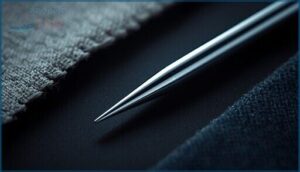
The shaft is the backbone of every needle — and it does more than you might think. Its diameter defines the needle size (a NM 75 shaft measures exactly 0.75 mm), while shaft strength and fabric penetration go hand in hand.
Get these three things right with your sewing needle selection:
- Shaft Material — hardened high-carbon steel balances shaft strength with controlled flexibility, so your needle bends slightly under load rather than snapping.
- Needle Alignment — any bend in the shaft throws off stitch quality instantly, misaligning the scarf and eye with the hook path.
- Metal Composition — chrome or titanium coatings over the base needle material reduce friction and extend wear life substantially.
Match your shaft diameter to your fabric weight, and you’ve already won half the battle.
The Eye and Groove
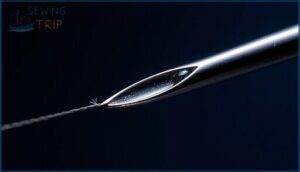
Two small features — the eye and the groove — control everything about thread protection and stitch formation. Eye geometry determines whether your thread moves freely or shreds under friction. The long groove, usually 40% of needle diameter in width, cradles the thread flush against the blade, cutting drag at high speeds. Nail this needle precision, and your stitches stay consistent.
| Eye/Groove Condition | Likely Result |
|---|---|
| Eye too small | Thread frays, frequent breaks |
| Eye too large | Visible holes, tension problems |
| Groove matched correctly | Smooth thread flow, clean stitches |
| Groove too narrow | Shredding, skipped stitches |
| Oversized groove, fine thread | Irregular loops, weak seams |
The Point and Scarf
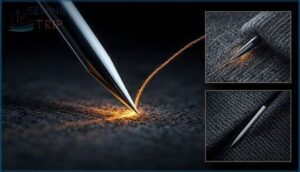
Think of the point and scarf as a two-part handshake between your needle and fabric.
Point geometry determines how the needle enters — sharp tips pierce woven cloth cleanly, while ballpoint tips part knit loops without cutting them.
The scarf, that small indentation above the eye, creates clearance so the machine hook catches the thread loop reliably. Together, they drive clean stitch formation every time.
How Sewing Needles Are Manufactured
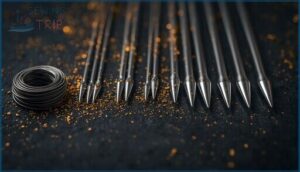
Every needle production goes through a surprisingly involved process before it reaches you. From raw wire to finished product, each stage plays a specific purpose in creating something strong, sharp, and consistent.
Here’s how it all comes together.
Wire Drawing and Shaping
Wire drawing is where the real transformation begins. High-carbon steel wire gets pulled through a series of 5 to 7 hardened dies, each one tighter than the last — a cold forming process that refines the diameter while work-hardening the metal.
This metalworking step, central to needle profiling and shaft polishing prep, demands tight tolerances, often within hundredths of a millimeter, to guarantee consistent material science and manufacturing process standards throughout.
Eye Formation and Stamping
Before the eye can be punched, die pressing shapes a thin web in the eye zone — controlled cold forming that keeps the surrounding metal strong.
High-speed stamping then pierces this section with hardened steel punches, handling thousands of needle blanks per hour.
Burr removal follows through barrel polishing, smoothing every edge so thread guidance stays clean and your stainless steel needle construction won’t fray a single strand.
Heat Treatment and Hardening
Raw steel blanks enter a furnace held under tight atmosphere control — think vacuum or nitrogen — then heat to around 1,032°C, triggering martensite formation that dramatically increases hardness.
Quenching methods drop that temperature fast, locking in strength. Tempering follows at roughly 200–264°C for 25–55 minutes, dialing back brittleness so your high-carbon steel needle flexes without snapping. Surface hardness can reach nearly 1,000 Vickers on finished nickel-plated versions.
Polishing and Coating
Once hardening locks in that strength, polishing takes over — and it matters more than you’d think.
Manufacturers run nickel-plated steel needles through multi-stage mechanical polishing, moving from coarse 80–240 grit down to fine 400+ passes. Here’s what that process delivers:
- Friction Reduction — smooth shafts glide through fabric without snagging
- Corrosion Resistance — chrome, nickel, or gold-plated layers protect against rust
- Decorative Finishes — titanium-coated and stainless steel needles get color-coded tips for quick identification
Quality control follows with optical inspection, confirming uniform gloss before packaging.
Types of Sewing Needles by Material
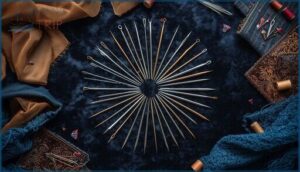
Not all sewing needles are built the same, and the material they’re made from changes everything about how they perform. Knowing which type fits your project saves you from skipped stitches, damaged fabric, and a lot of frustration.
Here are the main types you’ll want to know.
Universal Needles
Universal needles are your most reliable all-purpose sewing machine companion. Made from hardened high-carbon steel with a nickel-plated finish, their slightly rounded tip navigates both woven and stable knit fabric selection without tearing fibers.
Needle sizes range from 60 to 120, affecting stitch quality with different thread types. Size 80/12 is the practical starting point for everyday sewing needles.
Ballpoint and Embroidery Needles
Ballpoint and embroidery needles take needle tip geometry in two distinct directions.
Ballpoint tips — available in light (SES), medium, and heavy versions — slip between knit yarns instead of piercing them, protecting fabric selection like jerseys and fleece from runs.
Embroidery needles pair a deeper front groove with an enlarged, polished eye for thread compatibility with rayon and polyester, keeping stitch quality clean through dense embroidery techniques.
Leather, Quilting, and Specialty Needles
Where ballpoint and embroidery needles protect delicate fibers, leather, quilting, and specialty needles tackle the tough stuff. Leather point geometry uses wedge, diamond, or triangular cutting tips that slice clean holes rather than pushing fibers apart. Quilting needle design features a tapered shaft built for heavy fabric sandwich layers. Titanium durability coatings keep specialty needles sharper, longer.
- Leather needles use twist or triangular points, leaving shaped holes suited for decorative seams on thick hides
- Quilting needles range from size 75/11 to 90/14, with deeper grooves protecting thread through dense batting
- Titanium-coated needle materials last three to five times longer than standard chrome versions
- Denim and upholstery specialty sewing needles use reinforced shafts in sizes 100/16 or 110/18 for bulky seams
Factors Influencing Needle Material Choice
Picking the right needle material isn’t just a technical detail — it directly affects how your project turns out.
Several practical factors should guide that choice, from how the needle holds up over time to what fabric you’re working with.
Here’s what actually matters when making that call.
Durability and Flexibility
Durability and flexibility aren’t opposites — they’re a balancing act. Stainless steel sewing needles lean toward flexural strength, bending under pressure rather than snapping, which protects your machine.
High-carbon nickel-plated needle materials trade some flex for needle hardness and wear analysis shows they hold a sharper point longer. Repeated overloading causes metal fatigue, and corrosion resistance determines how long that durability actually lasts.
Fabric Type and Project Needs
Fabric selection shapes every needle decision you make. For project planning, match your needle material to the job: ballpoint needles protect knit loops, while denim and leather needles use reinforced steel to push through dense fibers cleanly.
Thread compatibility matters too — fine 60 wt thread needs a smaller eye than heavy 12 wt. Smart material matching means fewer skipped stitches, period.
Needle Maintenance and Longevity
Even the best needle material loses its edge without basic sewing tool maintenance. Needles usually hold up for 6 to 8 hours of active stitching — push past that and you’ll notice thread breakage, skipped stitches, or fabric damage prevention becomes impossible.
Smart needle replacement, proper needle storage tips, and sewing speed control all extend durability. Corrosion resistance starts with keeping sewing needles dry and lint-free.
Frequently Asked Questions (FAQs)
What material are sewing needles made of?
Most sewing needles rely on high-carbon steel as their foundation — needle material that balances hardness with just enough flex.
Nickel-plated and titanium coatings then handle sewing durability and smooth fabric interaction.
Can you get tetanus from a clean sewing needle?
A brand-new sewing needle carries very low tetanus risk, but “clean” isn’t a guarantee. Proper wound care and current vaccine boosters matter more than how sharp the needle looks.
Is a sewing needle metal?
Yes — almost always. Over 90% of sewing needles worldwide rely on steel alloys, primarily high-carbon steel, for their metal composition, needle durability, and magnetic properties, with nickel-plated, stainless steel, and titanium options rounding out the lineup.
Are stainless steel needles really better?
Not always. High-carbon steel needles hold sharper points longer and handle heavy fabrics better.
But if you’re dealing with nickel allergies or humid storage, stainless steel‘s built-in corrosion resistance wins hands down.
How old are the earliest known sewing needles?
The oldest known sewing needle dates back roughly 50,000 years, discovered in Denisova Cave, Siberia.
This prehistoric tool — complete with a carved eye — proves ancient sewing and needle evolution began far earlier than most expect.
What materials did prehistoric humans use for needles?
Before steel and titanium, bone tools, antler awls, ivory points, plant thorns, and shell needles all served as sewing needle materials — whatever was sharp, sturdy, and close at hand.
How should sewing needles be properly stored at home?
Keep sewing needles in a closed, dry container away from humidity to prevent rust.
Use labeled compartments for needle organization, store sharp tools out of children’s reach, and wipe needles clean before putting them away.
Can people with nickel allergies safely use all needles?
No, not all needles are safe for Nickel Allergies. Most standard options use NickelPlated Steel coatings that irritate sensitive skin.
Hypoallergenic materials like Titanium or oxidized high-carbon steel offer reliable Nickel Free Options for Allergy Prevention.
How often should sewing machine needles be replaced?
Change your sewing machine needles every 6 to 8 hours of use. Watch for skipped stitches or dull sounds — those wear signs mean it’s already time.
Conclusion
The irony is that something so small—easily lost in a cushion, forgotten in a seam allowance—turns out to be a carefully engineered piece of metallurgy. Now that you know what sewing needles are made of, that generic pack on your workbench looks a little different.
High-carbon steel, precision coatings, heat-treated hardness: none of it’s accidental. Match the right material to your fabric, and your needle stops being a commodity and starts being a tool you actually control.
- https://blog.colonialneedle.com/are-stainless-steel-needles-really-the-best/
- https://www.oreateai.com/blog/the-anatomy-of-a-sewing-needle-what-makes-it-tick/5b06efdea2c30a46ef9792b8473539bf
- https://www.pandahall.com/p-1294001-carbon-steel-sewing-needles-platinum-4-6x0-12cm.html
- https://www.knitpro.eu/usa/blog/carbon-fiber-vs-stainless-steel-vs-aluminum-knitting-needle
- https://prototek.com/article/the-benefits-of-nickel-plating/