This site is supported by our readers. We may earn a commission, at no cost to you, if you purchase through links.
Picking up a sewing pattern book feels straightforward—until you’re standing in a fabric store, flipping through pages, and realize you have no idea what separates a genuinely useful reference from one that’ll collect dust on your shelf. Most sewists learn this the hard way, buying a beautiful book only to find the instructions skip steps, the illustrations are too small to read, or the fit guidance assumes a body that doesn’t exist in real life.
Knowing what to look for in sewing pattern books saves you money, frustration, and hours of unpicking seams. The right book becomes a mentor you return to again and again.
Table Of Contents
Key Takeaways
- A good sewing pattern book shows you fit adjustments with real photos of real bodies, not idealized illustrations that don’t match how people actually look.
- Before you buy, check for skill-level indicators and clear step-by-step instructions—books that skip these will cost you time and unpicked seams.
- Fit details like ease allowances, grain line markings, and finished garment measurements matter more than a book’s looks or price tag.
- fit-focused manuals, pattern drafting guides, and versatile project books each serve a different sewist at a different stage.
Top 5 Sewing Pattern Books Worth Buying
Some books just earn a permanent spot on your sewing shelf.
These are the titles worth sharing, too — a curated list of sewing pattern books perfect for gift-giving proves that great books have a way of multiplying across shelves.
These five have proven their worth for sewers at every level, from total beginners to seasoned dressmakers.
Here’s what makes each one worth your money.
1. Readers Digest Complete Sewing Guide
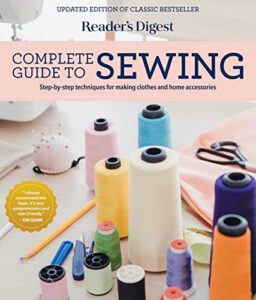
The Reader’s Digest Complete Guide to Sewing is one of those books you’ll reach for again and again. First published in 1976, it covers everything from tools and fabrics to hand stitching and pattern reading — all across 384 pages packed with thousands of illustrations.
The 2022 update adds 20 full projects, including shirts, dresses, and home-decor pieces. At around $20, it’s genuinely hard to beat.
Tim Gunn loves it. So does The New York Times. That’s a good sign.
| Best For | Anyone who wants to learn to sew from scratch or level up their skills — especially home sewists who want one solid reference book they can keep coming back to. |
|---|---|
| Format | Hardcover/Softcover |
| Language | English |
| Page Count | 384 pages |
| Skill Level | Beginner to Advanced |
| Visual Guides | Illustrations and diagrams |
| Price | $20.04 |
| Additional Features |
|
- Covers everything in one place — tools, fabrics, hand stitching, patterns, and 20 full projects.
- Packed with thousands of illustrations across 384 pages, so you can actually see what you’re doing.
- At around $20, it’s a steal for how much ground it covers — and it’s the #1 sewing book on Amazon.
- Projects aren’t organized by difficulty, so beginners may have to do some digging to find a good starting point.
- No videos or digital companion — just static images and text, which can be limiting for visual learners.
- It’s a big, heavy book (3.5 lbs), so it’s not something you’re tossing in a bag to take to a class.
2. Sewing Book Step by Step Techniques
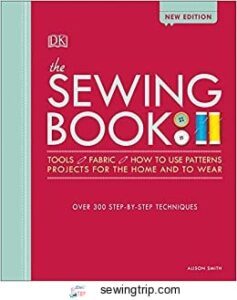
If you want something that shows rather than tells, the DK Sewing Book is worth a look. Published in 2018, it packs over 250 hand- and machine-sewing techniques into 400 pages, all illustrated with close-up photographs.
What makes it stand out is how it breaks things down — each project moves through clear stages, covering everything from cutting and pinning to finishing seams.
You also get a fabric directory, a terminology glossary, and coverage of more than 100 tools. At $30.99, it’s solid value.
| Best For | Beginner and intermediate sewists who learn best by seeing techniques broken down step by step, and anyone looking for a solid all-in-one sewing reference at home. |
|---|---|
| Format | Hardcover |
| Language | English |
| Page Count | 400 pages |
| Skill Level | Beginner to Intermediate |
| Visual Guides | Close-up photographs |
| Price | $30.99 |
| Additional Features |
|
- Over 250 techniques shown with close-up photos, so you’re never just guessing what something should look like.
- Covers everything from tools and fabrics to stitches, collars, and pockets — genuinely useful as a long-term reference.
- Includes 10 ready-to-make projects, so you can put what you learn to use right away.
- Experienced sewists won’t find much here — it skips advanced tailoring and pattern drafting.
- Some British terminology might trip up readers used to American sewing vocabulary.
- At 4.2 lbs and a large format, it’s a stay-at-home book — not one you’re tossing in a bag.
3. Singer Perfect Fit Sewing Reference Library
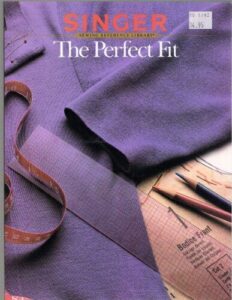
Photos and step-by-step clarity are great, but sometimes you need a book that zeroes in on fit. That’s where Singer’s The Perfect Fit earns its place on your shelf.
Before diving into fit adjustments, it helps to get comfortable with essential sewing terms like seam allowance and grainline so pattern instructions actually make sense.
128-page paperback walks you through figure analysis — shoulders, bust, waist, hips, and thighs — with close-up photographs showing exactly what’s going wrong and how to fix it.
Three adjustment methods are covered: tissue fitting, measurement-based scaling, and on-the-fly alterations.
At $12, it’s genuinely hard to beat.
| Best For | Beginner to intermediate sewers who want to get a better fit from commercial patterns without spending hours on muslins or test garments. |
|---|---|
| Format | Paperback |
| Language | English |
| Page Count | 128 pages |
| Skill Level | Beginner to Intermediate |
| Visual Guides | Photographic illustrations |
| Price | $12.00 |
| Additional Features |
|
- Three solid adjustment methods in one place — tissue fitting, measurement scaling, and sewing-as-you-go fixes
- Real photos of fit problems make it easy to spot what’s going wrong on your own garments
- At $12, it’s a low-risk addition to any sewing library
- Skips advanced territory — no slopers, no custom muslins, nothing too complex
- Published in 1990, so some techniques may feel a little dated compared to modern pattern drafting
- Experienced fitters will probably outgrow it fast
4. Perfect Fitting Photo Guide
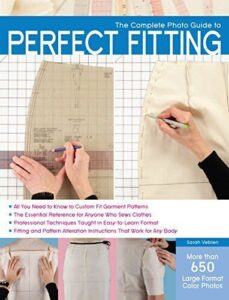
If Singer gets you oriented, Sarah Veblen’s The Complete Photo Guide to Perfect Fitting takes you deeper. This one is built around real bodies — hundreds of full-color photos showing drag lines, folds, and fitting fixes on actual people, not fashion illustrations.
Veblen introduces her "fitting axis" concept, a horizontal balance line that keeps your adjustments grounded in proportion.
At $21.32 for 224 pages, it’s a solid investment.
Visual learners especially will find it clicks in a way text-heavy books just don’t.
| Best For | Visual learners and intermediate sewists who want a systematic, photo-driven approach to fitting real bodies across a range of shapes and styles. |
|---|---|
| Format | Paperback |
| Language | English |
| Page Count | 224 pages |
| Skill Level | Intermediate to Advanced |
| Visual Guides | Full-color photographs |
| Price | $21.32 |
| Additional Features |
|
- Hundreds of full-color photos show fitting fixes on actual people — not idealized illustrations — making it easy to spot and solve problems on your own body.
- The "fitting axis" concept gives you a reliable framework so your adjustments stay balanced and proportional, not just guesswork.
- Covers bodices, skirts, sleeves, and pants all in one book, making it a genuinely useful all-around reference.
- The pants section is pretty brief, so if that’s your main focus you’ll likely need a second resource.
- Beginners may find the terminology and level of detail a bit overwhelming right out of the gate.
- You’ll need to sew test muslins to get the most out of it, which adds both time and material costs before you ever cut into your real fabric.
5. Kenneth King Smart Fitting Solutions
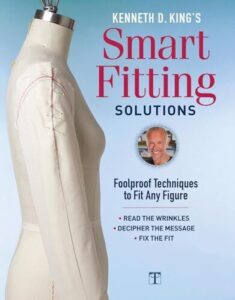
Kenneth King’s Smart Fitting Solutions is where fitting finally makes sense. King breaks every adjustment into three clear moves: net gain, net loss, and no net change. That framework alone is worth the price of the book.
You’re not guessing anymore — you’re reading wrinkles like a map and knowing exactly where to add or remove fabric.
With 35 upper-body alteration diagrams and muslin-testing guidance built in, this 236-page hardcover at $22.09 gives you a repeatable system you’ll use every time.
| Best For | Home sewers at any skill level who want a clear, repeatable system for diagnosing and fixing fit issues without the guesswork. |
|---|---|
| Format | Hardcover |
| Language | English |
| Page Count | 236 pages |
| Skill Level | Beginner to Advanced |
| Visual Guides | Illustrations and photographs |
| Price | $22.09 |
| Additional Features |
|
- Breaks fitting down into a simple three-move framework that actually makes sense of wrinkles and fabric pull
- Covers a wide range of body types with real photos and diagrams, so you can see your specific fit problem reflected back at you
- The muslin-testing method gives you a reusable process you’ll reach for every single project
- You’ll really need a fitting partner or a dress form to get the most out of it — solo fitting is tough
- Pants fitting isn’t covered, so if that’s your main challenge, you’ll need to look elsewhere
- Flipping back and forth between sections to compare before-and-after images can break your rhythm mid-project
Key Features to Check in Pattern Books
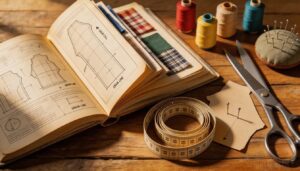
Not every pattern book earns a spot on your shelf, and a few key features can tell you quickly whether one is worth your money. Before you buy, it helps to know what to look for inside those pages.
Here are the details that actually matter.
Skill-Level Indicators for Each Pattern
Difficulty Icons, Skill Bars, and Technique Symbols take the guesswork out of picking your next project. Good pattern books use Level Annotations and Progression Charts to show exactly where each design sits on the learning curve.
You’ll spot whether a pattern needs zipper skills or dart work before you cut a single notch — a small feature that saves big frustration.
Clarity of Step-by-Step Instructions
When instructions flow in the right order, everything clicks. The best sewing tutorials and essential sewing reference books use sequential numbering with action verb consistency, so each step tells you exactly what to do, not what to think about.
Concise sentence structure keeps things moving.
Troubleshooting notes and visual cue alignment flag common mistakes before they happen — making even complex pattern fitting and alteration guides feel genuinely manageable.
Quality of Illustrations and Photographs
A blurry diagram can unravel an entire project.
The best books — like The Complete Photo Guide to Perfect Fitting, The Vogue Sewing Book, and The Dressmakers Handbook of Couture Sewing Techniques — nail Resolution DPI, Color Calibration, and Line Weight Consistency so every stitch path reads clearly. Scale Grain Arrows, Model Pose Variety, The Sewing Book, and The Pictorial Guide to Modern Home Dressmaking make visual guidance genuinely trustworthy.
Glossary and Abbreviation Definitions
A good glossary is worth its weight in fabric. Look for Glossary Placement near the back, where you can flip to it fast.
Strong Term Definition Clarity means abbreviations like SA for seam allowance or GL for grain line are spelled out with Symbol Iconography right beside them. Abbreviation Consistency throughout keeps you from second‑guessing yourself mid‑cut — a must in any solid reference guide for sewing.
How Pattern Measurements and Fit Details Matter
Getting a good fit starts long before you cut into your fabric.
Pattern measurements and fit details are the quiet workhorses behind every garment that actually looks right on a body.
Here’s what to pay attention to.
Size Range and Finished Garment Measurements
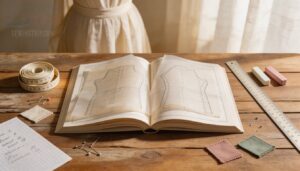
Size charts are your starting point, not the finish line. Modern inclusive size charts span XS to 5XL, but the real magic is understanding body vs garment measurements.
- Finished bust allowance runs larger than your actual bust
- Hip measurement differences of 3–5 inches are built right in
- Size grading techniques let you blend sizes for a custom fit
Always measure both.
Ease Allowances for Comfort and Movement
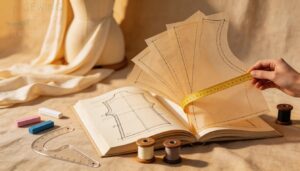
Ease is what turns a flat pattern into something you can actually live in. Think of it as breathing room baked right into the design.
Back Neck Ease prevents chafing, Underarm Sleeve Ease lets you reach freely, and Hip Thigh Allowance keeps walking comfortable.
Shoulder Seam Flex and Bust Dart Release handle real movement.
Good pattern books spell all this out clearly.
Fitting Alteration Diagrams and Solutions
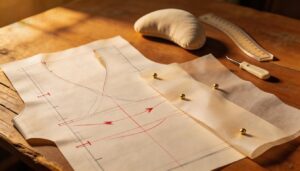
Beyond ease, you need diagrams that actually show you what to move and where.
Look for books with solid Diagram Scale references, clear Reference labeling at the bust top, waist, and hip, and Adjustment Legends explaining dart pivots and notch alignment. Cross-Piece Consistency matters too — your front, back, and sleeve alterations should all update together.
Practical Transfer Tips to look for:
- Trace changes onto tissue paper first.
- Baste before permanent stitching.
- Note adjustments on your pattern envelope.
Grain Line, Notches, and Seam Allowance Markings
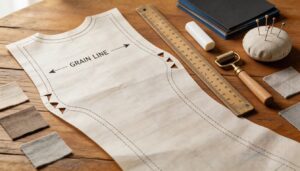
Once you’ve sorted fitting adjustments, quiet markings on your pattern tissue do a lot of heavy lifting.
Grain Line Alignment keeps pieces parallel to the selvage, preventing twist and uneven hems. Notch Placement guides Seam Allowance Variations during assembly, especially on curves.
And when Fabric Stretch Impact shifts things, solid Transfer Marking Techniques — tracing wheels, chalk, carbon paper — keep your cuts honest.
Choosing Pattern Books by Sewing Goal
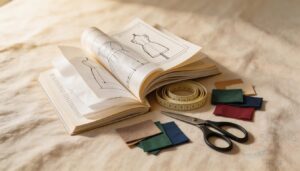
Not every sewing book works for every sewist, and that’s actually a good thing. The right book depends on what you’re trying to do — whether that’s nailing the perfect fit, drafting your own patterns from scratch, or building a wardrobe that goes from weekend casual to dinner-party ready.
three goals worth thinking about before you pick your next book.
Fit-Focused Manuals for Accurate Garment Adjustments
Getting the fit right is where most sewers hit a wall. That’s why fit-focused manuals are worth every penny.
Fit is where most sewers hit a wall — and the right manual is worth every penny
The best ones guide you through:
- Body Shape Analysis for proportion balancing techniques
- Shoulder slope corrections and sleeve cap adjustments
- Bodice fitting with measurement-driven pattern alterations
- Fabric stretch compensation for knits and wovens
Books like Smart Fitting Solutions make custom fit garment design techniques genuinely approachable.
Pattern Drafting Guides for Custom Garment Design
If you’re ready to design your own clothes from scratch, pattern drafting guides open that door.
Books like Metric Pattern Cutting for Women’s Wear and Patternmaking for Fashion Design walk you through Block Development, Dart Placement, and Fabric Behavior with real clarity.
They also cover Pattern Grading, Digital Conversion, and slopers and moulage — giving you genuine Custom fit garment design techniques rooted in the Flat Pattern Method.
Project Versatility Across Casual and Formal Styles
The best patternmaking books don’t just teach one look — they show you how to work one flat pattern across your whole wardrobe. Here’s what good project versatility looks like:
- Fabric Conversion Techniques that shift a casual tee into a formal blouse
- Convertible Details like adjustable necklines and removable sleeves
- Accessory Integration and Layering Strategies for day-to-night dressing
Pattern alterations, Modular Pattern Design, and custom fit options make your sewing skills go further.
Frequently Asked Questions (FAQs)
Can I find patterns for plus-size figures?
Yes, absolutely.
Many pattern books now include extended size charts, adjustable dart placement, and stretch fabric recommendations designed for curvy sewists — with proportional sleeve caps and body-positive design built right in.
Are digital or printable pattern versions available?
Absolutely — most publishers now offer instant PDF downloads in both print-at-home and large-format A0 files. Check licensing terms, print alignment guides, and whether update availability is included before buying.
Explore a large collection of free printable sewing patterns for beginner projects.
How do vintage books compare to modern ones?
Vintage books like The Vogue Sewing Book have charm, but paper quality and binding durability vary.
Modern titles win on image resolution and color fidelity.
Both deserve a spot on your shelf.
Which books work best for childrens clothing?
Think of children’s wear like building with blocks — the right patternmaking books make it simple.
Reader’s Digest and Kenneth King’s Smart Fitting Solutions both nail child-friendly stitch types, durable fabric choices, and budget-friendly options perfectly.
Where can I buy these books affordably?
You don’t need to spend much to build a solid library.
Sites like AbeBooks, ThriftBooks, and Better World Books offer great International Shipping Deals on used copies — often for just a few dollars.
Conclusion
Beware the siren song of cheap, flashy sewing pattern books that promise the world but deliver frustration. Your hard-earned cash deserves better.
When searching for what to look for in sewing pattern books, prioritize clarity, accuracy, and fit guidance.
A trusted reference book is like a loyal friend, guiding you through projects with ease.
Invest in quality, and you’ll reap rewards: fewer mistakes, less waste, and garments that make you proud.