This site is supported by our readers. We may earn a commission, at no cost to you, if you purchase through links.
Skipping stabilizer to save time feels harmless until your finished design puckers like crumpled tissue paper—and at that point, there’s no fixing it. Fabric moves constantly under a running needle, and each stitch pulls fibers inward with surprising force, enough to shift grain lines in woven cloth or stretch knit loops completely out of shape. That tension doesn’t just look bad; it compounds with every row, turning a clean logo or floral motif into a distorted mess.
Stabilizer sits beneath your fabric and absorbs that pull, keeping needle entry points consistent and registration tight across hundreds of stitch passes. The right type—cut-away, tear-away, wash-away—depends on your fabric and design density, and getting that match wrong causes problems just as reliably as skipping it entirely. Understanding why embroidery needs stabilizer underneath means understanding how to choose the correct backing before your machine takes a single stitch.
Table Of Contents
- Key Takeaways
- Stabilizer Keeps Embroidery From Puckering and Shifting
- What Stabilizer Actually Does Beneath Your Fabric
- Cut-Away Stabilizer Stays Permanently Under Embroidery
- Tear-Away Stabilizer Removes After Stitching is Done
- Design Density Determines Which Stabilizer Weight You Need
- Matching Stabilizer Type to Your Specific Fabric
- Wrong Stabilizer Choice Causes These Embroidery Problems
- How to Remove Stabilizer Without Damaging Your Embroidery
- Frequently Asked Questions (FAQs)
- Conclusion
Key Takeaways
- Stabilizer absorbs the tension every stitch creates, keeping your fabric from puckering, shifting, or distorting as the needle moves across it.
- Choosing the wrong stabilizer type—cut-away, tear-away, or wash-away— causes just as many problems as skipping it entirely, so matching backing to fabric and stitch count is non‑negotiable.
- Dense designs over 15,000 stitches demand heavy cut‑away support, while light monograms under 5,000 stitches can get away with a lighter tear‑away without sacrificing quality.
- Removing stabilizer carelessly—rushing a tear‑away or rinsing at the wrong temperature—can pull stitches and ruin a finished piece that survived the entire embroidery process just fine.
Stabilizer Keeps Embroidery From Puckering and Shifting
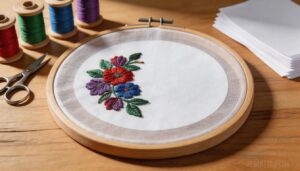
Every stitch your machine makes pulls on the fabric beneath it, and without something holding that fabric firm, things go sideways fast.
That’s especially true with stretchy materials, where the right tension and foot pressure make all the difference—sewing stretch fabric without puckering or skipping stitches comes down to a few techniques most beginners never hear about.
Stabilizer is what stands between a clean, crisp design and a puckered mess you can’t fix.
exactly how it does that job.
How Stitches Pull and Distort Fabric Without Support
Every stitch creates tension peaks where thread pulls fabric fibers inward, causing fiber bending and a ripple effect that travels outward from the stitch line. Woven fabrics show grain distortion as threads shift to follow stitch direction.
Knits are worse — their loop structure amplifies the stitch pull dramatically.
Without support, repeated needle penetration impact lets fibers migrate permanently, and preventing puckering, stretching, and distortion in embroidery becomes nearly impossible.
Why Fabric Stretches Inside The Hoop During Stitching
Stitch pull isn’t the only culprit — hoop pressure itself starts stretching your fabric before the needle even drops. As the hoop clamps down, surface friction and uneven hoop tension create localized stretch along the fabric grain.
Then stitch travel amplifies it: thread pull drags fibers inward with each pass, turning minor distortion into visible puckering.
Stabilizer weight matching to fabric weight is what keeps that chain reaction from starting.
How Stabilizer Holds Needle Entry Points Consistent
Once fabric stops drifting, your needle lands exactly where it should — every time. That’s where Layered Underlay Tension and Stabilizer Density Gradient do the real work.
- Needle Depth Control stays consistent when backing resists compression
- Hoop Pressure Balance eliminates micro-shifts between passes
- Material Stiffness Matching keeps entry holes uniform across rows
- Stabilizer weight matching to fabric weight prevents localized wobble
Skip this, and stitch distortion prevention becomes impossible.
What Stabilizer Actually Does Beneath Your Fabric
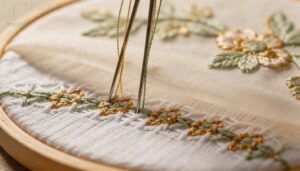
Stabilizer isn’t just padding — it’s doing real structural work every time your needle hits the fabric. Understanding what’s actually happening beneath your project helps you make smarter choices from the start.
Here’s what stabilizer is handling on your behalf.
Creating a Firm Base for Dense Stitch Counts
Dense designs put serious stress on fabric — we’re talking a 20% increase in local strain per test swatch.
That’s why stabilizer weight matching to fabric weight isn’t optional; it’s foundational.
Use this Stabilizer Weight Guidelines Based on Fabric Weight and Design Density table to stay accurate:
| Fabric Type | Stabilizer Weight Grading | Design Density |
|---|---|---|
| Lightweight wovens | Light (1.5 oz) | Under 5,000 stitches |
| Knits/Jersey | Medium mesh vs solid | 5,000–15,000 stitches |
| Denim/Canvas | Heavy (3.0 oz) cut-away | Over 15,000 stitches |
For extreme density, double up for dense designs using Dual-Layer Support — Pre-Stretch Tensioning before hooping keeps everything locked flat.
For best results with either method, understanding how stabilizer choice directly impacts embroidery quality helps you pick the right foundation before you ever hoop.
Preventing Thread Breaks From Fabric Movement
When fabric shifts mid-run, thread breaks follow fast. Stabilizer controls this through Needle Impact Dampening — absorbing each needle strike so the fabric doesn’t rebound and yank the thread.
That rebound is what breaks things. Proper stabilizer weight matching to fabric weight ensures Stitch Tension Uniformity and Thread Path Stability across every row, keeping fabric distortion and Active Stress Reduction working in your favor.
How Stabilizer Maintains Design Registration Across Rows
Row Alignment falls apart the moment your fabric creeps — even slightly — between stitches. Stabilizer Stiffness combined with Hoop Pressure creates a locked stitching plane, so each row lands exactly where it should.
Without Tension Balance and stabilizer weight matching to fabric weight, registration errors stack up fast, turning a clean design into a blurry mess. Good Hooping Techniques and Tension Adjustment for Machine Embroidery solve this before it starts.
Cut-Away Stabilizer Stays Permanently Under Embroidery
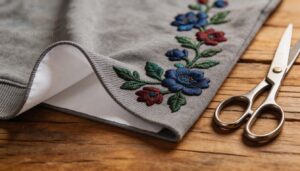
Cut-away stabilizer is the one type that never leaves — it stays permanently bonded beneath your embroidery, even after years of washing. That’s exactly why it’s the go-to choice for stretchy, high-wear fabrics that need ongoing structural support.
Here’s what makes cut-away the right call in specific situations.
Why Stretchy Knits and Jersey Need Cut-Away Support
Jersey and knit fabrics shift constantly under the needle — that’s exactly why cutaway stabilizer is non‑negotiable for stretch fabrics. It manages knit stretch mitigation by locking fibers in place, ensuring stitch density uniformity across fills.
Sharp curve retention stays consistent because the backing resists pull at every change.
Skip it, and you’re fighting puckering, distortion, and loose edges the whole way.
No-Show Mesh Cut-Away for Light-Colored Garments
Light-colored garments have a sneaky problem — regular cutaway stabilizer shows right through pale cotton or pastel knits. No-show mesh cutaway solves this by keeping mesh visibility practically invisible while still delivering full backing strength.
It preserves your light fabric drape, prevents color ghosting on white and pastel threads, and produces sharp stitch clarity that pastels demand. For edge finish quality and clean results, it’s the smart pick.
How Cut-Away Holds Shape Through 50+ Wash Cycles
Cut-away stabilizer isn’t just a one-time fix — it’s built for the long haul. Its rigid backbone distributes stress evenly, so no single stitch zone takes the full brunt of repeated laundering. That’s what keeps your embroidery looking sharp wash after wash.
Cut-away stabilizer is built for the long haul, distributing stress evenly so your embroidery stays sharp wash after wash
Here’s why cut-away wins on wash durability:
- Dimensional Stability — resists stretching and shrinking through 50+ cycles
- Post-Wash Shape — design edges stay crisp, not wavy
- Stress Distribution — spreads thread tension so seams don’t buckle
- Long-Term Stiffness — maintains structure where tear-away would be long gone
- Fabric Distortion Reduction — anchors knit fibers that naturally want to creep
Stabilizer weight matching to fabric weight matters here too. Light stabilizer on a dense design? It’ll fail fast. In the CutAway vs TearAway Stabilizer Performance Comparison, cut-away simply outlasts tear-away for anything that sees regular washing — no contest.
Tear-Away Stabilizer Removes After Stitching is Done
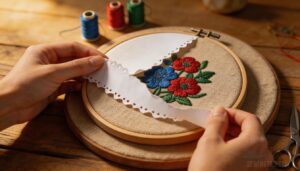
Tear-away stabilizer is the go-to choice when you want a clean finish without anything left behind. It works beautifully on stable woven fabrics, but knowing its limits keeps your embroidery looking sharp.
Here’s what you need to know before you reach for it.
Which Woven Fabrics Work Best With Tear-Away
Tear-away stabilizer is practically made for stable woven fabrics. Cotton, denim, poplin, and canvas hold their shape during stitching, so tear-away gives just enough support without overstaying its welcome.
Satin weave and metallic weave fabrics pair well with medium-weight tear-away, keeping stitches even without show-through.
Bedford cord, Terry Cloth, and chambray also respond well — solid fabric compatibility, clean removal, minimal fuss.
Stitch Count Limits Before Tear-Away Becomes Unreliable
Even stable wovens hit a wall when stitch count climbs too high. Tearaway stabilizer manages designs up to around 8,000 stitches well, but stitch density considerations matter just as much as raw numbers.
Dense fill coverage above 60 percent, tight satin blocks, or high hoop tension impact reliability quickly. For heavier design density, stitch count thresholds and fabric stretch limits both signal when you need cutaway instead.
How to Tear Away Cleanly Without Pulling Stitches
Once stitch count pushes your tearaway stabilizer to its limit, how you remove it matters just as much as which type you chose.
Use the Scissor Start Method — snip a small notch at the outer edge before tearing. From there, apply Controlled Short Pulls while keeping Fabric Tension Adjustment in mind: hold the garment taut, not stretched.
The Edge Tearing Technique works best when you bend the stabilizer slightly away from stitches, then tear at a low angle. Post-Tear Finishing means brushing off loose fibers and pressing gently.
Proper removal methods — trimming, tearing, and dissolving stabilizers — all depend on patience. Rush it, and you’ll pull threads you can’t fix.
Design Density Determines Which Stabilizer Weight You Need
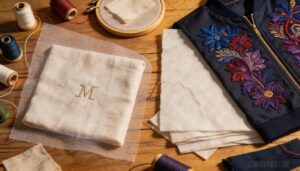
Not every design puts the same stress on your fabric, and your stabilizer weight needs to reflect that.
A tiny monogram is a very different job than a jacket back packed with dense fill stitches.
Here’s how stitch count should guide your stabilizer choice.
Light Designs Under 5,000 Stitches Vs. Heavy Fill Coverage
small monogram under 5,000 stitches puts minimal stress on fabric, so a light tearaway stabilizer manages the job without sacrificing breathability impact or causing post-wash stiffness.
Heavy fill coverage changes everything — dense design density pulls fibers hard, demanding stronger stabilizer weight for proper fabric stretch response and heat build-up management.
Matching stitch count flexibility to your backing keeps results clean every time.
Why Designs Over 15,000 Stitches Demand Heavy Cut-Away
Once your design crosses 15,000 stitches, needle penetration frequency climbs fast — tens of thousands of hits per minute create serious fabric shear resistance demands. That’s when heavy cutaway stabilizer becomes non‑negotiable.
Without it, you’re looking at:
- Thread shredding risk from fabric shifting mid‑run
- Design edges losing crisp satin definition
- Showthrough prevention failing under dense fill layers
- Long‑term dimensional stability collapsing after washing
Stabilizer weight matching at this stitch count isn’t optional — it’s just smart.
Layering Two Thin Stabilizers for Dense Embroidery
thin stabilizers stacked together can outperform a single heavy layer for dense embroidery. This dual layer tension approach distributes stitch force more evenly, so localized puckering stays minimal.
thin stabilizer pairing also makes removal cleaner — the top layer tears away while the bottom anchors the design.
weight matching strategy with cutaway stabilizer when layer alignment technique and edge registration boost matter most.
Matching Stabilizer Type to Your Specific Fabric
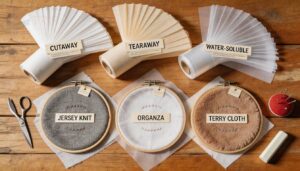
Not every fabric plays by the same rules, and the stabilizer that works great on a polo shirt can completely fail on organza or terry cloth.
Choosing the right type comes down to what your fabric actually needs — how much stretch it has, how much texture, and how it’ll hold up to washing.
Here’s how to match your stabilizer to three common fabric situations.
Sheer and Delicate Fabrics That Need Wash-Away Backing
Sheer fabrics like chiffon and organza have almost no tolerance for stiff backing — any residue shows right through. That’s why washaway stabilizer is the go-to for delicate fabrics and freestanding lace embroidery. It dissolves completely in warm water, leaving zero trace.
Here’s what to keep in mind:
- Opacity Control — Choose 18–26 gsm wash-away; heavier weights create visible shadows on transparent fibers.
- Fiber Compatibility — Washaway dissolves cleanly from microfibers and silk without trapping fragments or causing dye migration.
- Dissolution Testing — Always test a small patch first; full dissolution confirms your fabric survives the rinse.
- Temperature Sensitivity — Use warm, never hot, water; high heat can re-solidify polymer fibers against fine threads.
Edge preservation depends entirely on rinsing gently — rushed removal distorts seam allowances on light fabrics. Using washaway stabilizer for sheer and lace projects is honestly one of those choices you’ll never regret.
Denim, Canvas, and Heavy Wovens Require Heavier Support
Denim and canvas don’t forgive weak backing.
With stitch counts pushing 50,000, you need heavy cut-away stabilizer to handle the tension — otherwise fabric grain alignment breaks down and designs warp mid-run.
Stabilizer weight matching to your fabric isn’t optional here; it’s what keeps hoop pressure distribution even and stitches crisp through 50+ wash cycles.
| Fabric | Stabilizer Recommendation | Durability Through Washes |
|---|---|---|
| Denim | Heavy cut-away (3.0 oz) | 50+ cycles |
| Canvas | Medium-heavy cut-away (2.5 oz) | 40+ cycles |
| Heavy linen | Medium cut-away (2.0 oz) | 30+ cycles |
Towels and Fleece Need a Water-Soluble Topper Plus Backing
Towels and fleece are fabric traps — loose fibers swallow stitches whole if you skip the right setup. A water‑soluble topper laid over the nap acts as a smooth stitching surface, handling Towel Nap Stabilization and Fleece Pile Protection at once.
- Topper Application: Lay washaway stabilizer flat across the full design area before stitching.
- Backer Weight: Use medium cut-away underneath for stitch support without stiffness.
- Dissolution Testing: Soak in lukewarm water 15–20 minutes — confirm topper fully dissolves on a test swatch first.
Wrong Stabilizer Choice Causes These Embroidery Problems
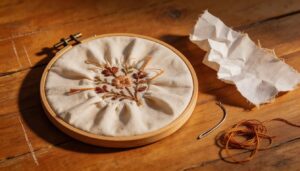
Using the wrong stabilizer doesn’t just affect how your embroidery looks — it can unravel the whole project. A few specific problems show up again and again when the backing isn’t right for the fabric or design.
what to watch for.
Puckering Around Design Edges and How to Fix It
Puckering along design edges usually comes down to two things: wrong stabilizer weight and bad hoop tension. When satin edge support is too light, stitches pull the fabric inward, creating that wave along the border.
Fix it by matching stabilizer weight to fabric weight, adding an edge stitch outline as an anchor, and finishing with post‑press relaxation using a pressing cloth.
Stitches Sinking Into Pile or Napped Fabric Surfaces
Pile friction is the hidden enemy on velvet, fleece, and terry cloth — it drags stitches downward through nap compression, burying your design instead of sitting on top. Needle grip worsens with longer satin stitches, causing stitch length variation across high-nap zones.
Use medium-to-heavy cut-away as your fabric backing, add underlay techniques first, and layer a wash-away topper. That combo is your best stabilizer selection for different fabric types with pile.
Hoop Marks on Delicate Fabrics and How to Avoid Them
Delicate fabrics like silk and chiffon bruise easily under hoop pressure — that ring impression isn’t just cosmetic, it can weaken fibers permanently. Fix it with proper Fabric Grain Positioning, Edge Cushioning, and Spray Adhesive Hold instead of hooping directly.
After stitching, Low-Heat Pressing with a cloth relaxes compression. Smart Hooping Techniques and Tension Adjustment for Machine Embroidery protect your fabric before the first stitch drops.
How to Remove Stabilizer Without Damaging Your Embroidery
Removing stabilizer is the step most embroiderers rush through — and that’s usually where things go wrong. The method you use depends entirely on which stabilizer type you chose at the start.
Here’s how to handle each one cleanly without pulling a single stitch.
Trimming Cut-Away Stabilizer Flush to The Stitch Line
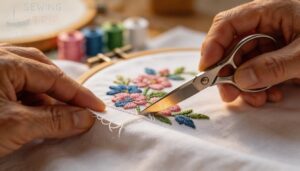
Once stitching is done, trim away the excess cutaway layer right at the stitch line — not a millimeter beyond it.
Sharp flush trim tools like embroidery snips or a micro-knife keep your edge alignment techniques precise, reducing bulk by nearly 1mm.
That bulk reduction benefit matters for drape, comfort, and preventing snags during wear or washing.
Dissolving Wash-Away Stabilizer Fully in Warm Water
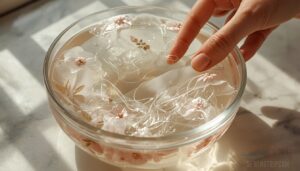
Where trimming manages cut-away, wash-away stabilizer removal is simpler — water does the work. Set your rinse to ideal temperature, around 45°C, and let the water‑soluble stabilizer break down in 2–5 minutes.
Use gentle agitation, not wringing.
A rinse clarity test confirms full washaway stabilizer removal when water runs clear.
For stubborn residue, a soap-assisted soak with mineral-free water finishes the job cleanly.
When Heat-Away is The Only Safe Removal Option
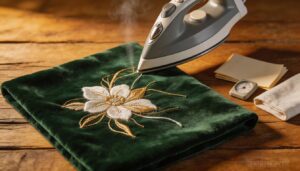
Water won’t save every fabric — and that’s exactly where heat-away stabilizer earns its place. For silk, velvet, or non-washable materials, it’s the only removal method that doesn’t risk color bleed or distortion.
- Heat‑sensitive fabrics stay safe with temperature control protocol and short iron bursts
- Metallic thread protection requires strict heat limits to prevent tarnish
- Adhesive bond safety means using parchment paper between iron and embroidery
- Post-heat aftercare includes a light steam pass and residue wipe-down
Frequently Asked Questions (FAQs)
Is a stabilizer required for embroidery?
Yes, stabilizer is required for embroidery. Without it, stitches pull the fabric, causing puckering, shifting, and uneven tension.
Choosing the right embroidery stabilizer is the difference between a clean finish and a ruined project.
Do you remove stabilizer after embroidery?
It depends on the type you used. Cut-away stays permanently under the design. Tear-away gets removed after stitching. Wash-away dissolves in warm water. Each removal method protects stitch integrity differently.
Can adhesive stabilizer replace hooping altogether?
Adhesive stabilizer makes hoop-free embroidery possible on caps, bags, and socks — items too awkward to hoop. It holds fabric firmly, though stitch density limits apply above 12,000 stitches without extra backing.
How does stabilizer affect embroidery drape and softness?
Stabilizer affects drape and softness by balancing weight distribution against fabric elasticity.
right stabilizer weight matching to fabric weight preserves post-wash drape, texture retention, and stitch softness balance without sacrificing fabric flexibility.
Does stabilizer weight change with machine speed?
Machine speed and stabilizer weight are directly linked. Higher speeds create more fabric movement, so heavier stabilizers become necessary.
Think of it as Speed Weight Balance — faster machines demand greater Rapid Stitch Support to maintain control.
How should stabilizers be stored to stay effective?
Store stabilizers properly in airtight packaging, away from heat and moisture. Keep temperatures between 15–25°C, use desiccants, and track shelf life carefully.
Cross-contamination control matters too — label everything, or you’ll grab the wrong type mid-project.
Conclusion
As the needle dances across your fabric, the stabilizer plays a silent guardian, ensuring every stitch lands with precision. Without it, your design risks becoming a puckered, distorted mess.
Understanding why embroidery needs stabilizer underneath enables you to choose the right type for your project.
With the right backing, your embroidery will shine, stitch by stitch. So, take a moment to match your fabric and design to the perfect stabilizer—your finished project will thank you, literally and figuratively, every time.