This site is supported by our readers. We may earn a commission, at no cost to you, if you purchase through links.
Thread color is one of those details that separates a polished garment from one that looks almost right. Pick the wrong shade and suddenly your seams draw the eye exactly where you don’t want it—or a carefully constructed quilt loses its sense of depth. Fabric gets most of the credit, but thread quietly controls whether your finished piece looks intentional or accidental.
Understanding why thread color matters for sewing projects means thinking beyond the spool rack and into how light, contrast, and color relationships shape what people actually see. Get it right, and your stitches disappear—or become the whole point.
Table Of Contents
- Key Takeaways
- Thread Color Changes How Your Project Looks
- Color Theory Basics Every Sewist Should Know
- Matching Thread Color to Your Fabric
- When Contrasting Thread is The Right Choice
- What Makes a Thread Color Neutral?
- Choosing Thread Color for Patterned Fabrics
- How to Test Thread Colors Before You Sew
- Thread Color Tips for Professional-Looking Results
- Frequently Asked Questions (FAQs)
- Conclusion
Key Takeaways
- Thread color controls whether your seams disappear into the fabric or become an unintended focal point, so going one shade darker than your fabric is your safest default for clean, professional results.
- Color theory isn’t just for painters — understanding complementary, analogous, and monochromatic relationships gives you a real framework for making thread choices that feel intentional, not accidental.
- Neutral threads like medium gray and warm beige outperform black and white in most situations because their midtone value lets them blend across a wider range of fabrics and lighting conditions.
- Testing thread on actual fabric scraps under both natural and indoor light before you sew is the single easiest habit that separates polished finishes from costly, hard-to-fix mistakes.
Thread Color Changes How Your Project Looks
Thread color does more than match your fabric — it shapes how the entire finished piece reads. A single shade off can make seams jump out when they should disappear, or fall flat when you actually want them to stand out.
When in doubt, choosing thread one shade darker than your fabric is a reliable trick that keeps seams clean and nearly invisible.
Here’s what’s really happening beneath the surface.
How Thread Color Affects Seam Visibility
Thread color shapes how your seams read — and it starts with color value contrast. A slight difference between thread and fabric can make seams nearly invisible from 60–90 cm away, while strong contrast turns every stitch into a visible line.
Sheen versus texture matters too, since glossy thread on matte fabric catches light and highlights seam type visibility. Always test under realistic lighting — perception shifts dramatically indoors versus natural daylight.
To adjust this effect, choose a thread that matches the fabric’s dominant color and undertone by matching thread and fabric colors, and test a few stitches on scraps before you commit to your final seams.
When Thread Becomes a Design Feature
Sometimes, hiding your seams isn’t the goal — showing them off is. Contrasting thread colors let you turn construction lines into intentional style statements. Here’s where thread visibility works for you:
- Decorative Topstitch Motifs outline pockets and collars with bold graphic lines
- Quilting Line Artwork transforms structural stitching into visible surface patterns
- Embroidery Color Stories build mood through curated thread palettes
- Visible Mending Highlights and Activewear Seam Accents make repairs and coverstitching eye-catching features
When working with embroidery, reference embroidery color theory basics to choose thread combinations that elevate your visible stitch details.
Your thread color choices shape the whole story.
Why One Wrong Shade Can Ruin a Finish
One wrong shade can quietly unravel everything you’ve worked for. Lighter thread advances visually, turning seams into outlines. Dye lot mismatches leave panels looking inconsistent. Texture-sheen conflicts — like glossy thread on matte cotton — distort perceived stitch quality. Metamerism and lighting shift colors between your sewing table and daylight.
These hidden quality defects are exactly what separate amateur results from professional-looking finishes.
Color Theory Basics Every Sewist Should Know
Color theory isn’t just for painters — it’s one of the most practical tools a sewist can have. Understanding how colors relate to each other helps you make smarter thread choices and avoid costly mistakes.
Here’s what you actually need to know.
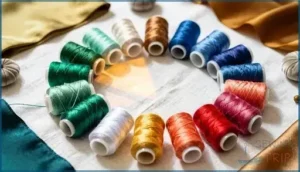
The Color Wheel and How to Use It
Think of the color wheel as your thread palette planning tool — a simple circle that takes the guesswork out of every project.
Color Wheel Basics start with 12 hues arranged by relationship: primaries, secondaries, and tertiaries. Warm Cool Mapping sits right on the wheel — warm hues on one side, cool on the other.
Use Hue Positioning Techniques to see instantly which threads will blend or clash with your fabric.
Complementary Colors for Bold Contrast
Complementary colors sit directly opposite each other on the color wheel — and that tension is exactly what makes Bold Complementary Pairings so striking. Choosing Complementary Opposites like blue thread on orange fabric or yellow on violet creates instant visual drama.
Value Contrast Choices sharpen this effect further: light thread on dark fabric hits harder than two midtones. For quilts, Complementary Quilting Accents make stitch lines pop from across the room.
When contrast alone isn’t enough, lighted seam rippers for quilting help you spot every stitch line clearly, even on the darkest fabrics.
If pure contrast feels too loud, Subtle Complementary Adjustments — like a grayed-down or deeper shade — keep thread color harmony without losing the punch.
Analogous Colors for Subtle Harmony
Blending rather than contrasting — that’s the heart of analogous color theory in sewing. Analogous Palette Basics draw from two to five neighboring hues on the color wheel, creating smooth color harmony.
- Warm Analogous Schemes (red, orange, yellow) feel sunny and energetic
- Cool Analogous Schemes (blue, purple, green) read calm and invigorating
- Analogous Thread Shading adds depth without visual tension
- Thread color matching techniques stay subtle — saturation matters as much as hue
- Fixing Analogous Mistakes often means rebalancing dominance: 60% main, 30% secondary, 10% accent
Monochromatic Schemes for a Cohesive Look
Monochromatic schemes are the quiet achievers of color harmony in sewing. Sticking to one Hue Family Selection — but varying the lightness — gives you natural Value Layering Techniques without any guesswork.
Pale, medium, and dark teal on the same quilt? That’s Monochrome Quilting Lines doing real work. It’s a reliable approach to thread color matching techniques, Coordinated Embellishment Details, and a genuinely coherent look.
Matching Thread Color to Your Fabric
Getting thread color right is about more than just picking something close enough from your sewing basket. The fabric you’re working with gives you real clues — about shade, weight, and fiber — if you know what to look for.
Here’s what to keep in mind before you thread your needle.
Why Thread Weight and Shade Must Align
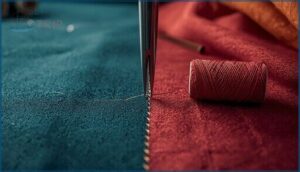
Thread weight and shade aren’t separate decisions — they work together. A fine 50–60 wt thread sinks into the weave, softening any slight color difference through light reflection effects. A heavier 30 wt thread sits proud of the surface, making even a close shade look bolder.
Getting fabric thickness balance right means your stitch texture perception, color, and durability versus visibility all land exactly where you want them.
Going One Shade Darker for Better Blending
When an exact match isn’t on the shelf, reach for one shade darker — it’s one of the most reliable thread blending strategies around. The One-Shade-Darker Rule works through Optical Shadow Blending: seams naturally fall into shadow, so darker thread visually recedes.
On mid-value fabric choices, this creates a smooth look without deliberate contrast.
Testing darker threads on scraps first helps you avoid common blending mistakes before committing.
Matching Thread to Fabric Fiber Type
Fiber Thread Compatibility goes deeper than color — it’s about how your seams age. Cotton thread on cotton fabric keeps shrinkage behavior in sync, so seams don’t pucker after washing. Polyester manages Stretch Fabric Pairings well because it flexes instead of snapping.
For Threads For Delicates like silk or rayon, match the fiber content closely — stronger thread can outlast and stress fragile fabric over time.
When Contrasting Thread is The Right Choice
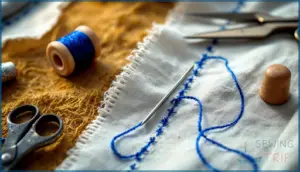
Sometimes the best move is to stop hiding your thread and let it do the talking. Contrast isn’t a mistake — it’s a choice, and a deliberate one can take your work from plain to polished.
Here’s when leaning into that difference actually works in your favor.
Topstitching as a Visible Design Element
Sometimes a seam deserves to be seen. Deliberate topstitching with contrasting colors — like bold red on black denim — turns structural seam emphasis into a statement.
Modern denim detailing often leans on thick jeans thread at 3.5–4mm stitch length for clean, confident lines. Layered topstitch textures and decorative stitch motifs on collars or cuffs enhance your sewing project aesthetics from functional to intentional.
Using Contrast to Highlight Quilt Blocks
Quilting takes that same principle further. Value Contrast Mapping — knowing where light meets dark across your quilt — guides your thread choices block by block.
Dark thread on light borders sharpens your Framing Quilt Grids, while Alternating Light Dark thread across blocks amplifies drama.
For Focal Motif Quilting, contrasting colors trace feathers or geometric shapes so they read as intentional design, not just stitching.
Balancing Multiple Thread Colors in One Project
Once you’ve mapped contrast across quilt blocks, the same thinking applies to any multi-piece project.
- Pick one dominant thread — usually your darkest repeated fabric tone — and use it for most seams
- Limit decorative colors to 2–3 so your thread color schemes stay cohesive
- Practice blended thread techniques by combining two close shades for softer seam lines
- Repeat color accents across different sections to build color harmony in sewing projects
What Makes a Thread Color Neutral?
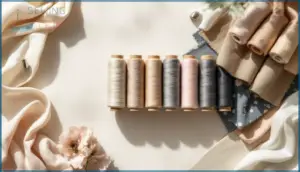
Not every sewing project calls for a perfect match — sometimes the smartest move is reaching for a neutral thread. Neutrals have a quiet way of working across fabrics without drawing attention to themselves. Here’s what you need to know to use them well.
Why Gray and Beige Outperform Black and White
Black and white threads seem like safe defaults, but they’re actually the trickiest to use well.
Gray and beige win because of their Midtone Value Advantage — they sit between light and dark, so Seam Blending Science works in your favor across most fabrics.
Sewing with neutral threads also gives you Dye-Lot Forgiveness and Multi-Fabric Compatibility, making them the smarter everyday choice.
Warm Beige Vs. Cool Gray — Which to Use
So how do you actually choose between the two? It comes down to undertone matching and value-range selection.
- Warm beige works best on creams, tans, and warm florals — your go-to neutral for garment sewing in linen or cotton.
- Cool gray manages blues, denim, and cool prints — ideal for quilting across mixed cool-leaning bundles.
- Garment vs quilting shapes the choice: beige for natural fibers, gray for piecing cool palettes.
- Mixed-bundle strategy — keep both on hand and test a strand against your fabric before committing.
The Optical Illusion That Makes Thread Disappear
Here’s what’s really happening when thread seems to vanish into fabric — it’s not magic, it’s human visual perception at work. When thread matches a fabric’s color temperature and sits within a 10–15% value contrast threshold, your eye reads it as shadow, not stitching.
When thread matches a fabric’s color temperature, your eye reads it as shadow, not stitching
Light angle effects, texture, and seam depth all reinforce that illusion, making the right neutral thread genuinely disappear.
Best Neutral Thread for Multicolor and Print Fabrics
For multicolor and print fabrics, your go-to neutrals come down to three: medium gray, warm beige, and soft off-white. Nail your neutral thread temperature first — cool gray complements blue, teal, and violet prints, while warm beige suits coral, tan, and mustard tones. Bridge neutrals like silver-green adapt to mixed palettes.
For bobbin neutral strategies, match the backing temperature so tension blips stay invisible.
Choosing Thread Color for Patterned Fabrics
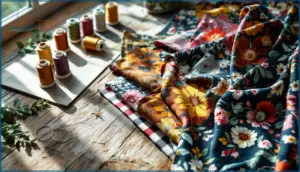
Patterned fabrics are where thread color decisions get genuinely tricky — and genuinely fun. A busy floral or bold patchwork doesn’t give you one obvious color to match, so you have to think a little differently.
Here’s what to keep in mind when the fabric itself is doing a lot of the talking.
The Challenge of Busy Prints and Patchwork
Busy prints are the supreme test of your thread selection skills. With so many colors competing for attention, Visual Noise Control becomes your priority — one wrong shade can slice through a beautiful print like a fault line.
- Patchwork Thread Strategy means accepting that no single thread will perfectly match every patch
- Balancing Print Density requires choosing a medium-value neutral that works across the whole surface
- Managing Seam Overload and Color Compromise Choices keep your project cohesive, not chaotic
Matching The Dominant Color Vs. Blending In
Dominant Color Detection starts with one simple question: what color does your eye land on first? That’s your anchor. Matching thread to that dominant fabric color is your best Seam Integration Technique — it lets stitching disappear into the design.
For Allover Print Blending, Background Matching Strategies and Value-Based Thread Selection often work better than chasing an exact hue, giving you a smooth look without the guesswork.
Using Variegated Thread on Batik and Florals
Variegated threads shine on batik fabric and floral prints — but Managing Variegated Color takes some planning. On batik background effects, thread shifts every 1–3 inches can pop or disappear depending on the light sections.
For enhancing floral prints, keep continuous quilting paths flowing across motifs.
Variegated thread troubleshooting tip: puddle your thread across the quilt top first to preview where each color lands.
How to Test Thread Colors Before You Sew
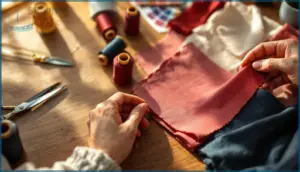
Picking the right thread color doesn’t have to be a guessing game. A few quick tests before you sit down at your machine can save you from seam regret later. Here’s what to do before you commit to a single spool.
Stitching Samples on Fabric Scraps
Cut a few fabric scraps — around 5–8 cm square — from your actual project material. Label each one with the thread color name or number so you can track your tests later. Then sew a short line on each:
- One straight stitch along the grain
- One zigzag section
- One folded edge to mimic a seam
Step back and check stitch visibility from arm’s length.
Comparing Multiple Thread Options Side by Side
Once your test stitches are done, lay several thread lengths directly on your fabric’s folded edge and squint — that’s your visual receding test in action.
Try a neutral lineup strategy with warm beige, cool gray, and medium brown side by side. Do lighting-based comparisons near a window and under your sewing lamp.
Texture and sheen checks matter too, so this fast elimination workflow saves you from second-guessing later.
Thread Color Tips for Professional-Looking Results
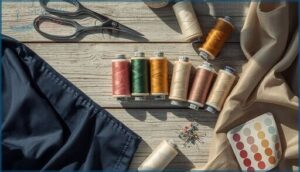
Getting the right thread color is only half the battle — keeping it consistent and accessible is what separates a good project from a great one.
A few smart habits can make a real difference in how polished your finished work looks. Here’s what professional sewists do to stay ahead.
Buying Extra Thread From The Same Dye Lot
Running short on thread mid-project is frustrating — and fixing it’s harder than it sounds. Dye Lot Basics matter here: even identical color names vary between batches.
For consistent sewing thread color selection, always:
- Note your dye lot number before leaving the store
- Buy backup spools for Planning Thread Yardage on large projects
- Stock extras for Coordinating Future Repairs and Avoiding Shade Lines
Thread color consistency depends on it.
Storing Thread to Prevent Color Fading
Once you’ve matched your dye lot, protect that investment. UV light protection matters more than most sewists realize — sunlight fades red threads fastest.
Store spools in airtight opaque containers at 15–25°C for temperature-controlled storage, and keep humidity between 40–60% for humidity-controlled storage.
Dust-free thread storage preserves both thread color consistency and thread durability, so closed bins beat open racks every time.
Building a Versatile Neutral Thread Stash
A smart core neutral palette doesn’t need to be big — just well-chosen. Five carefully picked spools can carry you through dozens of projects:
- Off-white or cream for warm, natural fabrics
- Light gray for cool palettes and pastels
- Medium gray as your default workhorse thread
- Warm beige for earth tones and skin-adjacent shades
- Charcoal for deep jewel tones and dark prints
Understanding fabric undertones helps you pick between warm-cool undertones confidently, and keeping light-dark values covered means your minimalist thread set manages almost anything.
Frequently Asked Questions (FAQs)
How to choose a sewing thread color?
Choose thread one shade darker than your fabric, match fiber type, and test in natural light.
Consider garment purpose, texture, trims, and future alterations when applying thread and fabric color matching techniques.
Why is color theory important in sewing?
Color theory in sewing shapes mood, harmony, and balance across every project. Understanding color psychology helps you avoid clashing, amplify fabric texture, and improve visual balance — turning good instincts into confident, intentional color choices.
How do I choose the best sewing thread?
Pick thread by matching fiber to fabric, weight to task, and color to finish.
The right thread keeps seams strong, stitches clean, and your work looking intentional from the very first stitch.
What color thread should I use?
The right thread color depends on your goal. For invisible seams, match your fabric or go one shade darker. For bold detail, contrast intentionally.
Medium gray and warm beige cover most fabrics beautifully.
Does thread color affect fabric durability over time?
Yes, thread color genuinely affects durability. UV-sensitive colors like bright yellows and reds fade and weaken faster outdoors. Heat-absorbing hues accelerate fiber breakdown, while high colorfastness and seams stay stronger through repeated washing and sun exposure.
Can lighting conditions change how thread color appears?
Absolutely — lighting shifts thread color more than most people expect. A match that looks perfect under warm indoor bulbs can look off in daylight, making natural light testing and high CRI lighting essential for accurate color matching.
How do I choose thread for sheer or lace fabrics?
Sheer and lace fabrics expose every mistake — thread included. Use fine 80–100wt neutrals like light gray or beige, match to your fabric’s undertone, and always test seams on scraps first.
Should embroidery thread follow the same color rules?
Embroidery thread plays by slightly different rules. Since it’s meant to be seen, color choices focus on motif readability contrast and artistic impact — not hiding seams. Sheen versus shade matters more here.
Conclusion
The moment you hold a finished piece up to the light, thread color tells the whole story—whether your work looks intentional or rushed, polished or forgettable. That quiet detail has been shaping your results all along.
Understanding why thread color matters for sewing projects isn’t just practical knowledge; it’s the difference between fabric that almost works and a finished piece that turns heads. Choose deliberately, and your stitches will never betray you again.
- http://www.jacksonsewingacademy.com/courses/free-foundation-course/lessons/thread-color-matching/
- https://mypacklove.com/blogs/label/sewing-with-clear-thread-pro-tips-for-invisible-seams-and-perfect-projects
- https://www.nationalquilterscircle.com/video/how-to-use-contrasting-thread-colors-in-your-quilt-009180
- https://lifestyle.sustainability-directory.com/learn/how-can-color-theory-be-applied-when-choosing-thread-for-visible-mending/
- https://www.hongqiaoxianye.com/blog/how-to-avoid-fading-in-embroidery-thread-colors548