This site is supported by our readers. We may earn a commission, at no cost to you, if you purchase through links.
Most sewists avoid zippers—not because they’re difficult, but because one misaligned stitch ruins the whole thing. 1 mm gap between your needle and the zipper teeth? It’s the difference between a polished finish and a seam that puckers, bunches, or bites the teeth entirely. The right presser foot eliminates that guesswork completely.
Zipper foot holds your fabric flush against the teeth, guides your needle along a consistent path, and keeps tension even from the first stitch to the last. It works for invisible zippers, exposed zippers, and even piping—anywhere you need to sew tight against a raised edge.
Zipper foot attachment guide walks you through choosing the correct foot, attaching it properly, and dialing in your settings for clean results every time.
Table Of Contents
- Key Takeaways
- What a Zipper Foot Does
- Choose The Right Zipper Foot
- Attach The Foot Correctly
- Sew With The Correct Settings
- Top 10 Presser Foot Options
- 1. Universal Zigzag Presser Foot
- 2. TISEKER Zipper and Invisible Zipper Foot
- 3. FIKLOTA Auto Buttonhole Presser Foot
- 4. Sewable Open Toe Walking Foot Adjustable Guide
- 5. Universal General Purpose Zigzag Presser Foot
- 6. TISEKER Low Shank Zipper Foot
- 7. Honeysew Automatic Button Hole Foot
- 8. Open Toe Walking Foot Guide
- 9. TISEKER Blind Hem Presser Foot
- 10. TISEKER Snap On Overcast Presser Foot
- Frequently Asked Questions (FAQs)
- Conclusion
Key Takeaways
- A zipper foot’s narrow sole lets you stitch within 1–2 mm of zipper teeth, eliminating the guesswork that causes puckered, crooked seams.
- Matching your foot to your machine’s shank style—low, high, or slant—isn’t optional; the wrong fit causes needle strikes before you sew a single stitch.
- Side selection matters: foot on the right for the zipper’s left side, foot on the left for the right—swap it, don’t skip it.
- One foot pulls triple duty—zippers, piping, and edge topstitching—making it the most versatile tool in your presser foot lineup.
What a Zipper Foot Does
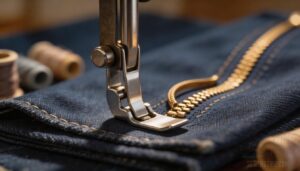
zipper foot does more than just help you sew zippers — it changes how close, clean, and controlled your stitching gets. It’s a small foot with a surprisingly wide range of jobs.
From piping and cording to invisible zippers, the full list of zipper foot uses and techniques might surprise you.
Here’s exactly what it covers.
Stitching Close to Zipper Teeth
Getting within 1 mm of zipper teeth — that’s where zipper foot attachment earns its keep. The narrow sole gives you zipper coil guidance and fabric edge stability that a standard foot simply can’t offer.
Adjust your needle position for close stitching, and you’ve got precision stitch spacing with proper needle tooth clearance.
No gaps. No exposed thread tension mistakes. Just clean, confident lines.
Why It Creates Cleaner Seams
Close stitching is only half the battle — the real win is what the foot does to your seam quality.
Groove guidance keeps the needle on a consistent path.
Uniform pressure stops puckering before it starts.
Edge tuck tucks the fabric flush against the teeth, so your clean flat seam looks deliberate, not accidental.
Presser foot alignment plus smart needle position equals seam consistency you’ll actually notice.
How It Prevents Fabric Shifting
Fabric shift is the quiet saboteur of a clean zipper seam.
Fabric shift is the quiet saboteur that turns a clean zipper seam into a crooked mess
The foot fights it on three fronts — Groove Locking anchors the needle path, Surface Texture Grip holds your layers steady, and Pressure Distribution spreads foot weight evenly so nothing creeps sideways.
Add Side Guide Stabilization and Foot Height Clearance, and your presser foot alignment keeps every stitch exactly where you put it.
Common Uses Beyond Zippers
That foot earns its keep well past zipper day. Use it for Edge Topstitching along bag edges, Leather Edge Finishing on thick seams, or Quilt Border Stitching where precision matters.
Cord Embellishment and Piping Embellishment both rely on its narrow profile to track cleanly beside raised edges.
Among sewing machine accessories, few tools pull double — or triple — duty this well.
When to Use It for Piping
Piping is where the zipper foot quietly becomes your best tool. For lightweight fabric piping or silk piping precision, it tracks cleanly beside the cord — no shifting, no guessing.
Heavy denim piping needs a test run first. Synthetic cord compatibility holds up to 3 mm without distortion.
Piping edge alignment stays consistent when you match foot orientation to your seam side.
Choose The Right Zipper Foot
Not all zipper feet are the same — and grabbing the wrong one wastes time fast.
Your machine, your zipper type, and even which side you’re stitching from, all factor in.
Here’s what you need to know before you pick one up.
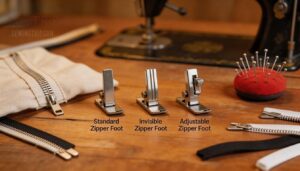
Standard Zipper Foot Vs Invisible Zipper Foot
These two feet solve different problems.
The standard zipper foot manages visible zippers — it’s your go-to for standard centered zip applications, offering solid edge finish quality on wovens and knits.
The invisible zipper foot places stitches directly along the coil width range, keeping seams hidden on lighter fabrics.
Thread tension control differs slightly between them, so test both before committing.
Adjustable Zipper Foot Features
The adjustable zipper foot gives you real control — not just left-or-right positioning, but fine-tuned precision through smart zipper foot adjustment mechanisms.
- Sliding Guide Range shifts up to 5 mm from the needle
- Thumbscrew Tightening locks the guide by hand — no tools
- Nonstick Surface keeps fabric moving smoothly past the teeth
- Reversible Orientation flips sides without removing the foot
- Interchangeable Toe Plates handle different zipper types cleanly
Snap-on Vs Screw-on Attachment
Snap-on feet win on Quick Change speed — press, click, done. Beginner Friendliness is built in, since no tools are needed.
Screw-on feet take an extra minute, but Threaded Stability and Secure Lock performance hold firm through heavy fabrics.
When installing a zipper foot on a sewing machine, choosing between snap-on and screw-on zipper feet comes down to this: speed versus staying power.
Low Shank, High Shank, and Slant Shank Compatibility
Your shank style isn’t optional trivia — it determines whether your zipper foot fits at all.
Three types exist, and each behaves differently:
- Low shank — shortest post, standard 1-inch clearance
- High shank — taller holder, needs more vertical space
- Slant shank — angled mount, shifts Needle Plate Alignment Issues slightly
- Adapters — Shank Adapter Solutions bridge mismatched Latch Height Variations
Wrong shank means needle strikes. Check yours first.
How to Match The Foot to Your Machine
Your model number is the key — look it up in your machine’s manual or run a quick Machine Compatibility Chart search online. Confirm your Presser Bar Fit, shank style, and Foot Width Matching before buying anything.
Then do a Needle Clearance Check by hand-turning the wheel. A simple tool compatibility check now saves a snapped needle later.
Which Side of The Foot to Use
Once your foot matches your machine, side choice becomes your next call. Use the Left Side Advantages for topstitching — it keeps stitches tight against the tape with minimal visibility. Flip to the Right Side Advantages when bulky coils need Coil Clearance Optimization.
Key rules for Seam Allowance Consistency:
- Left side: cleaner topstitch lines
- Right side: better control on thick fabric
- Adjustable Foot Switching: no foot removal needed
- Always test on scrap first
Attach The Foot Correctly
Attaching the zipper foot wrong is one of those small mistakes that wrecks an otherwise clean seam.
The good news — it’s a straightforward process once you know the exact steps. Here’s how to do it right, from powering down to locking the foot in place.
Turn Off and Prepare The Machine
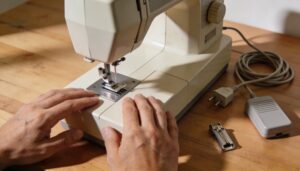
Before you touch anything, power off the machine and unplug it from the wall — then detach the foot control too.
That’s full power isolation, not just a soft switch.
Wait for residual motor stop — a few seconds of silence.
Clear a clean work surface, keep your hands dry for basic dry hands safety, and you’re ready.
Remove The Current Presser Foot
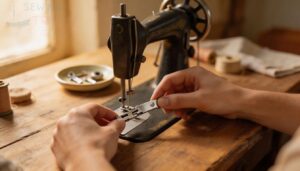
Now that the machine’s off and unplugged, let’s pull that old foot off cleanly. Turn the handwheel toward you — needle position safety first, needle goes up.
Hit the presser foot release mechanism lever or release button to disengage. Loosen the clamp fully.
Slide the the foot free. Store it somewhere it won’t vanish — a small container works perfectly.
How to Attach a Snap-on Zipper Foot
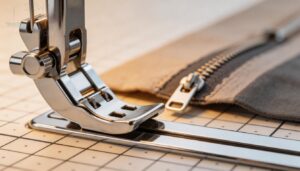
With the old foot gone, grab your snap-on zipper foot. Do a quick Pre-Installation Inspection — no lint, no bent parts.
Raise the needle with the handwheel — Needle Height Adjustment before anything else. Slide the foot onto the presser bar, press up until you hear the Snap Engagement Sound.
Tug it. Locked? Good. That click is your Post-Installation Test.
How to Attach a Screw-on Zipper Foot
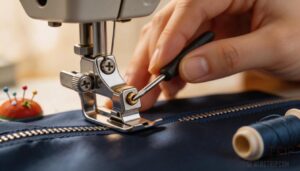
Screw-on zipper feet need a little more attention — but they reward you with a rock-solid hold.
Start with Safety Power Disconnect: power off and unplug. Do a quick Screw Thread Inspection — stripped threads mean wobble, and wobble ruins seams.
Slide the foot onto the presser bar using the Foot Alignment Procedure, hand‑tighten first, then snug it with a small screwdriver. Run a Needle Position Check before sewing.
Using a narrow profile stitches foot helps keep stitches close to zipper teeth without snagging.
Set Left or Right Foot Orientation
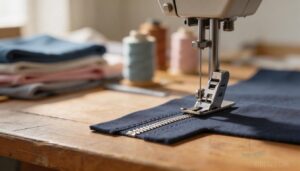
Which side the foot sits on — left or right — determines everything about your seam quality.
Use the Guide Slide Mechanism and Orientation Indicator to position the foot correctly before sewing:
- Attach foot on the right for sewing the zipper’s left side.
- Attach foot on the left for the right side.
- Adjust Foot Height Adjustment settings when switching sides.
- Slide the guide for Symmetric Zipper Placement and Pull Tab Clearance.
- Test on scrap first — always.
Check Needle Clearance by Hand
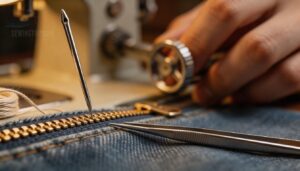
Before you sew a single stitch, do the Hand Gap Test — turn the handwheel slowly by hand and watch the needle swing. It should clear the zipper teeth without grazing them.
Use tweezers for Tweezers Gap Measurement at the closest point. If it’s tight, run a Clearance Adjustment Routine — shift your needle position left or right until alignment looks clean and confident.
Confirm The Foot is Locked Securely
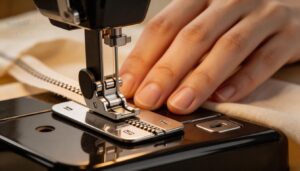
A loose foot will drift — and drift means crooked stitches. Run four quick checks before you sew.
First, listen for the Audible Snap Check — that click means the presser foot holder has engaged.
Then do the Alignment Mark Verification — the printed mark should line up cleanly.
Perform a Sideways Movement Test — less than 0.5 mm of play is your target.
Sew With The Correct Settings
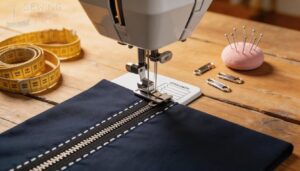
Getting your settings right makes everything else fall into place. A few small adjustments — needle position, stitch length, foot alignment — separate a clean zipper from a crooked mess.
Here’s what to dial in before you sew a single stitch.
Best Needle Position for Close Stitching
Needle clearance isn’t a suggestion — it’s the difference between a clean seam and a mangled one. For close stitching, aim 1–2mm from the zipper teeth. Open toe visualization helps you see exactly where the needle lands before committing.
- Keep needle 1–2mm from teeth for tape edge alignment
- Use invisible zipper needle placement just beside the coil — not on it
- For piping center positioning, stay 0.5–1mm from the coil
- Adjust needle position left or right using your machine’s width settings
- Always test adjusting needle position for close stitching on scrap first
Straight Stitch Settings and Stitch Length
Your stitch length dial does more work than you think. For zipper foot attachment method precision, short stitch strength (1–2mm) locks seams tight on lightweight fabric. Medium stitch versatility at 2.5mm covers most everyday zippers. Long stitch basting at 3.5–4mm is temporary — pull it out later.
| Setting | Best Use |
|---|---|
| 1–2mm short | Light fabrics, tight seams |
| 2.5mm medium | Standard zipper stitching |
| 3–3.5mm medium-long | Topstitching, denim |
| 4mm long | Basting only |
| Adjust gradually | Test stitch density control on scraps |
Straight stitch sewing near teeth demands consistency — adjusting stitch settings for zipper sewing mid-seam creates weak spots.
Aligning The Foot With Zipper Teeth
Your foot parallelism is everything here. The foot edge must run perfectly parallel to the zipper teeth — even a slight skew throws your seam edge guidance off entirely.
- Set alignment reference marks on your throat plate
- Keep needle position just beside — never biting — the teeth
- Use micro adjustment on adjustable feet: 0.2mm matters
- Balance fabric feed balance by anchoring the zipper first
- Check presser foot positioning for left and right zipper sides before you sew a single stitch
Sewing The First and Second Zipper Sides
Once your alignment is locked, First Side Stitching starts at the top — needle position hugging the teeth within 1–2 mm. Sew slowly.
Second Side Stitching reverses direction with the foot repositioned — Edge Support shifts to the opposite side. Coil Stabilization keeps everything from drifting.
| Step | Detail |
|---|---|
| First Side Start | Top of zipper, left foot edge |
| Needle Position | 1–2 mm from teeth |
| Second Side Setup | Reposition foot to right edge |
| Seam Overlap | Backstitch at both ends |
| Coil Stabilization | Close zipper before second pass |
Moving Past The Zipper Pull Smoothly
The zipper pull is where most sewers lose their nerve — don’t. Before you start, slide the slider to the top and orient the pull away from your needle line. That small move prevents catching.
- Lower presser foot pressure slightly near the pull
- Shorten stitch length as you approach
- Ease fabric slowly — feed dog control matters here
- Read tension after passing the pull
Tips for Centered, Lapped, and Invisible Zippers
Each technique has its own logic. For a centered zipper, seam symmetry is everything — both fabric edges must mirror each other across the tape. Lapped zippers need pull tab clearance and fabric tension control to lie flat.
Invisible zippers demand stitching from the tape inward, keeping teeth aligned with the seam line. Nail those details, and the finish speaks for itself.
Troubleshooting Skipped Stitches and Needle Strikes
Skipped stitches and needle strikes usually trace back to four fixable things — not bad luck.
- Needle type and position — wrong needle for your fabric thickness causes deflection and strikes; adjust machine needle alignment to clear the teeth.
- Thread tension adjustment — tight tension pulls fabric sideways and skips loops; balance it first.
- Thread quality — cheap thread shreds and jams.
- Machine timing — when strikes persist, that’s your cue.
Remember that needle deflection causes strikes when fabric is pushed manually.
Top 10 Presser Foot Options
Not all presser feet are created equal — and the right one makes a real difference. These ten options cover everything from basic zipper work to invisible seams and buttonholes.
Here’s what’s worth keeping in your kit.
1. Universal Zigzag Presser Foot
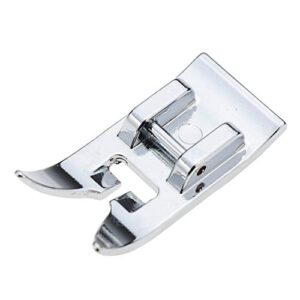
At $4.49, this little foot punches well above its weight.
It’s a universal clip-on zigzag foot — hard metal, silver finish, built for low-shank machines like Brother, Singer, and Janome.
The 7 mm wide needle slot accommodates everything from basic mending to elastic insertion without complaint.
It won’t work on slant-shank or high-shank machines, so check your shank before buying.
One piece, 18 grams, model Foot02 — simple, affordable, and surprisingly capable for everyday sewing tasks.
| Best For | Home sewers with low-shank machines who need an affordable, no-fuss zigzag foot for everyday tasks like mending, general sewing, and elastic insertion. |
|---|---|
| Material | Hard metal |
| Shank Type | Low-shank |
| Attachment Style | Clip-on |
| Price | $4.49 |
| Brand Compatibility | Singer, Brother, Janome |
| Finish/Color | Silver |
| Additional Features |
|
- At $4.49, it’s a genuinely cheap replacement that doesn’t feel cheap — hard metal build, solid finish
- The 7 mm needle slot handles a good range of stitches without needing a specialty foot
- Clips on and off easily, and fits most major brands like Brother, Singer, and Janome
- Won’t work on slant-shank or high-shank machines — you have to check before you buy
- No returns under Amazon’s Small and Light program, just a refund through customer service
- Only comes as a single piece, so no backup if something goes wrong
2. TISEKER Zipper and Invisible Zipper Foot
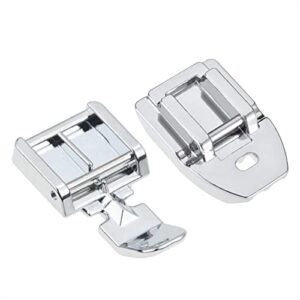
Two feet for $6.99 — that’s hard to argue with.
The TISEKER FOOT30 includes a standard zipper foot and an invisible zipper foot, both snap‑on, both metal, both silver‑finished and anti‑rust. No screwdriver needed. They click onto low‑shank machines from Brother, Singer, Janome, Babylock, and several others in seconds.
The invisible foot has built‑in grooves that guide the coil flush — so your seam practically disappears when the zipper closes. Note: some heavy‑duty Singer models may need a low‑shank adapter.
| Best For | Sewers who regularly work with invisible zippers and want a reliable, budget-friendly foot set that fits most home machines. |
|---|---|
| Material | Metal |
| Shank Type | Low-shank |
| Attachment Style | Snap-on |
| Price | $6.99 |
| Brand Compatibility | Singer, Brother, Janome, Juki |
| Finish/Color | Silver |
| Additional Features |
|
- Two feet for under $7 — seriously good value
- Snap-on design means no tools, no fuss — just click and sew
- Works with a wide range of low-shank machines, including older vintage models
- Not a guaranteed fit for every machine on the compatibility list
- Heavy-duty Singer models may need a separate low-shank adapter
- Metal build is solid, but getting close engagement with thicker zipper teeth can be tricky
3. FIKLOTA Auto Buttonhole Presser Foot
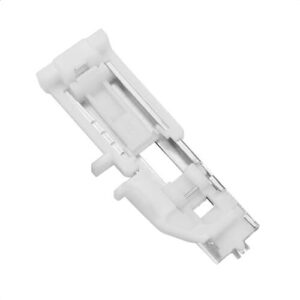
Buttonholes aren’t zippers — but your machine still needs the right foot to make them clean.
FIKLOTA Auto Buttonhole Presser Foot (model ESM68) snaps onto any low-shank machine — Singer, Brother, Janome, Juki, and more — no tools required.
It measures 95 mm × 33 mm and weighs just 24 g.
The built-in guide channel keeps your fabric aligned through every stitch cycle.
One thing to check first — it won’t fit high-shank or Bernette machines, so confirm your shank type before ordering.
| Best For | Home sewers and small workshop owners who want clean, consistent buttonholes on a low-shank machine without fussing over manual adjustments. |
|---|---|
| Material | Steel and plastic |
| Shank Type | Low-shank |
| Attachment Style | Snap-on |
| Price | N/A |
| Brand Compatibility | Singer, Brother, Janome, Juki |
| Finish/Color | White |
| Additional Features |
|
- Snaps on fast — no tools, no setup headaches
- Works with a wide range of popular brands like Singer, Brother, Janome, and Juki
- Lightweight and compact, so it won’t clutter your accessories drawer
- Won’t fit high-shank or Bernette machines, so you need to check your shank type first
- Some users have reported fit issues on certain heavy-duty Janome models
- Buttonhole width may fall short for wider zigzag stitch settings
4. Sewable Open Toe Walking Foot Adjustable Guide
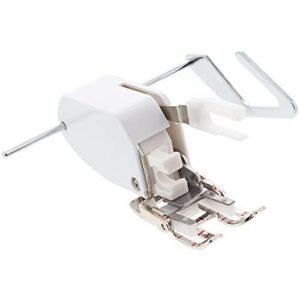
Layered fabrics love to wander — the Sewable Open Toe Walking Foot (model P60444‑OT) keeps them in line. At $18.99, it works with most low-shank machines: Brother, Singer, Janome, Babylock, and more.
The open-toe design gives you a clear view of the needle — no guessing where you’re stitching. The adjustable guide locks onto the back and holds your seam spacing steady.
It accommodates leather, vinyl, and minky without puckering. Just clean the toe area regularly — it collects lint fast.
| Best For | Quilters and sewists working with slippery, layered, or tricky fabrics who need straight, even seams without the headache. |
|---|---|
| Material | Leather and vinyl |
| Shank Type | Low-shank |
| Attachment Style | Snap-on |
| Price | $18.99 |
| Brand Compatibility | Brother, Janome, Singer, Babylock |
| Finish/Color | White |
| Additional Features |
|
- Dual feed dogs keep multiple layers moving together — no more puckering or drift
- Open-toe design gives you a clear view of exactly where the needle lands
- Works with a wide range of low-shank machines at a solid $18.99 price point
- The built-in guide can detach and get in the way of your stitching
- Not compatible with high-shank machines, so double-check your fit before buying
- The open toe collects lint quickly and needs regular cleaning to stay reliable
5. Universal General Purpose Zigzag Presser Foot
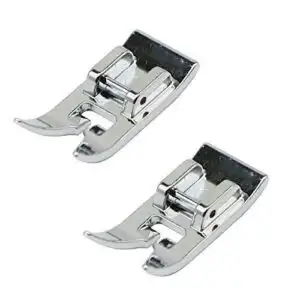
Sometimes you just need a foot that does everything without fuss. The Stormshopping GeneralFoot delivers exactly that — two snap-on metal feet for $4.99.
It performs straight stitching, zigzag up to 7 mm, elastic insertion, and basic mending.
Works with Brother, Janome, Singer, Bernina, and most other low‑end machines.
The wide needle slot gives you room to work. One heads‑up — some Brother models have pin-width quirks, so test fit before your project starts.
| Best For | Beginners and budget-conscious sewers who need a reliable everyday foot for common stitching tasks on low-shank machines. |
|---|---|
| Material | Metal (hard steel) |
| Shank Type | Low-shank |
| Attachment Style | Clip-on |
| Price | $4.99 |
| Brand Compatibility | Brother, Janome, Singer, Babylock |
| Finish/Color | Silver |
| Additional Features |
|
- Two feet for $4.99 — hard to beat that value, and having a spare on hand is genuinely handy
- Works with a wide range of machines including Brother, Janome, Bernina, and more
- Handles straight stitch, zigzag, elastic insertion, and basic mending all in one foot
- Only fits low-shank machines, so high-shank or industrial setups are out of luck
- Some Brother models have pin-width quirks that can cause fit issues
- Generic build means it probably won’t hold up as long as an OEM foot under heavy use
6. TISEKER Low Shank Zipper Foot
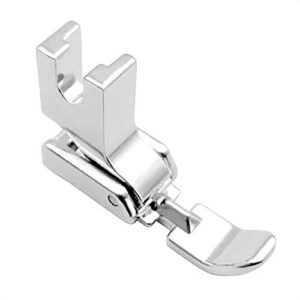
If the GeneralFoot is your everyday workhorse, the TISEKER Low Shank Zipper Foot is your precision tool.
At $5.99, it’s built from solid metal — narrow enough to stitch within 1–2 mm of zipper teeth without crowding them.
It screws on rather than snapping, so take an extra thirty seconds to secure it properly.
Compatible with Singer, Brother, Janome, and a dozen other low-shank brands — but skip it if your machine runs a slant or high shank.
| Best For | Home sewers and beginners who work with low-shank machines and want a cheap, reliable way to sew clean zippers without the frustration. |
|---|---|
| Material | Metal |
| Shank Type | Low-shank |
| Attachment Style | Screw-on |
| Price | $5.99 |
| Brand Compatibility | Singer, Brother, Janome, Bernina |
| Finish/Color | Gray |
| Additional Features |
|
- Solid metal build that’ll last way longer than a plastic foot
- Narrow enough to stitch right up close to zipper teeth with no crowding
- Works with a ton of popular brands — Singer, Brother, Janome, and more
- Screws on instead of snapping, so swapping it out takes a little extra time
- Leaves a small gap between foot and fabric edge, which won’t work for every project
- Not compatible with slant-shank or high-shank machines, and a few Janome models have had needle-bending issues
7. Honeysew Automatic Button Hole Foot
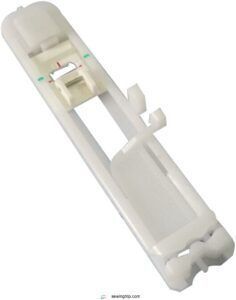
Not every project stops at zippers — and that’s where the Honeysew Automatic Button Hole Foot earns its spot in your kit.
It snaps on quickly, creates one-step buttonholes, and guides your machine through the full stitch cycle automatically. No measuring — just drop the button in, sew, done.
It works across low, high, and slant shank machines — but confirm your model provides an automatic buttonhole function first. Practice on scrap fabric before committing to your actual garment.
| Best For | Sewers who regularly make buttonholes and want consistent, hands-free results without all the fuss of manual measuring. |
|---|---|
| Material | Plastic |
| Shank Type | Short-shank |
| Attachment Style | Snap-on |
| Price | $7.79 |
| Brand Compatibility | Brother, Baby Lock only |
| Finish/Color | N/A |
| Additional Features |
|
- One-step buttonholes mean less setup and faster results
- Guide fingers keep everything centered and uniform every time
- Snaps on easily and comes in at a very affordable price point
- Only works with specific Brother and Baby Lock models, so check compatibility first
- Your machine needs a dedicated buttonhole lever — no lever, no go
- Plastic build may not hold up as well under heavy, high-speed use over time
8. Open Toe Walking Foot Guide
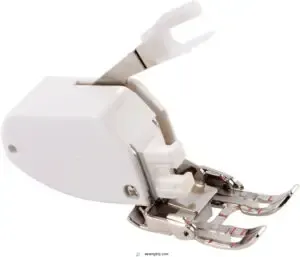
If buttonholes pushed your skills forward, this foot precision even further.
Open Toe Walking Foot Guide is built for quilting and topstitching — but it manages zipper‑adjacent work well too. The cutaway toe gives you a clear view of the needle drop, so you’re never guessing where your stitch lands. The built‑in guide bar keeps rows parallel without measuring twice. It fits most low‑shank machines — just confirm yours isn’t vintage or industrial before buying.
| Best For | Home quilters and beginners who want cleaner, straighter rows without the guesswork. |
|---|---|
| Material | Metallic alloy |
| Shank Type | Low-shank |
| Attachment Style | Screw-on |
| Price | $10.49 |
| Brand Compatibility | Singer, Brother, Janome, Juki |
| Finish/Color | Metallic |
| Additional Features |
|
- The open toe gives you a clear sightline to the needle, which makes in-the-ditch stitching way less stressful.
- The built-in guide bar keeps your rows evenly spaced without measuring every time.
- Easy to swap on and off most low-shank machines once you’ve done it a couple times.
- Durability is hit or miss — the foot plate and metal guide have been known to come apart after light use.
- Fitting it to some machines (like the Brother SE1900) can be a real headache.
- If something goes wrong and you need to return it, international buyers may end up paying more in shipping than the foot is worth.
9. TISEKER Blind Hem Presser Foot
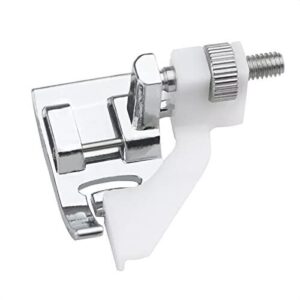
Not every sewing task needs a zipper foot — and that’s where the TISEKER Blind Hem Presser Foot earns its place. At $6.99, it’s a low-cost upgrade for pants, skirts, and curtains where visible stitching ruins the look.
The central metal guide locks your fabric fold in place — pulling just a few fibers into each stitch. Snaps onto most low-shank machines in seconds.
Some Singer models may need an adapter, so check your shank before ordering.
| Best For | Home sewers who want clean, invisible hems on pants, skirts, or curtains without spending much money. |
|---|---|
| Material | Metal |
| Shank Type | Low-shank |
| Attachment Style | Snap-on |
| Price | $6.99 |
| Brand Compatibility | Singer, Brother, Janome, Juki |
| Finish/Color | White |
| Additional Features |
|
- At $6.99, it’s an easy buy — great value for the results you get
- Snaps on and off in seconds, so swapping feet mid-project isn’t a hassle
- The metal guide keeps your fabric fold consistent, which makes a real difference on delicate or lightweight materials
- Doesn’t fit every Singer low-shank model, so double-check your machine before ordering
- Has a small lip on the bottom (Brother-style), which might throw you off if you’re used to a Babylock design
- Some machines still need a low-shank adaptor for a proper fit, adding a little extra cost
10. TISEKER Snap On Overcast Presser Foot
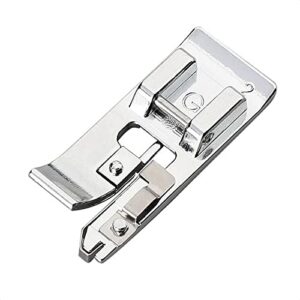
Raw edges are the enemy of any clean seam — and the TISEKER Snap On Overcast Foot manages them fast. At $6.99, this metal foot wraps thread around the fabric edge with every pass, mimicking a serger finish without the $200 machine.
Snap it onto any low-shank setup — Brother, Janome, Juki, and most others.
The center guide keeps your edge aligned and consistent.
Test tension on scrap first.
Singer models need an adapter, but otherwise, you’re ready to go.
| Best For | Beginners and casual sewists who want clean, serger-like edges without investing in a separate machine. |
|---|---|
| Material | Metal |
| Shank Type | Low-shank |
| Attachment Style | Snap-on |
| Price | $6.99 |
| Brand Compatibility | Singer, Brother, Janome, Juki |
| Finish/Color | White |
| Additional Features |
|
- At $6.99, it’s a genuinely cheap way to stop raw edges from fraying
- Fits most major brands — Brother, Janome, Juki, and more — right out of the box
- Metal build means it’ll outlast any flimsy plastic guide you’ve broken before
- Singer users may need an adapter, which adds a small extra step
- Can feel a bit wobbly or come loose mid-sew if not secured properly
- Backstitching is limited, so you might need to hand-tie threads to finish seams
Frequently Asked Questions (FAQs)
How do you attach a zipper foot to a sewing machine?
Turn off your machine first — no exceptions.
presser foot lever, align the zipper foot under the holder, and snap or screw it into place.
Test needle clearance before sewing.
What is a zipper foot on a sewing machine?
A zipper foot is a narrow presser foot that lets your needle stitch within 1–2 mm of zipper teeth.
That tight clearance creates clean, flat seams — no awkward gaps, no bunched fabric.
What is a zipper foot used for?
One small foot — completely transforms your zipper game. It lets you stitch within 1–2 mm of zipper teeth, creating clean, flat seams that look store-bought — every single time.
How do you use a zipper foot?
Attach the foot, position the needle beside the zipper teeth, and sew a straight stitch at 5 mm length.
Switch foot sides for each seam — that’s really all there is to it.
How do I attach my zipper foot?
Power off your machine first.
Raise the presser foot lever, align the zipper foot under the bar, then press up until it clicks — or tighten the thumbscrew if yours screws on.
How to know which side of zipper foot to use?
The side you use depends on where your needle needs to land. Sew the left zipper side — foot goes right. Sew the right side — foot goes left. Simple as that.
Is there a difference between a zipper foot and an invisible zipper foot?
Yes — and the difference matters.
A standard zipper foot offsets the needle to one side. An invisible zipper foot has a center groove that curls the coil away, hiding the seam completely.
How do I add a new zipper slider?
Match new slider to your zipper type and size first.
Feed the teeth in from the bottom, snap or screw it into place, then zip up and down to test.
Can a zipper foot work on leather fabrics?
Absolutely — a zipper foot works with leather well.
Use a sharp 90/14 or 100/16 needle, set stitch length to 5 mm, and keep the foot tight against the zipper teeth for clean, professional results.
How do I care for and store presser feet?
Wipe feet clean after use, oil the shank every few months, and store them in a labeled tray — away from dust, moisture, and anything heavy enough to warp the edges.
Conclusion
Think of your zipper foot as the unsung hero in your sewing kit—the steady hand that turns trembling stitches into perfect seams. Master this zipper foot attachment guide, and you’ll transform puckered zippers into polished finishes.
No more guesswork, just clean lines and professional results every time. Whether you’re tackling invisible zippers or piping, the right foot eliminates frustration.
Now go forth—your next project awaits, and those teeth? They’ll line up perfectly. Stitch with confidence.