This site is supported by our readers. We may earn a commission, at no cost to you, if you purchase through links.
A single failed seam on a climbing belt or dog leash can mean the difference between safety and disaster. When you’re sewing nylon webbing, you’re not just joining fabric—you’re engineering a connection that must hold under stress, weather, and time.
The material itself is forgiving: nylon webbing resists abrasion, sheds water, and stretches slightly to absorb shock. But that same toughness demands specific tools and techniques. Your standard sewing machine might balk at thick layers, and a simple straight stitch won’t distribute load the way a zigzag or box-X pattern will.
Get the setup right, though, and you’ll create seams that match or exceed factory strength.
Table Of Contents
Key Takeaways
- Choose nylon webbing with load ratings at least double your expected working load, and use heavy-duty needles (size 16-18) paired with bonded nylon thread (size 69, Tex 70) to create seams that match factory strength.
- Prevent fraying by heat-sealing cut edges with a flame or hot knife, which melts the filaments into a rounded bead that stops unraveling before it starts.
- Use reinforced stitch patterns like box-X, zigzag, or bar tacks at load-bearing points to distribute stress across the seam—double-stitching at attachment points boosts strength by 10-20%.
- Replace webbing immediately if you spot visible abrasion, cracks, fraying, discoloration from UV exposure, stiffness, or stitch pullout, since material degradation isn’t negotiable in safety-critical gear.
Choosing Materials for Sewing Nylon Webbing
Your webbing choice makes or breaks the project before you even thread the needle. Not all nylon webbing performs the same way, and picking the wrong type can mean redoing hours of work.
Choosing the wrong nylon webbing can cost you hours of work before you even start sewing
Let’s walk through what you need to know about webbing types, matching materials to your specific build, and how nylon stacks up against polyester.
Types of Nylon Webbing
Nylon webbing comes in two main constructions that affect how you’ll work with it. Flat webbing stays stable under tension and won’t twist, making it ideal for straps and grips. Tubular webbing forms a continuous tube that offers higher strength and smooth edges.
- Nylon 6,6 delivers exceptional tensile strength for heavy-duty applications like harnesses
- UV-stabilized options resist sun damage and extend outdoor life
- Webbing thickness ranges from lightweight to heavy-duty, usually 1–2 inches wide
Selecting Webbing for Specific Projects
Matching your gear’s demands to the right webbing materials selection keeps you safe and your project functional. For safety-critical work, choose load ratings at least double your expected working load. Outdoor projects need UV resistance—look for stabilized options with documented aging data. Abrasion testing results guide you when wear matters most.
Choose heavy-duty threads designed for leather when stitching webbing onto leather goods, since thread strength directly affects overall durability.
Here’s how different applications stack up:
| Project Type | Recommended Webbing |
|---|---|
| Climbing belt | Nylon 6,6, 2x safety factors |
| Dog leash | UV-stabilized, abrasion-tested |
| Backpack straps | Water-resistant, high tensile |
| Tie-down system | Wide width, coated for durability |
Comparing Webbing Materials (Nylon Vs. Polyester)
Once you’ve matched your project to load requirements, you’ll need to choose between nylon and polyester webbing. Nylon webbing offers higher stretch resistance and abrasion resistance, but polyester webbing wins on UV resistance and colorfastness. Tensile testing shows nylon elongates more before failure, while polyester maintains better dimensional stability when wet.
For projects exposed to direct sunlight, understanding how nylon performs in UV conditions helps you decide whether polyester’s superior sun resistance justifies the trade-off in strength.
- Nylon absorbs water and loses dimensional stability
- Polyester resists UV degradation far better over time
- Fiber comparison data guides material strength decisions
- Webbing durability depends on your specific exposure conditions
Preparing and Cutting Nylon Webbing
Cutting nylon webbing isn’t like cutting regular fabric—it frays fast and needs the right approach from the start. You’ll want sharp tools that won’t leave ragged edges, and you need to know how to seal those ends before they unravel on you.
Here’s what you need to get clean cuts and secure webbing every time.
Tools for Cutting Nylon Webbing
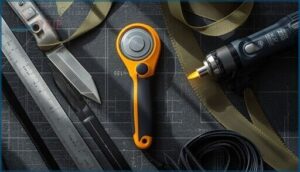
You’ll need sharp cutting tools that won’t leave frayed edges on your webbing. Stainless steel utility knife blades paired with a straightedge give you clean, straight cuts on webbing up to 1 inch wide.
For smoother results, use rotary cutters with a cutting mat—they handle multiple layers without creating burrs. A hot knife cutter seals edges as it cuts, preventing fraying instantly.
If you’re working with fitted sheets or complex cuts, this step-by-step bed sheet sewing tutorial walks you through handling fabric edges cleanly from start to finish.
Preventing Fraying and Securing Ends

Raw edges on your webbing will unravel fast without proper finishing. Heat sealing locks filaments together and stops fraying before it starts—here’s what works:
- Pass the cut edge near a small flame 6 to 10 mm away until it just melts into a rounded bead
- Use a hot knife cutter to seal as you cut, creating smooth, glossy edges
- Fold the raw edge under twice and stitch across with zigzag or bar tacks
- Apply hot glue lightly on lighter-duty straps where high loads aren’t expected
- Thread ends through buckles so hardware contains the raw edge and limits wear
Combine methods for secure terminations that last. For a strong and durable bond, understanding proper heat sealing is essential.
Measuring and Marking for Precision
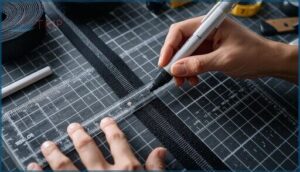
Precision matters when measuring nylon webbing—think of it as setting the foundation for every strong seam. Use rigid rulers for cutting accuracy, align webbing on a grid mat, and mark with water-soluble pens for clean lines. For repeated straps, stack and match lengths. The right measuring tools and marking techniques keep your webbing aligned and performance-ready. When working with various fabrics, it’s vital to use suitable fabric marking tools for accurate results.
| Measuring Tools | Marking Techniques | Precision Methods |
|---|---|---|
| Rigid Acrylic Ruler | Water-Soluble Marker | Grid Mat Alignment |
| Fiberglass Tape | Tailor’s Chalk | Stack and Match |
| Grid Ruler | Air Erasable Pen | Master Piece Reference |
| Sliding Gauge | Permanent Textile Pen | Orthogonal Layout |
| Cutting Mat | Fine Awl Prick | Sub-5mm Control |
Selecting The Right Tools and Supplies

Your sewing machine can handle nylon webbing, but you need the right setup to avoid frustration and weak seams. The key is matching your needle, thread, and accessories to the thickness of your material.
Here’s what works best for heavy-duty webbing projects.
For straps or handles, consider pairing it with stretchy ITY fabric if you need flexibility without compromising strength.
Best Sewing Machines for Nylon Webbing
Your standard home machine might tackle lightweight webbing, but thick, load-bearing straps demand a sewing machine built like a workhorse. Heavy-duty models deliver the motor power and thread tension control you need for nylon webbing sewing.
Look for machines with:
- Walking foot capability for even fabric feeding
- Adjustable sewing speed to maintain control through thick layers
- Metal frame construction that won’t flex under pressure
Needle and Thread Recommendations
Matching the right needle and thread turns an amateur seam into one that holds under real pressure. For standard nylon webbing, pair a size 16 or 18 heavy-duty needle with bonded nylon thread (size 69, Tex 70). Polyester thread resists UV damage better for outdoor projects. Thicker webbing demands size 110/18 needles and heavier thread—proper needle sizing prevents skipped stitches and thread breaks.
| Thread Type | Best Use |
|---|---|
| Bonded Nylon Thread | High strength, abrasion resistance |
| Polyester Thread | UV exposure, outdoor gear |
| Size 69 (Tex 70) | Standard webbing projects |
| Size 138 (Tex 135) | Heavy-duty straps, harnesses |
Essential Accessories for Heavy-Duty Sewing
Thick webbing fights back when you push it through a machine—the right accessories tilt the odds in your favor. A walking foot moves layers together without slipping, while roller attachments reduce friction on textured surfaces. Fabric clips hold bulky seams where pins fail.
- Walking foot: 3/8 inch lift manages multiple thick layers cleanly
- Roller presser feet: Even feeding prevents drag on heavy materials
- Wonder clips: Grip thick stacks without distorting curved seams
- Size 18–22 needles: Industrial-grade points penetrate dense webbing reliably
Sewing Techniques for Strong Webbing Seams

Your sewing technique makes the difference between webbing that holds and webbing that fails. The right stitch pattern distributes stress across the seam, while proper reinforcement keeps high-load areas from tearing out.
Here’s what you need to know about creating seams that won’t let you down.
Stitch Patterns for Durability (Zigzag, Box X, Bar Tack)
Strong stitch patterns mean the difference between gear that holds and gear that fails. For sewing webbing in load bearing applications, you’ll rely on three proven techniques: zigzag stitching at 6 to 8 stitches per inch distributes stress across the seam, box X patterns handle multidirectional pulls, and bartack geometry concentrates thread strength where you need it most. Each reinforcement stitch adds measurable durability.
Reinforcing Load-Bearing Areas
After you’ve laid down those foundational stitch patterns, focus on the points where force concentrates. Double-stitching at attachment points boosts seam strength by 10–20%, while bar tacks distribute load across stress zones—tested assemblies show up to 60% better performance. Overlapping webbing layers with dense rectangle stitching raises allowable loads by 15%.
Here’s how fiber locking and load distribution work together:
- Run two parallel rows at connection points for immediate seam reinforcement
- Place bar tacks vertically at pivot areas where pulls change direction
- Stack webbing layers with offset seams to spread forces across multiple planes
- Add zigzag edge stitching to lock fibers and resist unraveling under flex
- Test your work—pull hard to verify stitch reinforcement holds before field use
Tips for Handling Thick Webbing Layers
Dense layers resist your presser foot—swap to a walking foot for even feed through thick seam zones. Longer stitch lengths (3.5–4 mm) prevent perforation while maintaining webbing tension across stacked material.
Pin or tape for layer alignment before you start, then remove just ahead of the needle.
Edge finishing with heat-sealed cuts stops fraying.
Test scraps first to dial in settings for load-bearing applications.
Inspecting and Maintaining Nylon Webbing Projects

Your webbing project is only as safe as your commitment to checking it regularly. Even the strongest seams can fail if you ignore wear, dirt, or UV damage over time.
Here’s what you need to inspect, how to keep your webbing in top shape, and when it’s time to retire it for good.
Checking Stitch Quality and Seam Strength
Your stitching isn’t just decoration—it’s the backbone of your project’s durability. Run your fingers along each seam, feeling for loose threads or gaps. Look for 30-40 stitches per inch, tight and evenly spaced.
Check fabric tension by gently pulling the webbing; properly sewn seams won’t pucker or buckle.
For load-bearing gear, conduct breakage analysis on test samples before trusting your assembly under real-world stress.
Cleaning and Storing Nylon Webbing
Once you’ve confirmed your seam strength, proper webbing sanitation becomes your next line of defense. Hand wash your nylon webbing with mild soap and cool water—hot water weakens fibers. Air dry away from direct heat to maintain UV protection.
For storage methods that preserve durability, keep webbing in a cool, dry place out of sunlight, loosely wound to prevent compression that compromises fabric preparation quality.
Signs of Wear and When to Replace Webbing
Regular webbing inspection catches problems before they become failures. Check your nylon webbing after each heavy use and monthly for stored gear—durability testing saves lives.
Replace webbing immediately if you spot:
- Visible abrasion marks showing material thinning across load points
- Cracks or fraying along edges that reduce capacity
- Discoloration or glazing from UV exposure or heat
- Stiffness or elasticity loss affecting flexibility
- Stitch pullout at seams under stress
Material degradation isn’t negotiable in safety checks for outdoor applications.
Frequently Asked Questions (FAQs)
Can I dye nylon webbing after sewing it?
You can’t unscramble an egg—but you can dye sewn nylon webbing.
Use acid or disperse dyes near boiling with constant agitation. Pre-wash first, check thread compatibility, and expect moderate color fastness with proper heat-setting afterward.
How do I attach hardware to webbing securely?
You’ll need reinforcement strategies at attachment points. Sandwich extra webbing layers where hardware connects, then use diamond or W stitch patterns with bartack reinforcement.
This load distribution approach achieves nearly 100 percent strength retention.
What causes nylon webbing to stretch over time?
You’d think nylon webbing stays put, but several factors gradually lengthen it—especially in load-bearing applications. Creep deformation under sustained load, elastic stretch at working tension, moisture absorption, UV degradation, and thermal expansion all contribute to this effect.
How do I remove stitches from webbing projects?
Use a seam ripper or small scissors to cut thread segments carefully without nicking the webbing. Work from the bobbin side, cutting every few stitches, then pull the top thread free to preserve webbing integrity.
Conclusion
Before telegraphs carried urgent warnings, craftspeople knew: a weak join could cost a life. The same holds true when sewing nylon webbing today.
Your needle choice, stitch pattern, and thread tension aren’t minor details—they’re the difference between gear that endures and gear that fails.
Master the box-X, respect load paths, and test your work honestly. The webbing won’t lie under stress. Neither should your confidence in what you’ve built.
- https://www.thethreadexchange.com/miva/merchant.mvc?Screen=CTGY&Category_Code=needle-size-chart
- https://www.superiorthreads.com/education/bonded-thread-needle-guide
- https://www.hookandloop.com/converting/sewing
- https://www.practical-sailor.com/sails-rigging-deckgear/is-hand-stitched-nylon-webbing-strong-enough
- https://www.sailrite.com/How-to-Sew-Webbing-Loops