This site is supported by our readers. We may earn a commission, at no cost to you, if you purchase through links.
You don’t need a fancy machine to create something beautiful with your own two hands. Hand sewing gives you complete control over every stitch, every seam, every small repair or ambitious project.
It’s quieter than a machine, more portable, and remarkably forgiving when you’re just starting out. The barrier to entry? Lower than you think. A needle, thread, fabric, and scissors will get you surprisingly far.
Whether you’re fixing a torn hem, crafting a handmade gift, or diving into your first quilt square, this hand sewing for beginners guide walks you through the essential tools, fundamental stitches, and simple projects that build real skill without the overwhelm.
Table Of Contents
Key Takeaways
- You need surprisingly little to start hand sewing—just needles (size 7–8), 40-weight thread, fabric scissors, and pins will get you through most beginner projects without spending a fortune or waiting for a machine.
- Master five essential stitches (running stitch, backstitch, whip stitch, blanket stitch, and ladder stitch) and you’ll have the skills to repair anything, join seams securely, finish edges cleanly, and create invisible closures that look professional.
- Proper fabric prep matters more than you think—pre-washing cotton prevents up to 9.5% shrinkage, pressing before cutting ensures accuracy, and choosing stable medium-weight fabrics like cotton broadcloth gives beginners control from the first stitch.
- Start with small, practical projects like coasters, drawstring pouches, or sewing on buttons to build real confidence before tackling bigger items—each project teaches different techniques without overwhelming you with complexity.
Essential Hand Sewing Supplies
You don’t need a mountain of gear to start hand sewing—just a few reliable basics that’ll set you up for success.
The right tools make every stitch easier and help you build real confidence from day one.
Here’s what belongs in your starter kit.
Needles and Thread for Beginners
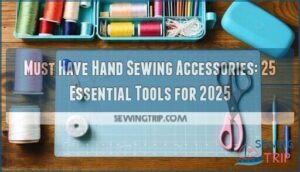
Your thread selection and needle sizes determine whether you’re fighting your fabric or dancing with it. Quality needles in sizes 7–8 balance handling ease with precision on most fabrics—higher numbers mean finer points. Start with 40-weight polyester or cotton thread for durability, then match your sewing needle to fabric weight.
Here’s your rebellion toolkit:
- Size 7–8 sharps needles for medium-weight cotton and linen
- 40-weight thread (TEX 25) for general projects and strong seams
- Polyester or poly-cotton blend for strength that won’t snap under tension.
Understanding the needle size charts is essential for selecting the right needles.
Choosing Scissors and Cutting Tools
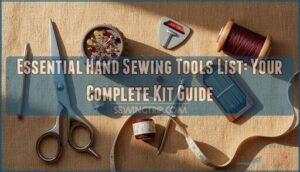
Your needle mastery won’t mean much with dull blades. Grab 8-inch fabric scissors with bent grips—they’ll keep your fabric flat while you cut. Add 3–4 inch embroidery snips for thread work, and consider a 45mm rotary cutter with a self-healing cutting mat for straight lines. Pinking shears give you that zigzag edge that stops fraying cold. For accurate fabric cutting, use a rotary cutting tool.
| Tool Type | Why You Need It |
|---|---|
| 8″ Fabric Scissors | Control meets power—bent grips cut clean without lifting your fabric |
| Embroidery Snips | Precision trimming in tight corners where big shears can’t reach |
| Rotary Cutter + Mat | Straight cuts, zero wrestling—your secret weapon for long strips |
Pins, Thimbles, and Storage Solutions
Now lock down those fabric layers with straight pins—grab a $2 pack to start. Glass-head pins won’t melt under your iron, while ballpoint types slip between knit fibers instead of snagging them.
Protect your pushing finger with a metal thimble when you’re wrestling denim or thick seams. Store everything in a magnetic pin holder or cushion so you’re not hunting for hand sewing basics mid-project.
Setting Up Your Sewing Workspace

Your workspace isn’t just about having a table and chair—it’s about setting yourself up so you can actually enjoy the process without fighting bad lighting or hunting for scissors every five minutes. A little upfront effort here pays off in comfort and fewer headaches down the road.
Let’s break down the essentials that’ll make your sewing sessions smoother and more productive.
Lighting and Ergonomic Seating
Your workspace can make or break your hand sewing journey. Set up task lighting at around 800–1,000 lux—roughly double standard desk brightness—to prevent eye strain and keep your focus sharp.
Pair that with ergonomic chairs that support a comfortable posture: feet flat, knees at 90 degrees, and the work surface just above elbow height. Proper workspace setup means you’ll sew longer without aching shoulders or a stiff neck.
Organizing Supplies for Efficiency
Chaos steals productivity. Place your sewing tools—fabric scissors, quality needles, thread spools—within arm’s reach to slash wasted motion. Industrial garment shops applying Tool Placement and Inventory Control principles have jumped from 70% to 90% efficiency.
You’re not running a factory, but the logic holds: labeled Storage Solutions, dedicated zones for cutting versus stitching, and ruthless decluttering transform your hand sewing for beginners setup into a simplified, distraction-free command center.
Prepping and Ironing Fabric
Wrinkled yardage sabotages accuracy. Press your fabric choice before you cut—cotton shrinks up to 9.5% in the first wash, distorting every pattern piece. Use a hot iron for linen, moderate heat for polyester, and always test on scraps.
Pressing Techniques differ from back-and-forth ironing: lift and lower the plate to avoid stretching bias edges.
Flat Seam Preparation and Fabric Stabilization turn guesswork into precision, arming you with the control pros demand.
Choosing and Preparing Fabric
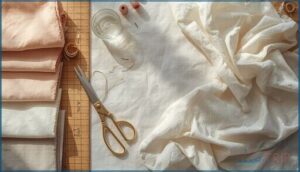
The fabric you pick can make or break your first hand sewing project—cotton is your friend, slippery satin isn’t.
Before you even thread a needle, you’ll need to prep that fabric properly or risk a finished piece that shrinks the first time it hits water.
Here’s how to choose smart, wash right, and cut clean so your project actually turns out the way you planned.
Selecting Beginner-Friendly Fabrics
The right fabric choice can make or break your textile crafts journey. Start with cotton—especially broadcloth or poplin—since their tight weave density and minimal stretch factors give you control from the first stitch.
Look for medium-weight options around 150–270 gsm with stable thread counts. Skip slippery silks and high-stretch knits for now; choosing the right fabric means picking something that won’t fight back while you’re learning.
Pre-Washing and Shrinkage Prevention
Fabric shrinkage steals your perfect fit before you even finish sewing. Pre-wash cotton and linen once—or twice if you’re playing it safe—at the hottest setting your finished piece will face.
Most cotton drops 3–8% in those first five cycles, locking in fabric relaxation and color fastness early. This simple pre-wash tip gives you shrinkage control and ensures your fabric choice won’t betray you later.
Marking and Cutting Fabric Accurately
Measure twice, cut once—this rule saves fabric and your sanity. Sharp fabric scissors and a flat surface turn measurement chaos into precision, while straight pins lock your pattern in place. A thimble protects your fingers as you mark each seam allowance with confidence.
- Use a clear ruler for accurate notching and seam allowance marks at the standard 5/8 inch
- Align your pattern with the grainline to prevent twisting and keep your fabric choice hanging straight
- Mark on the wrong side with chalk or washable pens to hide guidelines from view
- Straighten raw edges and match selvages before pinning to guarantee square, on-grain cuts
- Test cutting tools on fabric scraps—dull blades fray edges and ruin your hard work
Basic Hand Sewing Stitches
You don’t need to master a dozen stitches to start sewing—just a handful of basics will get you through most repairs and beginner projects. Each stitch has its own job, whether you’re joining fabric, finishing edges, or making your work look polished.
Let’s break down the five stitches that’ll give you real control over your sewing.
Running Stitch (Straight Stitch)
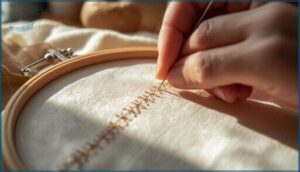
The running stitch is your gateway to hand sewing mastery—simple, fast, and endlessly useful. Thread your needle, weave in and out through fabric in a dashed line, and you’ve conquered the foundation. Keep stitch length around 2–3 millimeters for everyday seams, though it won’t hold heavy stress. Perfect tension keeps fabric flat without puckering.
| Element | Guideline |
|---|---|
| Stitch Length | 2–3 mm for standard seams |
| Tension Control | Even pull, fabric lies flat |
| Fabric Choice | Cotton or stable weaves |
| Seam Strength | Low-stress areas only |
Backstitch for Strong Seams
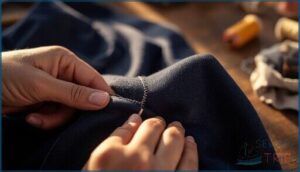
When running stitch can’t hold, backstitch gives you seam reinforcement you can trust. Overlap each pass by half—around 3–6 mm—and you’ve built a continuous line that laughs at stress. This hand sewing technique tackles high-tension spots like armholes and side seams where beginners need serious durability.
- Master stitch density: Closer spacing = unbreakable seams
- Thread selection matters: Polyester beats cotton for strength
- Control fabric tension: Keep it taut, never puckered
- Backstitch variations: Shorten for silk, lengthen for denim
- No gaps, no weakness: Your sewing techniques just leveled up
Whip Stitch for Edges
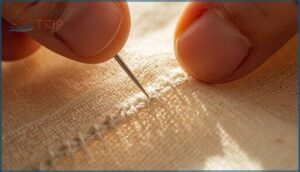
When edges need serious control, whip stitch locks fabric layers together while stopping fraying cold. Angle your needle through both edges, creating tight slanted wraps spaced 3–5 mm apart—closer for loose weaves, wider for felt.
This edge joining technique beats overcast stitch for seam security because each pass compresses fibers.
Perfect for linings, appliqués, and closing stuffed toys where your hand stitching sits right on the edge.
Blanket Stitch to Prevent Fraying
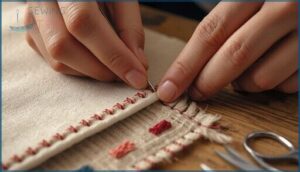
While whip stitch seals edges tight, blanket stitch turns fray prevention into a power move—reducing fraying by 70–80% while adding decorative edge finishing that screams craftsmanship. Work your needle through fabric 2–2.5 mm apart, catching loops perpendicular to the edge. Perfect stitch tension matters: too tight puckers, too loose gaps.
This hand sewing technique transforms raw edges into reinforced borders—your essential beginners guide to fabric selection and edge control.
- Cotton thread delivers reliable fray prevention for natural fabrics
- Polyester manages high-stress edges and repeated washing like a champion
- Fleece and synthetic weaves resist fraying naturally with this technique
- Consistent spacing (10–12 stitches per inch) maximizes durability
- Match thread choices to fabric weight for professional results
Ladder Stitch for Invisible Seams
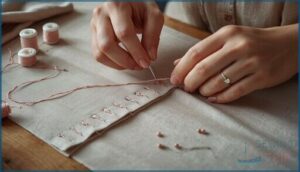
When blanket stitch guards edges, ladder stitch vanishes seams completely—your secret weapon for closing pillows, stuffed toys, and torn jeans without visible thread. This hand sewing technique uses tiny parallel bites on folded fabric edges, creating rungs that disappear when you tighten thread tension. Match thread color to fabric choice, space stitches 6mm apart, and pull gently every few passes for invisible seams that rival machine work.
Ladder stitch creates invisible seams by using tiny parallel bites on folded edges that disappear when you tighten the thread
Hand Sewing Tips for Beginners Guide: Start your ladder stitch inside the seam allowance so knots stay hidden. Practice on scrap fabric before tackling visible projects—accuracy beats speed. While backstitch wins for seam reinforcement under stress, ladder stitch delivers professional closures on stuffed items and repairs. Small, consistent stitches (10–12 per inch) prevent gapping and maintain durability through washing and handling.
| Fabric Type | Thread Choice | Stitch Spacing |
|---|---|---|
| Cotton/Natural | All-purpose cotton | 6mm for strength |
| Denim/Heavy | Polyester (durable) | 6mm, firm tension |
| Thin/Delicate | Fine matching thread | 3–5mm, gentle pull |
Step-by-Step Hand Sewing Techniques
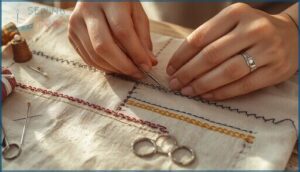
You’ve learned the stitches—now it’s time to put them to work. Mastering a few core techniques will give you the confidence to tackle real repairs and projects without second-guessing yourself.
Here’s what you need to know to start stitching like you mean it.
Threading a Needle and Knotting
Threading a needle doesn’t have to feel like defying physics. Start with a medium sharp around size 7–8—the eye’s easier to see, and you’ll master thread management without squinting yourself into a headache. Cut about fingertip-to-elbow length to prevent tangling.
For knot tying, try a quilter’s knot: wrap thread around your needle three times, slide it down, and pull tight.
Threading tools like needle threaders can save your sanity when eye visibility becomes a battle.
Starting and Ending a Seam
Seam security starts with intention—insert your needle twice through the same spot to lock the thread before you run that first stitch. Backstitch technique gives you strength at the start, while a simple running stitch works for lighter seams.
At the finish, weave back under nearby stitches, pull up a small loop, and knot it tight. That’s thread management that won’t quit on you.
Sewing on a Button
A loose button doesn’t stand a chance when you know the drill. Choose polyester thread for durability, cut about 18 inches, and double it for maximum hold.
- Mark your button placement with chalk—precision matters for a smooth close
- Use 8 passes through a two-hole button for reliable fabric support
- Insert a toothpick between button and fabric during shank creation
- Wrap thread around stitches underneath before knotting tight
That’s button sewing techniques that last.
Finishing Raw Edges
Raw edges fray like unraveling determination—but you can stop them cold. Overcasting stitches, placed 1–2 mm from the edge, cut fraying by 60–70% after five washes.
For lightweight fabrics, try French seams, or use a whip stitch and blanket stitch for quick control.
When machines are available, zigzag finishes work well, while bound edges and enclosed seams deliver pro-level durability through pure hand sewing skill.
Easy Hand Sewing Projects for Beginners
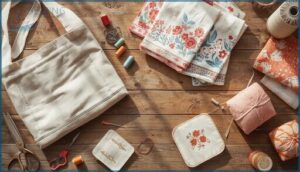
Now that you’ve got the stitches down, it’s time to put them to work on real projects. These beginner-friendly ideas will help you build confidence while creating things you’ll actually use.
Each one teaches you different skills without overwhelming you with complicated steps.
Simple Tote Bag
A tote bag is your declaration of independence—you don’t need a machine for this. Cut two rectangular fabric pieces for the body, then use a sturdy backstitch down the sides. Attach straps with reinforced whip stitch at the top.
Choose stable woven cotton for durability. Add bag linings if you want extra strength, or keep it raw and rebellious.
Fabric Coasters
Coasters are your perfect first rebellion against furniture rings—simple squares that prove you can master hand sewing without breaking a sweat. Cut two fabric pieces, layer them, then backstitch around three sides. Flip inside-out, blanket stitch the opening closed.
- Coaster Materials: Cotton works best for absorbing moisture and holding shape
- Edge Finishing: Blanket stitch with contrasting thread adds decorative rebellion
- Coaster Designs: Stack four identical squares for DIY home decor projects that showcase your fabric choices
This is power in portable form.
Drawstring Pouch
Once you’ve conquered coasters, level up to a drawstring pouch—your stash keeper for everything from craft supplies to rebellion snacks. Cut a rectangle, fold it in half, backstitch the sides, then fold over the top edge to create a channel for your cord.
Thread cord through using a safety pin—instant portable power. These sewing techniques and tips transform basic hand sewing into practical magic, no machine required.
| Pouch Materials | Why It Works |
|---|---|
| Cotton or canvas | Sturdy enough for daily use |
| Contrasting thread | Shows off your backstitch skills |
| Cord or ribbon | Creates functional bag closure |
| Optional lining | Adds professional pocket construction |
| Iron-on interfacing | Reinforces high-stress areas |
Patchwork Quilt Square
Patchwork squares let you play with color theory and block patterns without commitment—perfect practice for quilt design. Cut four equal fabric squares, arrange them using contrasting colors, then backstitch them together with precise seams.
Finish raw edges with a blanket stitch using fabric scissors for clean cuts. This hand sewing project builds your ladder stitch skills while creating something you’ll actually keep. These sewing tips turn scraps into portable art.
Basic Pillowcase
Once you’ve mastered squares, a pillowcase becomes your declaration of independence from store-bought basics. This beginner-friendly rectangle project teaches you fabric selection and sewing corners with confidence.
Hand sewing techniques make this portable, budget-proof craft yours to command.
- Cut two rectangles following pillowcase patterns
- Backstitch three sides using basic stitches
- Try decorative edging with blanket stitch
- Choose your closure methods—simple fold or envelope style
Frequently Asked Questions (FAQs)
How do I fix common hand sewing mistakes?
You’ll master sewing techniques fast when you fix tension control issues by shortening thread to 40–50 cm. Clip crooked seams and re-stitch those sections.
Error prevention beats fabric repair—press seams, use proper needles, and practice thread management consistently.
What tension should my hand stitches have?
Your hand stitches should lie flat without puckering—just tight enough to remove slack. Pull firmly but gently; fabric layers shouldn’t indent or gather.
Balanced hand tension prevents fabric distortion while maintaining strong seam integrity throughout your hand sewing projects.
Can I hand sew stretchy or knit fabrics?
You can absolutely hand sew knit fabrics, but stretch stitch techniques and elastic seam construction matter.
Choose ballpoint needles, polyester thread, and looser tension—tight stitches pop when knits stretch and recover during wear.
How do I transfer embroidery patterns to fabric?
You don’t need fancy gear to master embroidery patterns. Lightbox tracing, iron transfers, carbon paper, water soluble markers, and sticky stabilizers each work brilliantly—just test your method on scrap fabric first.
Whats the best way to store unfinished projects?
Store your unfinished hand sewing projects in clear containers or zipper bags—you’ll spot everything instantly.
Keep fabric storage dry, around 50% humidity levels, to avoid pests and protect your work-in-progress from damage.
Conclusion
You’ve got the needle. You’ve got the thread. You’ve got the stitches that hold fabric—and confidence—together.
This hand sewing for beginners guide didn’t just teach you technique; it handed you independence. No machine required. No waiting for repairs. No limits on where or when you create.
Start with a button, a hem, a single seam. Build from there. Every stitch you take is proof: you don’t need permission to make something lasting.
- https://www.arts.gov/sites/default/files/NationalReportforADPAccess-8-18-2023.pdf
- https://www.zippia.com/sewing-jobs/demographics/
- https://www.mordorintelligence.com/industry-reports/sewing-machines-market
- https://growthmarketreports.com/report/handheld-sewing-machine-market
- https://craftindustryalliance.org/pandemic-year-drives-popularity-of-hand-sewing/