This site is supported by our readers. We may earn a commission, at no cost to you, if you purchase through links.

A seam that puckers on silk but holds perfectly on denim isn’t a mystery—it’s a matter of stitch settings. The distance between each needle penetration and the horizontal spread of your zigzag pattern determine whether your fabric lies flat or bunches, whether your hem withstands years of wear or unravels after a few washes.
Adjustable stitch length and width give you precise control over these outcomes, transforming your machine from a one-trick device into a flexible tool that suits every fabric weight, thread type, and project purpose. Manual dials offer tactile feedback, while digital controls provide exact measurements down to the tenth of a millimeter.
Understanding how these adjustments work—and which settings match your material—means fewer seam failures, less wasted fabric, and consistent professional results whether you’re reinforcing workwear or adding decorative topstitching.
Table Of Contents
Key Takeaways
- Stitch length controls the distance between needle penetrations (typically 2.0-3.0mm for general seams), while stitch width adjusts the horizontal spread in zigzag patterns (0-6.0mm), directly affecting seam strength, fabric behavior, and whether your project puckers or lies flat.
- Matching stitch settings to fabric type prevents common failures—knits need longer lengths around 3.0mm to accommodate stretch, while delicate fabrics require narrower widths to avoid tearing, and heavy materials demand wider settings for durability.
- Manual dial controls offer tactile feedback for quick adjustments, whereas digital interfaces provide precise measurements down to tenths of a millimeter with programmable memory, so your choice depends on whether you prioritize mechanical simplicity or repeatable accuracy.
- Regular maintenance including needle replacement every 8-12 hours, lint removal, proper threading, and tension adjustments keeps your stitch settings performing consistently across projects and prevents skipped stitches, puckering, and fabric damage.
What is Adjustable Stitch Length and Width?
Before you can master stitch settings, you need to understand what you’re actually adjusting on your machine. Stitch length and width aren’t just numbers on a dial—they’re the foundation of every seam you sew, affecting everything from fabric handling to final appearance.
Let’s break down what these settings mean, how your machine controls them, and why getting them right matters for your projects.
Definition of Stitch Length and Width
Stitch length measures the distance between consecutive needle penetrations—usually 2.0 to 3.0 millimeters for general seams. Stitch width describes the horizontal spread in zigzag or decorative stitches, ranging from 0 millimeters (straight stitch) to about 6.0 millimeters.
Understanding these sewing machine settings gives you control over:
- Seam durability through adjusting stitch length basics
- Fabric interaction by modifying perforation density
- Stitch width control for edge finishing and decorative effects
How Adjustment Works on Sewing Machines
Your sewing machine calibration controls stitch adjustment techniques through two mechanisms. Mechanical cam systems translate dial turns into fixed steps, while electronic machines use microprocessors for smoother needle movement. The stitch length dial changes fabric feed distance; the stitch width control adjusts side-to-side needle movement.
To guarantee methodological rigor in scientific studies, like those on post retrieval auditing, is vital for accurate results.
| Adjustment Type | What It Controls |
|---|---|
| Stitch Length | Distance between needle penetrations |
| Stitch Width | Horizontal needle travel |
| Thread Tension | Upper thread tightness |
| Fabric Feed | Material advance rate |
| Stitch Mechanism | Combined length and width balance |
Modern machines integrate presser foot pressure with these settings, ensuring consistent stitch quality across projects.
Importance for Sewing Projects
Understanding adjustment controls matters because your seam quality depends on precise fabric compatibility. When you tailor stitch length and width properly, you prevent fraying on delicate materials and maintain stretch recovery in knits.
This stitch precision reduces rework, cutting down material waste. Mastering these stitch adjustment techniques for your sewing projects means consistent results every time—no more puckered seams or thread breaks disrupting your workflow.
Mastering stitch adjustments eliminates puckered seams and thread breaks, delivering consistent, professional results every time
How Stitch Length and Width Affect Sewing
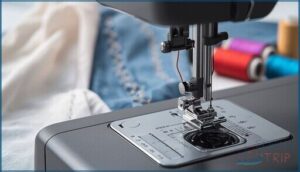
Adjusting your stitch length and width isn’t just about changing numbers on a dial—it directly shapes how your seams hold up, how your fabric behaves, and whether you’re creating something functional or decorative.
These settings work behind the scenes to determine if your project turns out professional or problematic. Let’s break down exactly how these adjustments affect your sewing in three critical ways.
Impact on Seam Strength and Durability
When you master stitch length and width adjustments, you’re directly controlling seam strength and durability. Longer stitches reduce seam creep under fabric tension, while shorter lengths boost stitch density for stronger bonds. Wider stitch width affects thread coverage in your seams, impacting overall seam integrity.
Getting these settings right prevents thread breakage and creates stress-resistant seams that pass any durability testing you throw at them.
Effects on Different Fabrics
Fabric weight changes everything regarding stitch settings. Knits need a longer stitch length—around 3.0 mm—to accommodate fabric stretch without breaking threads, while woven materials require shorter lengths to maintain seam integrity.
Lightweight fabrics demand careful thread tension and a smaller stitch width to prevent tearing, whereas heavy canvas thrives with wider settings that create the stitch density needed for bulletproof seams.
Role in Decorative Vs. Functional Stitches
Purpose shapes every adjustment you make. Decorative stitches prioritize stitch aesthetics and visibility, using shorter stitch length to maintain pattern integrity without straining fabric behavior. Functional straight stitches focus on seam strength, requiring adjusting stitch width and length to match thread choices and prevent unraveling.
- Decorative techniques rely on embroidery threads and stabilization for visual impact
- Structural seams need all-purpose thread selected for tensile strength and durability
- Weaving decorative and functional elements demands different needle sizes to balance complexity with fabric interaction
Comparing Adjustable Stitch Features on Machines
Not all sewing machines handle stitch adjustments the same way, and understanding these differences can save you time and frustration. Some models offer dial controls you turn by hand, while others use digital displays with push-button precision.
Let’s compare the key features so you can identify what matters most for your sewing needs.
Manual Vs. Digital Adjustment Controls

When you’re adjusting stitch length and width, control panel design matters more than you’d think. Manual dials give you direct, tactile feedback—turn a knob, feel the change, no electronic integration required.
Digital interfaces offer precision engineering with repeatable settings and user interface screens, but they add complexity to sewing machine operation.
Both systems handle stitch adjustments reliably; your choice depends on whether you prefer mechanical reliability or programmable control.
Range of Adjustment on Popular Models
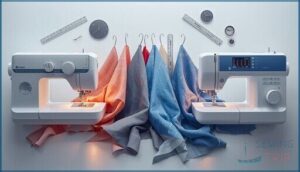
Most sewing machines offer stitch length adjustments from 0 to 4–6 mm, with stitch width ranging from 0 to 5–7 mm depending on the machine model. These adjustment ranges directly impact your sewing capabilities and fabric compatibility, especially when working with varied materials.
The Brother CS7000X provides 0–4 mm length and up to 7 mm width, while the Janome Magnolia 7318 extends to 6 mm length.
Key Features to Look for When Buying
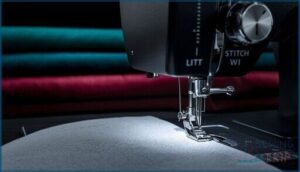
When you’re shopping for a sewing machine, the adjustment mechanism matters as much as the stitch settings themselves. Look for these core features:
- Stitch precision through clear, calibrated controls that deliver consistent stitch length and stitch width readings
- Machine durability with metal dials or reinforced digital interfaces that withstand frequent adjusting stitch operations
- User interface simplicity paired with fabric compatibility indicators for confident sewing machine operation
Choosing The Best Settings for Your Project
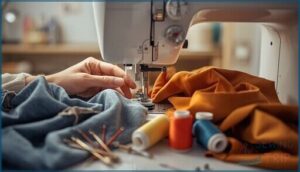
You can’t just spin the dials on your sewing machine and hope for the best. The right stitch settings depend on what you’re sewing, the thread you’re using, and even the needle in your machine.
Let’s break down how to match your settings to your project so you get professional results every time.
Matching Stitch Settings to Fabric Type
Your fabric selection directly drives stitch variation. Woven materials work best with shorter stitch lengths around 2.0–3.0 mm, while knits need 2.5–3.5 mm to handle fabric stretch without thread breaks.
Fabric density matters too—delicate fabrics require narrower stitch width to prevent fraying, whereas heavy fabric types demand wider settings for seam strength. Match these settings to thread tension for true sewing precision.
Adjusting for Thread Type and Needle Size
Thread choice and needle selection work hand-in-hand with fabric compatibility to achieve sewing precision. Match higher gauge needles to delicate fabrics for smooth penetration, and pair metallic threads with specialized needles to prevent snagging.
When you change needle size or thread type, you’ll need to retune stitch length, stitch width, and thread tension for stitch optimization—this quick adjustment keeps your seams consistent.
Recommended Settings for Common Projects
Now that you’ve fine-tuned for fabric choices and thread tensions, it’s time to nail down real-world stitch settings. For cotton garments, set stitch length at 2.2 mm and stitch width at 2.5 mm—this combination balances seam finishing with durability. Denim topstitching demands 3.0 mm on both scales for bold, even seams.
Project planning means testing stitch variations on scraps first, adjusting sewing techniques until your results match professional standards.
Troubleshooting Stitch Length and Width Issues

Even with the right settings dialed in, stitch problems can still pop up and throw your project off track. The good news is that most issues with stitch length and width have straightforward fixes once you know what to look for.
Let’s walk through the most common problems you’ll encounter and how to solve them quickly.
Fixing Uneven or Skipped Stitches
Consistency in stitch quality starts with proper needle alignment and thread tension. Re-thread your sewing machine completely, checking each guide for lint that creates friction.
Replace damaged needles immediately, matching needle type to your fabric—ballpoint for knits, sharp for wovens. Adjust thread quality to match your project, and maintain moderate sewing speed to prevent fabric shift that causes skipped stitches.
Preventing Fabric Damage and Puckering
Proper fabric tension prevents puckering before it starts. You’ll want to match your stitch length to fabric weight—shorter for delicate materials, longer for knits.
Here’s what makes the difference:
- Select ballpoint needles for knits to avoid snagging and laddering
- Use stabilizers under lightweight fabrics during seam finishing
- Adjust thread tension and presser foot pressure for balanced feeding
Test swatches reveal exactly what your fabric needs.
Maintenance Tips for Consistent Stitch Quality
Your machine’s precision depends on consistent upkeep. Start with machine cleaning to remove lint buildup that disrupts stitch formation. Replace needles every 8–12 hours of sewing—dull needles cause skipped stitches and puckering.
| Maintenance Task | Why It Matters |
|---|---|
| Needle replacement | Prevents skips and fabric damage |
| Thread tension checks | Ensures balanced, even stitches |
| Routine oiling | Reduces mechanical resistance |
Regular tension adjustments and proper fabric preparation keep your stitch settings performing flawlessly.
Frequently Asked Questions (FAQs)
Can stitch width be adjusted on vintage machines?
Yes, but with limits. Many vintage sewing machines allow stitch width adjustment through a function lever, generally offering fixed widths up to 5–7 millimeters for zigzag stitches when using compatible presser feet.
How does feed dog height affect stitch quality?
Feed Dog Adjustment directly controls Fabric Traction and Stitch Formation. Higher lift prevents skipped stitches on dense materials, while lower settings reduce puckering on delicates.
Proper Machine Calibration with Thread Tension ensures consistent Seam Regularity across projects.
What causes tension problems during width adjustments?
When you shift stitch width, thread misalignment around guides and the needle bar creates lateral tension variability.
Fabric interaction with feed dogs, improper machine calibration, and operator error compound the problem, disrupting balanced thread tension throughout your seam.
Do computerized machines remember custom stitch combinations?
Most modern computerized sewing machines let you save custom settings—stitch length, width, and thread tension—to memory slots.
Digital storage recalls your sequences instantly, though firmware updates occasionally improve memory capacity and stitch recall reliability.
When should you use zero stitch length?
You’ll use zero stitch length primarily to lock threads at seam starts and ends, preventing unraveling. It also secures high-stress joints and creates bar tacks, though you should avoid it on delicate fabrics.
Conclusion
Picture a seam lying perfectly flat, each stitch evenly spaced, the fabric gliding through without resistance—that’s the payoff when you master adjustable stitch length and width. You’ve learned how to match settings to fabric, troubleshoot common issues, and choose machines with the right controls.
Now you hold the blueprint for consistent, professional results. Dial in your settings with intention, test before committing, and watch every project—from hemming jeans to crafting heirloom quilts—transform under your confident hands.