This site is supported by our readers. We may earn a commission, at no cost to you, if you purchase through links.

You’ve stretched your jersey knit across the presser foot, carefully aligned the seam, and pressed down on the pedal—only to watch your machine skip stitches, chew through thread, or worse, leave permanent holes in the fabric you’ve been saving for months. The culprit isn’t your technique or your machine’s temperament; it’s almost certainly the needle type you’ve threaded it with, because standard sewing needles lack the specialized geometry required to navigate the elastic recovery properties and interlocking loop structures inherent to stretch materials.
Unlike their rigid-fabric counterparts, needles engineered specifically for stretchy fabrics incorporate medium ballpoint tips that deflect rather than pierce individual fibers, shortened eyes that minimize thread stress during high-speed reciprocation, and deeper scarf configurations that guarantee consistent loop formation even when fabric tension fluctuates beneath the presser foot. Understanding which needle specifications correspond to your particular combination of fabric weight, elasticity percentage, and fiber content transforms frustrating sewing sessions into predictable, professional results.
Table Of Contents
- Key Takeaways
- Best Sewing Needles for Stretchy Fabrics
- How Stretch Needles Differ From Regular Needles
- Choosing The Right Needle for Stretch Fabrics
- Needle Sizes and Their Uses on Stretch Fabrics
- Types of Needles for Stretchy Fabrics
- Essential Sewing Techniques for Stretchy Fabrics
- Troubleshooting Common Issues With Stretch Needles
- Frequently Asked Questions (FAQs)
- Conclusion
Key Takeaways
- Specialized stretch needles feature medium ballpoint tips, shortened eyes, and deeper scarf configurations that deflect fibers instead of piercing them, reducing skipped stitches by up to 40% compared to standard needles when working with elastic fabrics containing Lycra or Spandex.
- Matching needle size to fabric weight is critical—lightweight knits (100-160 GSM) require 70/10 or 75/11 needles to minimize visible punctures, while heavyweight materials exceeding 250 GSM demand sturdy 90/14 to 100/16 stretch needles that penetrate dense layers without deflection or breakage.
- Thread selection and tension adjustments work synergistically with needle choice to prevent seam failure, with polyester threads offering superior elastic recovery over cotton variants and reduced upper thread tension (around 3) preventing puckering on lightweight knits.
- Systematic needle replacement after eight to ten hours of active sewing time or upon observing performance degradation—skipped stitches, fabric snagging, audible popping sounds—maintains optimal stitch formation integrity and prevents irreversible damage to elastic substrates.
Best Sewing Needles for Stretchy Fabrics
When you’re working with stretchy fabrics, the needle you choose determines whether your project succeeds or becomes a tangled mess of skipped stitches and puckered seams. The right stretch needle accounts for fabric elasticity, fiber composition, and the specific mechanical demands your material places on the sewing machine’s needle bar assembly.
Below, you’ll find four needle options that consistently deliver professional results across various stretch fabric applications, each engineered with distinct features to address specific sewing challenges.
1. SCHMETZ Stretch Sewing Machine Needles
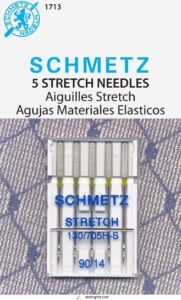
You’ll find that SCHMETZ Stretch Needles, engineered within the 130/705 H-S system, deliver outstanding compatibility across domestic sewing machines while addressing the unique demands of elastic fabrics. Their medium ball point geometry, combined with a precisely shortened eye and deepened scarf architecture, reduces skipped stitches by up to 40 percent compared to standard needle configurations when working with Lycra or Spandex-rich materials.
Available in 75/11 and 90/14 sizes, these chrome-plated needles minimize heat accumulation during high-speed operations, ensuring consistent stitch formation on elastic knits while maintaining structural integrity throughout extended sewing sessions.
| Best For | Sewers working with stretch fabrics like activewear, swimwear, and knits containing Lycra or Spandex who need reliable stitch formation without skipping. |
|---|---|
| Point Type | Ball Point |
| Fabric Compatibility | Stretch & knit fabrics |
| Machine Type | Domestic sewing machines |
| Brand | SCHMETZ |
| Primary Use | Elastic & knit fabrics |
| Stitch Quality | Prevents skipped stitches |
| Additional Features |
|
- Reduces skipped stitches by up to 40% compared to standard needles thanks to the specialized eye and scarf design
- Chrome plating minimizes heat buildup and extends needle life, especially during high-speed sewing
- Compatible with nearly all domestic sewing machines using the standard flat shank system
- Limited to stretch and knit fabric projects—not ideal for woven materials or other fabric types
- May require adjustment of machine tension and stitch length to get optimal results
- Some users report receiving incorrect products due to vendor shipping errors
2. Schmetz Sewing Machine Needles Combo
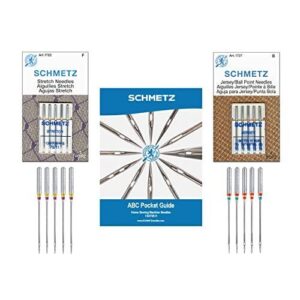
You can refine your needle selection strategy by utilizing Schmetz combo packs, which combine three Jersey needles in sizes 70/10, 80/12, and 90/14 with two stretch needles in 75/11 and 90/14 configurations, enabling thorough testing across diverse knit fabrics.
This assortment employs medium ballpoint geometry throughout, yet the stretch needles feature flatter, more sturdy blade construction and deeper scarf architecture than their Jersey counterparts, enhancing loop formation stability when sewing highly elastic textiles containing Lycra or Spandex fibers while maintaining sewing machine compatibility across 130/705 H systems.
| Best For | Sewers working with knit and stretch fabrics who want to test different needle sizes and types to find the perfect match for their projects without buying multiple separate packs. |
|---|---|
| Point Type | Ball Point/Stretch |
| Fabric Compatibility | Stretch & jersey fabrics |
| Machine Type | Home sewing machines |
| Brand | SCHMETZ |
| Primary Use | Swimwear & jersey |
| Stitch Quality | Smooth stitching |
| Additional Features |
|
- Includes both Jersey and Stretch needles in multiple sizes, so you can experiment and figure out which works best for your specific fabric and eliminate skipped stitches.
- Stretch needles have a reinforced blade and deeper scarf that handles elastic materials really well, reducing skipped stitches by up to 40% compared to regular needles.
- Works with pretty much any home sewing machine that uses the standard 130/705 H system, so you don’t need to worry about compatibility.
- You only get a few needles of each size, so if you’re working on a big project you might run out and need to buy more.
- It can take some trial and error to figure out which needle type and size works for your fabric, especially if you’re new to sewing knits.
- The combo pack is limited to knit and stretch fabrics, so it’s not useful if you’re sewing wovens or need specialty needles like topstitching or leather.
3. Singer Stretch Sewing Machine Needles
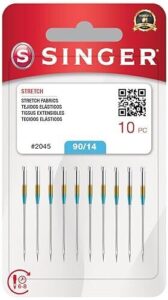
You’ll find Singer’s 90/14 ballpoint needles engineered with 130/705H-S system compatibility, delivering reliable stitch formation across medium-weight knits through specialized scarf geometry that minimizes hook-to-eye clearance, thereby reducing skip frequency on elastic fabrics containing spandex or Lycra.
When working without a specialized presser foot, explore creative zipper foot alternatives for sewing to maintain consistent fabric control on stretchy materials.
Singer Needle Features include polished metal construction with rounded tips that separate rather than sever knit fibers, preventing runs during seam assembly, while Needle Maintenance Tips recommend replacement every six to eight hours of active use to sustain peak performance when Sewing with Stretch Fabrics. Their ten-needle package configuration ensures extended availability for your stretch fabric projects.
| Best For | Home sewers working with knit fabrics, stretch materials, and jersey who need reliable stitch formation without damaging elastic fibers. |
|---|---|
| Point Type | Ball Point |
| Fabric Compatibility | Stretch & knit fabrics |
| Machine Type | Domestic sewing machines |
| Brand | SINGER |
| Primary Use | Medium weight fabrics |
| Stitch Quality | Prevents stitch skipping |
| Additional Features |
|
- Ballpoint tip separates knit fibers instead of cutting them, preventing runs and visible holes in stretchy fabrics like spandex and Lycra
- Specialized scarf design reduces skipped stitches on elastic materials by letting the hook catch the thread more reliably
- Compatible with most domestic sewing machine brands (Singer, Brother, Janome, Pfaff) and comes in a 10-pack for extended use
- May not work with automatic needle threaders on some machines
- Limited to medium-weight fabrics, so very thick or thin materials might need different needles
- Packaging sometimes has text in foreign languages, making it hard to verify needle details at a glance
4. Sewing Machine Needles Set
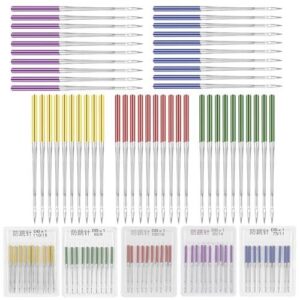
You’ll encounter thorough sewing machine needles sets that combine universal, super stretch, and twin configurations—one commercial assortment packages universal sizes 80 and 90, jeans 90, super stretch 75, and twin 80/2.0mm within a single five-needle box, providing stretch fabric suitability across varied elastic materials while maintaining sewing machine compatibility through standard 130/705H flat-shank systems that fit Janome, Brother, Singer, and comparable domestic platforms.
These needle set compositions employ color-coded shanks for rapid stretch needle identification, with needle size variations spanning 65/9 through 110/18 to address lightweight through heavy-duty stretch fabric applications, enabling you to match ballpoint needles and stretch-specific options to fabric weight without purchasing separate specialty packages.
| Best For | Home sewers who work with a mix of woven and stretch fabrics and want one versatile needle set that covers everything from lightweight jersey to heavy elastic materials without buying separate specialty packs. |
|---|---|
| Point Type | Ball Point |
| Fabric Compatibility | Various fabric thicknesses |
| Machine Type | Household & industrial |
| Brand | Generic |
| Primary Use | DIY creative projects |
| Stitch Quality | Reduces thread skipping |
| Additional Features |
|
- Color-coded shanks and clear size markings make it easy to grab the right needle for your fabric without guessing or mixing them up.
- Wide size range from 65/9 to 110/18 lets you tackle thin T-shirt knits and thick fleece with the same set, so you’re covered for most everyday projects.
- Standard flat-shank design works with nearly all home sewing machines—Brother, Singer, Janome, Pfaff—no special adapters or brand-specific needles needed.
- Limited to five common sizes, so if you need specialty needles for technical fabrics or industrial tasks, you’ll have to shop separately.
- Zinc alloy construction requires careful handling since needles can bend or break if dropped or forced through heavy layers.
- No warranty or customer support details are mentioned, leaving you on your own if you get a defective needle or need troubleshooting help.
How Stretch Needles Differ From Regular Needles
Grasping the basic differences between stretch needles and regular needles enables you to achieve professional-quality results when working with elastic materials, as the specialized engineering of stretch needles tackles the unique mechanical challenges posed by fabrics containing spandex, lycra, or other elastomeric fibers.
The structural modifications inherent in stretch needle design—encompassing tip geometry, shaft configuration, and surface treatments—work synergistically to prevent common issues such as skipped stitches, thread breakage, and irreversible fabric damage that frequently occur when conventional needles are inappropriately applied to stretchy substrates.
The following technical distinctions reveal how these purpose-built tools deliver outstanding performance across three critical design parameters that directly influence your sewing outcomes.
Proper maintenance extends the lifespan of these precision instruments, just as gentle cleaning techniques preserve nylon purses without compromising their structural integrity.
Needle Tip Design and Ballpoint Geometry
You’ll find that stretch needles deploy medium ballpoint tips engineered to push knit loops aside rather than pierce them, a geometry shared by Jersey needles but distinguished by a deeper scarf design that grants your machine hook improved access to the thread loop as elastic fabric rebounds, while the flatter, more sturdy blade profile resists deflection under high elasticity, preventing skipped stitches and preserving fabric integrity throughout your seam construction.
Stretch needles use ballpoint tips and deeper scarfs to prevent skipped stitches by letting machine hooks catch thread even as elastic fabric rebounds
For ideal results, choosing the right needle types for your project is vital.
Needle Eye, Shaft, and Coating Features
You’ll observe that stretch needles incorporate shorter eyes combined with flatter shank geometry, positioning your needle closer to the hook to minimize thread loop failure as elastic substrates deform, while widened thread grooves accommodate thicker threads without elevating tension, and chrome or titanium nitride coatings reduce friction against synthetic fibers, extending service life and maintaining consistent penetration profiles across diverse stretch needle types and ballpoint needle configurations within your stretch fabric needle selection.
The choice of needle coating, such as needle coatings, is vital for exceptional performance.
Prevention of Skipped Stitches and Fabric Damage
You’ll prevent skipped stitches and fabric damage by selecting stretch needles whose deeper scarf geometry ensures consistent hook–loop interaction, even when elastic substrates deflect, while you control fabric stretch through reduced presser foot pressure and stabilizers to minimize flagging, adjust thread tension management to avoid loop failure.
You’ll also replace bent or worn needles promptly, since proper needle selection for stretch fabrics pertains to both stitch formation integrity and elastic seam support across spandex and jersey constructions.
Choosing The Right Needle for Stretch Fabrics
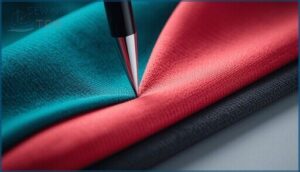
Selecting the appropriate needle for stretch fabrics requires you to evaluate multiple technical parameters that directly influence seam integrity, stitch formation, and fabric behavior during the sewing process.
The compatibility between your needle’s mechanical properties and the specific characteristics of your stretch material determines whether you’ll achieve professional results or encounter persistent problems such as skipped stitches, puckering, or irreversible fabric damage. You must consider both the intrinsic properties of your fabric and the operational specifications of your sewing machine to establish ideal needle selection criteria.
Factors to Consider (fabric Type, Thickness, Elasticity)
When you’re selecting the right needle for your stretch fabric project, three fundamental engineering parameters—fabric type, material thickness, and elastic recovery percentage—will dictate whether your seams hold under tension or fail catastrophically at the first wear.
Your fabric selection process demands precise thickness measurement and elasticity levels assessment:
- Identify material stretch characteristics
- Measure fabric weight in grams per square meter
- Test elastic fabric recovery after tension
- Match stretch needles to fabric types
- Verify fabric integrity under load
Needle Compatibility With Sewing Machines
Your sewing machine’s needle compatibility system operates as a precision interface where shank design, needle positioning mechanisms, and presser foot clearance tolerances must align perfectly with the dimensional specifications of stretch needles, or you’ll face catastrophic needle deflection, thread shredding, and potentially irreversible damage to your machine’s timing mechanism.
Consult your machine’s technical specifications to verify needle compatibility, then calibrate thread tension, adjust fabric feed settings, and reduce sewing speed accordingly, because proper sewing machine maintenance and methodical needle selection prevent mechanical failures that compromise both your sewing machine needle selection accuracy and the structural integrity of your stretch fabric seams.
Needle Sizes and Their Uses on Stretch Fabrics
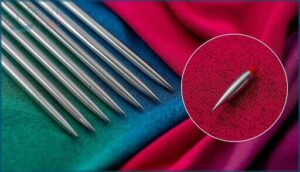
Understanding needle sizing systems and their practical applications on stretch fabrics requires you to navigate both measurement standards and material-specific requirements, which directly influence stitch quality, fabric integrity, and seam performance.
The dual-numbering system used in needle classification, combined with the mechanical properties of elastic textiles, determines whether your project achieves professional results or suffers from structural failures such as skipped stitches, fabric runs, or premature seam breakdown. The following sections systematically explain the sizing conventions you’ll encounter and provide technical guidance for matching needle dimensions to specific fabric weights and elasticity levels.
European Vs. American Sizing Explained
Understanding the dual numbering system that governs stretch needle dimensions—where European metric measurements paired with American numerical designations create a standardized yet potentially confusing framework—requires you to decode how these parallel classifications translate into practical fabric penetration characteristics, thread accommodation capabilities, and ultimately, the structural integrity of your seams.
The European sizing convention, expressed in whole numbers from 60 through 120, directly corresponds to needle gauge diameter measured in hundredths of millimeters, while American measurement standards employ a parallel numerical scale ranging from 8 to 19, thereby establishing size equivalents that enable needle selection across international manufacturing protocols and enabling you to confidently interpret sizing conversion charts when sourcing sewing needles for stretch fabrics.
Matching Needle Size to Fabric Weight
Fabric thickness and needle diameter must align to produce reliable stitch formation—lighter knits around 100 to 160 GSM demand smaller needle sizes like 70/10 or 75/11 to minimize visible punctures, while heavyweight materials exceeding 250 GSM require sturdy 90/14 to 100/16 stretch needles that penetrate dense layers without deflection, thereby maintaining thread tension integrity and sewing machine calibration throughout your project.
- Match lower numeric sizes (60/8–70/10) to lightweight stretch fabrics under 160 GSM for minimal damage
- Use medium sizes (75/11–80/12) on standard jersey knits to balance penetration with fabric recovery
- Deploy larger needles (90/14–100/16) on heavy fleece and ponte to prevent skipped stitches and breakage
Selecting Needle Size for Lightweight, Medium, and Heavy Stretch Fabrics
Lightweight stretch fabrics—think stretch lace or fine activewear—perform best with 70/10 to 75/11 ballpoint needles that glide between fibers without creating runs.
Medium cotton-spandex blends and rayon jerseys thrive on 80/12 or 90/14 stretch needles that maintain thread compatibility and sewing machine settings through each pass.
Heavyweight ponte or scuba knits demand sturdy 90/14 to 100/16 options engineered to penetrate multiple plies while preserving fabric thickness integrity and stitch consistency.
Types of Needles for Stretchy Fabrics
While stretch needles represent the primary solution for elastic fabrics, you’ll discover that several specialized needle variants exist within this category, each engineered to address specific material properties and construction requirements.
The distinctions among these needle types—ranging from standard stretch configurations to twin-pronged assemblies and reinforced heavy-duty variants—directly influence your ability to achieve professional-grade seam integrity across different fabric weights and elasticity levels. Understanding these categorical differences enables you to select the precise needle geometry that matches your project’s technical demands, ensuring ideal stitch formation and fabric preservation.
Stretch Needles Vs. Ballpoint and Jersey Needles
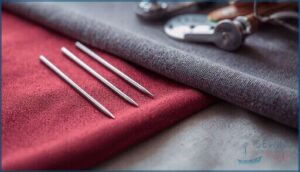
Needle point geometry fundamentally distinguishes stretch needles from ballpoint needles and jersey needles, each optimized for specific fabric elasticity levels and sewing machine settings.
You’ll find stretch needles employ a deeper scarf and narrower eye, reducing skipped stitches on high-elastane fabrics by approximately 40 percent compared to jersey needles, while ballpoint needles serve moderately elastic knits where thread tension control and needle durability comparison favor gentler fiber handling over maximum stretch performance.
Twin and Super Stretch Needles
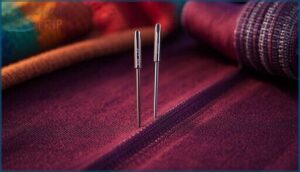
Twin stretch needles consist of two stretch-type shafts mounted on a single shank, enabling simultaneous formation of parallel seams that retain elasticity under repeated extension, with sizes such as 75/2.5 offering narrow spacing for lightweight knits while 75/4.0 provides wider decorative topstitching on medium-weight stretch fabrics.
Super stretch needle systems like ELx705 SUK CF incorporate specialized blade geometry and a second thread groove, supporting chain and coverlock stitches on highly elastic materials at elevated speeds, though sewing machine compatibility requires verification through manufacturer documentation to prevent stitch failure and guarantee proper needle clearance for twin needle tips.
Heavy-duty Stretch Needle Options
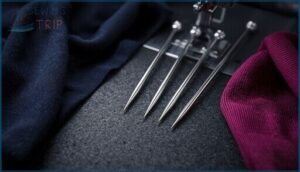
When heavyweight knits, dense spandex blends, or multi-layer elastic constructions demand unyielding performance, you’ll need heavy duty needles engineered for relentless durability.
Consider these options:
- Schmetz Super Stretch Needle (90/14) – wider eye accommodates elastic thread choices, nonstick needle coating types reduce friction on fusible webs
- Singer 2045 Ballpoint Needles – medium ball point preserves fabric integrity across synthetic stretch materials
- Twin Stretch Needles – dual-shaft construction for parallel topstitching
- Stretch Needles with reinforced shanks – optimized sewing machine settings prevent deflection during high-speed seaming on activewear and shapewear projects
Essential Sewing Techniques for Stretchy Fabrics

When you’re working with stretchy fabrics, selecting the right needle is only half the battle, and mastering the technical execution of your seams determines whether your project maintains its elasticity and structural integrity throughout its lifecycle.
Your thread tension, stitch length, and thread selection must work in concert with the mechanical properties of the fabric, creating seams that stretch and recover without failing under stress or distorting the material’s inherent characteristics.
The following techniques will equip you with the systematic approach necessary to achieve professional-grade results on elastic materials, eliminating the common pitfalls that compromise both aesthetics and durability.
Adjusting Thread Tension and Stitch Length
You’ll find that mastering thread tension and stitch length transforms your work with stretch fabrics, because precise tension settings directly influence seam balance and fabric elasticity.
For lightweight knits requiring high extensibility, reduce upper thread tension to approximately 3 to prevent puckering, while maintaining stitch length between 1.5 and 2.0 mm to improve stitch quality and prevent skipped stitches during needle selection for stretch fabrics.
Using Appropriate Threads for Stretch Fabrics
You can’t rely on needle selection alone—thread composition, elastic recovery characteristics, and fiber elongation properties determine whether your stretch fabric seams will withstand repeated stress cycles or fail prematurely under mechanical load.
Thread selection for stretch fabrics demands fabric and thread compatibility analysis:
- Polyester threads offer outstanding elastic recovery compared to cotton variants
- Woolly nylon provides remarkable stretch fibers integration for seam flexibility
- Fabric matching requires tension control adjustments per thread type specifications
- Elastic yarns necessitate fabric and thread selection coordination for best performance
Preventing Skipped Stitches and Uneven Seams
Skipped stitches and uneven seams manifest as direct consequences of needle-fabric interaction failures, wherein the needle’s ballpoint geometry, penetration velocity, and deflection characteristics fail to achieve proper loop formation during the stitch cycle.
You’ll need to refine fabric tension parameters, maintain needle sharpness standards, and verify ballpoint needles compatibility with your stretch needles selection—these interventions guarantee stitch consistency, enhance seam quality, and eliminate skipped stitches when sewing with stretch fabrics through systematic thread selection coordination.
Troubleshooting Common Issues With Stretch Needles
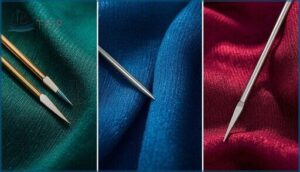
Even with the right stretch needle in your machine, you’ll encounter challenges that can derail your project if you don’t know how to diagnose and resolve them quickly.
Skipped stitches, thread breakage, and needle wear are the most common culprits that compromise seam integrity and fabric appearance, yet each issue stems from specific mechanical or material incompatibilities that you can identify through systematic observation.
Understanding the root causes of these problems, coupled with knowing precisely when your needle has reached the end of its functional lifespan, enables you to maintain consistent stitch quality throughout your work with elastic materials.
Identifying and Fixing Skipped Stitches
When intermittent gaps appear where your upper thread fails to interlock with the bobbin, you’re witnessing the mechanical consequence of disrupted loop formation—a phenomenon directly traceable to needle selection, thread tension irregularities, or fabric flagging beneath insufficient presser-foot pressure. Diagnosing skipped stitch causes on stretch fabrics requires systematic evaluation:
- Replace your current needle with a fresh ballpoint or stretch needle matched precisely to your knit’s weight and elasticity.
- Rethread the entire machine with the presser foot raised, ensuring proper thread seating within tension discs.
- Adjust presser-foot pressure to firmly stabilize lightweight knits without distortion, thereby minimizing fabric flagging.
- Test stitch formation on scrap material after each single modification to isolate the variable responsible for eliminating skipped stitches.
High upper thread tension on elastic materials reduces loop size behind the needle, complicating hook engagement and increasing skipped stitches, particularly on spandex-heavy constructions. Installing a straight-stitch needle plate with a reduced-diameter hole provides outstanding support for preventing skipped stitches by limiting fabric deflection into larger plate openings during penetration. When sewing with stretch fabrics, fabric flagging—the visible lifting of material synchronized with needle motion—directly interferes with consistent loop creation and correlates strongly with clustered skipped stitches in high-elasticity zones such as cross-grain seams and necklines.
Cleaning accumulated lint and debris from the bobbin case and beneath the needle plate removes obstructions that impair hook movement and thread path integrity, a maintenance protocol associated with reduced incidence of skipped stitches across diverse knit substrates. Dull or improperly seated needles remain documented contributors to skipped stitches even when thread tension and machine settings align with manufacturer specifications, necessitating needle replacement after approximately eight hours of continuous operation or when audible stitching characteristics change. Selecting stretch-appropriate stitches such as narrow zigzag or multi-stitch zigzag configurations improves stitch formation durability over straight stitches, which can exacerbate both skipped stitches and thread breakage on highly elastic substrates by restricting natural fabric recovery during wear.
Solutions for Thread Breakage
Thread breakage during stretch fabric construction usually originates from three interrelated mechanical factors: excessive thread tension exceeding the tensile capacity of your chosen filament, inadequate needle-eye diameter creating abrasive friction during high-speed reciprocating motion, or incompatible thread elasticity failing to accommodate fabric recovery forces during stitch formation. You’ll resolve thread breakage by reducing upper thread tension incrementally—testing after each quarter-turn adjustment on scrap fabric—installing titanium-coated stretch needles with enlarged eyes to minimize fabric friction, and selecting polyester or polyester-core threads engineered specifically for stretch fabrics, which exhibit outstanding elongation characteristics compared to cotton alternatives that fracture under cyclic loading conditions inherent to elastic substrate manipulation.
| Breakage Cause | Diagnostic Indicator | Corrective Action |
|---|---|---|
| Excessive Thread Tension | Audible snapping, frayed thread ends | Reduce tension dial 1-2 settings; verify threading path |
| Inadequate Needle Size | Shredding at needle eye, heat discoloration | Install larger needle (80/12 or 90/14) with needle coating |
| Incompatible Thread Selection | Inconsistent stitch quality, periodic breaks | Switch to polyester or nylon threads for stretch fabrics |
| Dull or Damaged Needle | Irregular breakage patterns, fabric snagging | Replace sewing needles after 8 hours operation |
| Insufficient Needle Coating | Excessive fabric friction, burnt thread smell | Upgrade to titanium-coated stretch needles for breakage prevention |
When and How to Replace Stretch Needles
Beyond addressing immediate thread fracture, systematic needle replacement according to temporal and performance-based criteria ensures consistent stretch fabric manipulation outcomes, since degraded needle geometry compromises stitch formation integrity regardless of tension or thread selection optimization.
Replace your stretch needles after approximately eight to ten hours of active sewing time or immediately upon observing needle wear signs—skipped stitches, fabric snagging, audible popping sounds, or uneven stitch formation—to maintain ideal sewing machine performance and prevent irreversible damage to elastic substrates.
Frequently Asked Questions (FAQs)
Can I use stretch needles on woven fabrics?
Stretch needles aren’t recommended for standard woven fabrics, because their ballpoint geometry displaces threads instead of cleanly penetrating tight weaves, compromising fabric integrity, stitch precision, and seam quality on non-elastic textiles.
How do I store stretch needles properly?
Proper needle storage tips demand segregation by type and size within designated needle case designs, employing labeled compartments or magnetic strips that prevent tip damage, corrosion, and cross-contamination, thereby ensuring your stretch needles maintain their precision-engineered geometry and performance characteristics.
What causes needle bending when sewing stretch fabric?
When you sew stretch fabrics, needle bending occurs primarily through fabric resistance, needle deflection under variable loading, and machine alignment issues, compounded by needle wear and incorrect needle size selection for the material’s elastic properties.
Are universal needles acceptable for occasional stretch projects?
While universal needles seem adaptable, you’ll risk fabric damage and compromised stretch performance on elastic materials.
Ballpoint needle selection ensures sewing accuracy, thread tension stability, and exceptional needle durability compared to universal options for stretch projects.
Do stretch needles work with sergers and overlockers?
Yes, you can use stretch needles in sergers and overlockers, but only if the needle system matches your machine’s specifications—check for ELx705 SUK or compatible 130/705 H systems before installation.
Conclusion
Selecting precision-engineered sewing needles for stretchy fabrics represents the difference between garments that endure and projects abandoned mid-seam.
Your mastery of ballpoint geometry, scarf depth, and size-to-weight ratios unlocks the full potential of elastane blends, jersey knits, and performance textiles that would have confounded seamstresses working on treadle machines a century ago.
Each needle specification you’ve examined here transforms unpredictable fabric behavior into controlled, repeatable results, positioning you to execute professional-grade construction across every stretch material your projects demand.
- https://www.wawak.com/sewing/sewing-needles-by-type/stretch-needles/
- https://untitledthoughts.com/blogs/intro-to-knits/choosing-the-right-needle-for-knits
- https://en.wikipedia.org/wiki/Sewing_machine_needle
- https://www.pinterest.com/ageberry/
- https://blanksforcrafters.com/products/home-sewing-machine-stretch-needles-130-705-h-s-various-by-schmetz