This site is supported by our readers. We may earn a commission, at no cost to you, if you purchase through links.
Your first hand-sewn button might wobble loose after two wears, or that quick hem repair could unravel before you leave the house. These frustrating moments don’t mean you’re bad at sewing—they usually mean you’re using the wrong stitch for the job.
Mastering just five basic hand stitches transforms you from someone who “can’t sew” into someone who fixes, creates, and customizes with confidence. Each stitch fulfills a specific purpose, and once you know which one to reach for, you’ll stop dreading those wardrobe emergencies and start seeing possibilities everywhere.
The techniques take minutes to learn but stick with you for life, turning needle and thread into tools you actually know how to wield.
Table Of Contents
Key Takeaways
- Mastering five basic hand stitches—running stitch, back stitch, basting stitch, whip stitch, and overcast stitch—transforms you from helpless to capable, turning wardrobe emergencies into quick five-minute fixes you can handle with confidence.
- The right tools matter more than quantity: match your needle type to your fabric weight, choose thread that complements your material (cotton for natural fibers, polyester for synthetics), and grab a thimble, sharp scissors, and needle threader to make stitching smooth instead of frustrating.
- Even tension and consistent stitch length separate amateur work from professional-looking seams—hold fabric flat, pull thread in one steady motion, and practice with visual guides until muscle memory takes over.
- Hand sewing isn’t a lost art or temporary skill—it’s permanent capability that puts you in control of your clothes, letting you repair, customize, and create instead of discarding or depending on others.
Essential Tools for Easy Hand Stitching
You don’t need a mountain of supplies to start hand sewing—just a few basic tools that’ll make your stitching smoother and more enjoyable.
If you’re just getting started, this hand sewing guide for beginners walks you through exactly what you need and how to use it.
Getting the right needles, thread, and accessories sets you up for success from your very first stitch. Let’s walk through what you actually need in your beginner toolkit.
A good beginner sewing accessories kit includes basics like pins, scissors, a seam ripper, and a measuring tape to round out your essentials.
Choosing The Right Hand Sewing Needles
The right sewing needle transforms hand sewing for beginners from frustrating to enjoyable. Your needle material, eye size, and shaft design must match your fabric type and thread compatibility.
Before you start hand sewing, review essential sewing machine pattern tips to understand how needle selection applies across different sewing techniques.
Selecting the correct needle becomes easier when you understand the different types of hand sewing needles and their specific functions.
- Sharps needles suit most woven fabrics with their medium length and round eye
- Betweens excel at precise stitches on lighter materials
- Embroidery needles feature larger oval eyes for decorative threads
- Ball point needles prevent snags in knit fabrics
- Beading needles slip through tiny beads effortlessly
Selecting Thread for Hand Stitches
Thread choices shape how your hand stitching looks and performs. Cotton thread works beautifully on natural fabrics like linen, giving you soft seams and clear detail.
For synthetic blends or stretchy fabrics, polyester thread offers durability and flexibility that helps you achieve professional results in your sewing projects.
Polyester adds strength without sagging—perfect for basic sewing stitches on woven materials. Match your thread color one shade darker than patterned fabrics for flawless blending.
For weaving delicate projects, silk thread creates an elegant finish you’ll love. It’s important to understand how thread selection affects quality since the type you use directly impacts your project’s durability and appearance.
Must-Have Accessories (Thimble, Scissors, Needle Threader)
Beyond thread and needle, three simple accessories transform hand sewing from frustrating to fun. A thimble shields your fingertip from punctures—look for brass, steel, or padded options that fit snugly.
Sharp scissors with ergonomic grips cut cleanly without fraying fabric. A needle threader‘s wire loop guides thread through tiny eyes in seconds, saving your patience and eyesight every single time.
How to Thread a Needle and Start Stitching
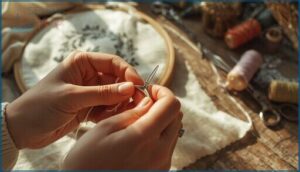
Before you can create beautiful stitches, you’ve got to master the basics—and that means getting your thread through that tiny needle eye without losing your mind. It’s one of those tasks that seems impossible until you learn the right technique, and then it becomes second nature.
Let’s walk through threading your needle, tying a solid starting knot, and prepping your fabric so you’re ready to stitch with confidence.
Threading Techniques for Beginners
Getting thread through that tiny needle eye doesn’t have to feel like threading a noodle through a keyhole. Here’s how to master hand threading:
- Cut your thread from palm to elbow—long enough to work without constant rethreading
- Trim the end cleanly with sharp scissors so fibers don’t fray
- Try sliding the needle onto a still thread instead of pushing thread toward the eye
- Use a wire loop needle threader if your hands shake or eyes strain
Tying Secure Knots
Once you’ve conquered threading, lock down your stitches with a solid starting knot. A simple overhand knot at the thread end stops your first stitch from ghosting through the fabric—just loop and pull tight about half a centimeter from the edge.
For a complete walkthrough of hand sewing fundamentals, including stitch spacing and tension control, this guide covers everything beginners need to master the basics.
| Knot Types | When to Use |
|---|---|
| Single overhand | Cotton thread on medium fabrics |
| Double knot | Slippery polyester thread |
| Quilter’s knot | Fine work requiring small, buried knots |
For slippery polyester thread, stack two overhand knots for extra security. Position your starting knot close to the fabric edge but not right on it—fraying edges can let even tight knots slip free. Test tension control by tugging gently after your first few running stitch or back stitch passes.
Preparing Fabric for Hand Sewing
Before any hand sewing begins, prewash your fabric in the same cycle you’ll use for the finished item—this flushes out shrinkage and chemicals that can warp seams later.
Press flat, then align the grain by matching selvedges so your basic sewing stitches sit straight. Finish raw edges with pinking shears or a quick overcast stitch for fray prevention and fabric stabilization during stitching.
Basic Hand Stitches Everyone Should Learn
Think of these five stitches as your foundation—the building blocks you’ll use again and again, whether you’re mending jeans or stitching a quilt. Each one fulfills a specific purpose, and once you’ve got them down, you’ll have the skills to tackle nearly any hand-sewing project that comes your way.
Let’s walk through each stitch step by step so you can practice and master them at your own pace.
Running Stitch Step-by-Step
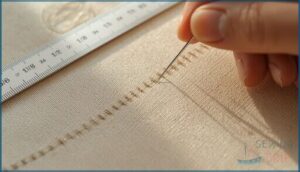
Think of the running stitch as your gateway into hand sewing—it’s forgiving, quick, and surprisingly adaptable for basic sewing stitches.
The running stitch is your forgiving gateway into hand sewing—quick, adaptable, and perfect for beginners
Here’s how to master it:
- Mark a straight guideline on your fabric choice with chalk or pen
- Bring your needle up at point A, down at point B, creating even intervals
- Keep stitch length around 1/8 inch for sewing for beginners
- Maintain consistent thread tension without pulling too tight
Adjust your sewing speed and try stitch variations as confidence builds.
Back Stitch for Strong Seams
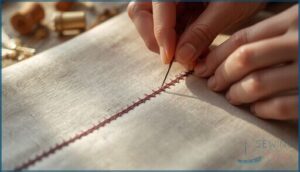
When you need seam reinforcement that won’t pop under pressure, back stitch is your go-to hand sewing technique. Bring your needle up one stitch length ahead, then insert it back into the end of your previous stitch—that overlap creates serious stitch security.
Aim for 1/8 to 1/4 inch stitch length depending on fabric selection, and keep your thread tension firm but not strangling the material.
Basting Stitch for Temporary Holds
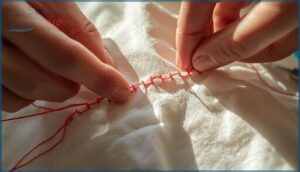
Basting Stitch gives you the ultimate fabric control without commitment. These long running stitches hold layers together while you test fit or adjust before permanent sewing.
For hand basting, weave your needle through with 1/4 to 1/2 inch stitches using contrasting thread.
The beauty of basting techniques? Stitch removal takes seconds when you’re ready, making this temporary hold perfect for sewing basics like fitting and alignment.
Whip Stitch for Edges
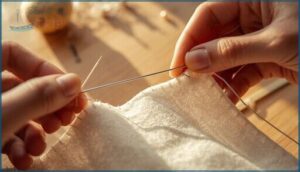
When you’re closing stuffed toys or joining felt pieces, whip stitch becomes your go-to edge finishing technique. Thread your needle from the back, wrap over both fabric edges about 1/8 inch apart, and repeat—creating those diagonal lines that secure seams beautifully.
Keep your stitch tension snug but relaxed to prevent puckering, and you’ll master this basic hand sewing technique in minutes.
Overcast Stitch to Prevent Fraying
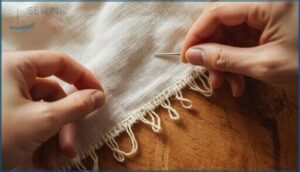
The overcast stitch wraps thread around raw fabric edges at slight diagonals, catching loose threads before they escape. Start about 1/8 inch from the edge, working right to left with consistent spacing—closer stitches (roughly 1/8 to 1/4 inch apart) for high-fraying fabrics like loosely woven cottons, wider for stable materials.
Your sewing needle creates protective loops that redirect wear from fabric to thread, keeping seam allowances tidy inside unlined garments.
Decorative and Useful Hand Stitches
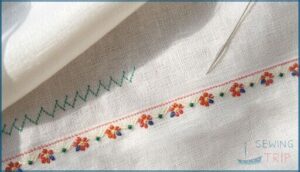
Once you’ve mastered the basics, you’re ready to expand your stitching toolkit with techniques that do double duty—they’re both beautiful and practical.
These stitches add personality to your projects while solving real sewing challenges like creating invisible seams or finishing edges with flair.
Let’s explore four adaptable stitches that’ll give you more creative freedom and control over your handwork.
Blanket Stitch for Edging
You’ll love blanket stitch for edge finishing—it creates those neat vertical legs along fabric borders while looking decorative and professional. This hand sewing technique works beautifully on felt, fleece, or woven edges.
Start about 5 millimeters from the edge, keeping your stitch variations even. Corner techniques require extra stitches at pivot points, and edging patterns stay consistent when you maintain steady spacing throughout your basic sewing skills practice.
Chain Stitch for Embellishments
Chain stitch creates linked loops that sit raised on fabric—perfect for outlining shapes or filling designs. Start by bringing your needle up, then insert it almost at the same spot while catching the thread loop beneath. Pull gently to form each chain link.
This embroidery favorite works beautifully on cotton or linen with perle cotton thread, letting you trace curves and add texture to any project.
Slip Stitch for Invisible Seams
When you need invisible hemming or seam finishing that truly disappears, slip stitch is your secret weapon. This hand sewing technique catches just one or two fabric threads before sliding through the fold, creating stitch camouflage even on dress pants and curtains.
- Match thread color to fabric for the best edge binding results
- Space stitches 6–10 millimeters apart to prevent puckering
- Use gentle tension so the seam lies flat without ridges
- Pick fabric selection carefully—slip stitch shines on woven materials
French Knot for Texture
Want to add charming dimension to your embroidery? The French knot creates raised bumps that bring flower centers and berries to life.
Wrap thread around your needle once or twice—more wraps mean bigger, bolder texture—then insert it close to where you started.
These tiny dimensional stitching gems cluster beautifully for embroidery effects that practically beg to be touched.
Tips to Improve Your Hand Stitching Skills
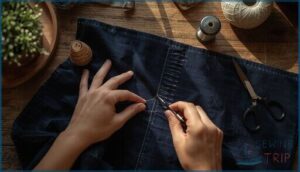
You’ve learned the stitches—now let’s talk about making them look clean and professional. Even experienced sewers deal with tangled thread and uneven tension, so don’t worry if you’re not perfect right away.
Here are the key techniques that’ll take your hand sewing from shaky beginner work to something you’re actually proud to show off.
Maintaining Even Tension
Keeping your hand stitching smooth comes down to mastering thread control and fabric tension. Hold the fabric flat in your non-dominant hand, which stops tight spots or loose loops from sneaking into your seam.
Pull the thread through in one steady motion rather than quick tugs—this keeps your backstitch looking neat. Your hand position matters too: rest on the table so movements stay controlled and tension stays even.
Preventing Tangled Threads
Thread conditioning with beeswax cuts down on tangles while you stitch. Here’s your tangle prevention toolkit:
- Ideal length: Cut thread between 18 and 24 inches—fingertip to elbow works perfectly.
- Needle selection: Match the eye size to your thread weight for smooth pulling.
- Thread management: Let your needle hang freely every few stitches to untwist.
- Condition first: Run thread through beeswax twice before threading.
- Smart threading: Use the spool end, not the freshly cut end.
Practicing Consistent Stitch Length
Mastering even stitches starts with visual guides—try marking dots 3 to 5 millimeters apart along your seam line. Your finger placement against the fabric edge creates a natural ruler for running stitches and backstitch.
Slow your pace, control thread tension to keep it just taut, not tight. Daily practice on scrap fabric builds muscle memory fast, turning wobbly hand sewing into precise, confident basic stitches within weeks.
Troubleshooting Common Hand Sewing Problems
When your thread breaks mid-stitch, you’re likely using low-quality thread or a needle that’s too small for the fabric weight. Fabric puckering? That’s tension problems—loosen your grip and let the fabric rest naturally. Needle damage shows up as skipped stitches, so swap bent needles immediately.
These hand sewing techniques for beginners turn frustrating bobbin issues into confident sewing tips and tricks, building your hand stitches into a reliable sewing stitches guide.
Frequently Asked Questions (FAQs)
What’s the easiest stitch to learn?
The running stitch takes the crown for beginners—just weave your needle in and out along a straight line with even spacing.
You’ll master it in minutes and use it everywhere.
Is hand stitching good for beginners?
Yes—hand sewing for beginners builds fine motor skills and hand eye coordination while teaching basic stitching techniques. You’ll improve stitch quality through skill building, all without expensive equipment.
How do I transfer embroidery patterns onto fabric?
You’ll want to trace your design using a lightbox or sunny window, transfer it with carbon paper, or try iron-on transfer pens—just prewash your fabric first and test on scraps before committing.
What stitch is best for sewing on buttons?
For flat buttons, use a parallel stitch or cross stitch pattern with three to five passes through the holes. Always create a thread shank by wrapping threads beneath the button for smoother fastening.
Can hand stitches replace machine sewing for garments?
Think of hand sewing as the steady tortoise to the machine’s hare—you can absolutely hand stitch entire garments, though it demands patience, careful fabric choice, and realistic expectations about seam durability and construction time.
How do I fix mistakes in hand stitching?
Fixing errors starts with a seam ripper or small scissors to unpick stitches carefully. Work from the wrong side, then press the fabric before repairing with matching thread using back stitch or slip stitch.
Whats the difference between embroidery and hand sewing?
Hand sewing builds seams and hems that hold garments together, while embroidery decorates fabric surfaces with visible designs.
Sewing prioritizes hidden strength; embroidery showcases texture, color, and artistic patterns on top.
Conclusion
Some believe hand sewing died with grandma’s generation, but the truth is simpler: these easy hand stitches to learn never went anywhere—they just waited for you to pick up the needle. What felt impossible last week becomes muscle memory by next month.
Your wardrobe stops controlling you when loose buttons and torn hems turn into five-minute fixes instead of donation-pile casualties. That’s not nostalgia talking—that’s capability you’ll carry forever.
- https://www.youtube.com/playlist?list=PL2vt_TPKQbZo5gs9BxIXkgCyGFfwHpose
- https://www.instagram.com/p/BDlH0hivT-X/?taken-by=redtedart
- https://www.redtedart.com/basic-hand-stitches-beginners/
- https://happiestcamper.com/free-sewing-practice-sheets-to-help-you-become-a-pro-sewist/
- https://www.instructables.com/Threading-Needles-and-Knotting-Thread/