This site is supported by our readers. We may earn a commission, at no cost to you, if you purchase through links.
Your first knitting project probably looked a little wonky. Mine did too—uneven stitches, mysterious holes, and edges that resembled a mountain range more than a scarf. But here’s the thing: those wobbly beginnings don’t mean you lack knitting talent. They mean you haven’t learned how different stitches behave yet.
Each basic pattern has its own rhythm and personality. Garter stitch forgives nearly every mistake while stockinette reveals every tension hiccup. Once you understand what makes each stitch tick, you’ll stop fighting your needles and start enjoying the process. The secret isn’t flawlessness—it’s knowing which patterns work best as you build your skills.
Table Of Contents
Key Takeaways
- Garter stitch is the most forgiving pattern for beginners because it hides tension mistakes and uses only knit stitches in every row, making it the perfect foundation for building confidence.
- Your workspace setup directly impacts learning success—proper lighting (450-800 lumens), ergonomic seating, and organized yarn storage prevent fatigue and let you practice longer.
- Stockinette stitch creates professional-looking fabric by alternating knit rows on the right side with purl rows on the wrong side, though it requires consistent tension to avoid curling edges.
- Joining knitting communities provides essential support through live demonstrations at local meetups and 24/7 troubleshooting help in online forums, which accelerates skill development and reduces frustration.
Essential Tools for Learning Stitch Patterns
You can’t build a house without a hammer, and you can’t knit beautiful stitches without the right tools.
If you’re picking up a needle for the first time, this beginner’s guide to sewing walks you through the essentials step by step.
Just as a hammer is essential for building a house, the right tools are essential for knitting beautiful stitches
Getting started doesn’t mean buying everything at the craft store. Let’s look at the three essentials that’ll set you up for success.
Choosing The Right Knitting Needles
Your first needles shape every stitch you’ll master. Beginner knitters need tools that feel right and support learning without frustration. Here’s what matters most:
- Needle material like bamboo grips yarn gently and helps you control stitches
- Ergonomic grips reduce hand fatigue during practice sessions
- Circular options work for flat and round projects as you grow
- Needle sizes around US 6-9 pair perfectly with beginner-friendly yarns
Choose interchangeable tips for maximum flexibility. Beginners can learn more about for better project results.
Selecting Suitable Yarn for Beginners
Once you’ve got needles sorted, yarn makes or breaks your learning curve. Medium worsted weight yarn is your best friend—it’s forgiving and shows every stitch clearly.
Choose smooth wool blends or acrylic in light solid colors so you can spot mistakes fast. Budget-friendly yarns work perfectly for practice. Avoid fuzzy or dark options that hide your hard work.
For a thorough overview of different yarn types for beginners, check out expert advice before making your choice.
Setting Up a Comfortable Workspace
Your yarn and needles won’t help much if you’re hunched over a wobbly table. An ergonomic setup keeps you knitting longer without aches or eye strain.
Here’s what matters for workspace organization and comfort accessories:
- Position a desk lamp at 450 to 800 lumens for clear stitch visibility.
- Adjust your chair to 90 degrees at the knees for proper posture.
- Keep a yarn bowl nearby to prevent tangling.
- Maintain room temperature between 68 and 72 degrees.
- Use air quality control with adequate ventilation.
Mastering Basic Knitting Stitches
You’re ready to learn the building blocks of knitting. These four stitches form the foundation for almost every pattern you’ll encounter.
If you’re also curious about hand embroidery, check out these simple hand embroidery stitches that share similar techniques and precision.
Master these basics and you’ll have the skills to tackle countless beautiful projects.
Garter Stitch Step-by-step Tutorial
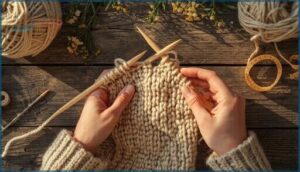
You’ll love how garter stitch becomes your foundation for all future knit stitch patterns. This knitting for beginners tutorial teaches you to simply knit every row. Turn your work after each row and repeat. That’s the whole technique!
Here’s your quick reference for garter stitch basics:
| Step | Action | Key Tip |
|---|---|---|
| Cast On | Use long tail method | Keep tension comfortable |
| Row 1 | Knit all stitches | Maintain even knitting tension |
| Turn Work | Flip fabric over | Don’t purl any rows |
| Repeat | Knit every row | Count ridges for progress |
Your garter fabric will show identical ridges on both sides and lie perfectly flat without curling.
Stockinette Stitch Instructions
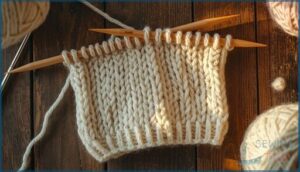
Stockinette stitch creates that gorgeous smooth fabric you see on most sweaters. Alternate knit rows on the right side with purl rows on the wrong side. This classic knit purl pattern will become your go-to technique.
Master stockinette fabric with these essential steps:
- Cast on an even number of stitches for symmetrical edges
- Knit every stitch on right side rows to form smooth V shapes
- Purl every stitch on wrong side rows for bumpy texture
- Practice stitch counting regularly to catch skipped stitches early
- Use blocking techniques after finishing to reduce edge curling
Your stockinette stitch will show beautiful smooth knit stitch patterns on one side and horizontal ridges on the other. Keep your tension consistent across both sides for professional results. This foundational technique paves the way for countless knitting tutorials and sophisticated stitch patterns and techniques you’ll explore next!
1×1 and 2×2 Rib Stitch Techniques
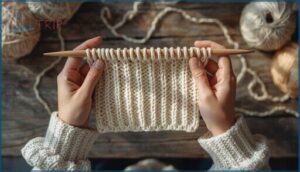
Ribbing creates that stretchy fabric perfect for cuffs and hems. You’ll alternate knit and purl stitches in the same row to form elastic columns. This knitting technique gives you complete elasticity control through simple stitch repeats.
| Pattern | Setup | Best For |
|---|---|---|
| 1×1 Rib | K1, P1 across | Snug cuffs |
| 2×2 Rib | K2, P2 across | Wider bands |
| Both Ribs | Even stitches | Flat knitting |
Master these rib stitch basics and you’ll gain essential knit purl patterns. Keep your tension loose for maximum stretch. These ribbing tips transform beginner stitch patterns into professional-looking knitting for beginners projects!
Seed Stitch Pattern Guide
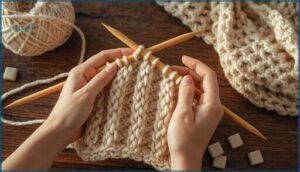
Bumpy texture on both sides makes seed stitch a reversible winner. You alternate knit and purl stitches in each row to create those yummy raised dots. This stitch pattern hides tension wobbles perfectly for beginner-friendly scarves and washcloths.
- Cast on an even number of stitches for balanced fabric texture
- Row 1: Knit one, purl one across the entire row
- Row 2: Purl one, knit one to offset the stitch repeats
- Keep your tension control relaxed for uniform seed stitch basics
- Choose smooth yarn choices with good stitch definition for clarity
Practicing Intermediate Stitch Patterns
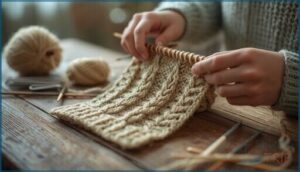
You’ve got the basics down, and now it’s time to level up your skills.
Intermediate patterns add beautiful texture and visual interest to your knitting projects. Let’s explore three outstanding stitches that’ll make your work look more polished and professional.
Andalusian Stitch for Added Texture
You’re ready to add some yummy dimension to your Knitting Techniques with the Andalusian Stitch. This intermediate Stitch Pattern creates raised bumps on a smooth background.
It uses a four-row repeat in Textile Arts that combines Knit Stitch and purl for perfect Texture Elements. Try it with smooth DK yarn for scarves or blankets.
Hand wash your finished Project Ideas gently, following basic Care Tips for lasting beauty.
Hurdle and Moss Stitch Variations
You’ll love how Hurdle Texture resembles jumping hurdles along your fabric. This Knit Purl Combination uses four rows that alternate knit and purl to create distinct ridges.
Moss Stitch softens those ridges for a quilted look. Both are Reversible Patterns perfect for scarves and blankets. Try pairing these Stitch Variations together—they work beautifully as a duo, highlighting each other’s texture while keeping your piece drapey.
Waffle Stitch for Decorative Effects
Waffle Stitch creates raised grid squares that pop like tiny cushions across your fabric. This decorative pattern adds visual interest and textured warmth to any project you tackle.
Perfect projects for Waffle Stitch Basics:
- Cozy scarves that drape beautifully
- Sturdy dishcloths with scrubbing texture
- Eye-catching blanket panels
- Hats that hold their shape
Start with multiples of three stitches for clean alignment.
Tips for Perfecting Stitch Patterns
You’ve learned the patterns and practiced your stitches. Now it’s time to hone your skills and make every stitch look perfect.
These simple tips will help you troubleshoot problems and grow as a knitter.
Maintaining Even Tension
Even tension separates wobbly scarves from professional-looking knit stitch patterns. Your yarn feeding method matters most—wrap it around your pinky and over your index finger so each garter stitch uses the same length.
Keep needle handling tight by working at the tips, not down the shaft. Relax your shoulders while you purl stitch, and practice row repeats until tension control becomes second nature through simple relaxation techniques.
Fixing Common Beginner Mistakes
Tension control gives you smooth fabric, but mistake management keeps your work on track. When you spot a dropped stitch, slip your needle under the loose loop and lift it back up before continuing your knit stitch pattern.
- Count stitches every few rows to catch accidental increases early
- Tug lightly at finished rows to identify pulled stitches
- Practice stitch correction with light-colored yarn so you easily spot misaligned basic stitch patterns
Joining Knitting Communities for Support
Mistake recovery is powerful, yet knitting community support takes your skills further. Local groups at yarn shops or libraries meet weekly for 60 to 120 minutes, offering pattern demos and beginner-friendly guidance. Online forums provide 24/7 help through photos and progress updates. This mental wellness boost reduces isolation while you master knitting patterns.
| Feature | Local Groups | Online Forums |
|---|---|---|
| Access | Weekly meetups at yarn shops or cafes | 24/7 participation across time zones |
| Learning | Live demos and hands-on tutorials | Searchable archives with troubleshooting |
| Connection | Face-to-face friendships and charity projects | Virtual knit-alongs and quick feedback |
| Environment | Structured sessions for introverts and extroverts | Moderated supportive communities |
| Practical Tips | Bring basic project and notebook | Post photos for fast pattern help |
When choosing groups, filter by skill level and attend a trial session to gauge inclusivity in the knitting community.
Frequently Asked Questions (FAQs)
What is the easiest stitch for beginners?
Picture yourself sitting down with needles for the first time—garter stitch becomes your best friend.
You’ll knit every row, creating forgiving fabric that hides knit tension wobbles and stitch errors beautifully.
How do I read knitting pattern abbreviations?
Pattern symbols show what each knit stitch or purl stitches means, like K for knit and P for purl.
These knit codes simplify knitting patterns so you master stitch techniques quickly.
Whats the difference between knitting continental vs English?
Continental and English knitting styles differ in yarn control and hand movement.
Continental holds yarn in your left hand, creating faster stitch speed. English uses your right hand, offering steadier tension difference for beginners.
How do I block finished knitted projects?
You’ll soak your finished piece in cool water, gently squeeze out excess moisture, then pin it flat on blocking mats to your desired shape and let it air dry completely.
When should I switch to circular needles?
You’re ready for circular needles when your project grows wider than straight needles allow.
When knitting in the round, circulars support continuous tube creation and reduce wrist strain during long rows.
How do I fix dropped stitches easily?
You can rescue a dropped stitch by sliding a crochet hook under the loose yarn bar above it, then pulling the loop up.
Repeat until the stitch reaches your working row, maintaining even yarn tension control throughout.
Conclusion
Think of learning basic stitch patterns like building a vocabulary in a new language. Each stitch you master gives you another way to express yourself through your needles.
Your garter stitch won’t look perfect at first, and that’s completely normal. What matters is showing up row after row, letting muscle memory take over. Those wobbly early projects? They’re proof you’re growing. Keep your needles moving and trust the process.
- https://www.youtube.com/watch?v=iRzUxOYaxaQ
- https://weareknitters.com/collections/pima-cotton-skeins
- https://www.instagram.com/weareknitters/
- https://quinceandco.com/blogs/news/tip-tuesday-a-knitter-s-5-minute-guide-to-fixing-tension
- https://www.mindbodyspirityoga.net/blog/2024/3/19/knitting-comfortably-how-to-release-tension-while-knitting